
Review CHAPTER 6 6 1 Perception The process





- Slides: 74
Review
CHAPTER 6
6. 1 Perception • The process by which an individual selects, organizes, and interprets stimuli into a meaningful and coherent picture of the world • Elements of Perception 1 - Sensation 2 - Absolute threshold 3 - Differential threshold 4 - Subliminal perception Copyright 2010 Pearson Education, Inc. Publishing as Prentice Hall Chapter Six Slide
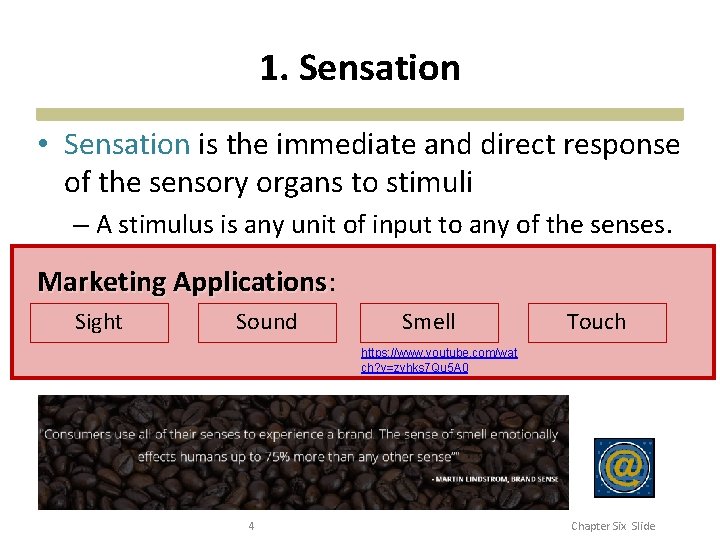
1. Sensation • Sensation is the immediate and direct response of the sensory organs to stimuli – A stimulus is any unit of input to any of the senses. Marketing Applications: Applications Sight Sound Smell Touch https: //www. youtube. com/wat ch? v=zyhks 7 Qu 5 A 0 4 Chapter Six Slide
2 - The absolute Threshold • The absolute threshold is the lowest level at which an individual can experience a sensation. Implication to marketing: - To change the advertising to avoid absolute threshold to decrease. • To use methods that will increase sensory input. E. g: experiential marketing, sophisticated scented ads, Sophisticated inserts and pop ups, Ambush advertising, Product placement 5 Chapter Six Slide
2 - Absolute Threshold Marketing Implications • • • Experiential Marketing Sophisticated scented ads Sophisticated inserts and pop ups Ambush advertising Product placement James Bond Xperia Replacement https: //www. youtube. com/watch? v=Yyg. WUF 3 ufu. E https: //www. youtube. com/watch? v=auq 549 l. Ti. A 6 Chapter Six Slide
3 - Differential Threshold (Just Noticeable Difference – j. n. d. ) • Minimal difference that can be detected between two similar stimuli (perception is relative and comparable) • Weber’s law – The j. n. d. between two stimuli is not an absolute amount but an amount relative to the intensity of the first stimulus – The stronger the initial stimulus, the greater the additional intensity needed for the second stimulus to be perceived as different. 7 Chapter Six Slide
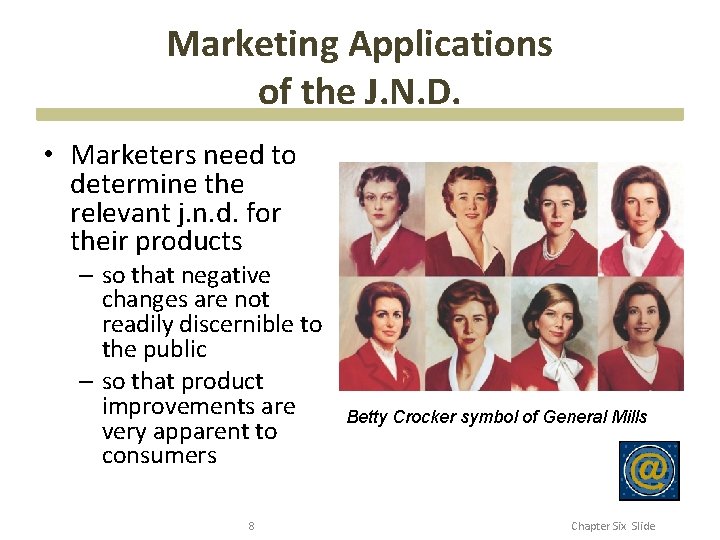
Marketing Applications of the J. N. D. • Marketers need to determine the relevant j. n. d. for their products – so that negative changes are not readily discernible to the public – so that product improvements are very apparent to consumers 8 Betty Crocker symbol of General Mills Chapter Six Slide
3 - Subliminal Perception • Stimuli that are too weak or too brief to be consciously seen or heard – They may be strong enough to be perceived by one or more receptor cells. • Is it effective? – Extensive research has shown no evidence that subliminal advertising can cause behavior changes – Some evidence that subliminal stimuli may influence affective reactions 9 Chapter Six Slide
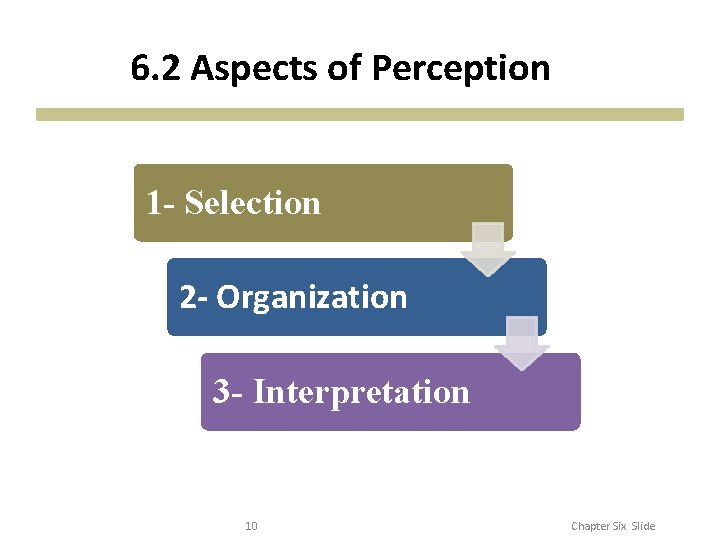
6. 2 Aspects of Perception 1 - Selection 2 - Organization 3 - Interpretation 10 Chapter Six Slide
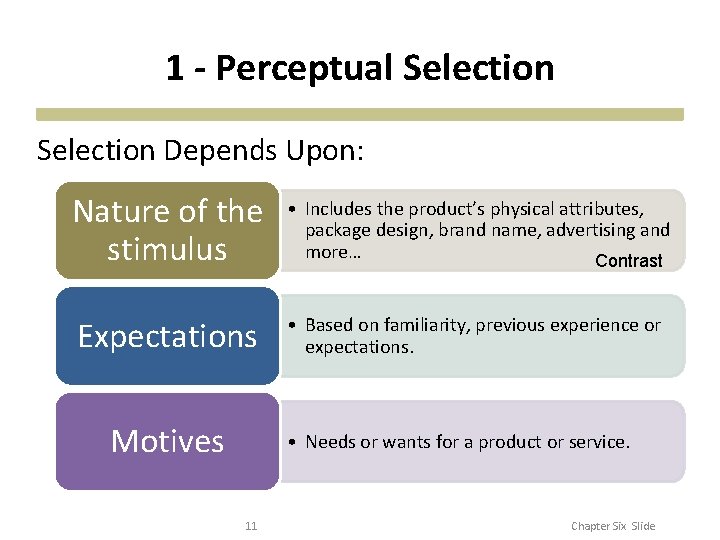
1 - Perceptual Selection Depends Upon: Nature of the stimulus • Includes the product’s physical attributes, package design, brand name, advertising and more… Contrast Expectations • Based on familiarity, previous experience or expectations. Motives • Needs or wants for a product or service. 11 Chapter Six Slide
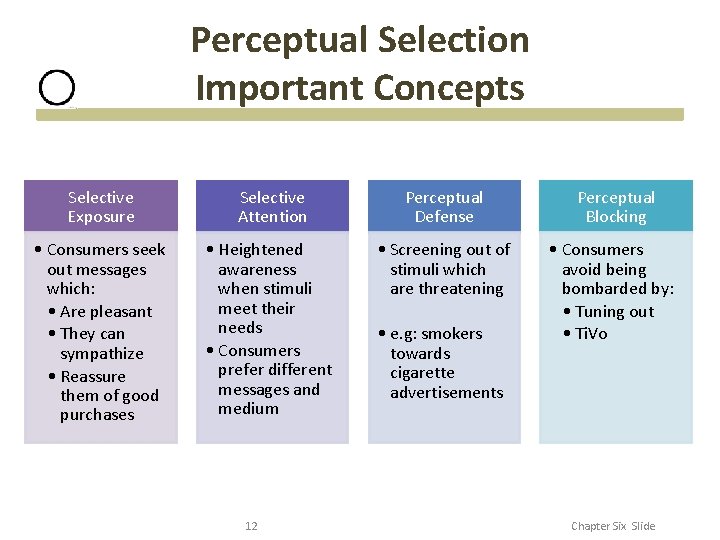
Perceptual Selection Important Concepts Selective Exposure Selective Attention Perceptual Defense Perceptual Blocking • Consumers seek out messages which: • Are pleasant • They can sympathize • Reassure them of good purchases • Heightened awareness when stimuli meet their needs • Consumers prefer different messages and medium • Screening out of stimuli which are threatening • Consumers avoid being bombarded by: • Tuning out • Ti. Vo 12 • e. g: smokers towards cigarette advertisements Chapter Six Slide
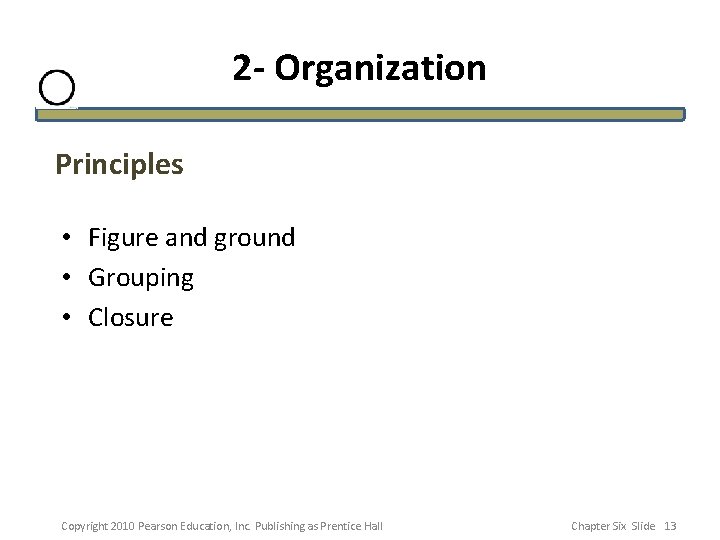
2 - Organization Principles • Figure and ground • Grouping • Closure Copyright 2010 Pearson Education, Inc. Publishing as Prentice Hall Chapter Six Slide 13
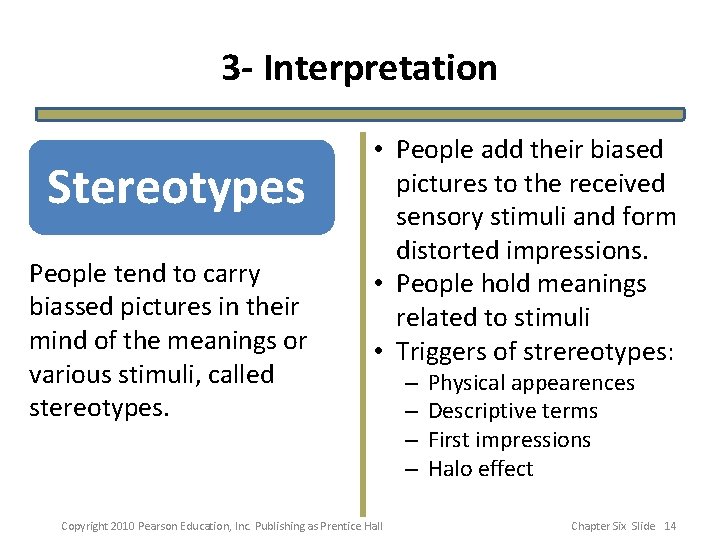
3 - Interpretation Stereotypes People tend to carry biassed pictures in their mind of the meanings or various stimuli, called stereotypes. • People add their biased pictures to the received sensory stimuli and form distorted impressions. • People hold meanings related to stimuli • Triggers of strereotypes: Copyright 2010 Pearson Education, Inc. Publishing as Prentice Hall – – Physical appearences Descriptive terms First impressions Halo effect Chapter Six Slide 14
6. 3 Consumer Imagery • Consumers have a number of enduring images or perceptions towards products or services or brands. • Products and brands have symbolic value for individuals, who evaluate them with their personal pictures of themlseves. 15 Chapter Six Slide
Product Positioning • Establishing a specific image for a brand in the consumer’s mind in relation to competing brands • Poisitining is the unique position of a product that occupies in consumers’ minds • Conveys the product in terms of how it fulfills a need • Successful positioning creates a distinctive, positive brand image 16 Chapter Six Slide
Perceptual Mapping • Perceptual Mapping enables marketers to determine how tehy want ther product or services to appear to cınsumers in relation to competitors’ brands on one or more relevant characteristics. • An analytical technique that enables marketers to plot graphically consumers’ perceptions concerning product attributes of specific brands 17 Chapter Six Slide
Perceptions • • Perceived Quailty Perceived Product Perceived Price Perceivedd Risk 18 Chapter Six Slide
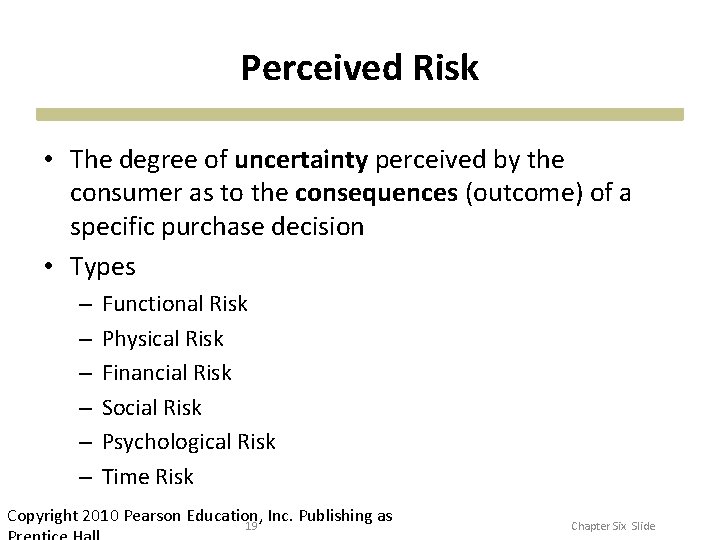
Perceived Risk • The degree of uncertainty perceived by the consumer as to the consequences (outcome) of a specific purchase decision • Types – – – Functional Risk Physical Risk Financial Risk Social Risk Psychological Risk Time Risk Copyright 2010 Pearson Education, Inc. Publishing as 19 Chapter Six Slide
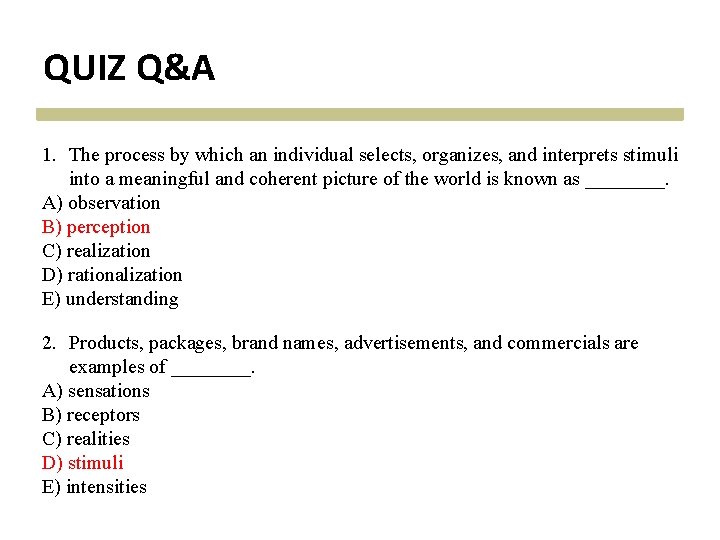
QUIZ Q&A 1. The process by which an individual selects, organizes, and interprets stimuli into a meaningful and coherent picture of the world is known as ____. A) observation B) perception C) realization D) rationalization E) understanding 2. Products, packages, brand names, advertisements, and commercials are examples of ____. A) sensations B) receptors C) realities D) stimuli E) intensities
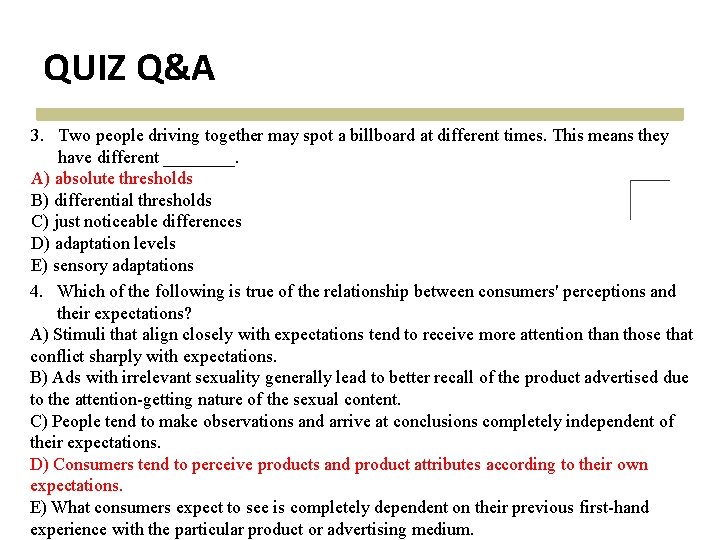
QUIZ Q&A 3. Two people driving together may spot a billboard at different times. This means they have different ____. A) absolute thresholds B) differential thresholds C) just noticeable differences D) adaptation levels E) sensory adaptations 4. Which of the following is true of the relationship between consumers' perceptions and their expectations? A) Stimuli that align closely with expectations tend to receive more attention than those that conflict sharply with expectations. B) Ads with irrelevant sexuality generally lead to better recall of the product advertised due to the attention-getting nature of the sexual content. C) People tend to make observations and arrive at conclusions completely independent of their expectations. D) Consumers tend to perceive products and product attributes according to their own expectations. E) What consumers expect to see is completely dependent on their previous first-hand experience with the particular product or advertising medium.
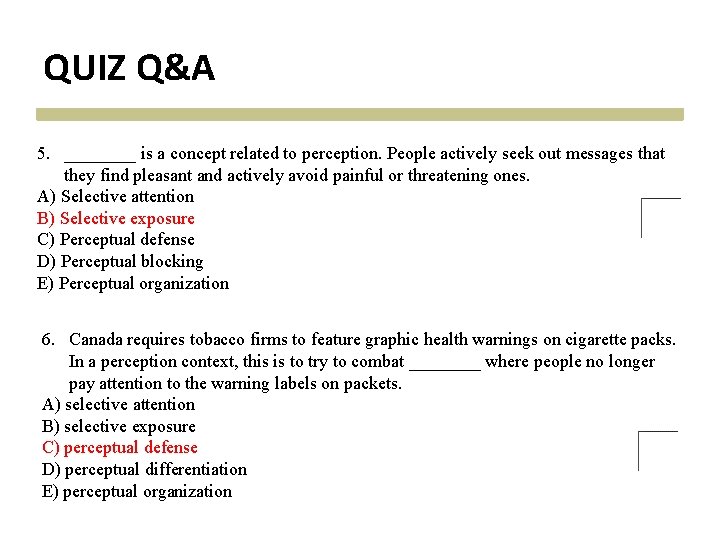
QUIZ Q&A 5. ____ is a concept related to perception. People actively seek out messages that they find pleasant and actively avoid painful or threatening ones. A) Selective attention B) Selective exposure C) Perceptual defense D) Perceptual blocking E) Perceptual organization 6. Canada requires tobacco firms to feature graphic health warnings on cigarette packs. In a perception context, this is to try to combat ____ where people no longer pay attention to the warning labels on packets. A) selective attention B) selective exposure C) perceptual defense D) perceptual differentiation E) perceptual organization
QUIZ Q&A 7. To simplify life, people have a natural tendency to select stimuli from the environment and organize them into groups and perceive them as a unified whole. In a perception context, this is known as ____. A) perceptual defense B) perceptual blocking C) perceptual mapping D) perceptual organization E) selective perception
CHAPTER 7
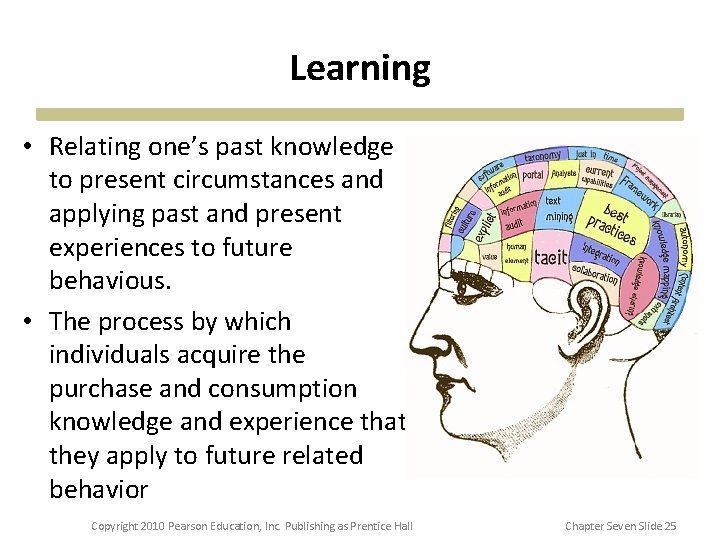
Learning • Relating one’s past knowledge to present circumstances and applying past and present experiences to future behavious. • The process by which individuals acquire the purchase and consumption knowledge and experience that they apply to future related behavior Copyright 2010 Pearson Education, Inc. Publishing as Prentice Hall Chapter Seven Slide 25
Learning üConsumer learning; is a process continually evolves, change as a result of knowledge or from actual experience üLearning can be; i. Intentional: acquired by searching ii. Incidental: acquired by accidental üConsumer learning can be; i. Simple almost reflexive responces ii. Abstract concepts iii. Complex problem solving Copyright 2010 Pearson Education, Inc. Publishing as Prentice Hall Chapter Seven Slide 26
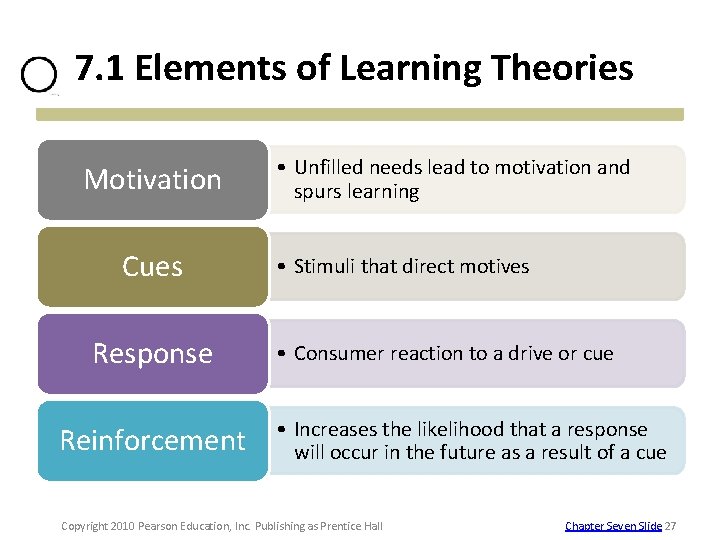
7. 1 Elements of Learning Theories Motivation Cues Response Reinforcement • Unfilled needs lead to motivation and spurs learning • Stimuli that direct motives • Consumer reaction to a drive or cue • Increases the likelihood that a response will occur in the future as a result of a cue Copyright 2010 Pearson Education, Inc. Publishing as Prentice Hall Chapter Seven Slide 27
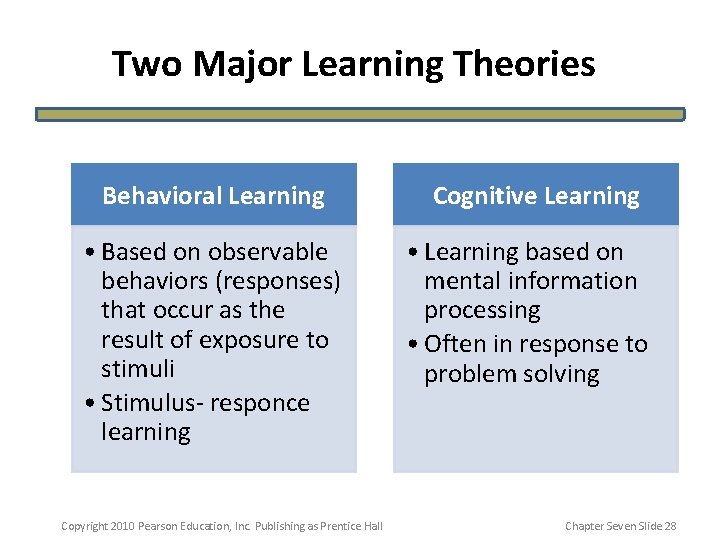
Two Major Learning Theories Behavioral Learning • Based on observable behaviors (responses) that occur as the result of exposure to stimuli • Stimulus- responce learning Copyright 2010 Pearson Education, Inc. Publishing as Prentice Hall Cognitive Learning • Learning based on mental information processing • Often in response to problem solving Chapter Seven Slide 28
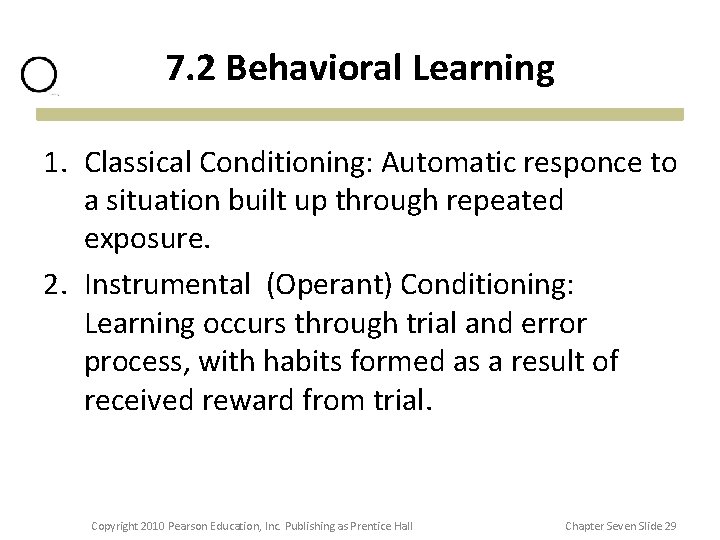
7. 2 Behavioral Learning 1. Classical Conditioning: Automatic responce to a situation built up through repeated exposure. 2. Instrumental (Operant) Conditioning: Learning occurs through trial and error process, with habits formed as a result of received reward from trial. Copyright 2010 Pearson Education, Inc. Publishing as Prentice Hall Chapter Seven Slide 29
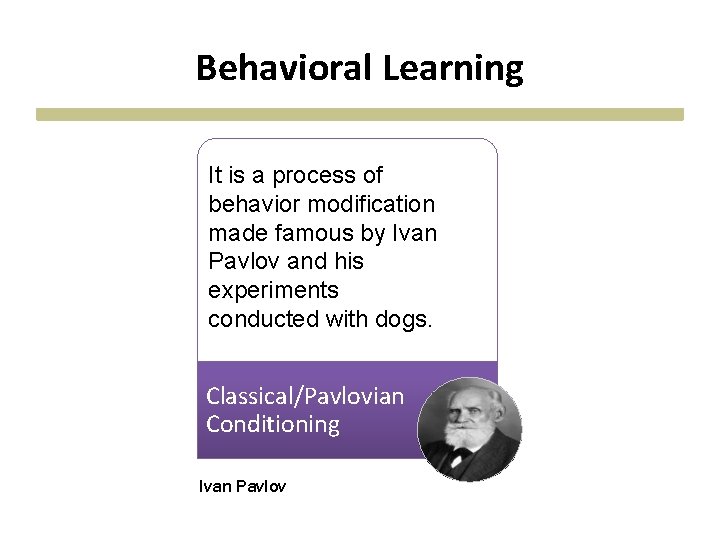
Behavioral Learning It is a process of behavior modification made famous by Ivan Pavlov and his experiments conducted with dogs. Classical/Pavlovian Conditioning Ivan Pavlov
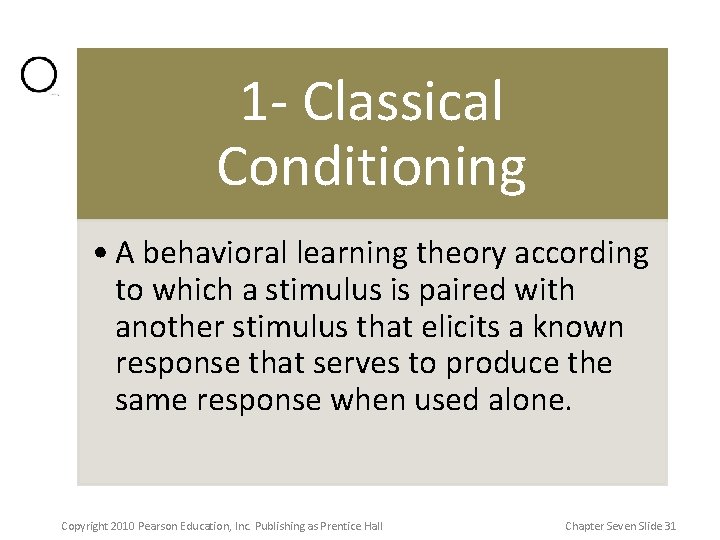
1 - Classical Conditioning • A behavioral learning theory according to which a stimulus is paired with another stimulus that elicits a known response that serves to produce the same response when used alone. Copyright 2010 Pearson Education, Inc. Publishing as Prentice Hall Chapter Seven Slide 31
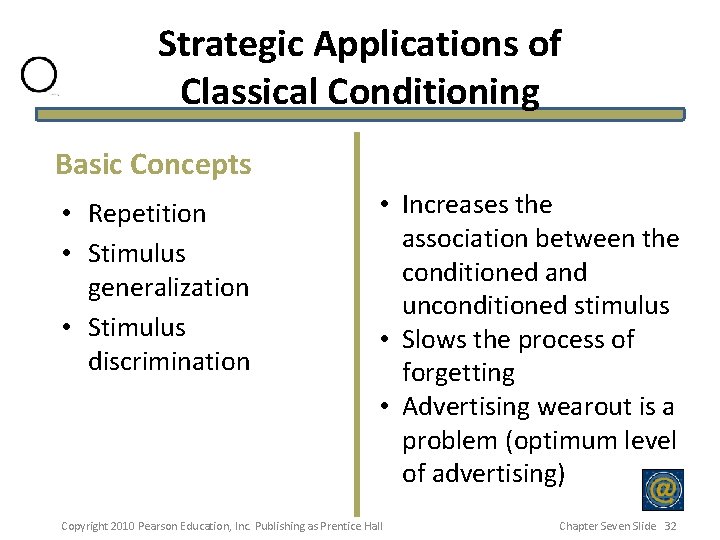
Strategic Applications of Classical Conditioning Basic Concepts • Repetition • Stimulus generalization • Stimulus discrimination • Increases the association between the conditioned and unconditioned stimulus • Slows the process of forgetting • Advertising wearout is a problem (optimum level of advertising) Copyright 2010 Pearson Education, Inc. Publishing as Prentice Hall Chapter Seven Slide 32
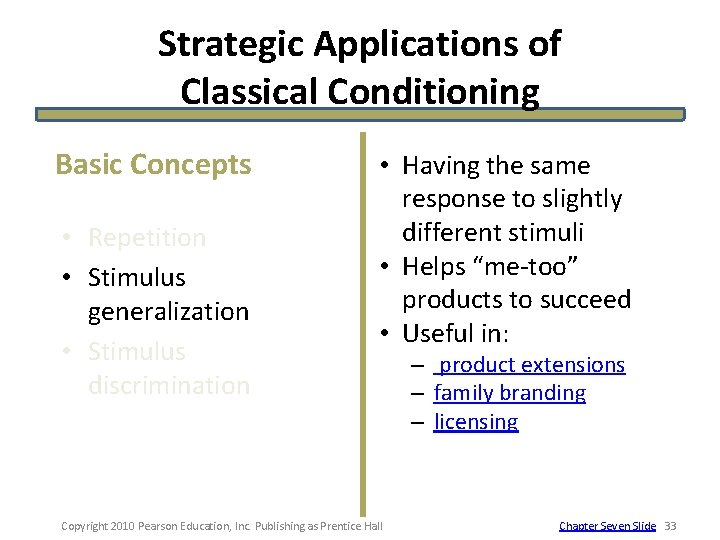
Strategic Applications of Classical Conditioning Basic Concepts • Repetition • Stimulus generalization • Stimulus discrimination • Having the same response to slightly different stimuli • Helps “me-too” products to succeed • Useful in: Copyright 2010 Pearson Education, Inc. Publishing as Prentice Hall – product extensions – family branding – licensing Chapter Seven Slide 33
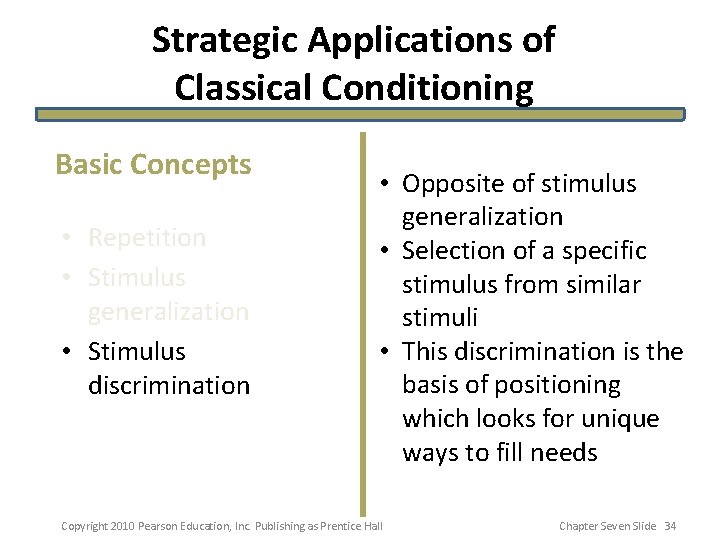
Strategic Applications of Classical Conditioning Basic Concepts • Repetition • Stimulus generalization • Stimulus discrimination • Opposite of stimulus generalization • Selection of a specific stimulus from similar stimuli • This discrimination is the basis of positioning which looks for unique ways to fill needs Copyright 2010 Pearson Education, Inc. Publishing as Prentice Hall Chapter Seven Slide 34
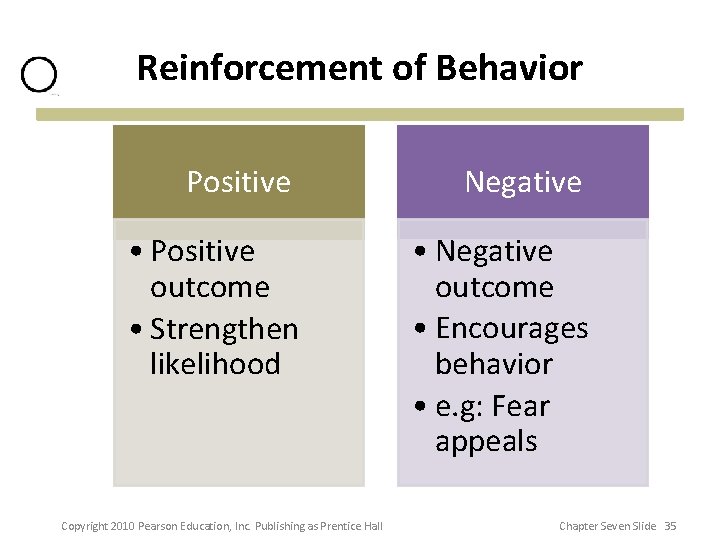
Reinforcement of Behavior Positive Negative • Positive outcome • Strengthen likelihood • Negative outcome • Encourages behavior • e. g: Fear appeals Copyright 2010 Pearson Education, Inc. Publishing as Prentice Hall Chapter Seven Slide 35
Strategic Applications of Instrumental Conditioning • • Customer Satisfaction (Reinforcement) Reinforcement Schedules Shaping e. g: test drive Massed versus Distributed Learning Copyright 2010 Pearson Education, Inc. Publishing as Prentice Hall Chapter Seven Slide 36
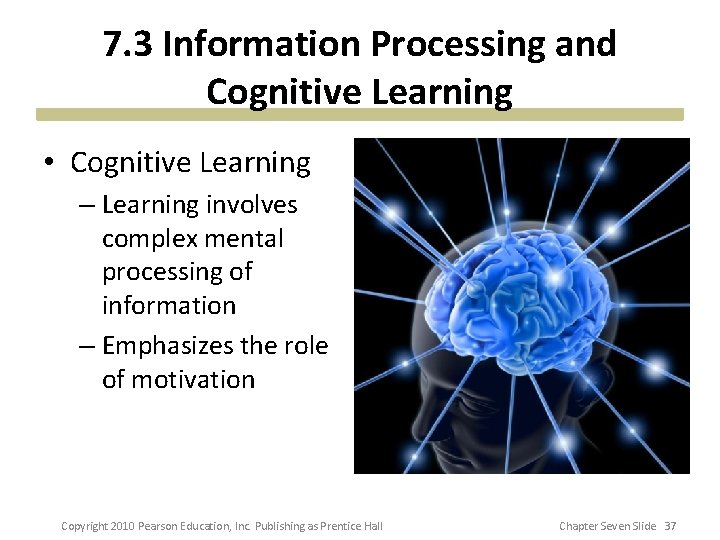
7. 3 Information Processing and Cognitive Learning • Cognitive Learning – Learning involves complex mental processing of information – Emphasizes the role of motivation Copyright 2010 Pearson Education, Inc. Publishing as Prentice Hall Chapter Seven Slide 37
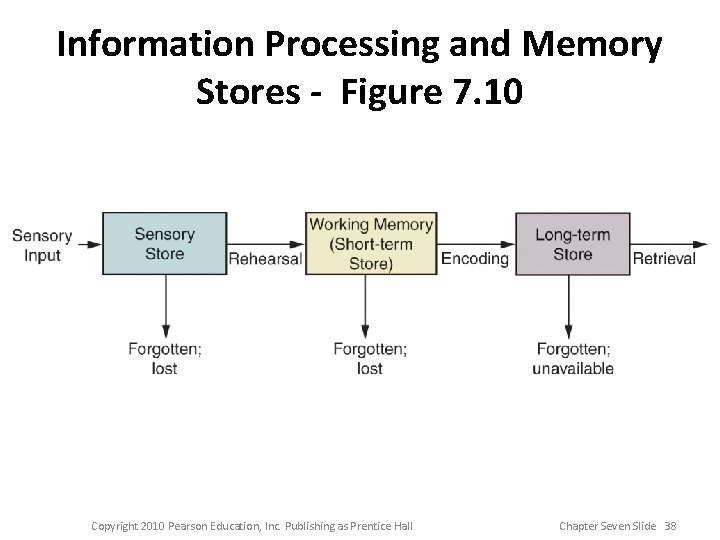
Information Processing and Memory Stores - Figure 7. 10 Copyright 2010 Pearson Education, Inc. Publishing as Prentice Hall Chapter Seven Slide 38
Involvement and Passive Learning Topics • • Definitions and Measures of Involvement Marketing Applications of Involvement Central and Peripheral Routes to Persuasion Hemispheral Lateralization and Passive Learning Copyright 2010 Pearson Education, Inc. Publishing as Prentice Hall Chapter Seven Slide 39
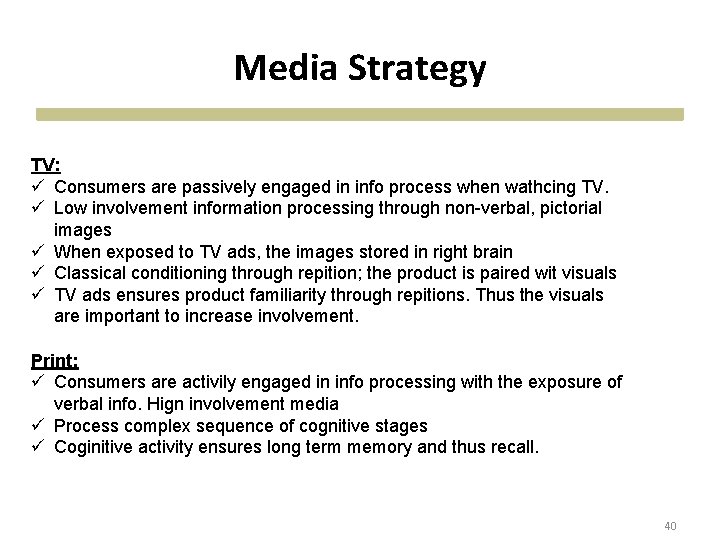
Media Strategy TV: ü Consumers are passively engaged in info process when wathcing TV. ü Low involvement information processing through non-verbal, pictorial images ü When exposed to TV ads, the images stored in right brain ü Classical conditioning through repition; the product is paired wit visuals ü TV ads ensures product familiarity through repitions. Thus the visuals are important to increase involvement. Print: ü Consumers are activily engaged in info processing with the exposure of verbal info. Hign involvement media ü Process complex sequence of cognitive stages ü Coginitive activity ensures long term memory and thus recall. 40
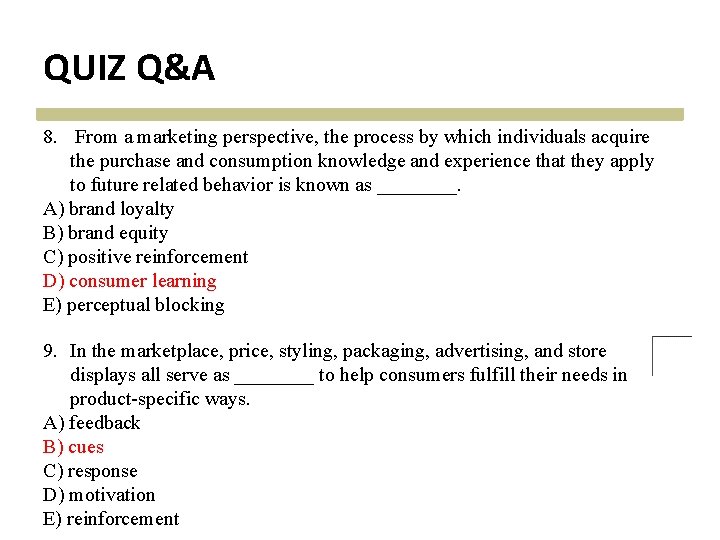
QUIZ Q&A 8. From a marketing perspective, the process by which individuals acquire the purchase and consumption knowledge and experience that they apply to future related behavior is known as ____. A) brand loyalty B) brand equity C) positive reinforcement D) consumer learning E) perceptual blocking 9. In the marketplace, price, styling, packaging, advertising, and store displays all serve as ____ to help consumers fulfill their needs in product-specific ways. A) feedback B) cues C) response D) motivation E) reinforcement
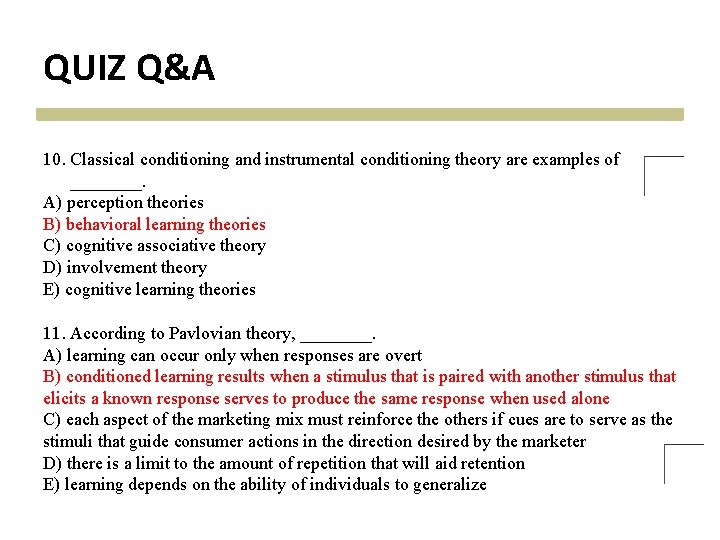
QUIZ Q&A 10. Classical conditioning and instrumental conditioning theory are examples of ____. A) perception theories B) behavioral learning theories C) cognitive associative theory D) involvement theory E) cognitive learning theories 11. According to Pavlovian theory, ____. A) learning can occur only when responses are overt B) conditioned learning results when a stimulus that is paired with another stimulus that elicits a known response serves to produce the same response when used alone C) each aspect of the marketing mix must reinforce the others if cues are to serve as the stimuli that guide consumer actions in the direction desired by the marketer D) there is a limit to the amount of repetition that will aid retention E) learning depends on the ability of individuals to generalize
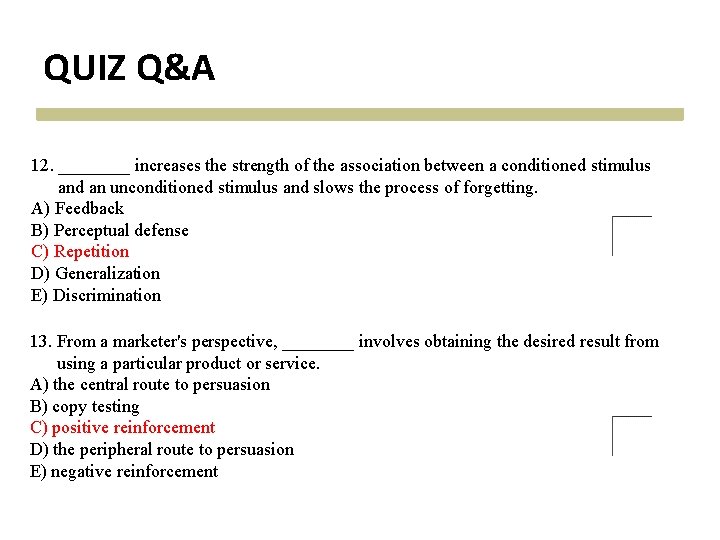
QUIZ Q&A 12. ____ increases the strength of the association between a conditioned stimulus and an unconditioned stimulus and slows the process of forgetting. A) Feedback B) Perceptual defense C) Repetition D) Generalization E) Discrimination 13. From a marketer's perspective, ____ involves obtaining the desired result from using a particular product or service. A) the central route to persuasion B) copy testing C) positive reinforcement D) the peripheral route to persuasion E) negative reinforcement
QUIZ Q&A 14. ____ involves developing a close, personalized relationship with customers, and is one form of non-product reinforcement. A) Relationship marketing B) Copy testing C) Involvement theory D) Comprehension E) Shaping
CHAPTER 8
Attitude A learned predisposition to behave in a consistently favorable or unfavorable manner with respect to a given object. Copyright 2010 Pearson Education, Inc. Publishing as Prentice Hall Chapter Eight Slide 46
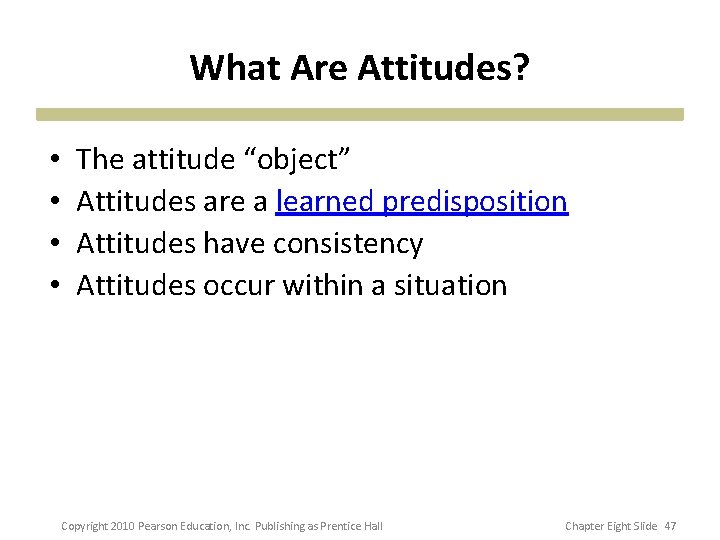
What Are Attitudes? • • The attitude “object” Attitudes are a learned predisposition Attitudes have consistency Attitudes occur within a situation Copyright 2010 Pearson Education, Inc. Publishing as Prentice Hall Chapter Eight Slide 47
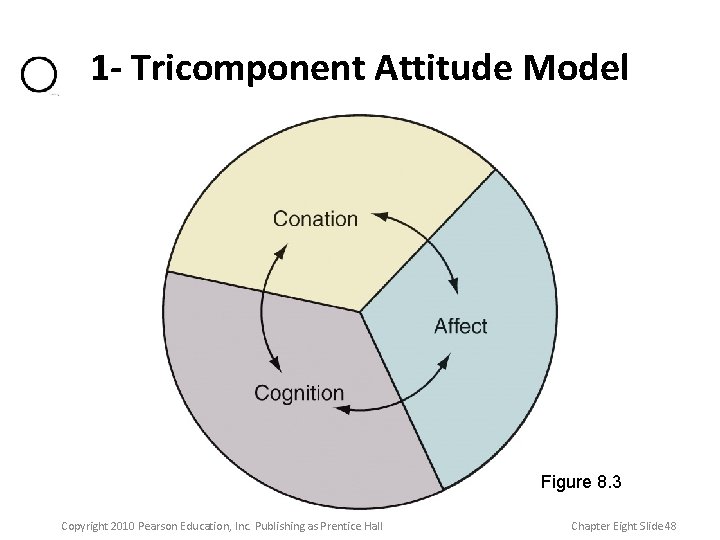
1 - Tricomponent Attitude Model Cognition Figure 8. 3 Copyright 2010 Pearson Education, Inc. Publishing as Prentice Hall Chapter Eight Slide 48
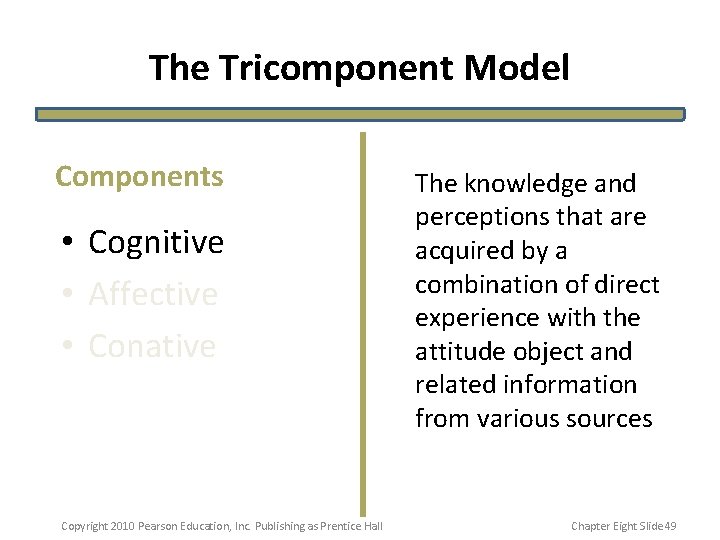
The Tricomponent Model Components • Cognitive • Affective • Conative Copyright 2010 Pearson Education, Inc. Publishing as Prentice Hall The knowledge and perceptions that are acquired by a combination of direct experience with the attitude object and related information from various sources Chapter Eight Slide 49
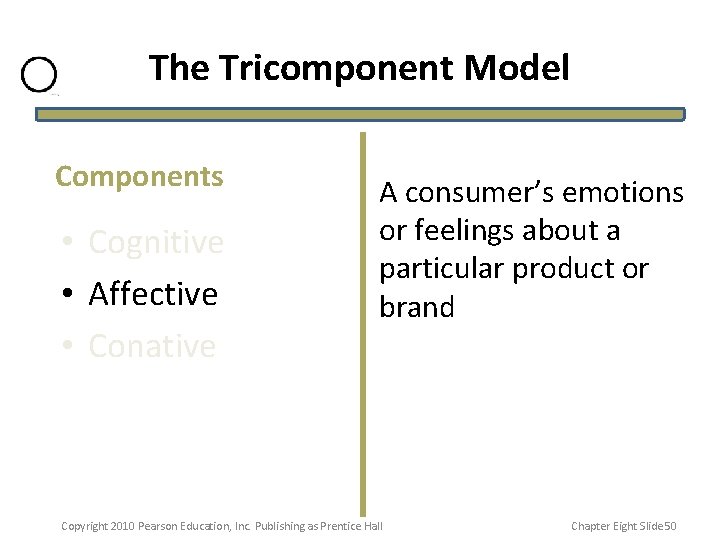
The Tricomponent Model Components • Cognitive • Affective • Conative A consumer’s emotions or feelings about a particular product or brand Copyright 2010 Pearson Education, Inc. Publishing as Prentice Hall Chapter Eight Slide 50
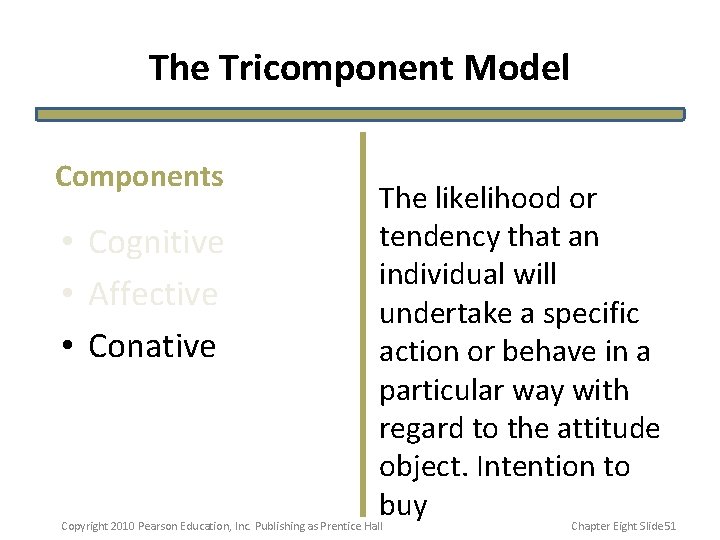
The Tricomponent Model Components • Cognitive • Affective • Conative The likelihood or tendency that an individual will undertake a specific action or behave in a particular way with regard to the attitude object. Intention to buy Copyright 2010 Pearson Education, Inc. Publishing as Prentice Hall Chapter Eight Slide 51
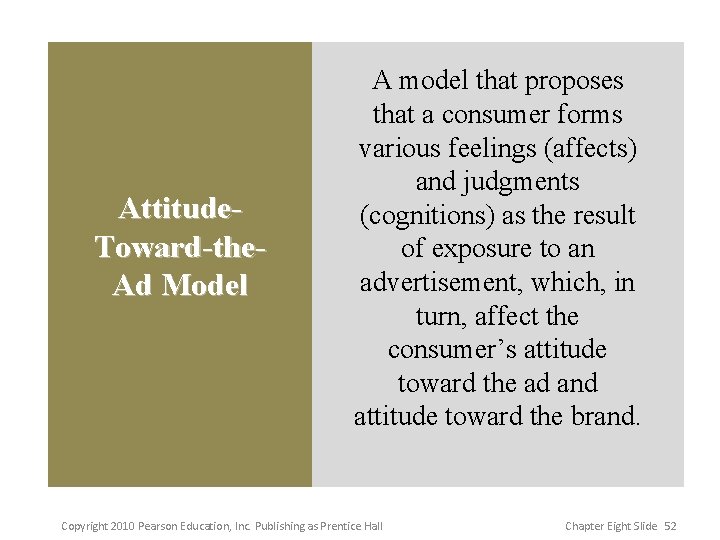
Attitude. Toward-the. Ad Model A model that proposes that a consumer forms various feelings (affects) and judgments (cognitions) as the result of exposure to an advertisement, which, in turn, affect the consumer’s attitude toward the ad and attitude toward the brand. Copyright 2010 Pearson Education, Inc. Publishing as Prentice Hall Chapter Eight Slide 52
8. 3 Issues in Attitude Formation • How attitudes are learned – Conditioning and experience – Knowledge and beliefs Copyright 2010 Pearson Education, Inc. Publishing as Prentice Hall Chapter Eight Slide 53
Issues in Attitude Formation • Sources of influence on attitude formation – Personal experience – Influence of family – Direct marketing and mass media • Personality factors Copyright 2010 Pearson Education, Inc. Publishing as Prentice Hall Chapter Eight Slide 54
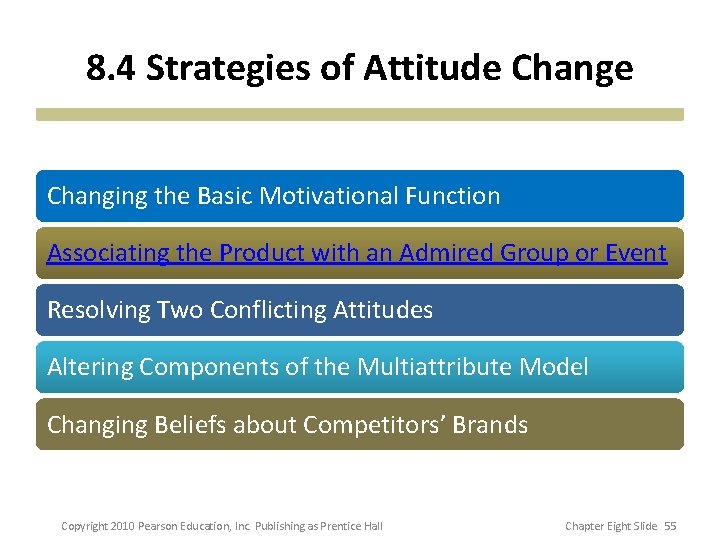
8. 4 Strategies of Attitude Changing the Basic Motivational Function Associating the Product with an Admired Group or Event Resolving Two Conflicting Attitudes Altering Components of the Multiattribute Model Changing Beliefs about Competitors’ Brands Copyright 2010 Pearson Education, Inc. Publishing as Prentice Hall Chapter Eight Slide 55
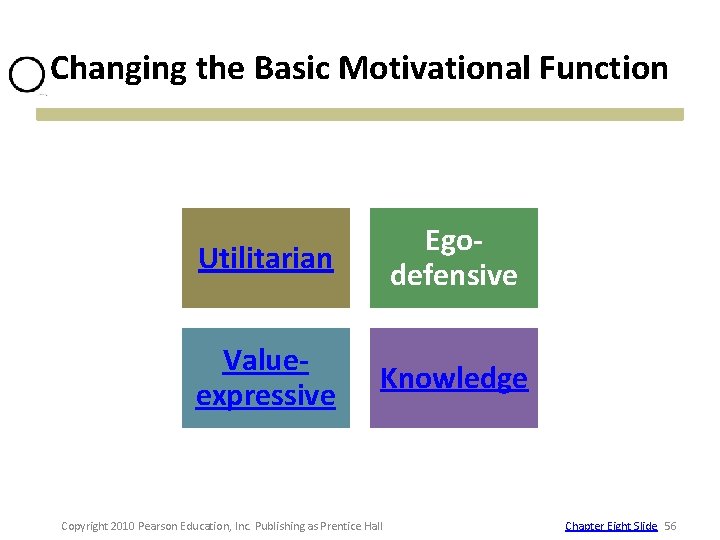
Changing the Basic Motivational Function Utilitarian Egodefensive Valueexpressive Knowledge Copyright 2010 Pearson Education, Inc. Publishing as Prentice Hall Chapter Eight Slide 56
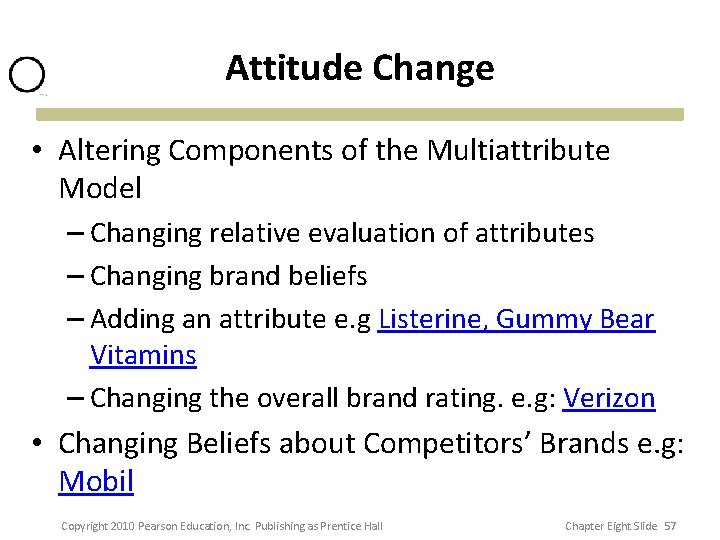
Attitude Change • Altering Components of the Multiattribute Model – Changing relative evaluation of attributes – Changing brand beliefs – Adding an attribute e. g Listerine, Gummy Bear Vitamins – Changing the overall brand rating. e. g: Verizon • Changing Beliefs about Competitors’ Brands e. g: Mobil Copyright 2010 Pearson Education, Inc. Publishing as Prentice Hall Chapter Eight Slide 57
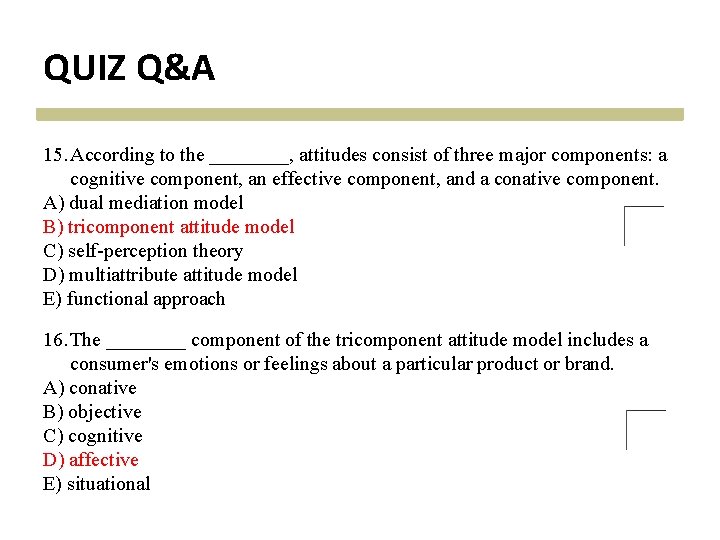
QUIZ Q&A 15. According to the ____, attitudes consist of three major components: a cognitive component, an effective component, and a conative component. A) dual mediation model B) tricomponent attitude model C) self-perception theory D) multiattribute attitude model E) functional approach 16. The ____ component of the tricomponent attitude model includes a consumer's emotions or feelings about a particular product or brand. A) conative B) objective C) cognitive D) affective E) situational
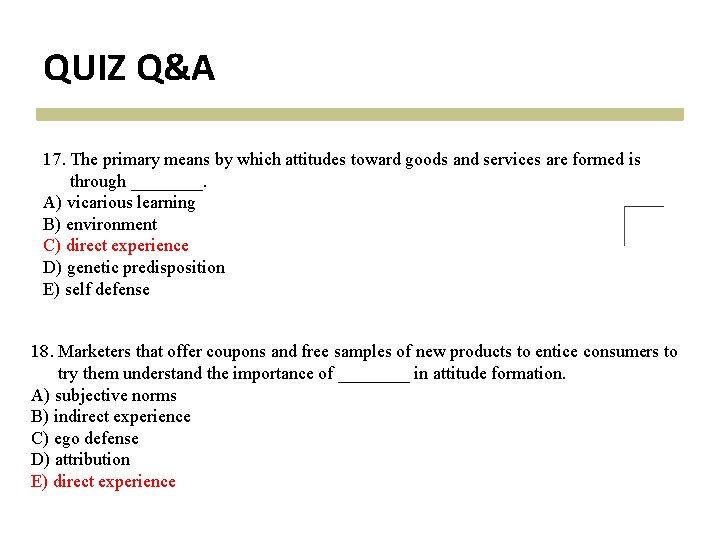
QUIZ Q&A 17. The primary means by which attitudes toward goods and services are formed is through ____. A) vicarious learning B) environment C) direct experience D) genetic predisposition E) self defense 18. Marketers that offer coupons and free samples of new products to entice consumers to try them understand the importance of ____ in attitude formation. A) subjective norms B) indirect experience C) ego defense D) attribution E) direct experience
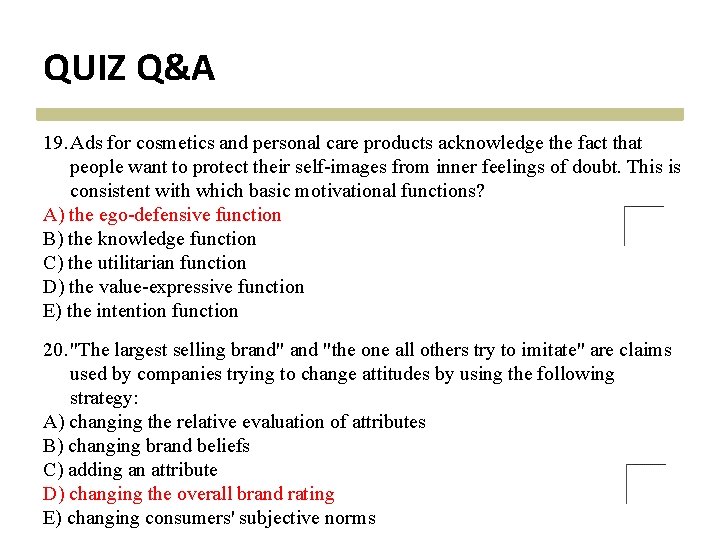
QUIZ Q&A 19. Ads for cosmetics and personal care products acknowledge the fact that people want to protect their self-images from inner feelings of doubt. This is consistent with which basic motivational functions? A) the ego-defensive function B) the knowledge function C) the utilitarian function D) the value-expressive function E) the intention function 20. "The largest selling brand" and "the one all others try to imitate" are claims used by companies trying to change attitudes by using the following strategy: A) changing the relative evaluation of attributes B) changing brand beliefs C) adding an attribute D) changing the overall brand rating E) changing consumers' subjective norms
CHAPTER 9
9. 1 The Source as the Initiator Formal Communication Source • Marketer or organization Informal Source • A parent, friend or other consumer Copyright 2010 Pearson Education, Inc. Publishing as Prentice Hall Chapter Nine Slide 62
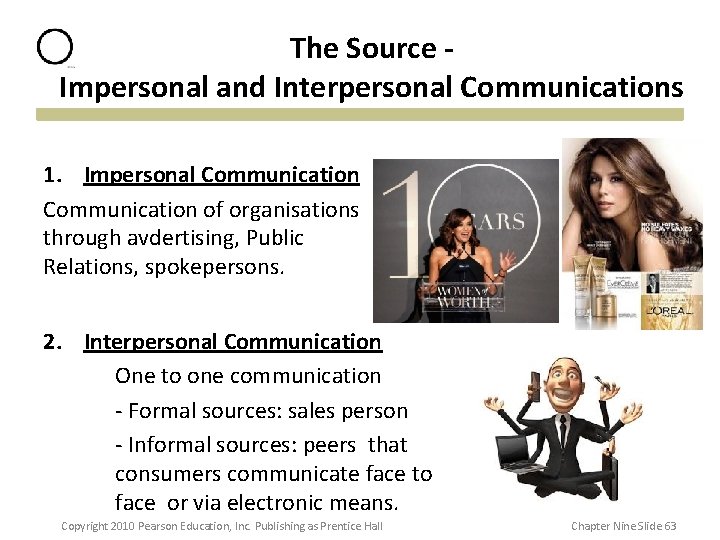
The Source Impersonal and Interpersonal Communications 1. Impersonal Communication of organisations through avdertising, Public Relations, spokepersons. 2. Interpersonal Communication One to one communication - Formal sources: sales person - Informal sources: peers that consumers communicate face to face or via electronic means. Copyright 2010 Pearson Education, Inc. Publishing as Prentice Hall Chapter Nine Slide 63
Source Credibility • Source Credibility: The perceived honesty and credibility of the source of communication has influence of on the acceptance of the info by receiver. Copyright 2010 Pearson Education, Inc. Publishing as Prentice Hall Chapter Nine Slide 64
The Source - Rererence Groups: • Reference Groups – Normative: Influencing defined values or behaviour – Comparative: Benchmark spesific but narrow part of ones lifestyle. – Membership: – Symbolic: the consumer is not member but takes the values anf attitutes of the group Copyright 2010 Pearson Education, Inc. Publishing as Prentice Hall Chapter Nine Slide 65
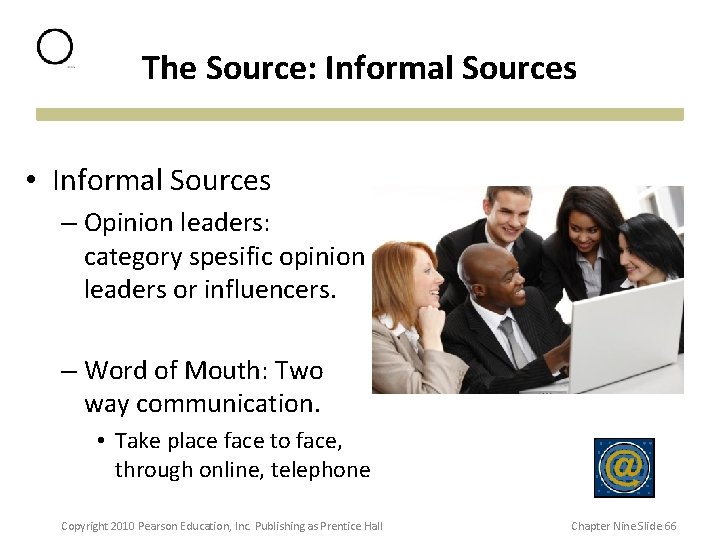
The Source: Informal Sources • Informal Sources – Opinion leaders: category spesific opinion leaders or influencers. – Word of Mouth: Two way communication. • Take place face to face, through online, telephone Copyright 2010 Pearson Education, Inc. Publishing as Prentice Hall Chapter Nine Slide 66
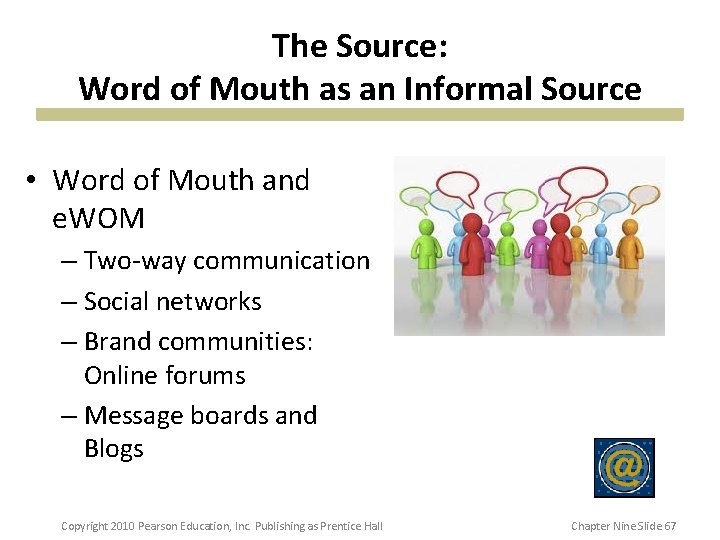
The Source: Word of Mouth as an Informal Source • Word of Mouth and e. WOM – Two-way communication – Social networks – Brand communities: Online forums – Message boards and Blogs Copyright 2010 Pearson Education, Inc. Publishing as Prentice Hall Chapter Nine Slide 67
The Source Word of Mouth – Strategic Applications • Buzz Agents • E-ferrals and recommendations: sending notices about ones selections • Viral Marketing Online viral campaigns need to be managed carefully to tackle negative comments Copyright 2010 Pearson Education, Inc. Publishing as Prentice Hall Chapter Nine Slide 68
Credibility of Formal Sources Endorser Effectiveness is related to the message and its ease of comprehension Synergy between the endorser and the product types is important. (Match up theory) Endorser’s demographic characteristics should be similar to the target Endorser credibility is not a substitute for corporate credibility Endorser’s words must be realistic for them Copyright 2010 Pearson Education, Inc. Publishing as Prentice Hall Chapter Nine Slide 69
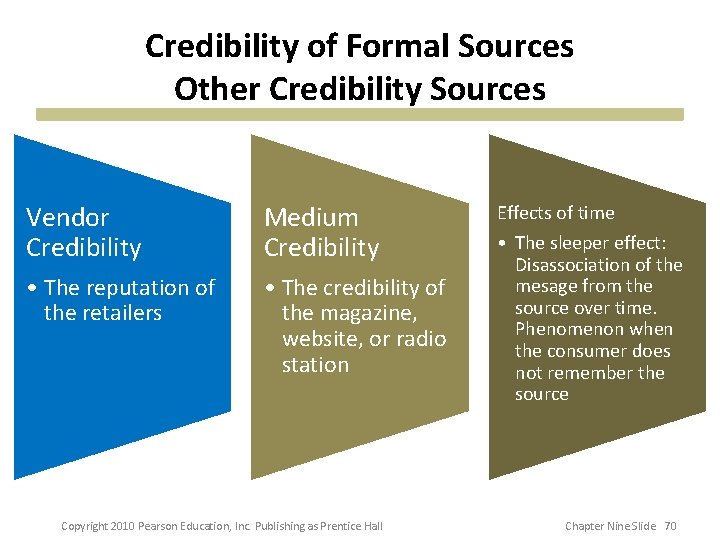
Credibility of Formal Sources Other Credibility Sources Vendor Credibility Medium Credibility • The reputation of the retailers • The credibility of the magazine, website, or radio station Copyright 2010 Pearson Education, Inc. Publishing as Prentice Hall Effects of time • The sleeper effect: Disassociation of the mesage from the source over time. Phenomenon when the consumer does not remember the source Chapter Nine Slide 70
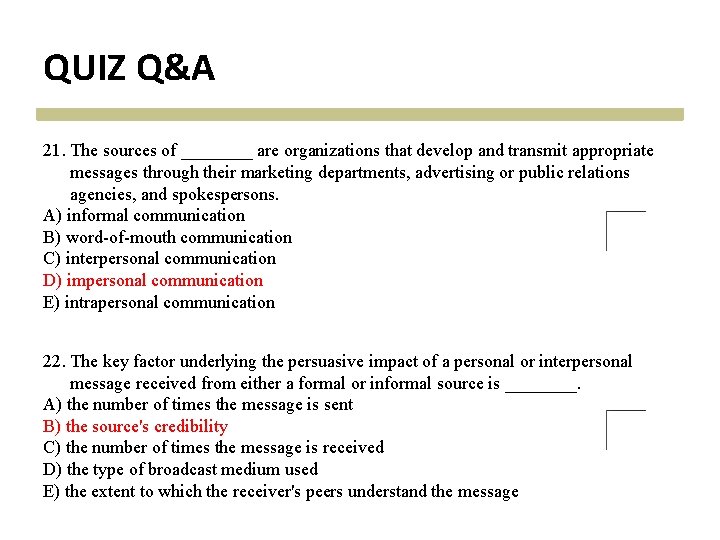
QUIZ Q&A 21. The sources of ____ are organizations that develop and transmit appropriate messages through their marketing departments, advertising or public relations agencies, and spokespersons. A) informal communication B) word-of-mouth communication C) interpersonal communication D) impersonal communication E) intrapersonal communication 22. The key factor underlying the persuasive impact of a personal or interpersonal message received from either a formal or informal source is ____. A) the number of times the message is sent B) the source's credibility C) the number of times the message is received D) the type of broadcast medium used E) the extent to which the receiver's peers understand the message
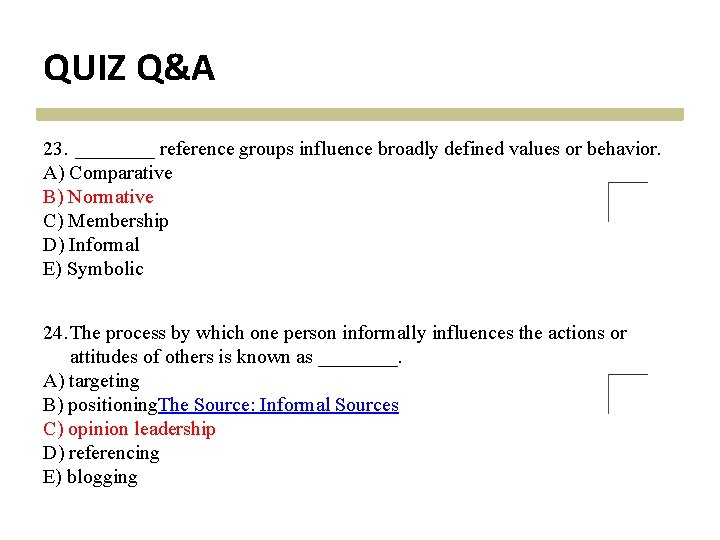
QUIZ Q&A 23. ____ reference groups influence broadly defined values or behavior. A) Comparative B) Normative C) Membership D) Informal E) Symbolic 24. The process by which one person informally influences the actions or attitudes of others is known as ____. A) targeting B) positioning. The Source: Informal Sources C) opinion leadership D) referencing E) blogging
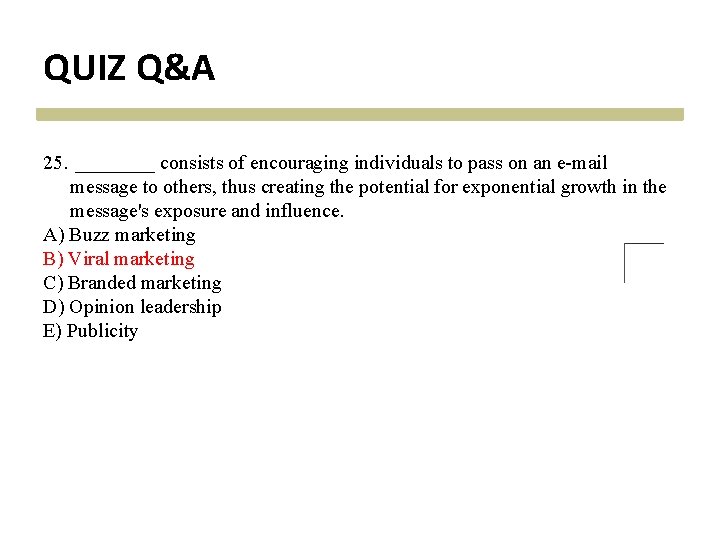
QUIZ Q&A 25. ____ consists of encouraging individuals to pass on an e-mail message to others, thus creating the potential for exponential growth in the message's exposure and influence. A) Buzz marketing B) Viral marketing C) Branded marketing D) Opinion leadership E) Publicity
THANKS YOU GOOD LUCK