
Review before break Mechanical Advantage Speed Ratio Efficiency
Review before break § Mechanical Advantage §Speed Ratio §Efficiency § Work § Efficiency (of Work)
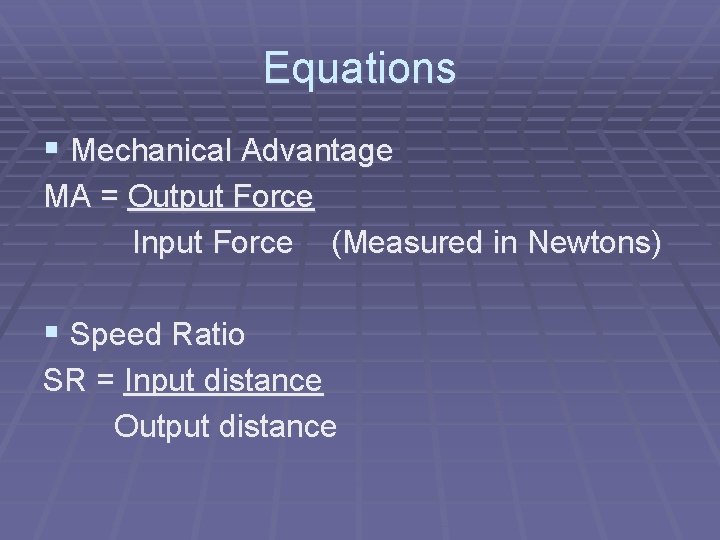
Equations § Mechanical Advantage MA = Output Force Input Force (Measured in Newtons) § Speed Ratio SR = Input distance Output distance

Equations Cont… § Efficiency of a Machine Efficiency = Mechanical Advantage Speed Ratio § Work W=Fxd X 100% *Work is only done if the object moves* § Efficiency of work Efficiency = Work output Work input x 100%
Section 2. 3 The Big Movers – Hydraulics § Most machines that move very large, very heavy objects use a hydraulic system that applies force to levers, gears or pulleys. § A hydraulic system uses a liquid under pressure to move loads. § It is able to increase the mechanical advantage of the levers in the machine.
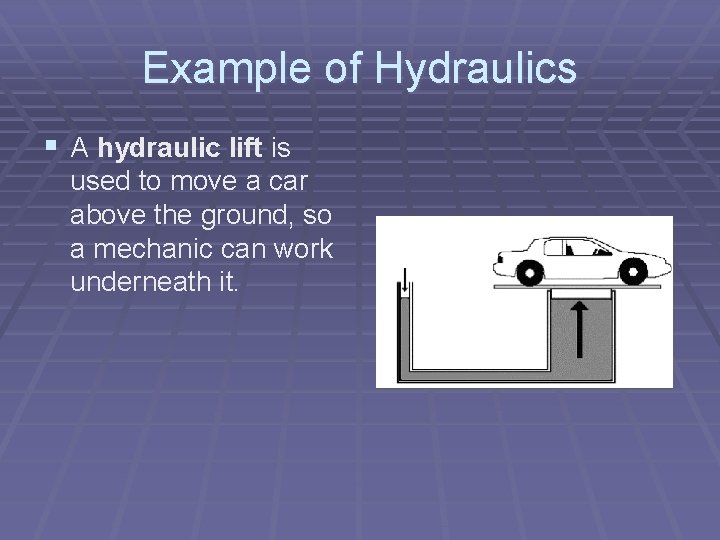
Example of Hydraulics § A hydraulic lift is used to move a car above the ground, so a mechanic can work underneath it.
Pressure in Fluids § Pressure is a measure of the amount of force applied to a given area. p =F/A § p is pressure, F is Force, and A is Area § The unit of measurement for pressure is a pascal (Pa), named after Blaise Pascal who did important research on fluids. 1 Pascal is equal to the force of 1 Newton over an area of 1 m 2

Blaise Pascal § Pascal discovered that pressure applied to an enclosed fluid is transmitted equally in all directions throughout the fluid. § This is known as Pascal’s Law and it makes hydraulic (liquid) and pneumatic (air) systems possible.
Pistons § In hydraulic systems, the pressure is created using a piston. Pistons can be different sizes and hydraulic devices use pistons that are different sizes attached to each other with a flexible pipe. § Input piston is used to apply force to the fluid, which creates pressure in the fluid. § The fluid transfers this pressure to the output piston. § This pressure exerts a force on the output piston and the result is a mechanical advantage.
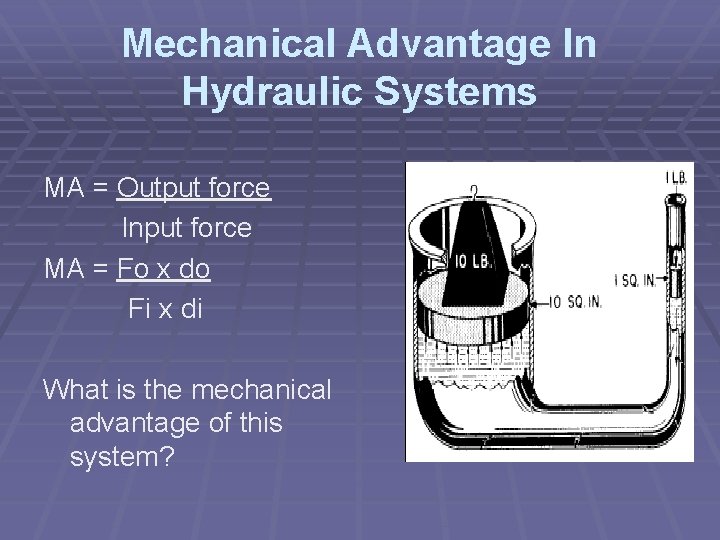
Mechanical Advantage In Hydraulic Systems MA = Output force Input force MA = Fo x do Fi x di What is the mechanical advantage of this system?
Pressure and Mechanical Advantage § The reason for the large mechanical advantage in a hydraulic system is the ability of the fluid to transmit pressure equally. p=Fx. A § From Pascal’s law, we know that the pressure the small piston creates is the same everywhere in the fluid. So the large piston has a larger area and is able to multiply the pressure because of its larger area.
Pascal’s Law § Since the smaller piston creates equal pressure on the larger piston we can use the following equation. Force of the small piston = Force of the large piston Area of the small piston Area of the large piston If we have three of the variables we can then solve for the unknown!!!
Cost of creating a higher mechanical advantage § Mechanical advantage in hydraulic systems has a cost. That cost is the increased distance the smaller force must go through to make the large force move a small distance. § To increase the force on the output piston , the input piston must move through a greater distance.
Brainpops § In the engineering and tech section § Gears § Hydraulics § Incline plane § Levers § Pulley § Wheel + axle
- Slides: 13