
Review and checkin Final paper Cover page Like



- Slides: 18
Review and check-in
Final paper Cover page Like before, but make sure the title reflects your study
Abstract in bold centered, no indent 1 -2 sentences each on: Problem you’re addressing Method (future tense) Expected results (future tense) Implications https: //apastyle. apa. org/instructional-aids/abstract-keywords-guide. pdf
Introduction (lit review) Same as before, but Update/address comments from previous draft In your “setup, ” add a sentence on what your study will investigate Make sure to update your current study section
Method Update based on feedback Starts immediately after introduction section, bold centered Method
Expected Results Update based on feedback
Discussion Summarize what you expect to find Tell what it would mean if you did find that or didn’t find that Address at least two limitations to your study and two ways those limitations could be addressed in future research End with the implications of your expected findings (e. g. , for theory, for clinicians, for society)
References Starts on a new page Includes everything cited in THIS PAPER, but nothing else APA style
Appendices For any measures that you created, one per measure
Peer review Upload a copy of your full paper to Bb by the start of class on Monday (under assignments) Rough draft of entire proposal for peer review Copy will be reviewed by a peer reviewer in lab on Monday (you have to turn one in to get feedback) Answer the questions and upload the review
Final paper Due next Wednesday Upload “final paper” in Bb Upload your final “annotated bibliography” (earlier one has been cleared— make sure it includes notes on the articles!) Upload “letter to the editor” Respond to the feedback points you got from your peer reviewer Copy and paste with your changes made in response
Test Friday Similar to past format Study
Review
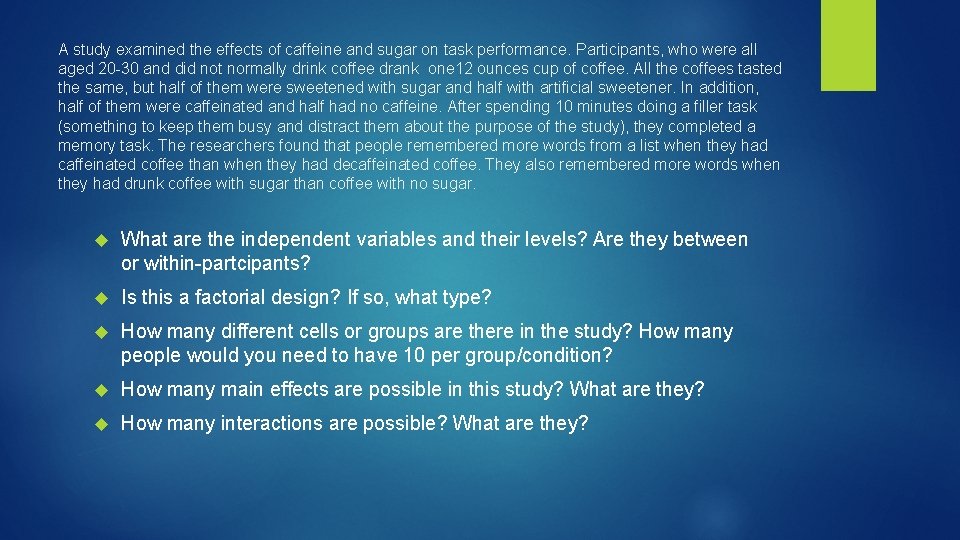
A study examined the effects of caffeine and sugar on task performance. Participants, who were all aged 20 -30 and did not normally drink coffee drank one 12 ounces cup of coffee. All the coffees tasted the same, but half of them were sweetened with sugar and half with artificial sweetener. In addition, half of them were caffeinated and half had no caffeine. After spending 10 minutes doing a filler task (something to keep them busy and distract them about the purpose of the study), they completed a memory task. The researchers found that people remembered more words from a list when they had caffeinated coffee than when they had decaffeinated coffee. They also remembered more words when they had drunk coffee with sugar than coffee with no sugar. What are the independent variables and their levels? Are they between or within-partcipants? Is this a factorial design? If so, what type? How many different cells or groups are there in the study? How many people would you need to have 10 per group/condition? How many main effects are possible in this study? What are they? How many interactions are possible? What are they?
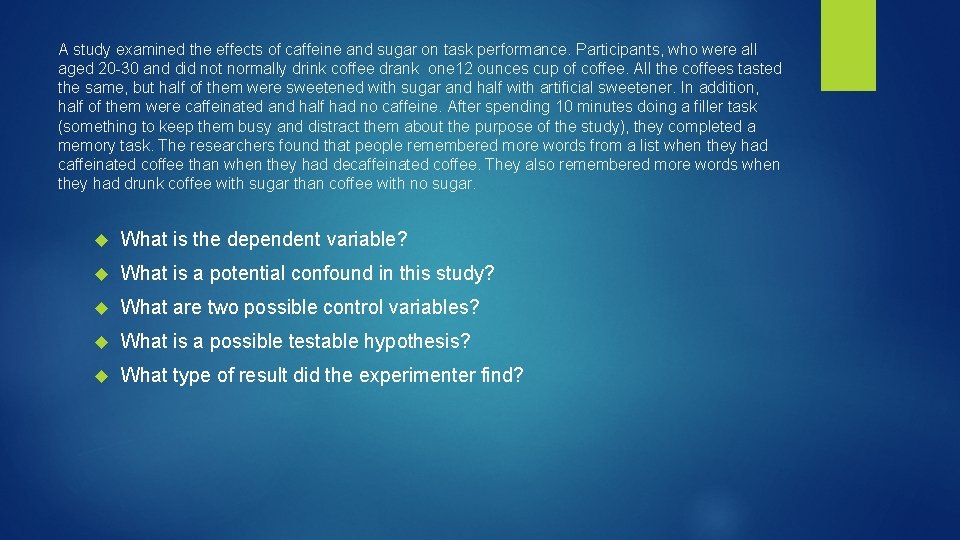
A study examined the effects of caffeine and sugar on task performance. Participants, who were all aged 20 -30 and did not normally drink coffee drank one 12 ounces cup of coffee. All the coffees tasted the same, but half of them were sweetened with sugar and half with artificial sweetener. In addition, half of them were caffeinated and half had no caffeine. After spending 10 minutes doing a filler task (something to keep them busy and distract them about the purpose of the study), they completed a memory task. The researchers found that people remembered more words from a list when they had caffeinated coffee than when they had decaffeinated coffee. They also remembered more words when they had drunk coffee with sugar than coffee with no sugar. What is the dependent variable? What is a potential confound in this study? What are two possible control variables? What is a possible testable hypothesis? What type of result did the experimenter find?
A researcher has children choose to watch one of several cartoons. He then observes that the children who chose to watch violent cartoons act more aggressively toward toys (as coded by observers who are blind to condition) than children who chose to watch nonviolent cartoons. He concludes that watching violent cartoons causes children to act more aggressively. What is the major problem with this conclusion?
What are the ethical issues involved in the Glenwood Resource Center investigation?
Suppose a researcher wanted to investigate what types of people call tipster lines. He created posters with a picture of a “missing person” (not really missing) and put them up around town and asked people to call with any information. When they called, he asked them their gender, age, and ethnicity along with their tip. What ethical issue or issues are involved in this study? Name at least 2.