
Review 3 4 What is compressibility What state
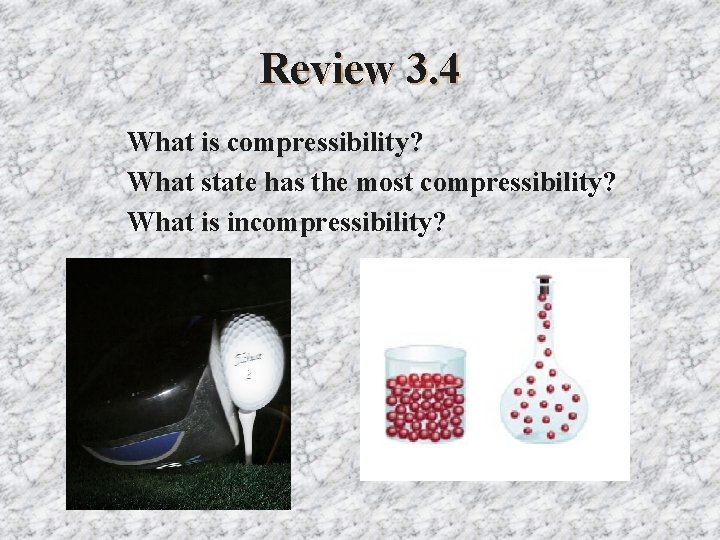
Review 3. 4 What is compressibility? What state has the most compressibility? What is incompressibility?
3. 0 Properties of Liquids and Gases 3. 5 Pressure in Fluid’s-Pascal’s Law
Review of Compressibility n n n Compressibility is the extent to which a solid liquid or gas can be compressed Compression is the decrease of volume and the increase of density due to a force pushing on an object Objects under compression tend to deform in shape Gases can be compressed more than liquids Incompressible materials cannot be compressed easily
Pressure in Fluids n n Fluids (gases and liquids) can be very useful in helping us perform tasks because of the way they transmit pressure n Hydraulic systems-use water under pressure to move loads n Pneumatic systems-use gas under pressure to move loads An important part of understanding how to use fluids to help us perform tasks is knowing the relationship between force, area and pressure.
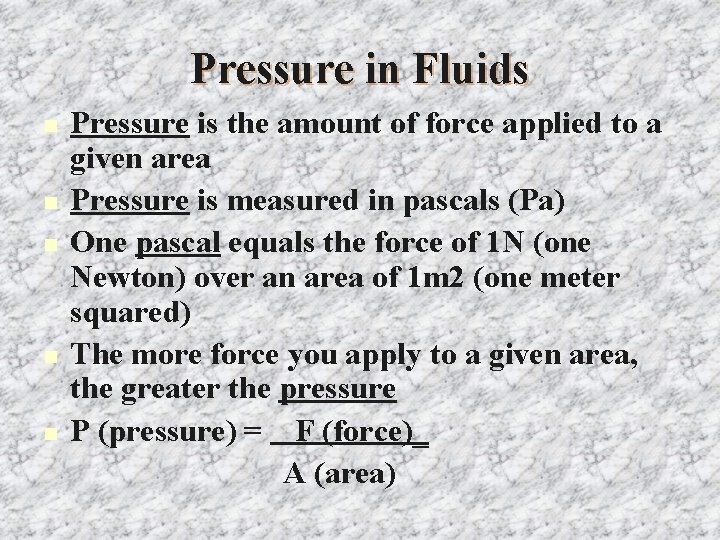
Pressure in Fluids n n n Pressure is the amount of force applied to a given area Pressure is measured in pascals (Pa) One pascal equals the force of 1 N (one Newton) over an area of 1 m 2 (one meter squared) The more force you apply to a given area, the greater the pressure P (pressure) = F (force)_ A (area)
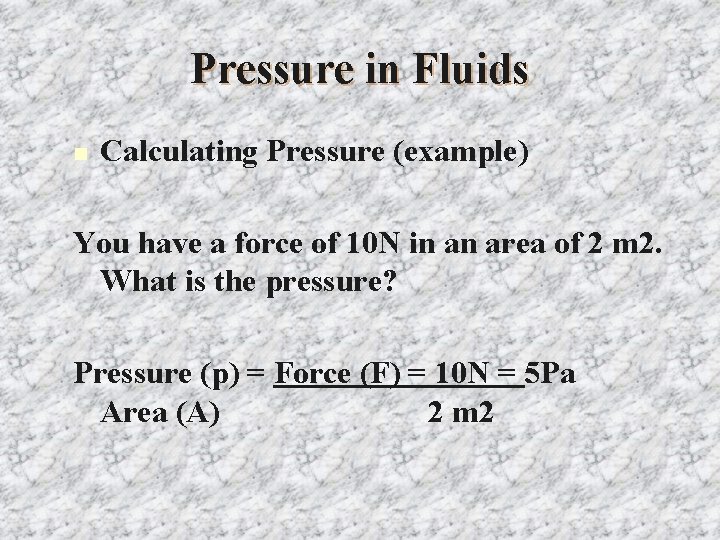
Pressure in Fluids n Calculating Pressure (example) You have a force of 10 N in an area of 2 m 2. What is the pressure? Pressure (p) = Force (F) = 10 N = 5 Pa Area (A) 2 m 2
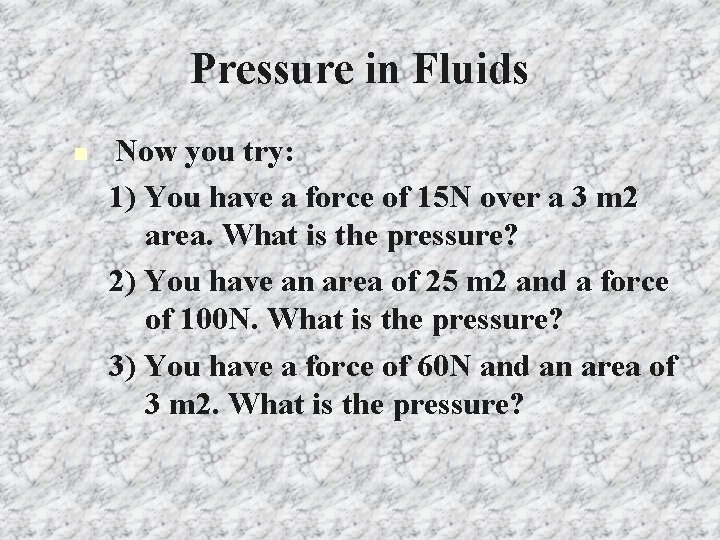
Pressure in Fluids n Now you try: 1) You have a force of 15 N over a 3 m 2 area. What is the pressure? 2) You have an area of 25 m 2 and a force of 100 N. What is the pressure? 3) You have a force of 60 N and an area of 3 m 2. What is the pressure?
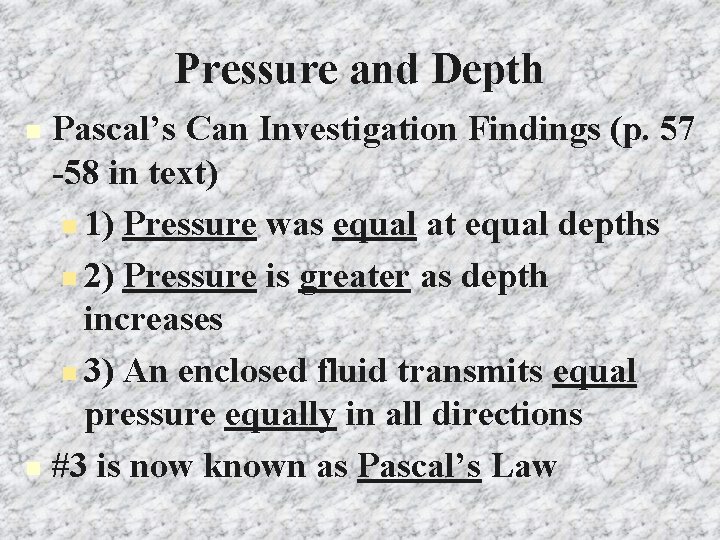
Pressure and Depth Pascal’s Can Investigation Findings (p. 57 -58 in text) n 1) Pressure was equal at equal depths n 2) Pressure is greater as depth increases n 3) An enclosed fluid transmits equal pressure equally in all directions n #3 is now known as Pascal’s Law n
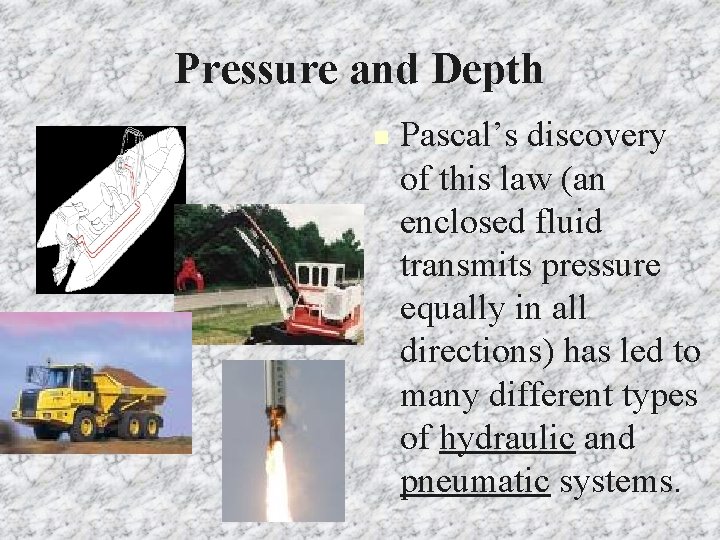
Pressure and Depth n Pascal’s discovery of this law (an enclosed fluid transmits pressure equally in all directions) has led to many different types of hydraulic and pneumatic systems.
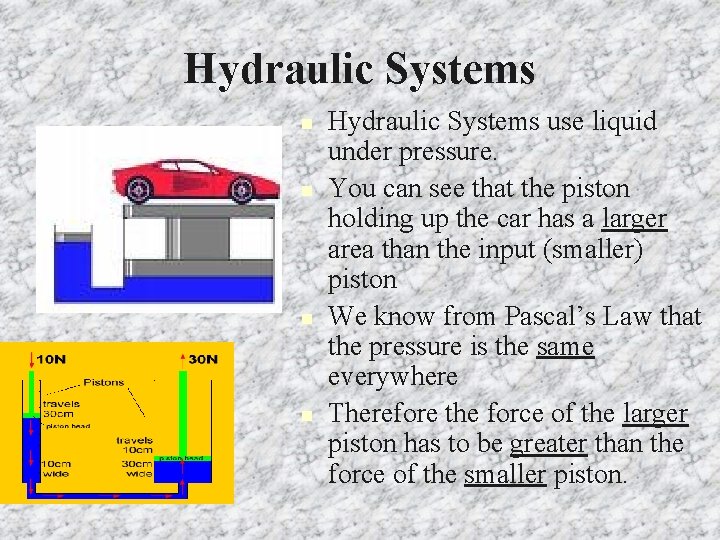
Hydraulic Systems n n Hydraulic Systems use liquid under pressure. You can see that the piston holding up the car has a larger area than the input (smaller) piston We know from Pascal’s Law that the pressure is the same everywhere Therefore the force of the larger piston has to be greater than the force of the smaller piston.
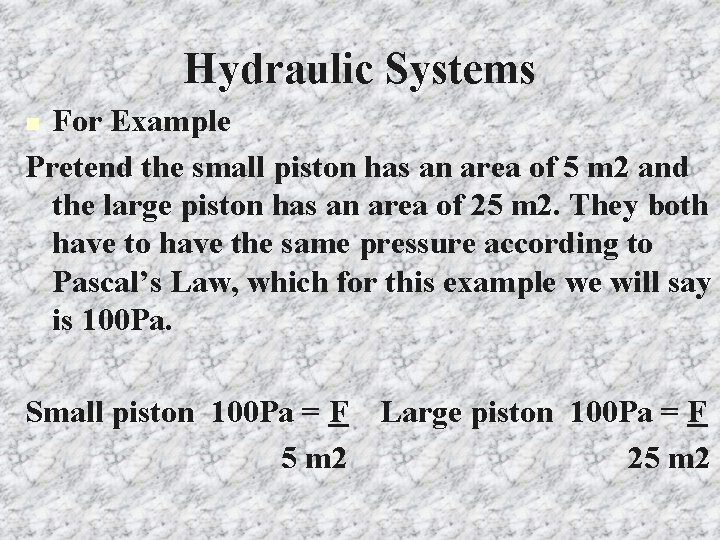
Hydraulic Systems For Example Pretend the small piston has an area of 5 m 2 and the large piston has an area of 25 m 2. They both have to have the same pressure according to Pascal’s Law, which for this example we will say is 100 Pa. n Small piston 100 Pa = F 5 m 2 Large piston 100 Pa = F 25 m 2
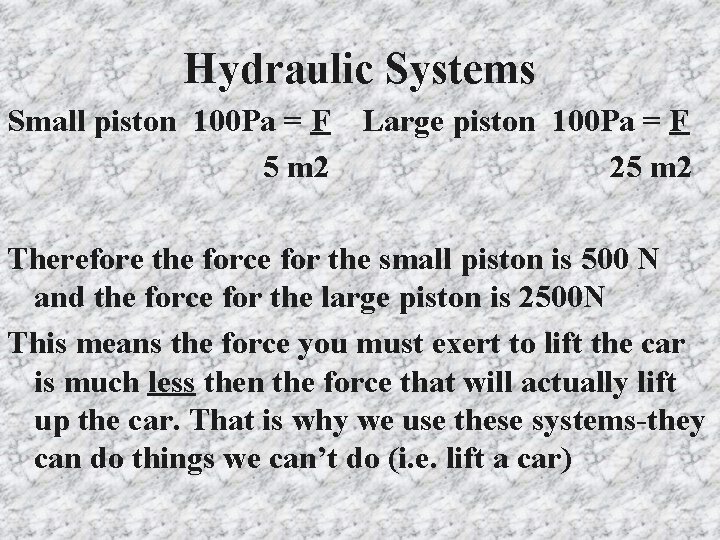
Hydraulic Systems Small piston 100 Pa = F 5 m 2 Large piston 100 Pa = F 25 m 2 Therefore the force for the small piston is 500 N and the force for the large piston is 2500 N This means the force you must exert to lift the car is much less then the force that will actually lift up the car. That is why we use these systems-they can do things we can’t do (i. e. lift a car)
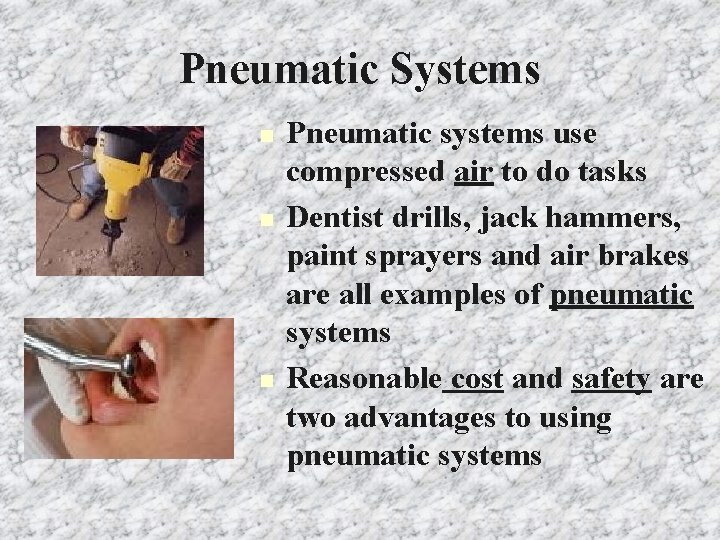
Pneumatic Systems n n n Pneumatic systems use compressed air to do tasks Dentist drills, jack hammers, paint sprayers and air brakes are all examples of pneumatic systems Reasonable cost and safety are two advantages to using pneumatic systems
Hydraulic and Pneumatic Systems n For hydraulic and pneumatic systems to function properly, the system must be completely sealed. Even the smallest leak can cause the system to break down n Ex: Car brakes n Ex: Bus doors
Review ? ? ? Any Questions? ? ? I have some for you… What is pressure? How do you calculate pressure? What is Pascal’s Law? What is a hydraulic system? What is a pneumatic system? Why would we use a hydraulic system?
- Slides: 15