
Review 1 Identify the 4 market structures 2



- Slides: 15
Review 1. Identify the 4 market structures. 2. Identify the 3 types of market. 3. Identify 4 types of monopoly. 4. Explain why D is greater than MR in monopoly. 5. Define price discrimination. 6. List characteristics of perfect competition. 7. List monopoly characteristics. 8. Examples of non-price competition. 9. List three economies of scales. 10. Name 10 types of candy. 1
Monopolistic Competition 3
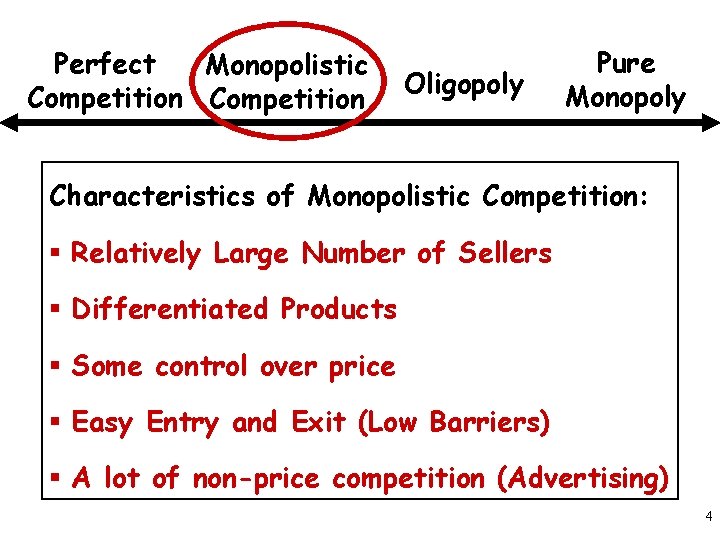
Perfect Monopolistic Competition Oligopoly Pure Monopoly Characteristics of Monopolistic Competition: § Relatively Large Number of Sellers § Differentiated Products § Some control over price § Easy Entry and Exit (Low Barriers) § A lot of non-price competition (Advertising) 4
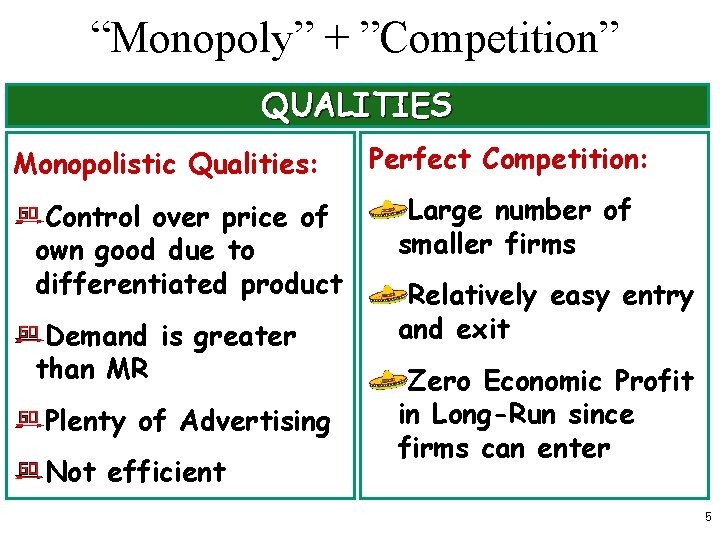
“Monopoly” + ”Competition” QUALITIES Monopolistic Qualities: Control over price of own good due to differentiated product Demand is greater than MR Plenty of Advertising Not efficient Perfect Competition: Large number of smaller firms Relatively easy entry and exit Zero Economic Profit in Long-Run since firms can enter 5
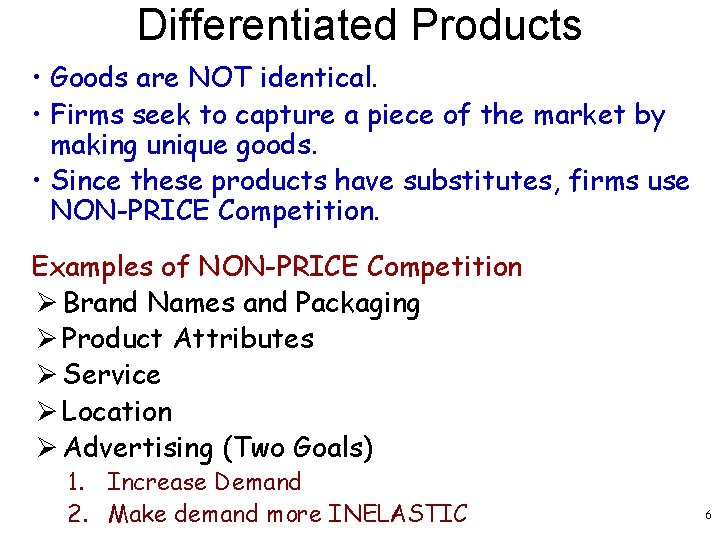
Differentiated Products • Goods are NOT identical. • Firms seek to capture a piece of the market by making unique goods. • Since these products have substitutes, firms use NON-PRICE Competition. Examples of NON-PRICE Competition Ø Brand Names and Packaging Ø Product Attributes Ø Service Ø Location Ø Advertising (Two Goals) 1. Increase Demand 2. Make demand more INELASTIC 6
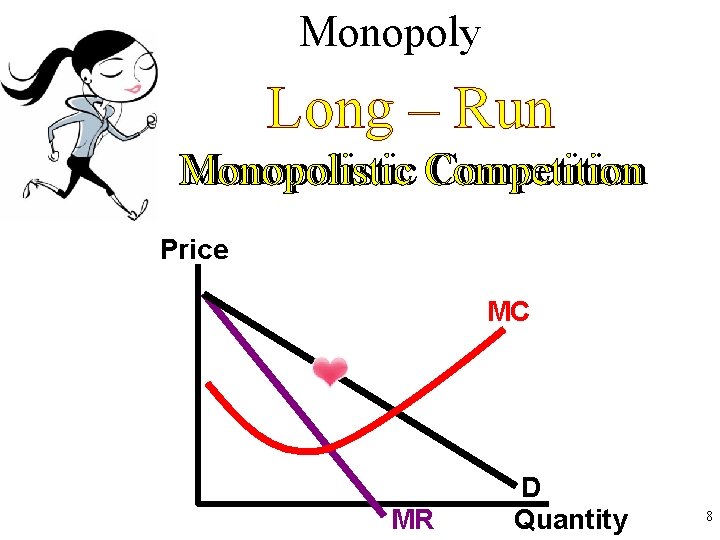
Drawing Monopolistic Competition 7
Monopoly Long – Run Monopolistic Competition Price MC MR D Quantity 8
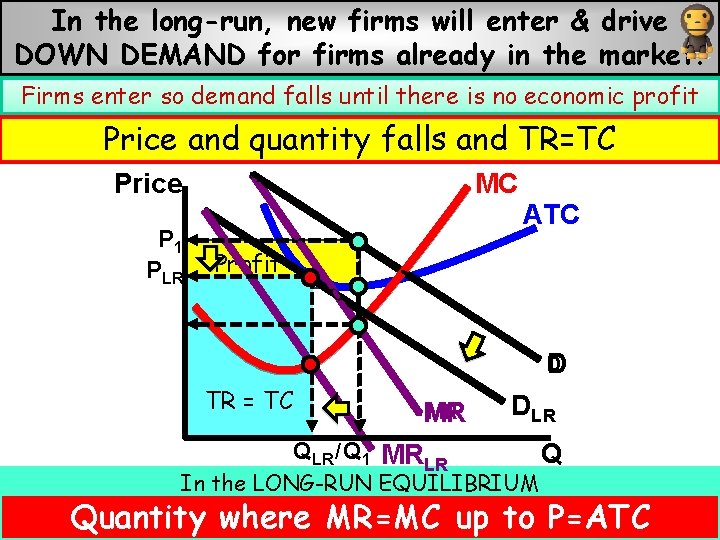
Monopolistic Competition is made up of&prices In the long-run, new firms will enter drive makers so for MRfirms is lessalready than Demand DOWN DEMAND in the market. Firms entershort-run, so demand fallsituntil no economic In the is there the is same graphprofit as monopoly making profit Priceaand quantity falls and TR=TC MC Price P 1 PLR ATC Profit D D TR = TC MR MR QLR / Q 1 MRLR DLR In the LONG-RUN EQUILIBRIUM Q Quantity where MR=MC up to P=ATC 9
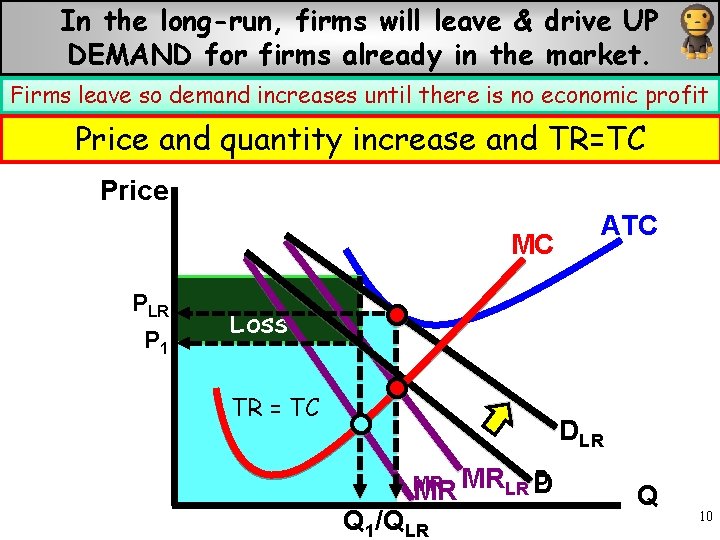
In. What the long-run, leave happensfirms whenwill there is &a drive loss? UP for firmsitalready the market. In. DEMAND the short-run, is theinsame graph as Firms leave so demand increasesmaking until there no economic profit a monopoly a isloss Price and quantity increase and TR=TC Price MC PLR P 1 ATC Loss TR = TC DLR D MR MR MRLR D Q 1/QLR Q 10
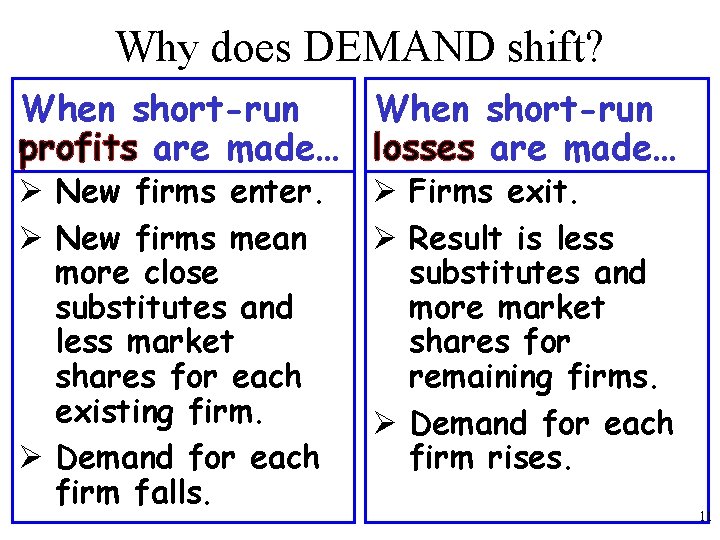
Why does DEMAND shift? When short-run profits are made… losses are made… Ø New firms enter. Ø New firms mean more close substitutes and less market shares for each existing firm. Ø Demand for each firm falls. Ø Firms exit. Ø Result is less substitutes and more market shares for remaining firms. Ø Demand for each firm rises. 11
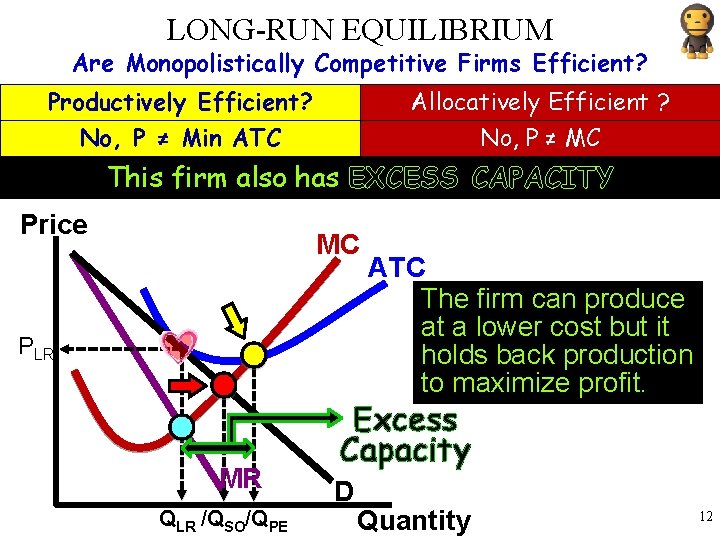
LONG-RUN EQUILIBRIUM Are Monopolistically Competitive Firms Efficient? Productively Efficient? No, P ≠ Min ATC Allocatively Efficient ? No, P ≠ MC This firm also has EXCESS CAPACITY Price MC PLR MR QLR /QSO/QPE ATC The firm can produce at a lower cost but it holds back production to maximize profit. Excess Capacity D Quantity 12
Excess Capacity 1. Given current resources, the firm CAN produce at the lowest costs (min ATC) but they decide not to. 2. The output b/w the minimum ATC & the profit maximizing. 3. Not the amount under-produced. 13
Advantages of MONOPOLISTIC COMPETITION Ø Large number of firms and product variation meets societies needs. Ø Nonprice Competition (product differentiation and advertising) may result in sustained profits for some firms. Ex: Nike might continue to make above normal profit because they are a well known brand. 14
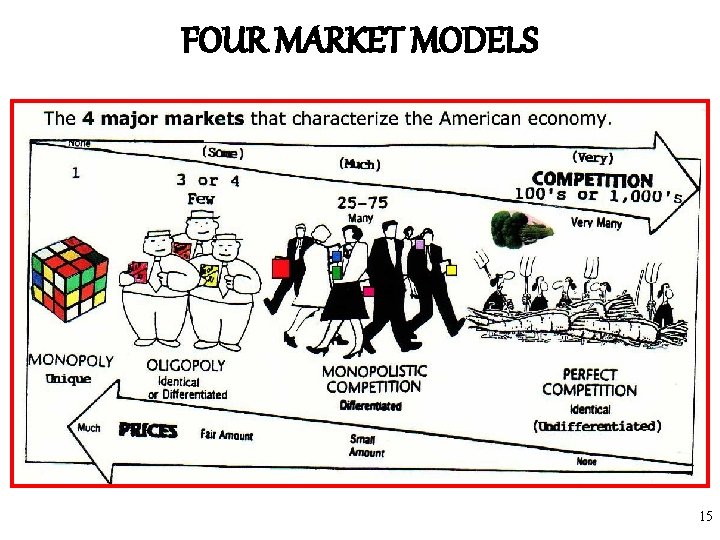
FOUR MARKET MODELS 15
2002 AP Microeconomics Form B Question 1 Assume that two firms are operating with identical cost schedule, but one firm is in a perfectly competitive industry and the other is in a monopolistically competitive industry. (a) Using two correctly labeled graphs, show the long-run equilibrium price and output levels for each of these two firms. (b) Compare the long-run equilibrium and output levels for these two firms. (c) What level of economic profit will each firm earn in the long run? Why do these results occur? (d) For each of the two firms at the equilibrium quantity, indicate whether the firm’s demand curve is perfectly elastic, unit elastic, inelastic or perfectly inelastic. How can you tell? 16