
Reversible processes in gas experimental setup The dwarfs
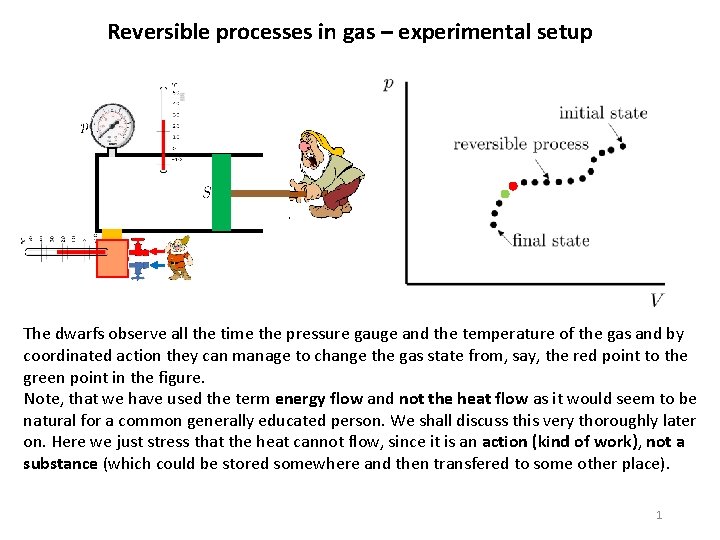
Reversible processes in gas – experimental setup The dwarfs observe all the time the pressure gauge and the temperature of the gas and by coordinated action they can manage to change the gas state from, say, the red point to the green point in the figure. Note, that we have used the term energy flow and not the heat flow as it would seem to be natural for a common generally educated person. We shall discuss this very thoroughly later on. Here we just stress that the heat cannot flow, since it is an action (kind of work), not a substance (which could be stored somewhere and then transfered to some other place). 1
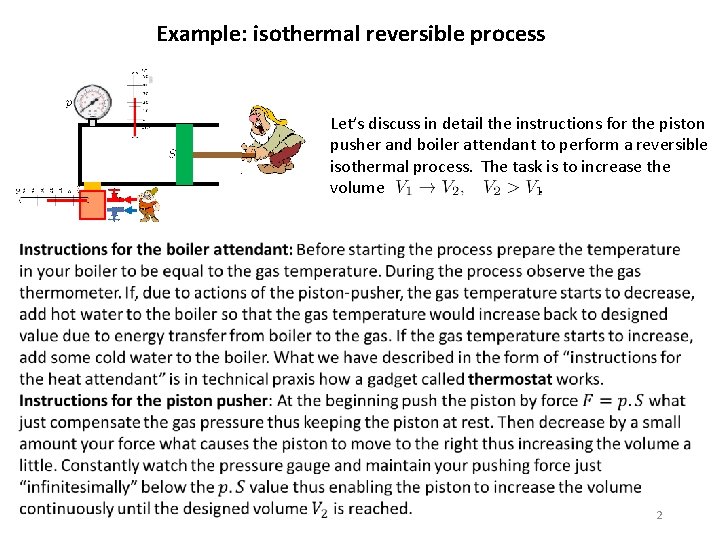
Example: isothermal reversible process Let’s discuss in detail the instructions for the piston pusher and boiler attendant to perform a reversible isothermal process. The task is to increase the volume. 2
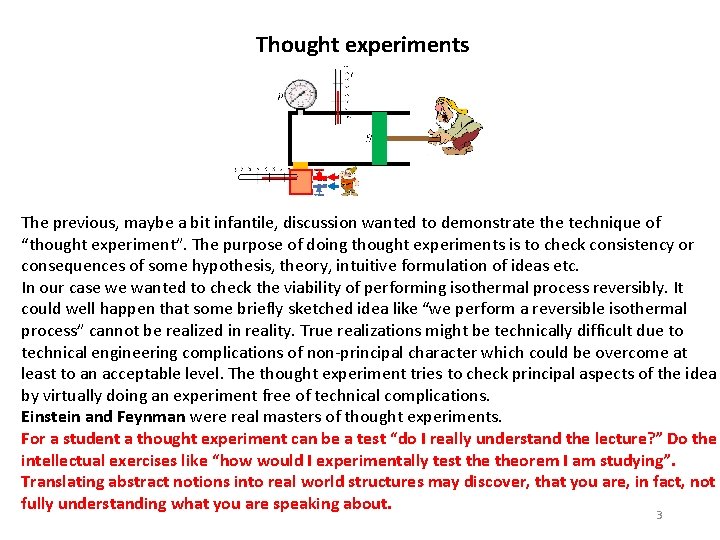
Thought experiments The previous, maybe a bit infantile, discussion wanted to demonstrate the technique of “thought experiment”. The purpose of doing thought experiments is to check consistency or consequences of some hypothesis, theory, intuitive formulation of ideas etc. In our case we wanted to check the viability of performing isothermal process reversibly. It could well happen that some briefly sketched idea like “we perform a reversible isothermal process” cannot be realized in reality. True realizations might be technically difficult due to technical engineering complications of non-principal character which could be overcome at least to an acceptable level. The thought experiment tries to check principal aspects of the idea by virtually doing an experiment free of technical complications. Einstein and Feynman were real masters of thought experiments. For a student a thought experiment can be a test “do I really understand the lecture? ” Do the intellectual exercises like “how would I experimentally test theorem I am studying”. Translating abstract notions into real world structures may discover, that you are, in fact, not fully understanding what you are speaking about. 3
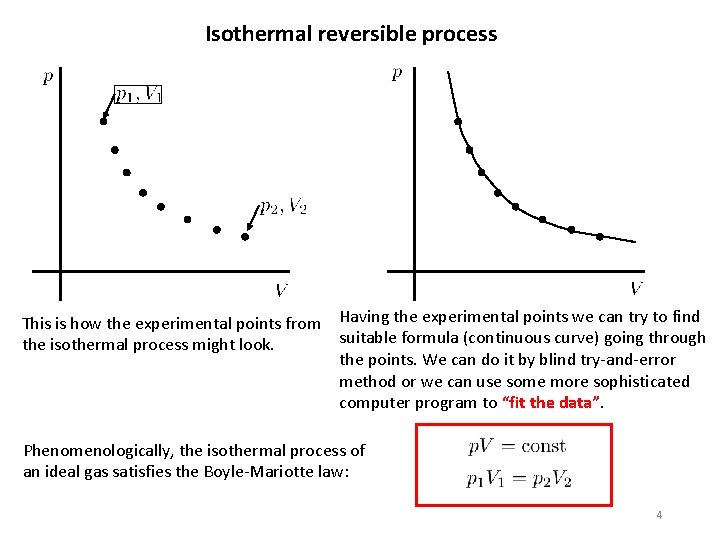
Isothermal reversible process This is how the experimental points from the isothermal process might look. Having the experimental points we can try to find suitable formula (continuous curve) going through the points. We can do it by blind try-and-error method or we can use some more sophisticated computer program to “fit the data”. Phenomenologically, the isothermal process of an ideal gas satisfies the Boyle-Mariotte law: 4

Isotherms of ideal gas 5

Isobaric process 6
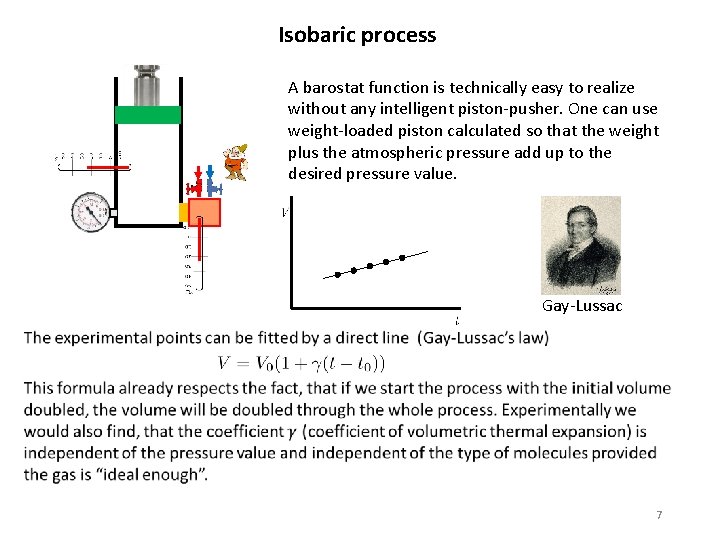
Isobaric process A barostat function is technically easy to realize without any intelligent piston-pusher. One can use weight-loaded piston calculated so that the weight plus the atmospheric pressure add up to the desired pressure value. Gay-Lussac 7
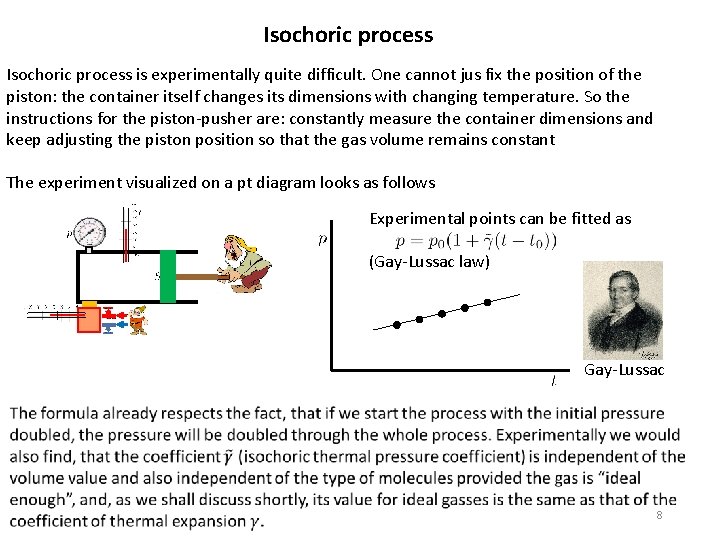
Isochoric process is experimentally quite difficult. One cannot jus fix the position of the piston: the container itself changes its dimensions with changing temperature. So the instructions for the piston-pusher are: constantly measure the container dimensions and keep adjusting the piston position so that the gas volume remains constant The experiment visualized on a pt diagram looks as follows Experimental points can be fitted as (Gay-Lussac law) Gay-Lussac 8
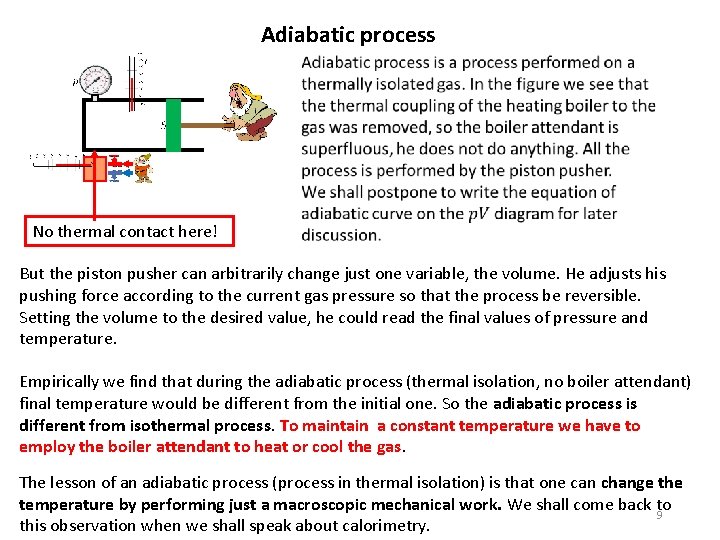
Adiabatic process No thermal contact here! But the piston pusher can arbitrarily change just one variable, the volume. He adjusts his pushing force according to the current gas pressure so that the process be reversible. Setting the volume to the desired value, he could read the final values of pressure and temperature. Empirically we find that during the adiabatic process (thermal isolation, no boiler attendant) final temperature would be different from the initial one. So the adiabatic process is different from isothermal process. To maintain a constant temperature we have to employ the boiler attendant to heat or cool the gas. The lesson of an adiabatic process (process in thermal isolation) is that one can change the temperature by performing just a macroscopic mechanical work. We shall come back to 9 this observation when we shall speak about calorimetry.
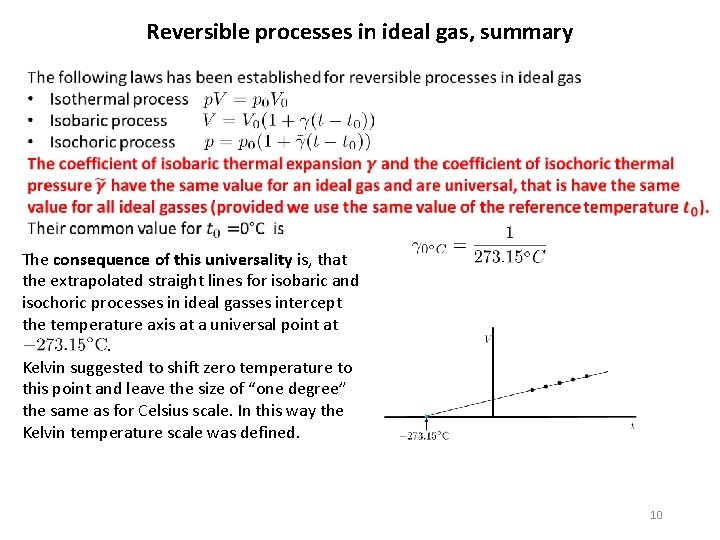
Reversible processes in ideal gas, summary The consequence of this universality is, that the extrapolated straight lines for isobaric and isochoric processes in ideal gasses intercept the temperature axis at a universal point at. Kelvin suggested to shift zero temperature to this point and leave the size of “one degree” the same as for Celsius scale. In this way the Kelvin temperature scale was defined. 10
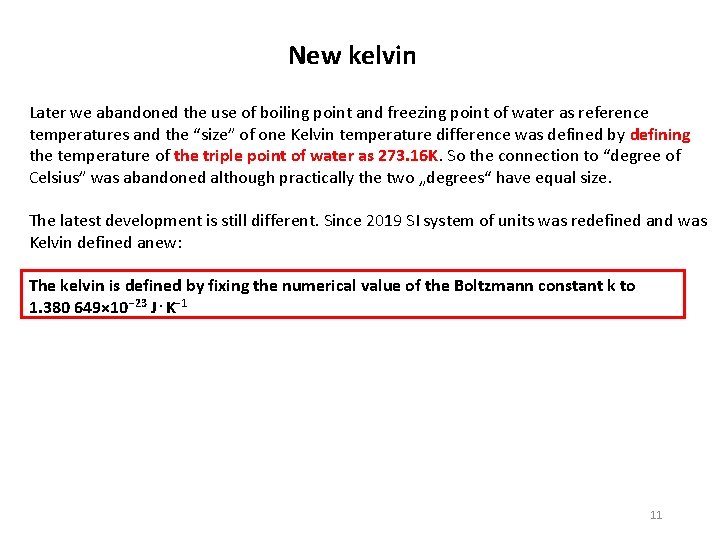
New kelvin Later we abandoned the use of boiling point and freezing point of water as reference temperatures and the “size” of one Kelvin temperature difference was defined by defining the temperature of the triple point of water as 273. 16 K. So the connection to “degree of Celsius” was abandoned although practically the two „degrees“ have equal size. The latest development is still different. Since 2019 SI system of units was redefined and was Kelvin defined anew: The kelvin is defined by fixing the numerical value of the Boltzmann constant k to 1. 380 649× 10− 23 J⋅K− 1 11
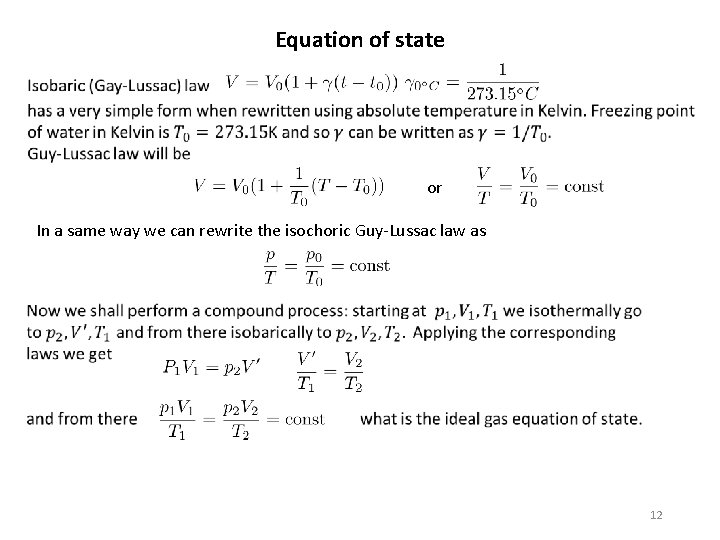
Equation of state or In a same way we can rewrite the isochoric Guy-Lussac law as 12
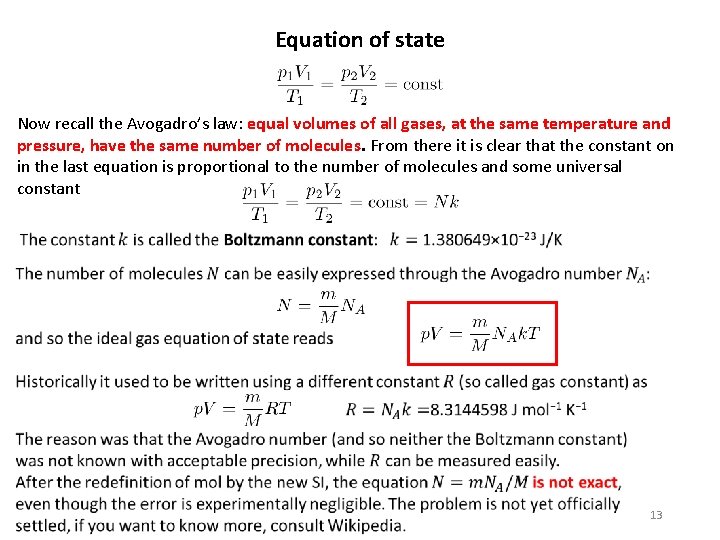
Equation of state Now recall the Avogadro’s law: equal volumes of all gases, at the same temperature and pressure, have the same number of molecules. From there it is clear that the constant on in the last equation is proportional to the number of molecules and some universal constant 13
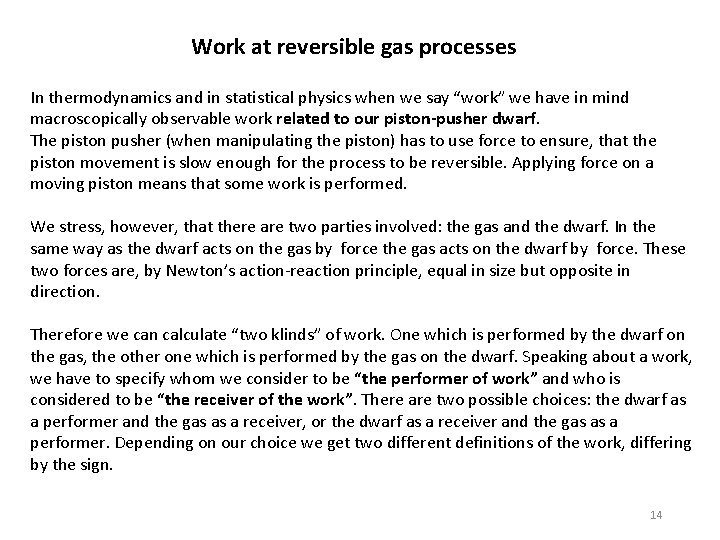
Work at reversible gas processes In thermodynamics and in statistical physics when we say “work” we have in mind macroscopically observable work related to our piston-pusher dwarf. The piston pusher (when manipulating the piston) has to use force to ensure, that the piston movement is slow enough for the process to be reversible. Applying force on a moving piston means that some work is performed. We stress, however, that there are two parties involved: the gas and the dwarf. In the same way as the dwarf acts on the gas by force the gas acts on the dwarf by force. These two forces are, by Newton’s action-reaction principle, equal in size but opposite in direction. Therefore we can calculate “two klinds” of work. One which is performed by the dwarf on the gas, the other one which is performed by the gas on the dwarf. Speaking about a work, we have to specify whom we consider to be “the performer of work” and who is considered to be “the receiver of the work”. There are two possible choices: the dwarf as a performer and the gas as a receiver, or the dwarf as a receiver and the gas as a performer. Depending on our choice we get two different definitions of the work, differing by the sign. 14
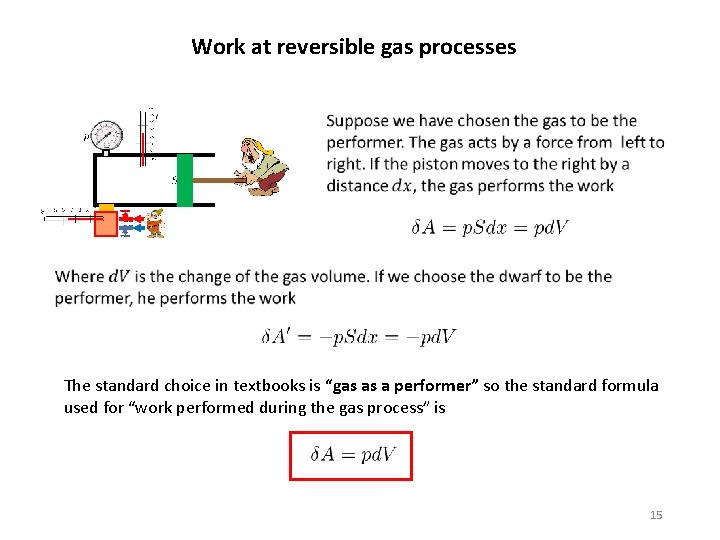
Work at reversible gas processes The standard choice in textbooks is “gas as a performer” so the standard formula used for “work performed during the gas process” is 15
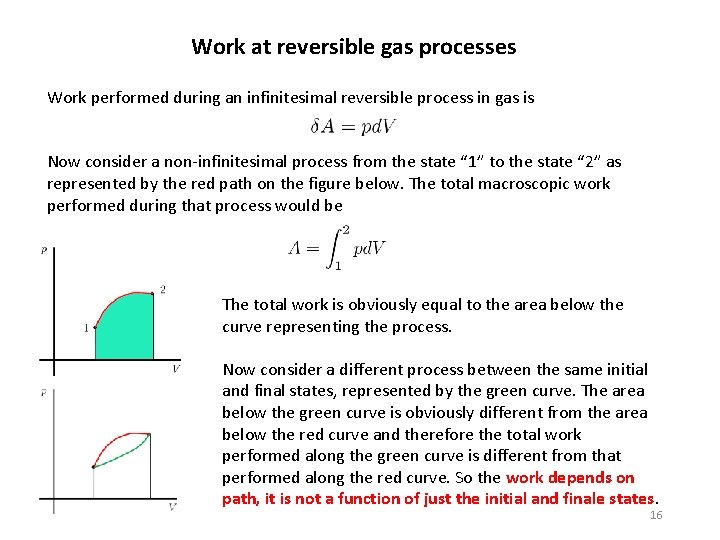
Work at reversible gas processes Work performed during an infinitesimal reversible process in gas is Now consider a non-infinitesimal process from the state “ 1” to the state “ 2” as represented by the red path on the figure below. The total macroscopic work performed during that process would be The total work is obviously equal to the area below the curve representing the process. Now consider a different process between the same initial and final states, represented by the green curve. The area below the green curve is obviously different from the area below the red curve and therefore the total work performed along the green curve is different from that performed along the red curve. So the work depends on path, it is not a function of just the initial and finale states. 16
- Slides: 16