
Reversible Catalyst Operates Without Added Energy Resolving Key
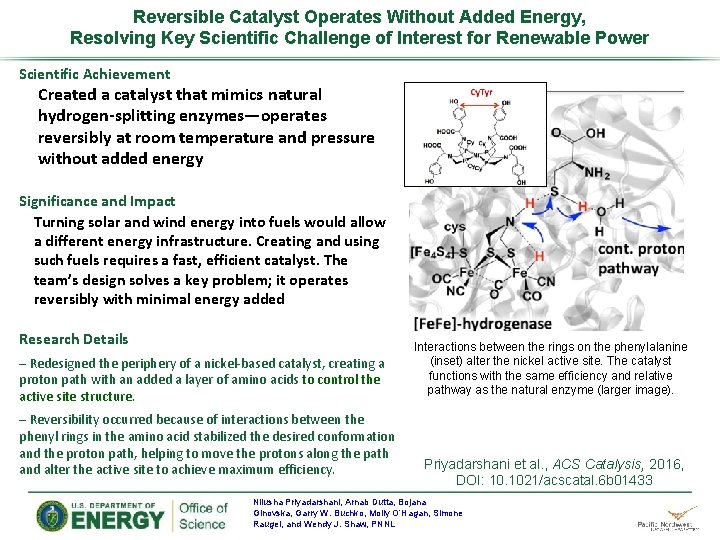
Reversible Catalyst Operates Without Added Energy, Resolving Key Scientific Challenge of Interest for Renewable Power Scientific Achievement Created a catalyst that mimics natural hydrogen-splitting enzymes—operates reversibly at room temperature and pressure without added energy Significance and Impact Turning solar and wind energy into fuels would allow a different energy infrastructure. Creating and using such fuels requires a fast, efficient catalyst. The team’s design solves a key problem; it operates reversibly with minimal energy added Research Details – Redesigned the periphery of a nickel-based catalyst, creating a proton path with an added a layer of amino acids to control the active site structure. – Reversibility occurred because of interactions between the phenyl rings in the amino acid stabilized the desired conformation and the proton path, helping to move the protons along the path and alter the active site to achieve maximum efficiency. Interactions between the rings on the phenylalanine (inset) alter the nickel active site. The catalyst functions with the same efficiency and relative pathway as the natural enzyme (larger image). Priyadarshani et al. , ACS Catalysis, 2016, DOI: 10. 1021/acscatal. 6 b 01433 Nilusha Priyadarshani, Arnab Dutta, Bojana Ginovska, Garry W. Buchko, Molly O’Hagan, Simone Raugei, and Wendy J. Shaw, PNNL
- Slides: 1