
REVERSE TOTAL SHOULDER ARTHROPLAST Y Jonathan Samuelson WHY

- Slides: 48
REVERSE TOTAL SHOULDER ARTHROPLAST Y Jonathan Samuelson
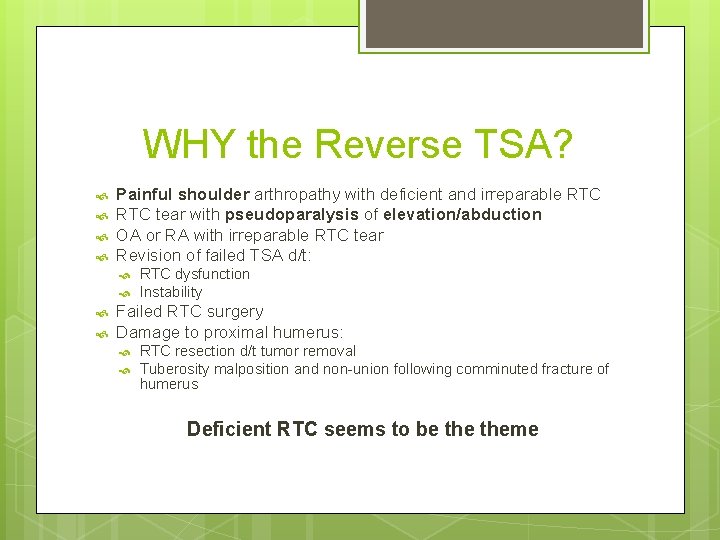
WHY the Reverse TSA? Painful shoulder arthropathy with deficient and irreparable RTC tear with pseudoparalysis of elevation/abduction OA or RA with irreparable RTC tear Revision of failed TSA d/t: RTC dysfunction Instability Failed RTC surgery Damage to proximal humerus: RTC resection d/t tumor removal Tuberosity malposition and non-union following comminuted fracture of humerus Deficient RTC seems to be theme
WHY NOT Reverse TSA? Insufficient deltoid mm Axillary nerve damage Poor glenoid bone quality d/t: Infection Osteopenia Complications R TSA > TSA
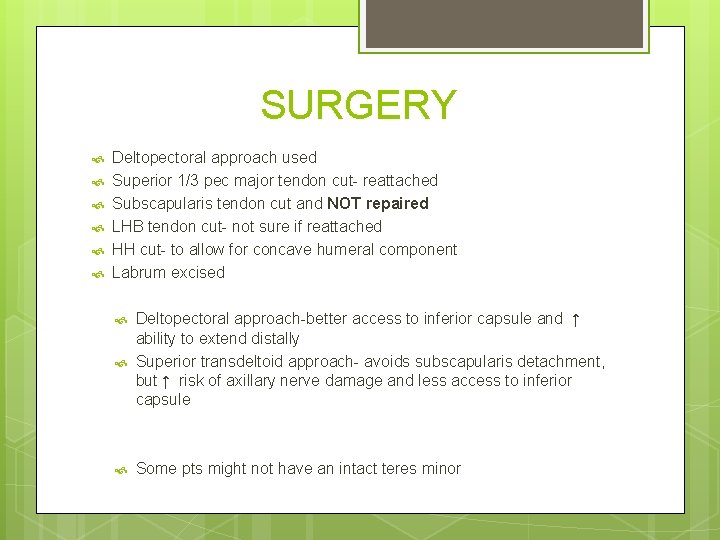
SURGERY Deltopectoral approach used Superior 1/3 pec major tendon cut- reattached Subscapularis tendon cut and NOT repaired LHB tendon cut- not sure if reattached HH cut- to allow for concave humeral component Labrum excised Deltopectoral approach-better access to inferior capsule and ↑ ability to extend distally Superior transdeltoid approach- avoids subscapularis detachment, but ↑ risk of axillary nerve damage and less access to inferior capsule Some pts might not have an intact teres minor
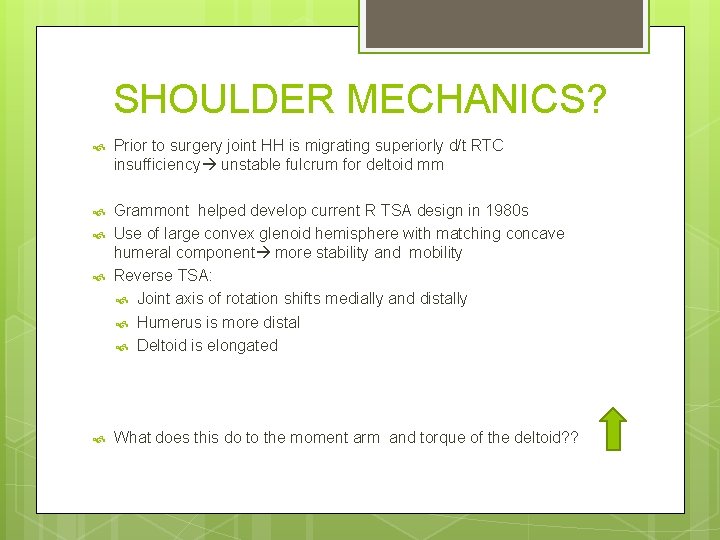
SHOULDER MECHANICS? Prior to surgery joint HH is migrating superiorly d/t RTC insufficiency unstable fulcrum for deltoid mm Grammont helped develop current R TSA design in 1980 s Use of large convex glenoid hemisphere with matching concave humeral component more stability and mobility Reverse TSA: Joint axis of rotation shifts medially and distally Humerus is more distal Deltoid is elongated What does this do to the moment arm and torque of the deltoid? ?
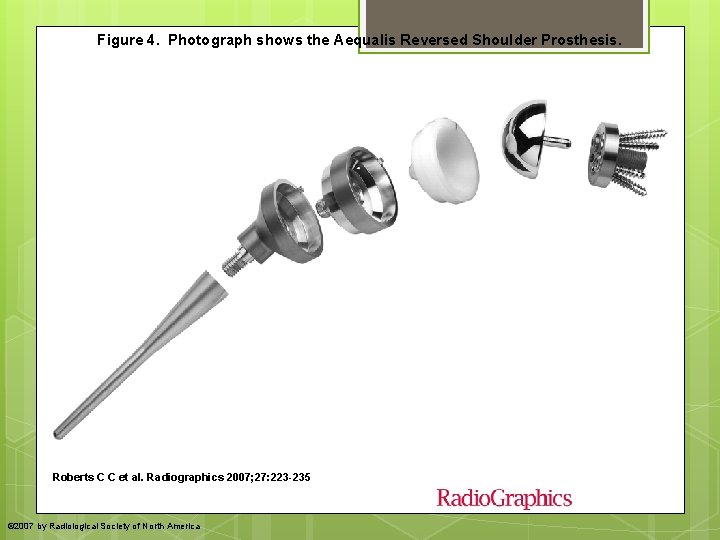
Figure 4. Photograph shows the Aequalis Reversed Shoulder Prosthesis. Roberts C C et al. Radiographics 2007; 27: 223 -235 © 2007 by Radiological Society of North America
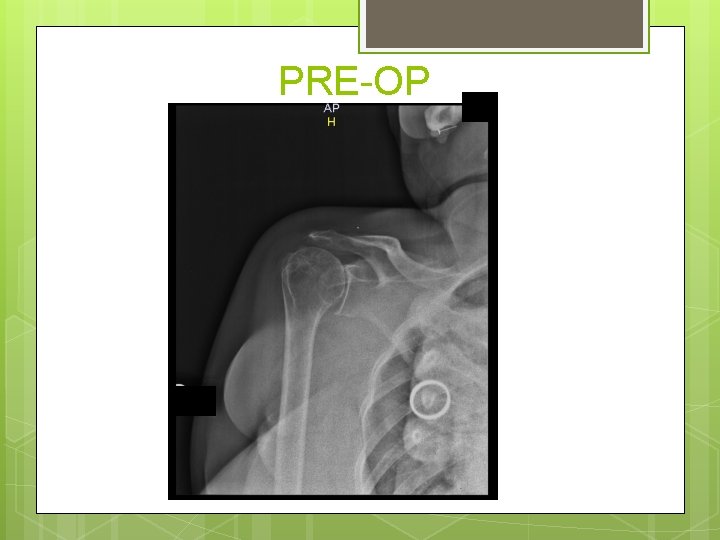
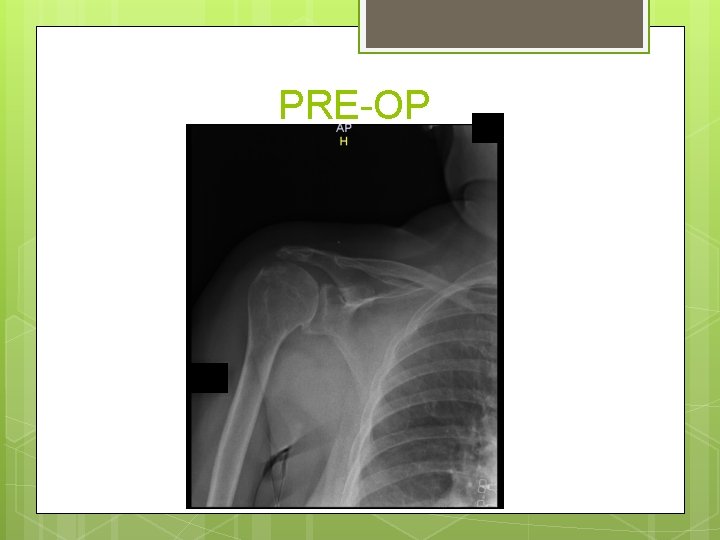
PRE-OP
PRE-OP
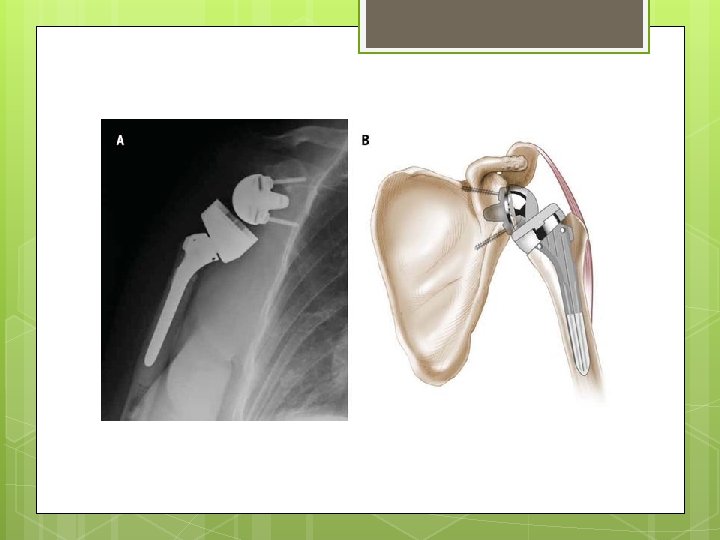
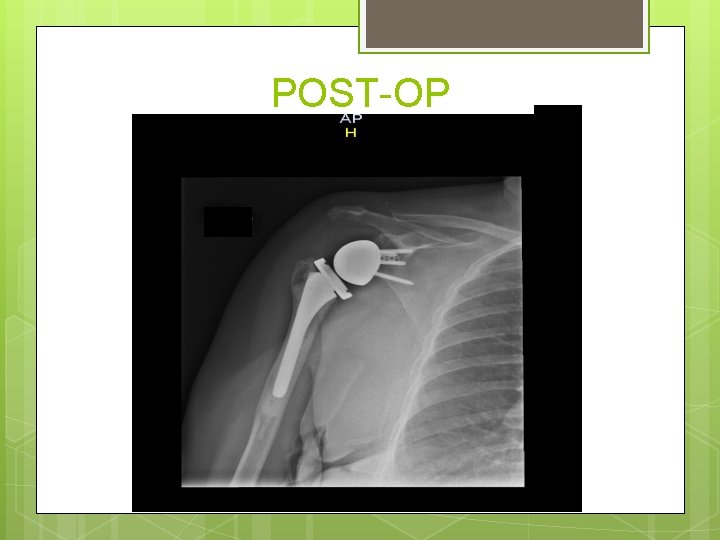
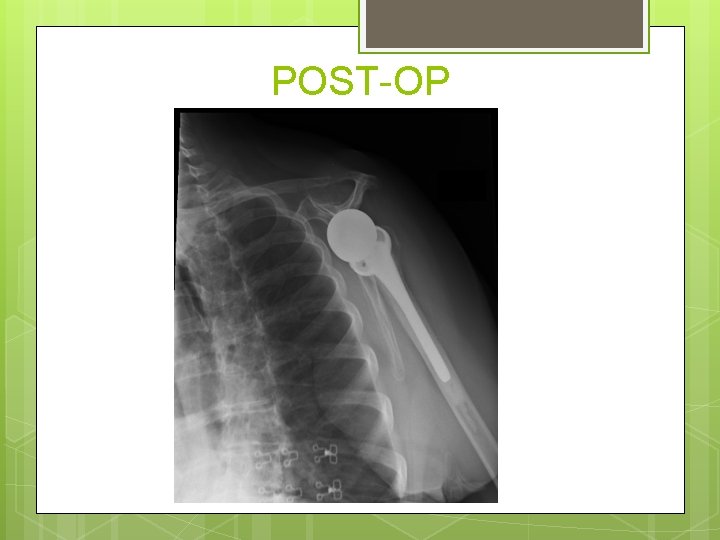
POST-OP
POST-OP
APTA PRACTICE PATTERN 4 H- Impaired Joint Mobility, Motor Function, Muscle Performance, and Range of Motion Associated with Joint Arthroplasty. Goals: decrease pain, improve range of motion and improve strength. Treatment may include: Therapeutic Exercise Manual Therapy Electrotherapeutic Modalities Functional Training Physical Agents and Mechanical Modalities
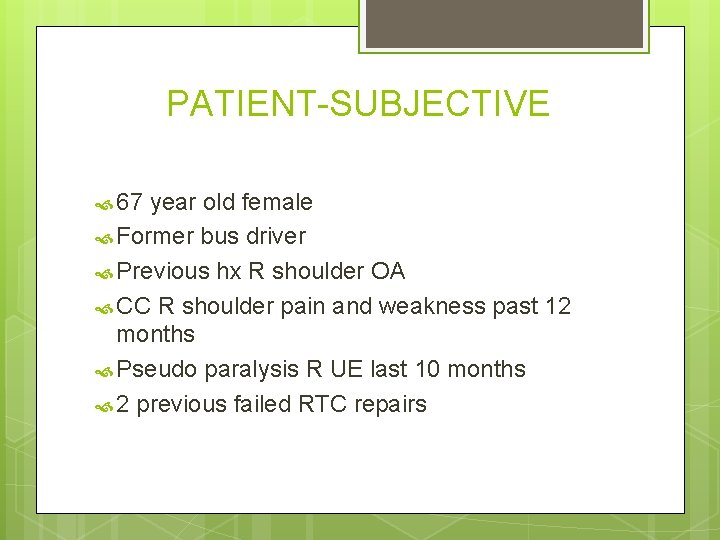
PATIENT-SUBJECTIVE 67 year old female Former bus driver Previous hx R shoulder OA CC R shoulder pain and weakness past 12 months Pseudo paralysis R UE last 10 months 2 previous failed RTC repairs
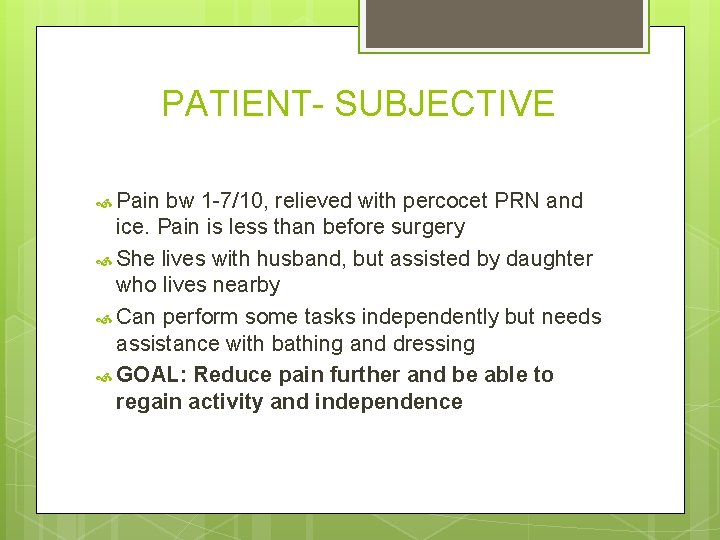
PATIENT- SUBJECTIVE Pain bw 1 -7/10, relieved with percocet PRN and ice. Pain is less than before surgery She lives with husband, but assisted by daughter who lives nearby Can perform some tasks independently but needs assistance with bathing and dressing GOAL: Reduce pain further and be able to regain activity and independence
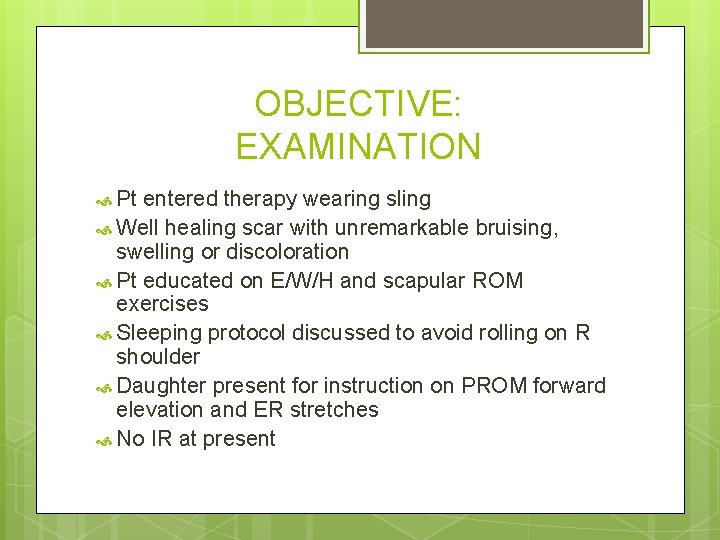
OBJECTIVE: EXAMINATION Pt entered therapy wearing sling Well healing scar with unremarkable bruising, swelling or discoloration Pt educated on E/W/H and scapular ROM exercises Sleeping protocol discussed to avoid rolling on R shoulder Daughter present for instruction on PROM forward elevation and ER stretches No IR at present
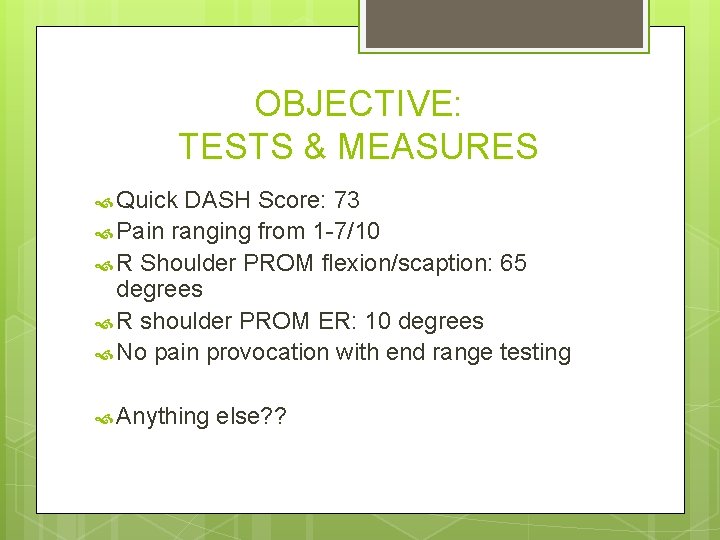
OBJECTIVE: TESTS & MEASURES Quick DASH Score: 73 Pain ranging from 1 -7/10 R Shoulder PROM flexion/scaption: 65 degrees R shoulder PROM ER: 10 degrees No pain provocation with end range testing Anything else? ?
ASSESSMENT Pt presents with signs and sx consistent with 2. 5 weeks s/p R Reverse TSA No signs of infection or significant distal neural involvement Pt and family compliant with R UE NWB status, sleeping precautions and ROM limitations
IMPAIRMENTS Decreased PROM Decreased functional AROM/strength R UE Increased R UE pain Above QOL results in decreased functionality and
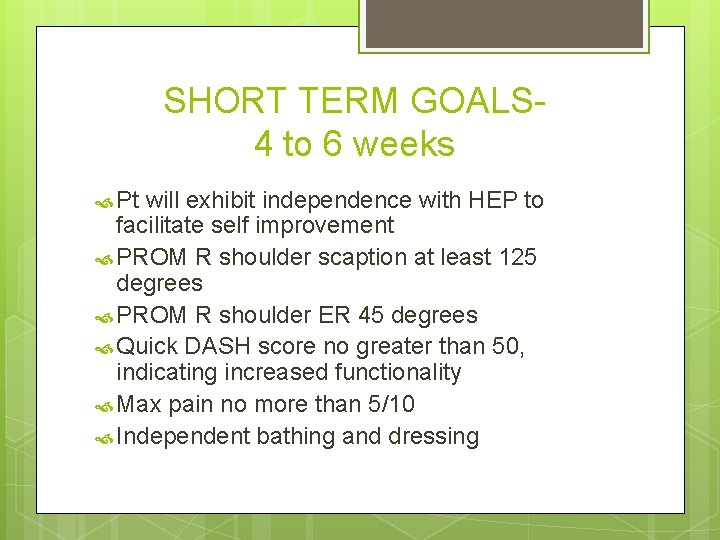
SHORT TERM GOALS 4 to 6 weeks Pt will exhibit independence with HEP to facilitate self improvement PROM R shoulder scaption at least 125 degrees PROM R shoulder ER 45 degrees Quick DASH score no greater than 50, indicating increased functionality Max pain no more than 5/10 Independent bathing and dressing
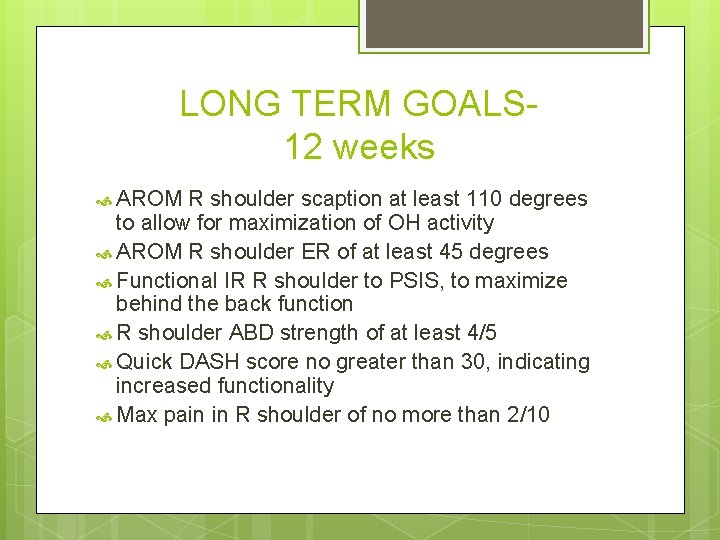
LONG TERM GOALS 12 weeks AROM R shoulder scaption at least 110 degrees to allow for maximization of OH activity AROM R shoulder ER of at least 45 degrees Functional IR R shoulder to PSIS, to maximize behind the back function R shoulder ABD strength of at least 4/5 Quick DASH score no greater than 30, indicating increased functionality Max pain in R shoulder of no more than 2/10
PLAN OF CARE (POC) Pt will be seen once per week for 12 weeks with reassessment to follow Tx plan to include: Therex Manual therapy Local modalities PRN Pt education HEP
1 st SESSIONTHERAPEUTIC EXERCISE Therex Family assisted: PROM scaption x 2’ PROM ER x 2’ Pt performed: Pole ER x 2’ Scapular retraction/rolls x 10 reps Shoulder shrugs x 10 reps Step Backs 3 x 30
1 st SESSIONMANUAL THERAPY PT performed PROM scaption to about 120 degrees x 12 minutes PT performed PROM ER in ABD up to 30 degrees x 12 minutes
1 st Session Daily Note. ASSESSMENT Pt tolerated therapy well Very compliant Understands importance of progressing at appropriate pace Pt shows motivation and capability to progress towards STG/LTG
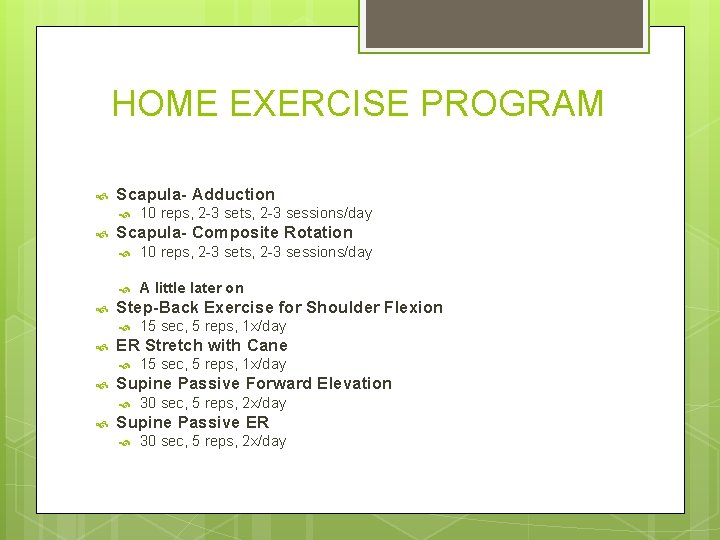
HOME EXERCISE PROGRAM Scapula- Adduction Scapula- Composite Rotation 10 reps, 2 -3 sets, 2 -3 sessions/day A little later on Step-Back Exercise for Shoulder Flexion 15 sec, 5 reps, 1 x/day Supine Passive Forward Elevation 15 sec, 5 reps, 1 x/day ER Stretch with Cane 10 reps, 2 -3 sets, 2 -3 sessions/day 30 sec, 5 reps, 2 x/day Supine Passive ER 30 sec, 5 reps, 2 x/day
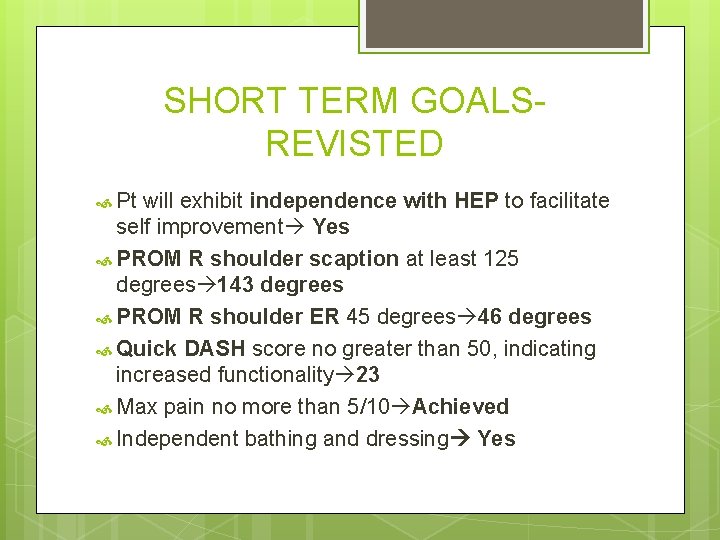
SHORT TERM GOALSREVISTED Pt will exhibit independence with HEP to facilitate self improvement Yes PROM R shoulder scaption at least 125 degrees 143 degrees PROM R shoulder ER 45 degrees 46 degrees Quick DASH score no greater than 50, indicating increased functionality 23 Max pain no more than 5/10 Achieved Independent bathing and dressing Yes
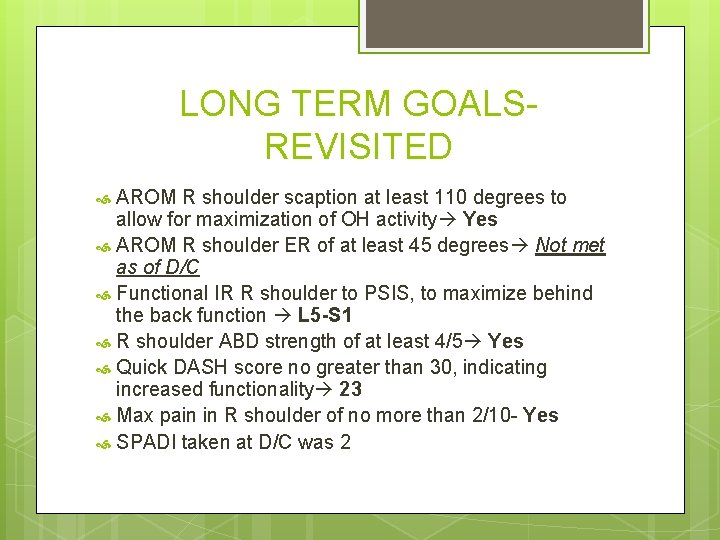
LONG TERM GOALSREVISITED AROM R shoulder scaption at least 110 degrees to allow for maximization of OH activity Yes AROM R shoulder ER of at least 45 degrees Not met as of D/C Functional IR R shoulder to PSIS, to maximize behind the back function L 5 -S 1 R shoulder ABD strength of at least 4/5 Yes Quick DASH score no greater than 30, indicating increased functionality 23 Max pain in R shoulder of no more than 2/10 - Yes SPADI taken at D/C was 2
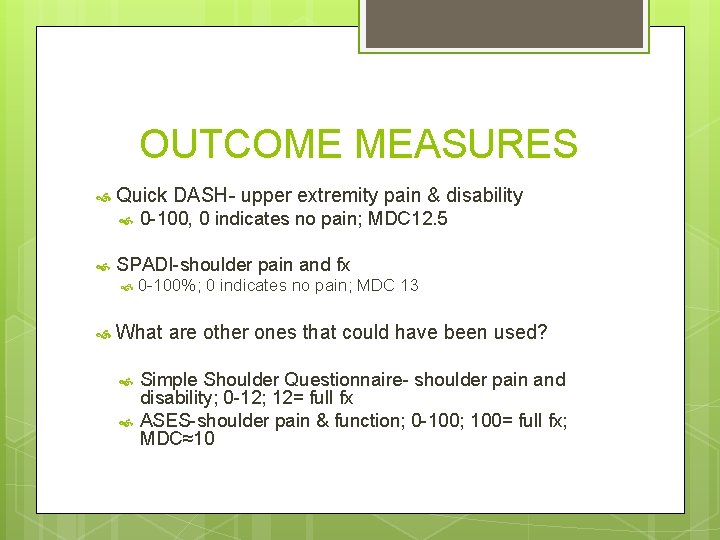
OUTCOME MEASURES Quick DASH- upper extremity pain & disability SPADI-shoulder pain and fx 0 -100, 0 indicates no pain; MDC 12. 5 0 -100%; 0 indicates no pain; MDC 13 What are other ones that could have been used? Simple Shoulder Questionnaire- shoulder pain and disability; 0 -12; 12= full fx ASES-shoulder pain & function; 0 -100; 100= full fx; MDC≈10
DIFFERENCES WITH REGULAR TSA and COMPLICATIONS? Dislocation/instability more of an issue vs TSA R TSA- more dislocation risk in ADD, IR, EXT Conventional TSA-more dislocation risk with ER in ABD Scapular notching- humeral component bumping up against scapular neck. So component is now being shifted distally during surgery to avoid contact. Deterioration of components Movement into soft tissue
PUBLISHED PROTOCOL Boudreau JOSPT 743 et al. Dec 2007; Vol 37; Number 12 734 -
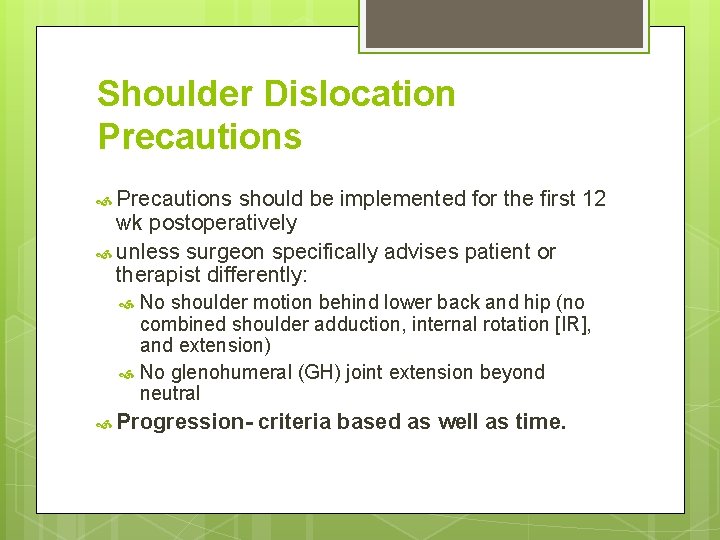
Shoulder Dislocation Precautions should be implemented for the first 12 wk postoperatively unless surgeon specifically advises patient or therapist differently: No shoulder motion behind lower back and hip (no combined shoulder adduction, internal rotation [IR], and extension) No glenohumeral (GH) joint extension beyond neutral Progression- criteria based as well as time.
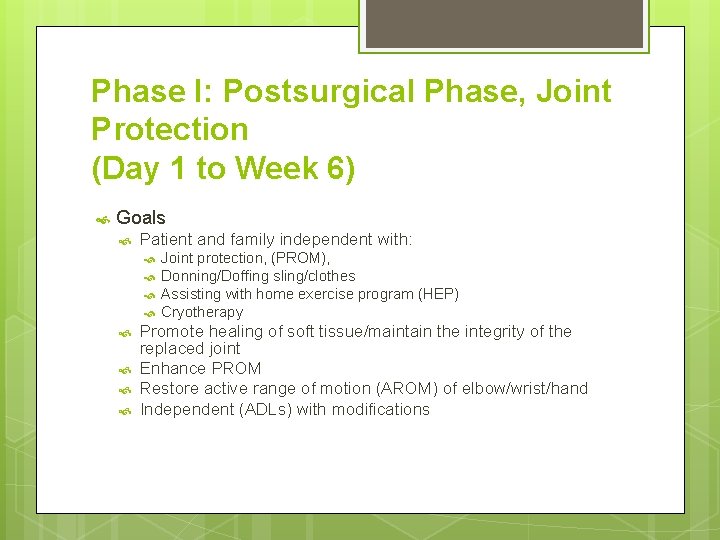
Phase I: Postsurgical Phase, Joint Protection (Day 1 to Week 6) Goals Patient and family independent with: Joint protection, (PROM), Donning/Doffing sling/clothes Assisting with home exercise program (HEP) Cryotherapy Promote healing of soft tissue/maintain the integrity of the replaced joint Enhance PROM Restore active range of motion (AROM) of elbow/wrist/hand Independent (ADLs) with modifications
Phase I Days 1 -4 PROM forward flex and scaption while supine to 90 PROM ER in scapular plane ~20 -30 No IR AAROM c-spine, E/W/H Periscapular isometrics Frequent cryotherapy
Phase I Days 5 -21 Continue previous exercises and cryotherapy Commence submax deltoid isometrics in scapular plane
Phase I Weeks 3 -6 Progress previous exercises, continue cryotherapy PROM Flex and scaption to 120 ER in scapular plane to tolerance PROM IR to tolerance Slightly resisted E/W/H exercises
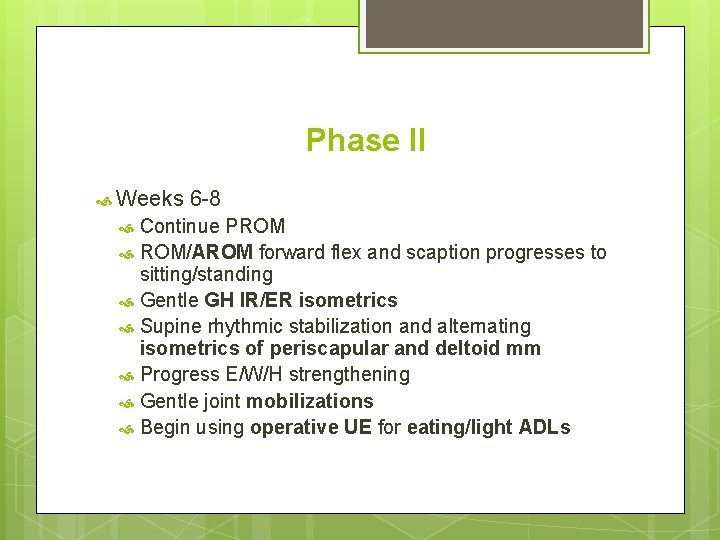
Phase II: AROM, Early Strengthening Phase (Weeks 6 to 12) Goals PROM progression Gradually restore AROM Control pain and inflammation Allow continued healing of soft tissue/do not overstress healing tissue Re-establish dynamic shoulder stability
Phase II Weeks 6 -8 Continue PROM ROM/AROM forward flex and scaption progresses to sitting/standing Gentle GH IR/ER isometrics Supine rhythmic stabilization and alternating isometrics of periscapular and deltoid mm Progress E/W/H strengthening Gentle joint mobilizations Begin using operative UE for eating/light ADLs
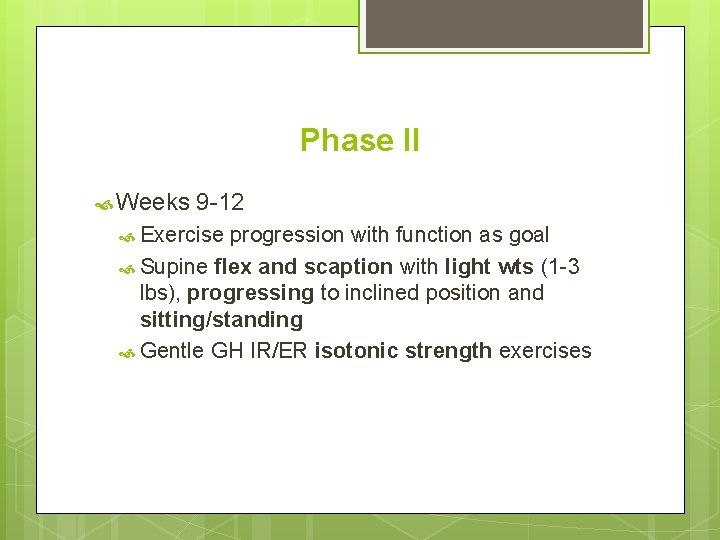
Phase II Weeks 9 -12 Exercise progression with function as goal Supine flex and scaption with light wts (1 -3 lbs), progressing to inclined position and sitting/standing Gentle GH IR/ER isotonic strength exercises
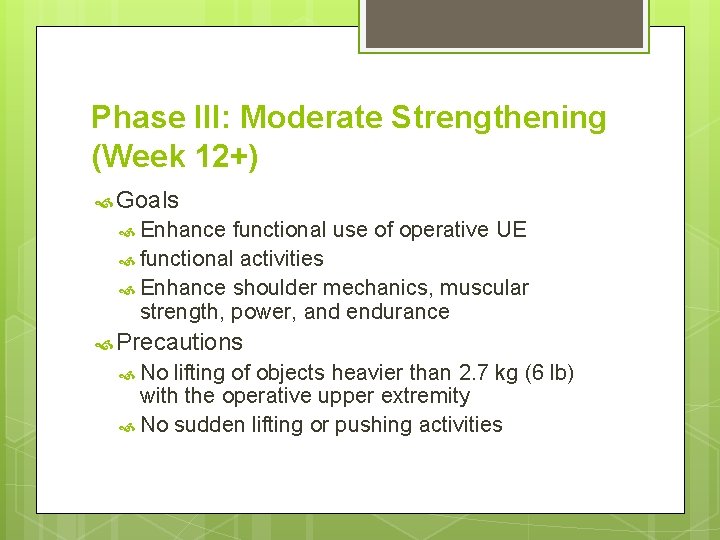
Phase III: Moderate Strengthening (Week 12+) Goals Enhance functional use of operative UE functional activities Enhance shoulder mechanics, muscular strength, power, and endurance Precautions No lifting of objects heavier than 2. 7 kg (6 lb) with the operative upper extremity No sudden lifting or pushing activities
Phase III Weeks 12 -16 Continue prior exercises Gentle resisted flex in standing
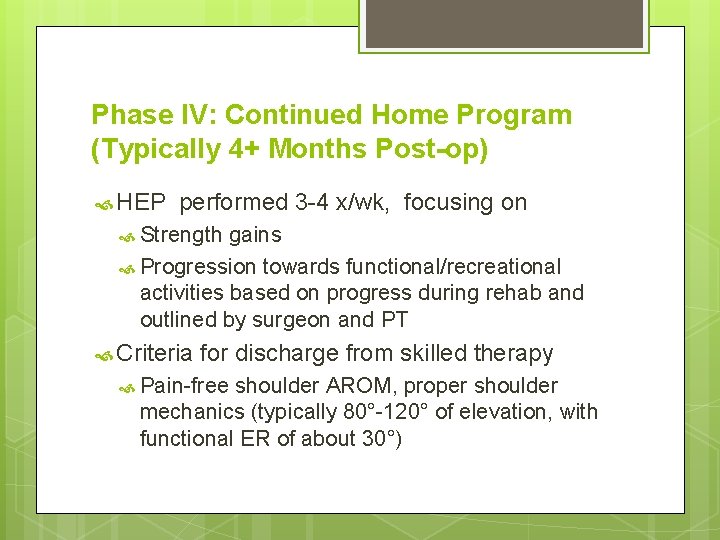
Phase IV: Continued Home Program (Typically 4+ Months Post-op) HEP performed 3 -4 x/wk, focusing on Strength gains Progression towards functional/recreational activities based on progress during rehab and outlined by surgeon and PT Criteria for discharge from skilled therapy Pain-free shoulder AROM, proper shoulder mechanics (typically 80°-120° of elevation, with functional ER of about 30°)
RESEARCH Reverse Total Shoulder Arthroplasty: A Review of Results According to Etiology Wall et al. Between 1995 -2003 186 pts with 191 Reverse TSA followed over ~40 months Average 72. 7 years
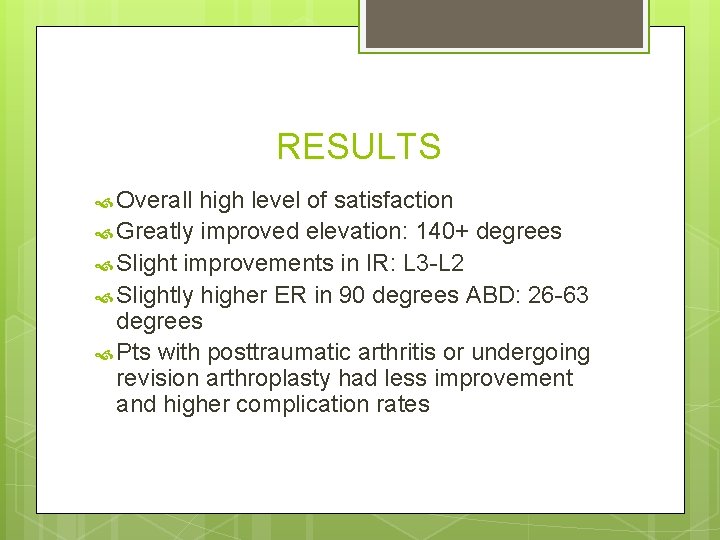
RESULTS Overall high level of satisfaction Greatly improved elevation: 140+ degrees Slight improvements in IR: L 3 -L 2 Slightly higher ER in 90 degrees ABD: 26 -63 degrees Pts with posttraumatic arthritis or undergoing revision arthroplasty had less improvement and higher complication rates
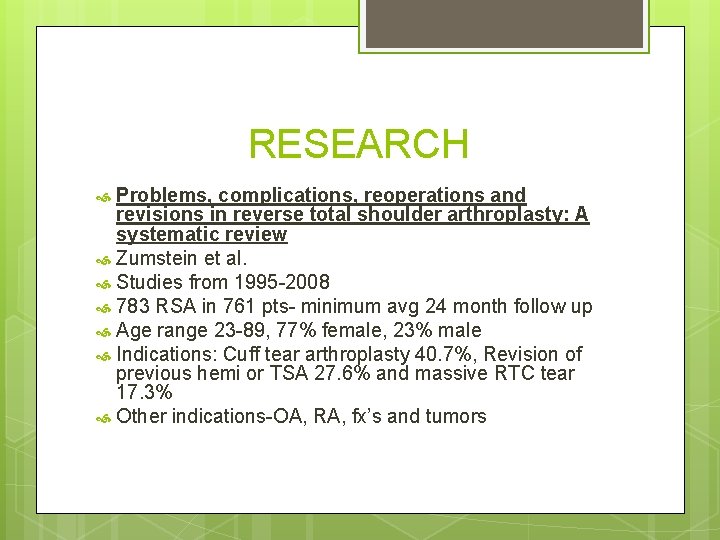
RESEARCH Problems, complications, reoperations and revisions in reverse total shoulder arthroplasty: A systematic review Zumstein et al. Studies from 1995 -2008 783 RSA in 761 pts- minimum avg 24 month follow up Age range 23 -89, 77% female, 23% male Indications: Cuff tear arthroplasty 40. 7%, Revision of previous hemi or TSA 27. 6% and massive RTC tear 17. 3% Other indications-OA, RA, fx’s and tumors
RESULTS Problems 44%- ie. Scapular notching, though rarely significant Complications 24%- instability, infection, glenoid loosening/disassembly, humeral loosening/disassembly Reoperations 3. 5% Revisions 10%- d/t instability and infections
SUMMARY This is a last ditch effort to restore/reserve shoulder function RTC deficiency is key indication Deltoid will be prime mover Change in biomechanics-moment arm increased as well deltoid tension ↑ deltoid function Rehab- protection ROM strength function; supine inclined sitting standing; isometric isotonic Somewhat different rehab from TSA More risk of dislocation Avoid ADD, IR, EXT (behind the back) early in rehab
REFERENCES 1. Boileau P, Gonzalez J, Chuinard C, Bicknell R, Walch G. Reverse total shoulder arthroplasty after failed rotator cuff surgery. Journal of Shoulder and Elbow Surgery. 2009; 18(4): 600 -606. doi: http: //dx. doi. org. libproxy. lib. unc. edu/10. 1016/j. jse. 2009. 03. 011. 2. Boudreau S, Boudreau ED, Higgins LD, Wilcox RB, 3 rd. Rehabilitation following reverse total shoulder arthroplasty. J Orthop Sports Phys Ther. 2007; 37(12): 734 -743. doi: 10. 2519/jospt. 2007. 2562; 10. 2519/jospt. 2007. 2562. 3. Gerber C. Reverse total shoulder arthroplasty. J Am Acad Orthop Surg. 2009; 17(5): 284. 4. Sanchez-Sotelo J. Reverse total shoulder arthroplasty. Clinical Anatomy. 2009; 22(2): 172182. doi: 10. 1002/ca. 20736. 5. Seebauer L, Walter W, Keyl W. Reverse total shoulder arthroplasty for the treatment of defect arthropathy. Oper Orthop Traumatol. 2005; 17(1): 1 -24. doi: 10. 1007/s 00064 -005 -11191. 6. Wall B, Nove-Josserand L, O'Connor DP, Edwards TB, Walch G. Reverse total shoulder arthroplasty: A review of results according to etiology. J Bone Joint Surg Am. 2007; 89(7): 1476 -1485. doi: 10. 2106/JBJS. F. 00666. 7. Wilcox RB, Arslanian LE, Millett P. Rehabilitation following total shoulder arthroplasty. J Orthop Sports Phys Ther. 2005; 35(12): 821 -836. 8. Zumstein MA, Pinedo M, Old J, Boileau P. Problems, complications, reoperations, and revisions in reverse total shoulder arthroplasty: A systematic review. Journal of Shoulder and Elbow Surgery. 2011; 20(1): 146 -157. doi: http: //dx. doi. org. libproxy. lib. unc. edu/10. 1016/j. jse. 2010. 08. 001.
QUESTIONS?