
Reverse Stress Testing Ron Papanek 2011 All rights


- Slides: 29
Reverse Stress Testing Ron Papanek © 2011. All rights reserved. msci. com
Agenda § What is Reverse Stress Testing? § Why is it important? § Practitioner Examples § Single-Factor § Multi-Factor § Historical § Monte Carlo § Related Stress Tests § Historical Unwind § Liquidity § Hedging © 2011. All rights reserved. msci. com
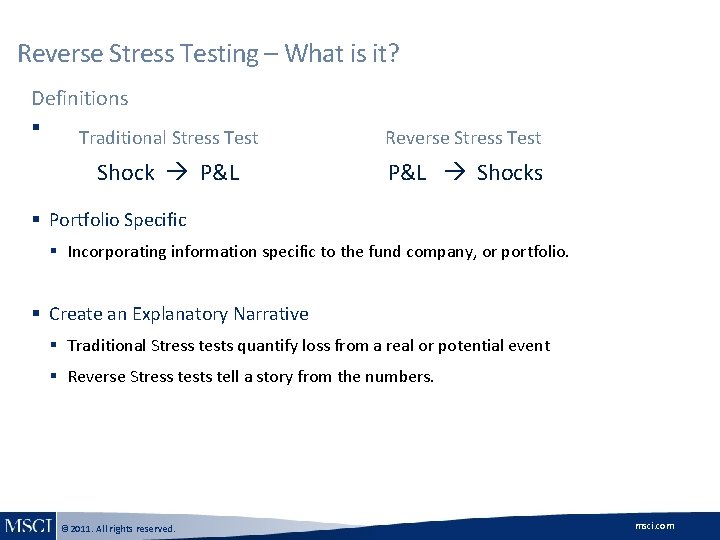
Reverse Stress Testing – What is it? Definitions § Traditional Stress Test Reverse Stress Test Shock P&L Shocks § Portfolio Specific § Incorporating information specific to the fund company, or portfolio. § Create an Explanatory Narrative § Traditional Stress tests quantify loss from a real or potential event § Reverse Stress tests tell a story from the numbers. © 2011. All rights reserved. msci. com
Reverse Stress Testing – Why is it Important? § Engages Management § The methodology leads to a better understanding of firm risk through the process of identifying thresholds and the exploration of macro scenarios § Connects the portfolio risk to the business risk § Provides a different perspective than traditional stress tests § Provides a more thorough examination of tail risk § Can yield more efficient hedging strategies § Tells a story § Advocated by Regulators § FSA, BIS, FED, CRMPG have all voiced support for reverse stress testing § “The emphasis of a ‘reverse-stress test’ would be on identifying the high impact stress events which would cause the firm to fail and considering the appropriate action, if any, to protect against such failure. ” FSA 12/2008 (2. 27) § Identify systemic risk and trigger points for contagion © 2011. All rights reserved. msci. com
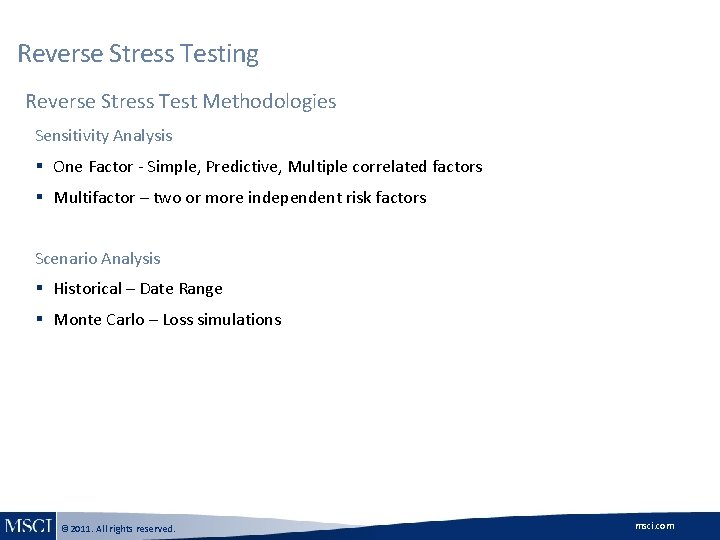
Reverse Stress Testing Reverse Stress Test Methodologies Sensitivity Analysis § One Factor - Simple, Predictive, Multiple correlated factors § Multifactor – two or more independent risk factors Scenario Analysis § Historical – Date Range § Monte Carlo – Loss simulations © 2011. All rights reserved. msci. com
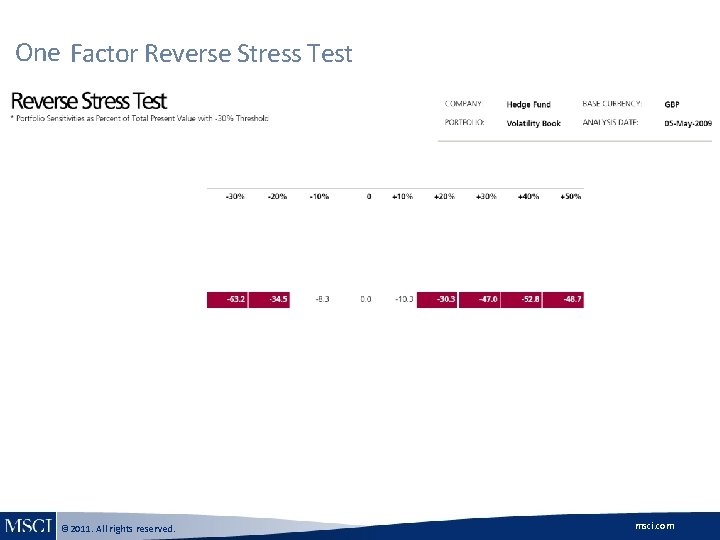
Reverse Stress Testing - One Factor Traditional stress test § is a function § not necessarily monotonic. Reverse stress test § is not a function § Different shocks can produce the same P&L © 2011. All rights reserved. msci. com
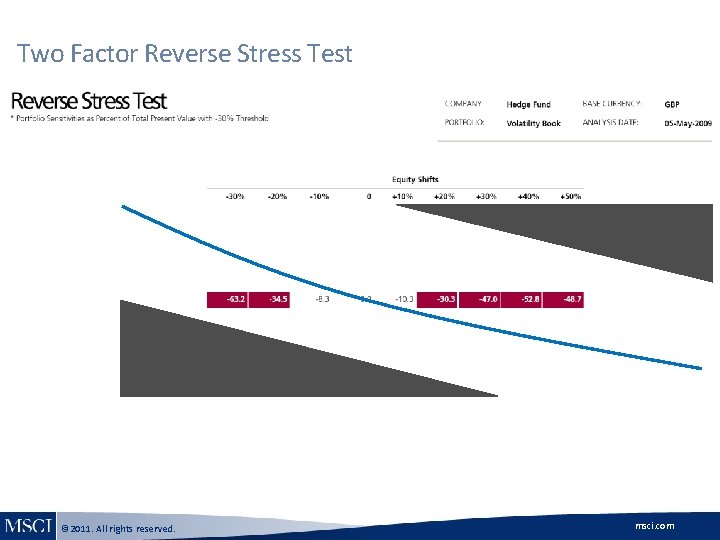
One Two Factor Reverse Stress Test Equity Shift P&L © 2011. All rights reserved. msci. com
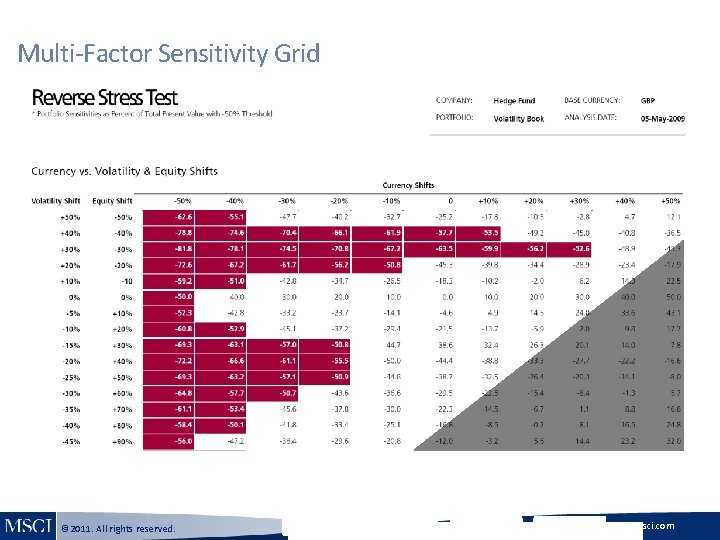
Sensitivity Analysis Multi-Factor à One Factor – One Dimension à Two Factors – Two Dimensions à Locking two factors together allows us to introduce a third factor © 2011. All rights reserved. msci. com
Two Factor Reverse Stress Test © 2011. All rights reserved. msci. com
Multi-Factor Sensitivity Grid © 2011. All rights reserved. 20 % 3 0 40 % 50 % msci. com
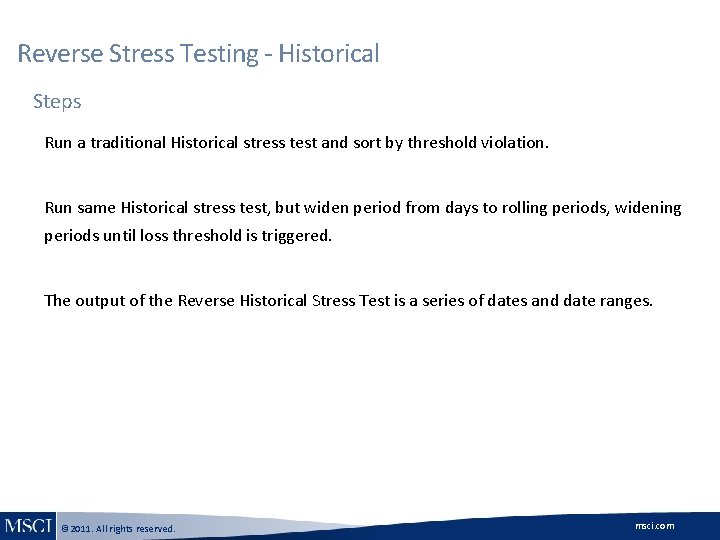
Reverse Stress Testing - Historical Steps à Run a traditional Historical stress test and sort by threshold violation. à Run same Historical stress test, but widen period from days to rolling periods, widening periods until loss threshold is triggered. à The output of the Reverse Historical Stress Test is a series of dates and date ranges. © 2011. All rights reserved. msci. com
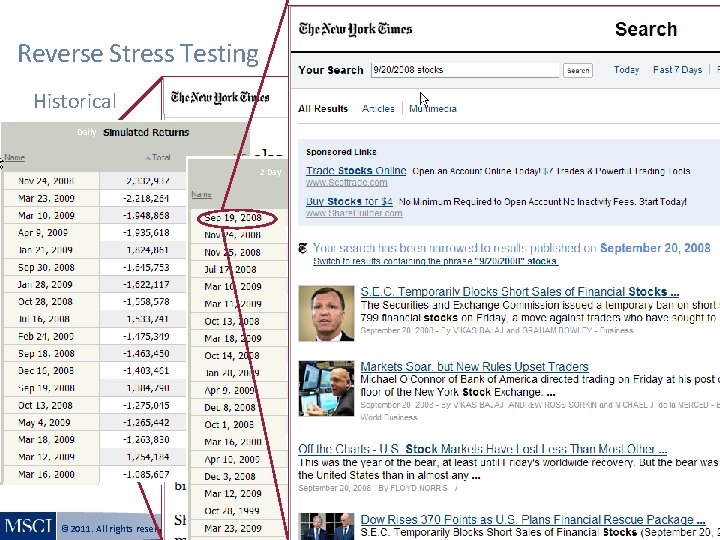
Reverse Stress Testing Historical Daily Day 22 Day Weekly Monthly © 2011. All rights reserved. msci. com
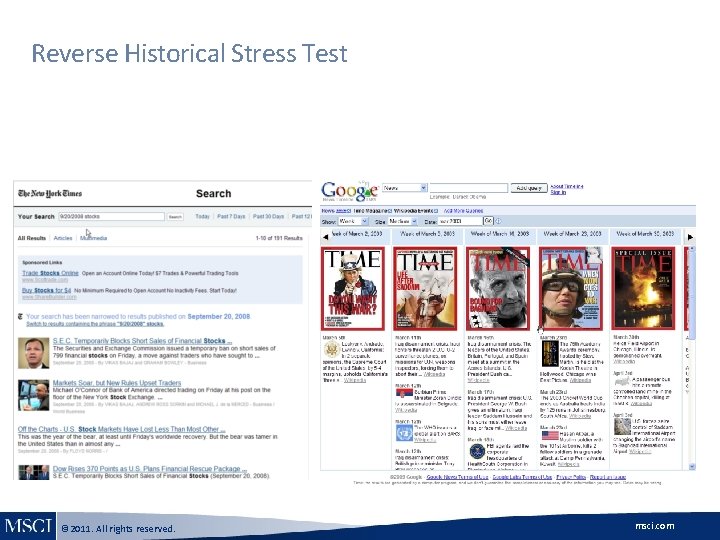
Reverse Historical Stress Test Match date scenario with events to explains the portfolio loss Single Date September 20, 2008 © 2011. All rights reserved. Date Range March 2003 msci. com
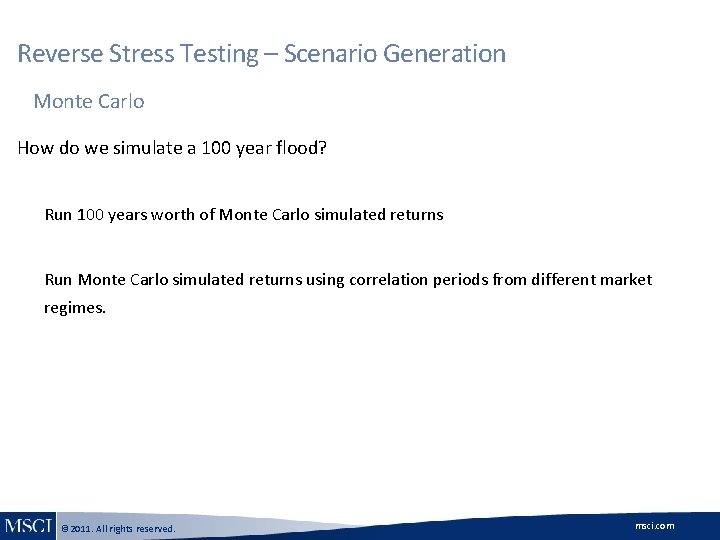
Reverse Stress Testing – Scenario Generation Monte Carlo How do we simulate a 100 year flood? à Run 100 years worth of Monte Carlo simulated returns à Run Monte Carlo simulated returns using correlation periods from different market regimes. © 2011. All rights reserved. msci. com
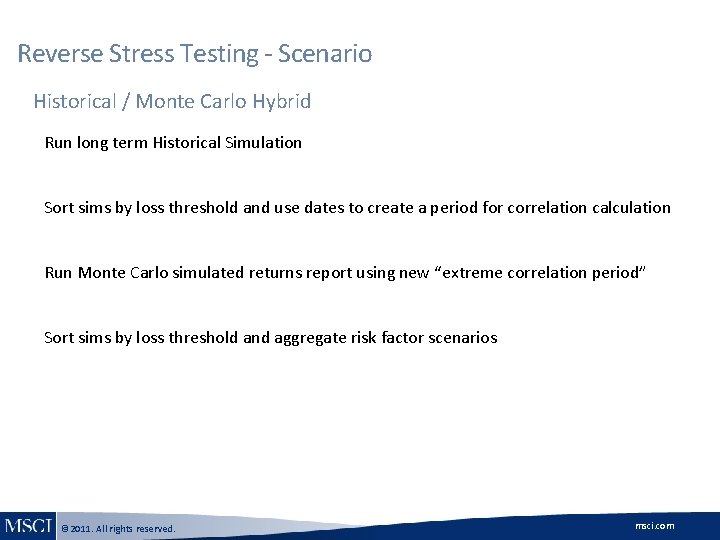
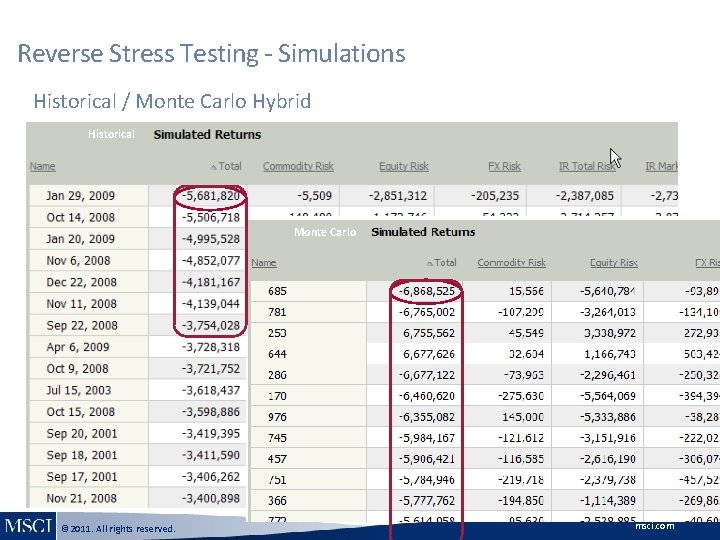
Reverse Stress Testing - Scenario Historical / Monte Carlo Hybrid à Run long term Historical Simulation à Sort sims by loss threshold and use dates to create a period for correlation calculation à Run Monte Carlo simulated returns report using new “extreme correlation period” à Sort sims by loss threshold and aggregate risk factor scenarios © 2011. All rights reserved. msci. com
Reverse Stress Testing - Simulations Historical / Monte Carlo Hybrid Historical Monte Carlo © 2011. All rights reserved. msci. com
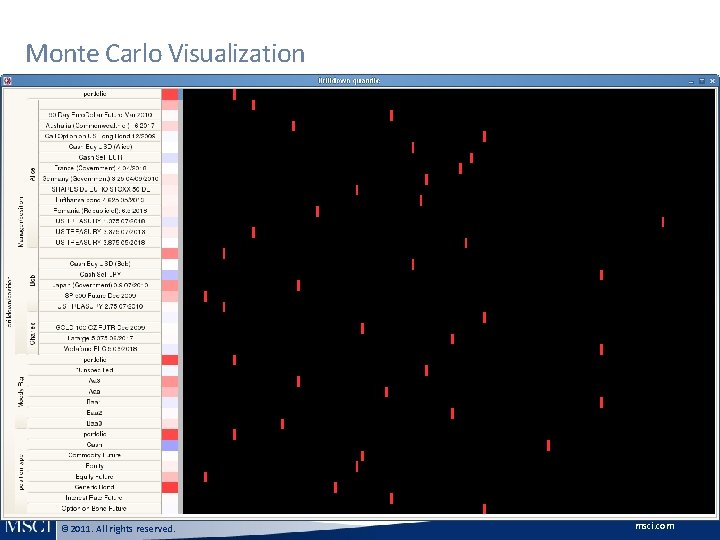
Monte Carlo Visualization Worst © 2011. All rights reserved. to Best msci. com
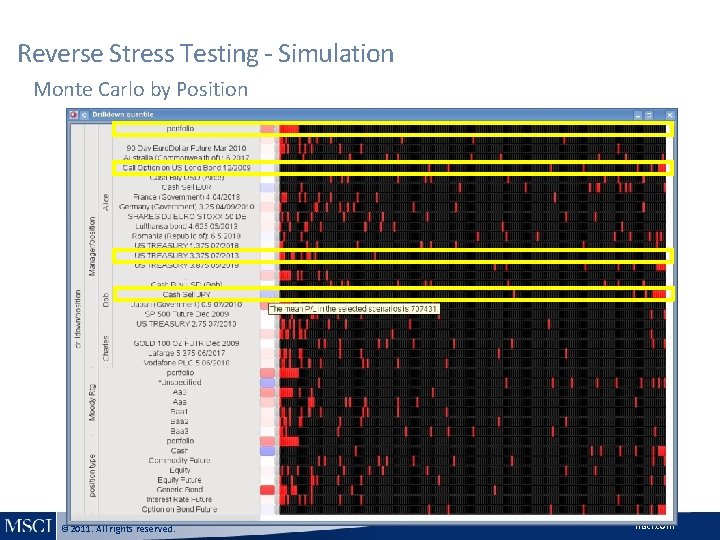
Reverse Stress Testing - Simulation Monte Carlo by Position © 2011. All rights reserved. msci. com
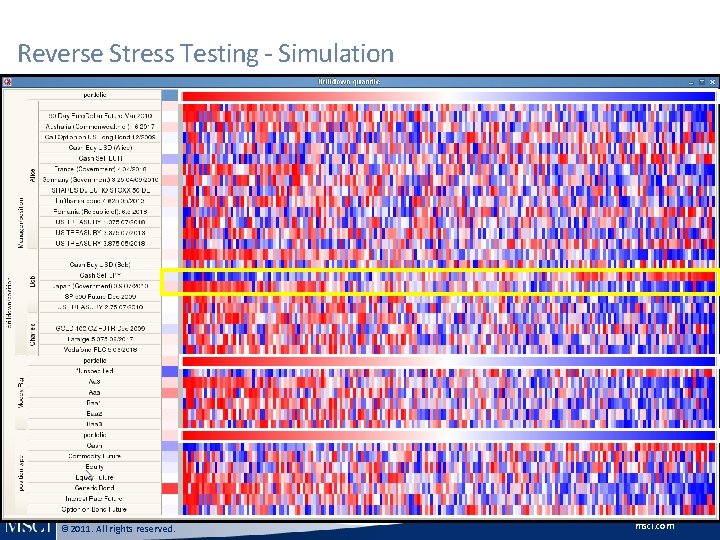
Reverse Stress Testing - Simulation © 2011. All rights reserved. msci. com
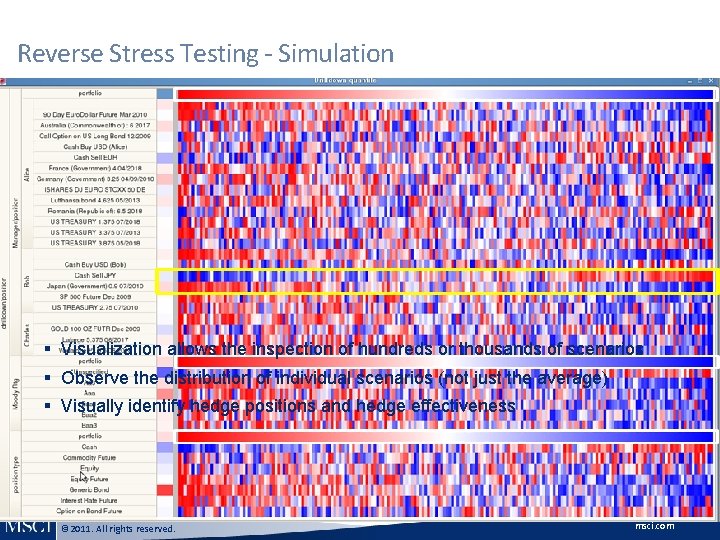
Reverse Stress Testing - Simulation Monte Carlo Visualization § Visualization allows the inspection of hundreds or thousands of scenarios § Observe the distribution of individual scenarios (not just the average) § Visually identify hedge positions and hedge effectiveness © 2011. All rights reserved. msci. com
Agenda § What is Reverse Stress Testing? § Why is it important? § Practitioner Examples § Single-Factor § Multi-Factor § Historical § Monte Carlo § Related Tools § Historical Unwind § Liquidity § Hedging © 2011. All rights reserved. msci. com
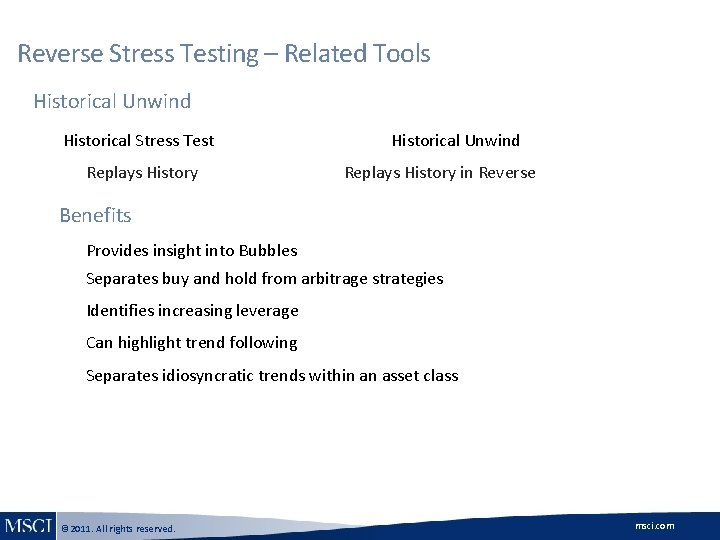
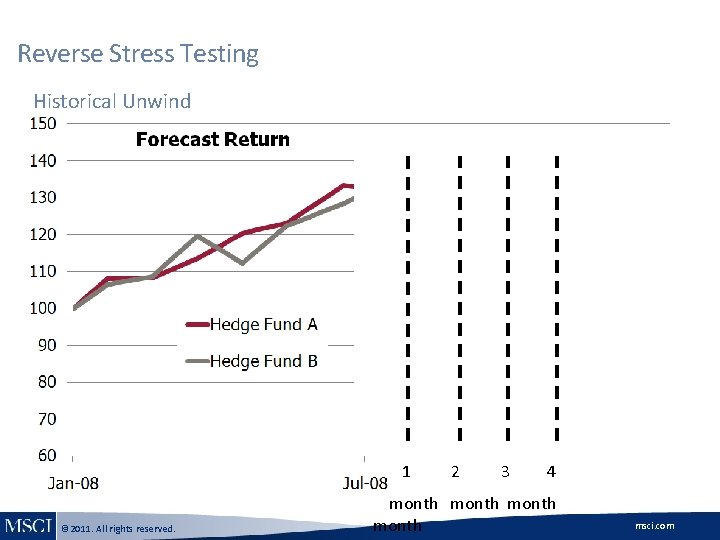
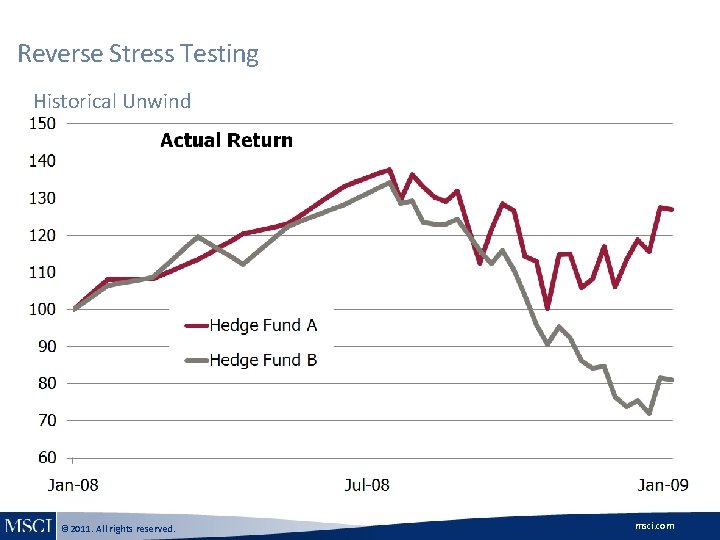
Reverse Stress Testing – Related Tools Historical Unwind Historical Stress Test Replays History Historical Unwind Replays History in Reverse Benefits à Provides insight into Bubbles à Separates buy and hold from arbitrage strategies à Identifies increasing leverage à Can highlight trend following à Separates idiosyncratic trends within an asset class © 2011. All rights reserved. msci. com
Reverse Stress Testing Historical Unwind 1 © 2011. All rights reserved. 2 3 4 month msci. com
Reverse Stress Testing Historical Unwind © 2011. All rights reserved. msci. com
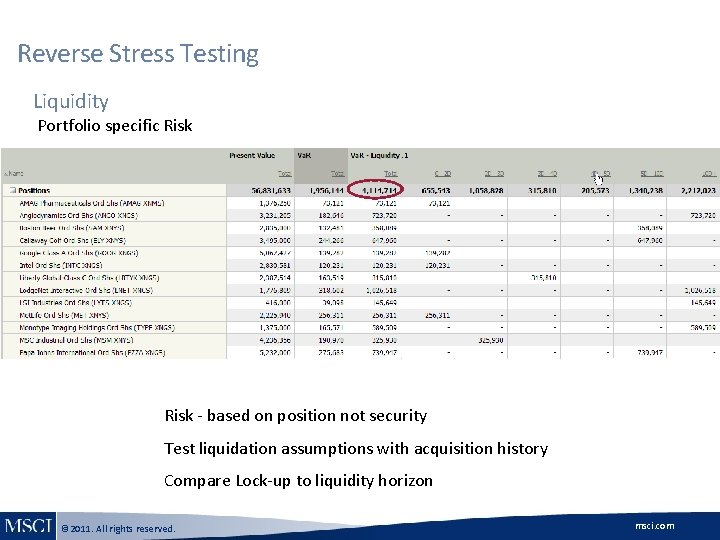
Reverse Stress Testing Liquidity Portfolio specific Risk à Risk - based on position not security à Test liquidation assumptions with acquisition history à Compare Lock-up to liquidity horizon © 2011. All rights reserved. msci. com
Agenda § What is Reverse Stress Testing? § Why is it important? § Practitioner Examples § Single-Factor § Multi-Factor § Historical § Monte Carlo § Related Tools § Historical Unwind § Liquidity § Hedging © 2011. All rights reserved. msci. com
Reverse Stress Testing - Hedging Hedge the Business not the Portfolio à Focus on hedging the tail à Identify and aggregate the most commonly occurring risk factor scenarios à Finding the cheapest and most efficient hedge à Strategies à Costless Collar à Correlated Asset Put Spread à Macro Scenario overlay © 2011. All rights reserved. msci. com
Reverse Stress Testing - Conclusions à Engage management as much as the risk department à The information flow between CEO and risk department is two way à There is a significant amount of firm specific data that should be incorporated into stress testing and risk management. à Connect a story to the risk à The event has more meaning than the date or the scenario # or the P&L à Firm risk is not portfolio risk – Hedge Appropriately à P&L is linear Risk is not à Reverse Stress Testing helps to identify the conditions for failure allowing for early warning as wells as prevention. © 2011. All rights reserved. msci. com
http: //www. riskmetrics. com/events/risk 2009 © 2011. All rights reserved. msci. com