
Reverse Logistics Networks Steven Walker Logistic Systems Design
- Slides: 20
Reverse Logistics Networks Steven Walker Logistic Systems: Design and Optimization (Chapter 6)
Introduction n Definition n Reverse logistics – n Handling of the return flows of product or equipment back from consumer for reuse, recovery, or recycling. n How is it different? n Reverse flow of goods back from customer n May require additional facilities and transportation costs for material handling (disassembly)
Introduction n Reasons for Reverse Logistic (RL) Networks: n Environmental n n Economic n n Green initiatives Electronic waste Hazardous metals (Ro. HS) Reduced raw material costs Customer Service n Customer satisfaction
Introduction n Applications n Facility Location* n Inventory Management* n Transportation* n Production Planning *Example problem will focus on these applications.
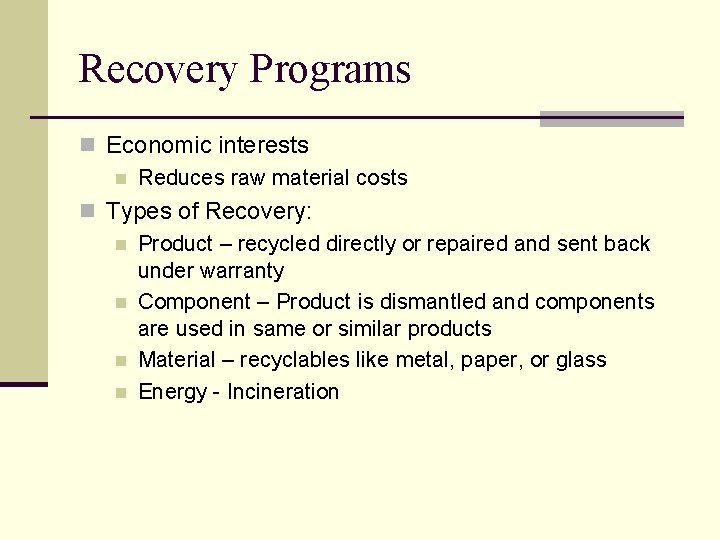
Recovery Programs n Economic interests n Reduces raw material costs n Types of Recovery: n Product – recycled directly or repaired and sent back under warranty n Component – Product is dismantled and components are used in same or similar products n Material – recyclables like metal, paper, or glass n Energy - Incineration
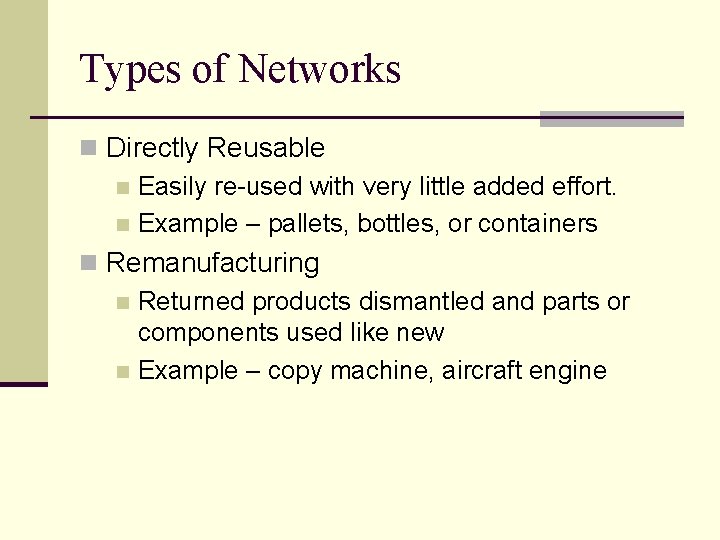
Types of Networks n Directly Reusable n Easily re-used with very little added effort. n Example – pallets, bottles, or containers n Remanufacturing n Returned products dismantled and parts or components used like new n Example – copy machine, aircraft engine
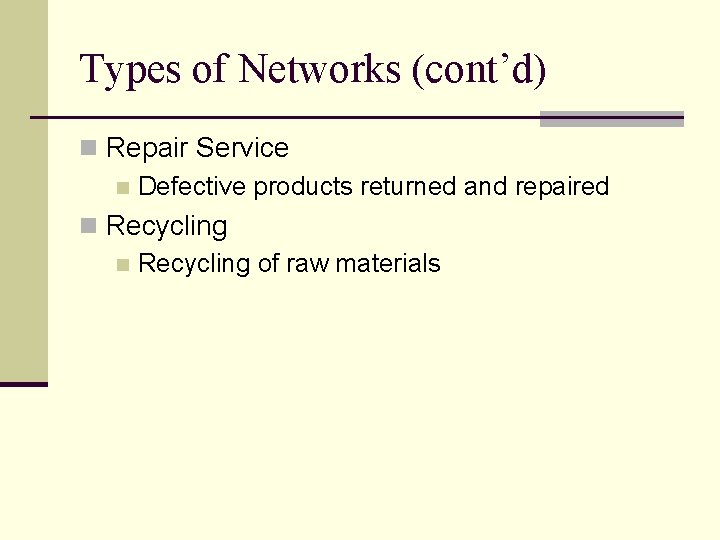
Types of Networks (cont’d) n Repair Service n Defective products returned and repaired n Recycling of raw materials
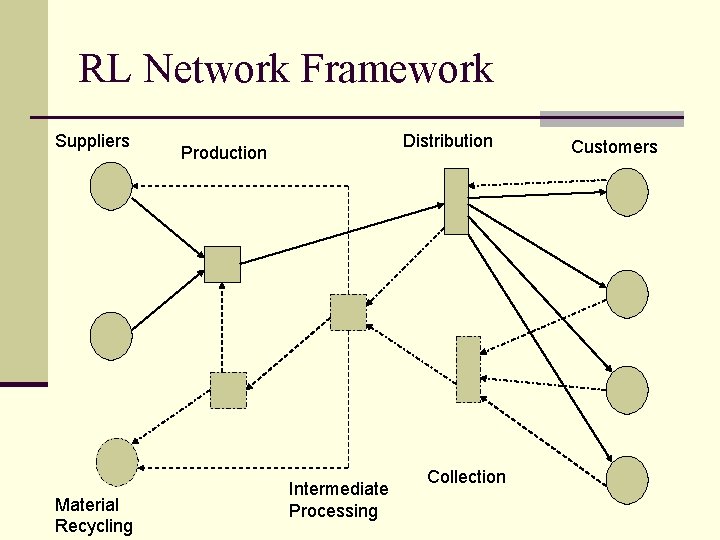
RL Network Framework Suppliers Material Recycling Distribution Production Intermediate Processing Collection Customers
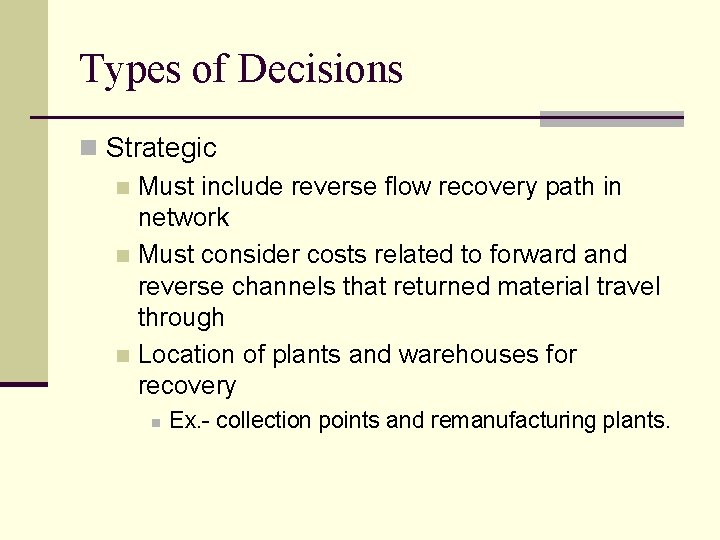
Types of Decisions n Strategic n Must include reverse flow recovery path in network n Must consider costs related to forward and reverse channels that returned material travel through n Location of plants and warehouses for recovery n Ex. - collection points and remanufacturing plants.
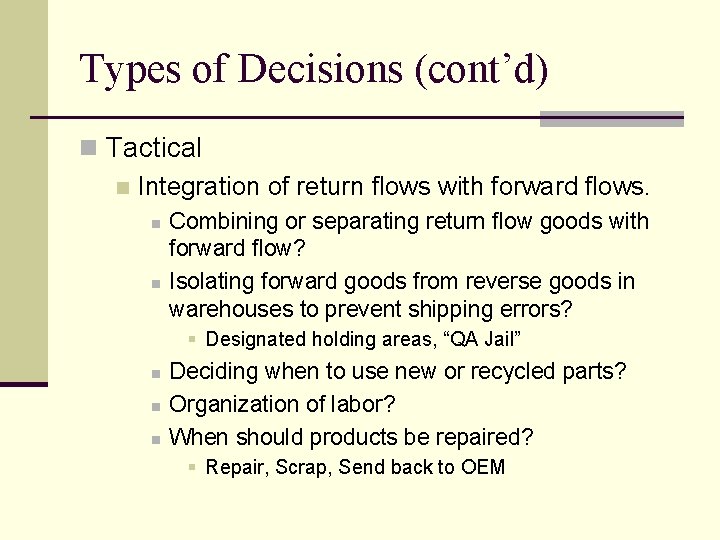
Types of Decisions (cont’d) n Tactical n Integration of return flows with forward flows. n n Combining or separating return flow goods with forward flow? Isolating forward goods from reverse goods in warehouses to prevent shipping errors? § Designated holding areas, “QA Jail” n n n Deciding when to use new or recycled parts? Organization of labor? When should products be repaired? § Repair, Scrap, Send back to OEM
Types of Decisions (cont’d) n Operational n Production Scheduling n Assignment of Labor n Disassembly and reassembly
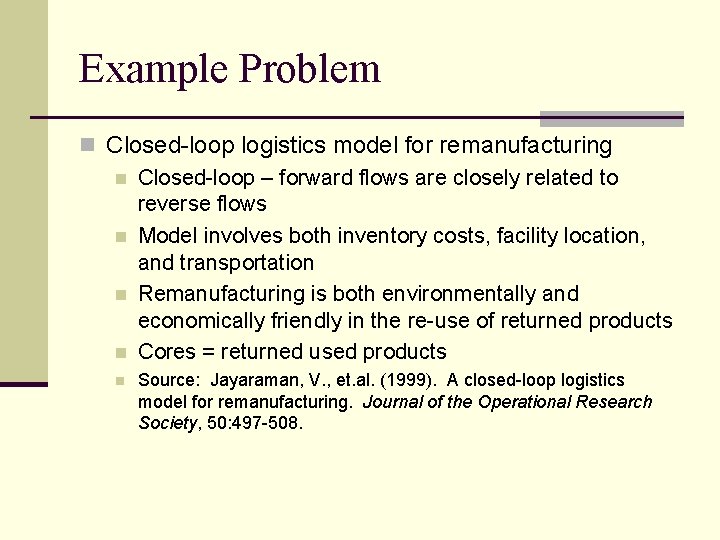
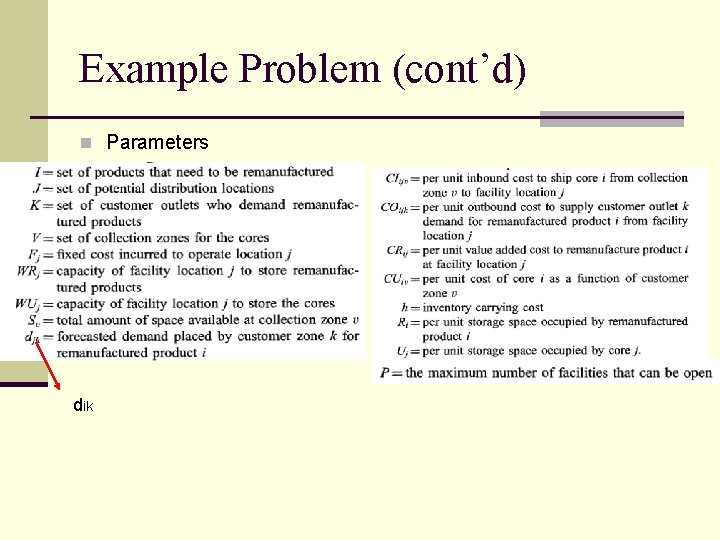
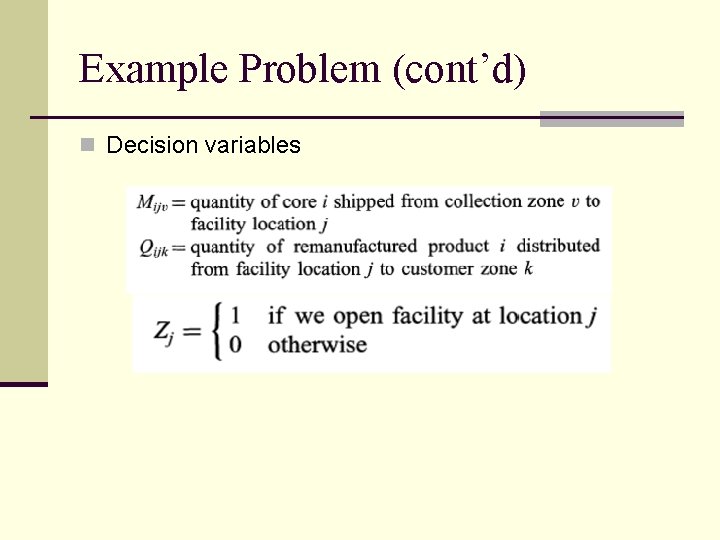
Example Problem n Closed-loop logistics model for remanufacturing n Closed-loop – forward flows are closely related to reverse flows n Model involves both inventory costs, facility location, and transportation n Remanufacturing is both environmentally and economically friendly in the re-use of returned products n Cores = returned used products n Source: Jayaraman, V. , et. al. (1999). A closed-loop logistics model for remanufacturing. Journal of the Operational Research Society, 50: 497 -508.
Example Problem (cont’d) n Parameters dik
Example Problem (cont’d) n Decision variables
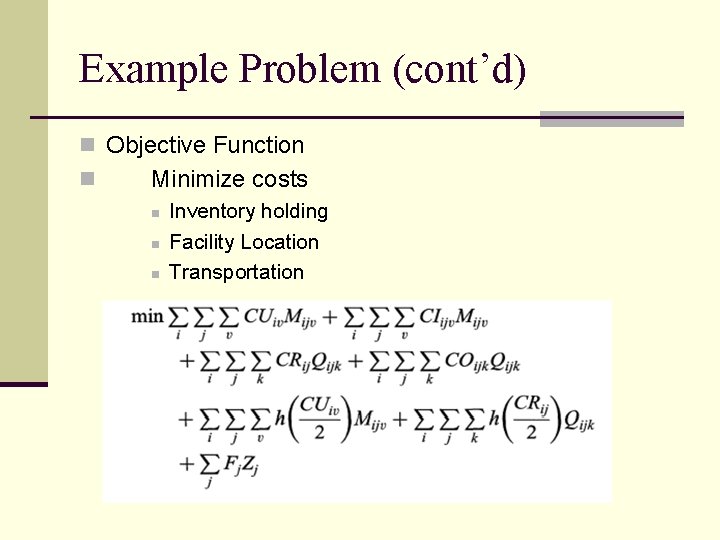
Example Problem (cont’d) n Objective Function n Minimize costs n n n Inventory holding Facility Location Transportation
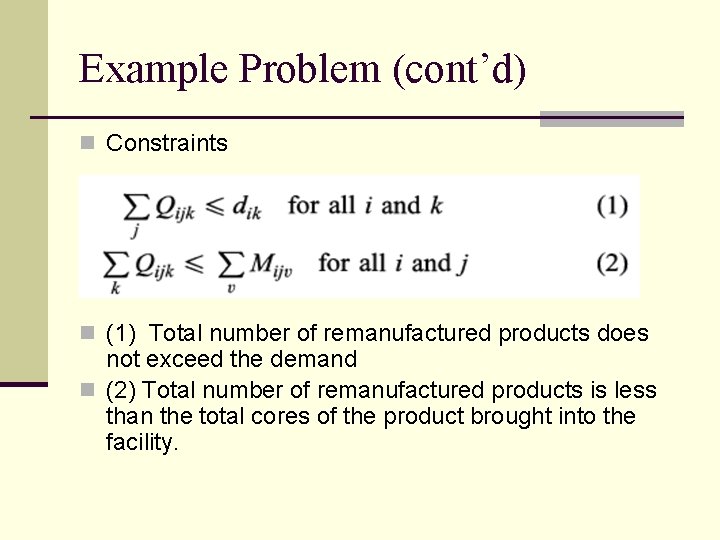
Example Problem (cont’d) n Constraints n (1) Total number of remanufactured products does not exceed the demand n (2) Total number of remanufactured products is less than the total cores of the product brought into the facility.
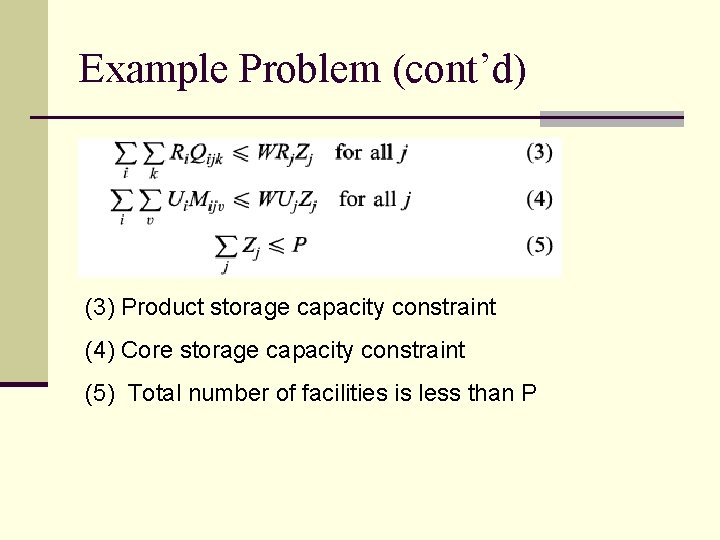
Example Problem (cont’d) (3) Product storage capacity constraint (4) Core storage capacity constraint (5) Total number of facilities is less than P
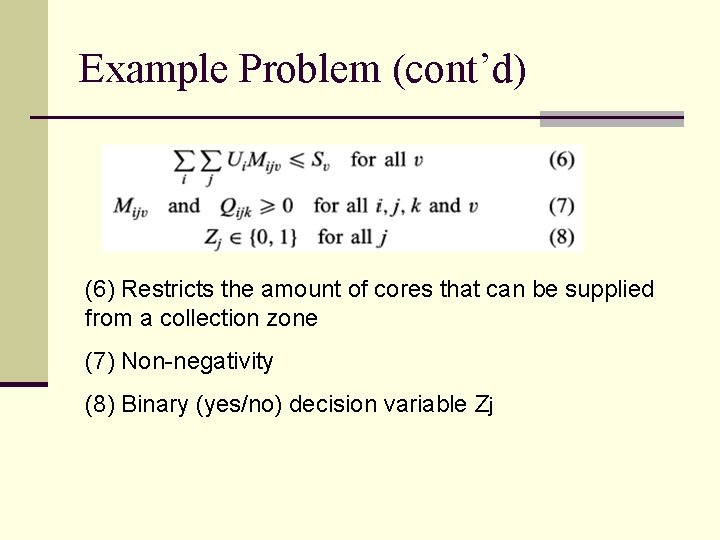
Example Problem (cont’d) (6) Restricts the amount of cores that can be supplied from a collection zone (7) Non-negativity (8) Binary (yes/no) decision variable Zj
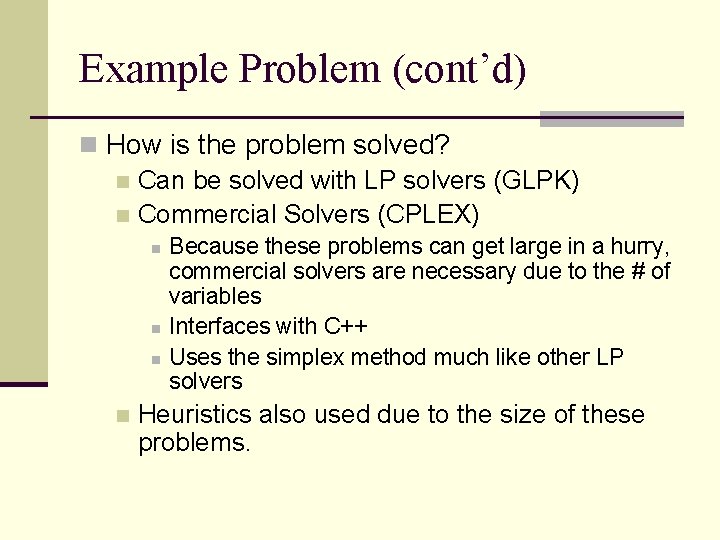
Example Problem (cont’d) n How is the problem solved? n Can be solved with LP solvers (GLPK) n Commercial Solvers (CPLEX) n n Because these problems can get large in a hurry, commercial solvers are necessary due to the # of variables Interfaces with C++ Uses the simplex method much like other LP solvers Heuristics also used due to the size of these problems.
Questions? n ? ?