
Reverse Engineering Dr Tyler Bletsch and Jiaming Li
Reverse Engineering Dr. Tyler Bletsch and Jiaming Li Includes material adapted from "Computer Science 654 Lecture 5: Software Reverse Engineering" by Wayne Patterson, Howard Univ. 2009. 1
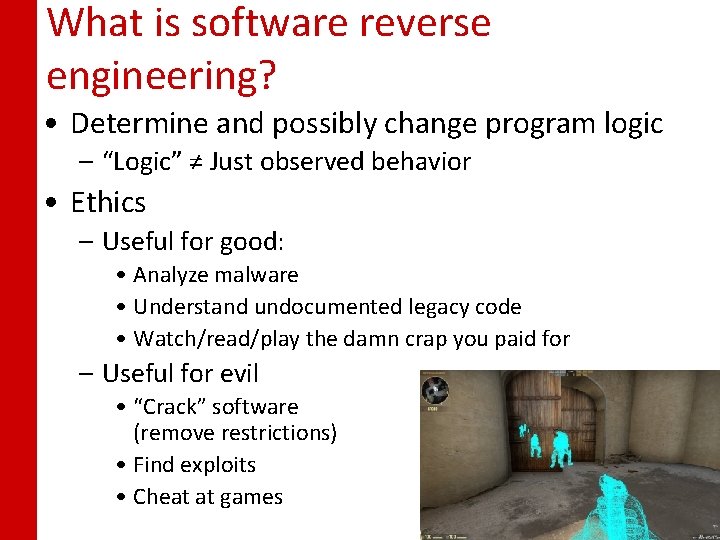
What is software reverse engineering? • Determine and possibly change program logic – “Logic” ≠ Just observed behavior • Ethics – Useful for good: • Analyze malware • Understand undocumented legacy code • Watch/read/play the damn crap you paid for – Useful for evil • “Crack” software (remove restrictions) • Find exploits • Cheat at games 2
Types of tools • Disassembler – Turn compiled program into assembly Also, decompiler: – Not perfect • Attempts to turn assembly back into source code. – Static tool • Usually awful at machine code, but managed code (e. g. Java, • Debugger Python) can produce decent results. – Step through running program – Dynamic tool • Hex editor – Make changes to binaries • Monitoring tools – Watch system calls, library calls, etc. 3
Examples of tools • Linux: – – Disassember: objdump (free), IDA Pro (free and paid versions) Debugger: gdb and its front-ends Hex editor: okteta, bless, lots more… Monitoring: strace, ltrace IDA Pro eats basically anything • Windows: – – Disassembler: IDA Pro (free and paid versions) Debugger: Win. DBG (basic), Olly. Dbg (shareware), Soft. ICE ($1000+) Hex editor: XVI 32, Notepad++ with plugin, etc. Monitoring tools: Process Monitor, Explorer, and more. • X 86 in general: A hypervisor (VMware, KVM, etc. ) 4
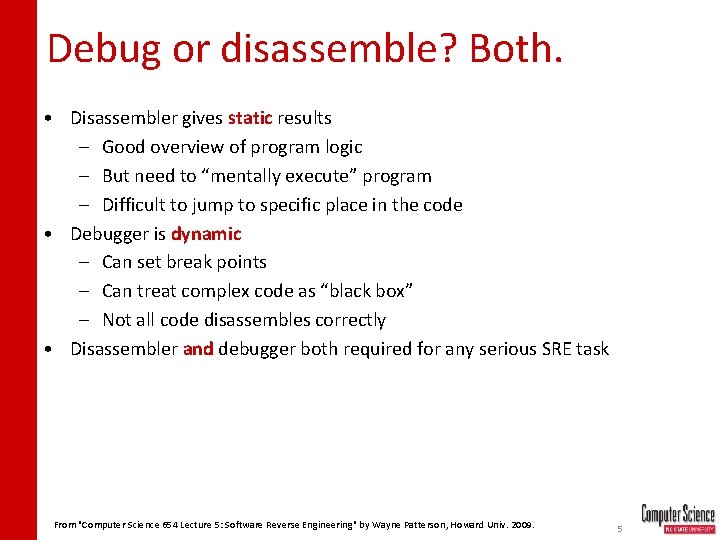
Debug or disassemble? Both. • Disassembler gives static results – Good overview of program logic – But need to “mentally execute” program – Difficult to jump to specific place in the code • Debugger is dynamic – Can set break points – Can treat complex code as “black box” – Not all code disassembles correctly • Disassembler and debugger both required for any serious SRE task From "Computer Science 654 Lecture 5: Software Reverse Engineering" by Wayne Patterson, Howard Univ. 2009. 5
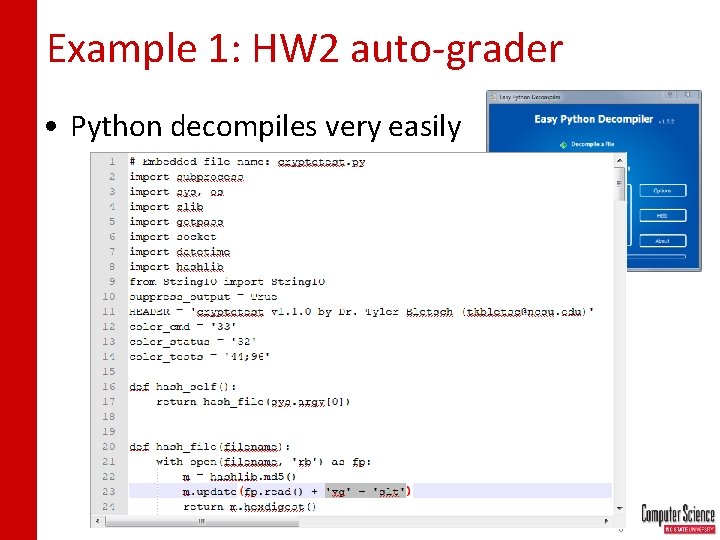
Example 1: HW 2 auto-grader • Python decompiles very easily 6
Example 2: Minecraft • Minecraft is a Java program, no mod support • All mods use something like the Mod Coder Pack (MCP): – “Use MCP to decompile the Minecraft client and server jar files. – Use the decompiled source code to create mods for Minecraft. – Recompile modified versions of Minecraft. – Reobfuscate the classes of your mod for Minecraft. ” • Entire mod community is built on reverse engineering! 7
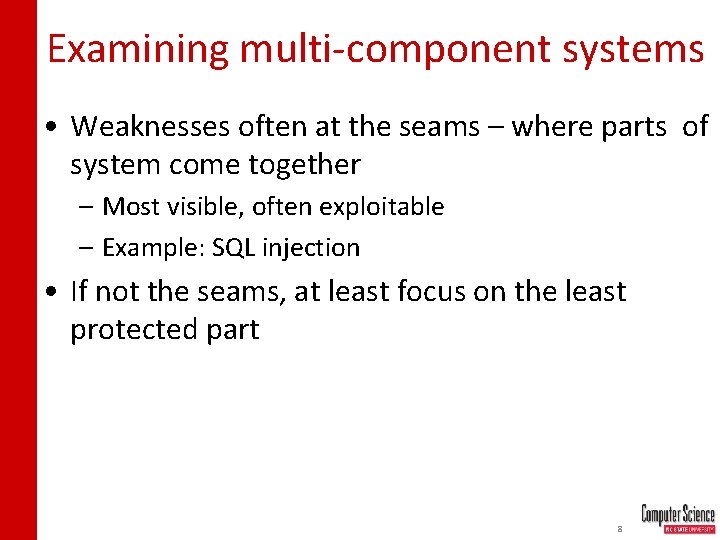
Examining multi-component systems • Weaknesses often at the seams – where parts of system come together – Most visible, often exploitable – Example: SQL injection • If not the seams, at least focus on the least protected part 8
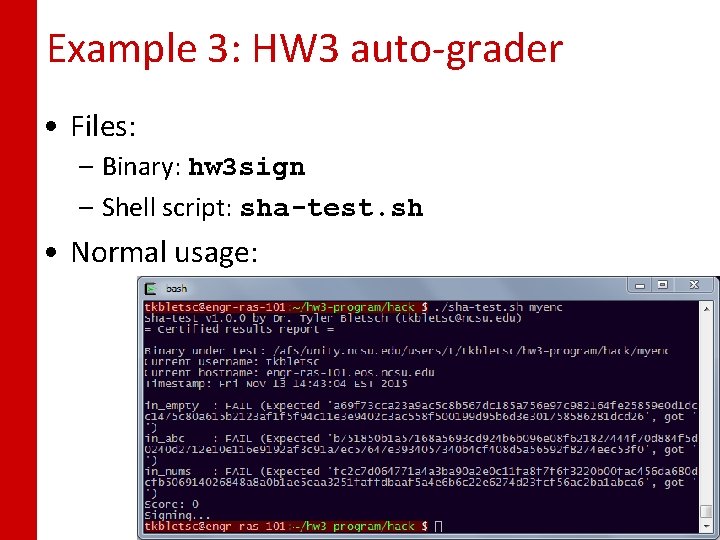
Example 3: HW 3 auto-grader • Files: – Binary: hw 3 sign – Shell script: sha-test. sh • Normal usage: 9
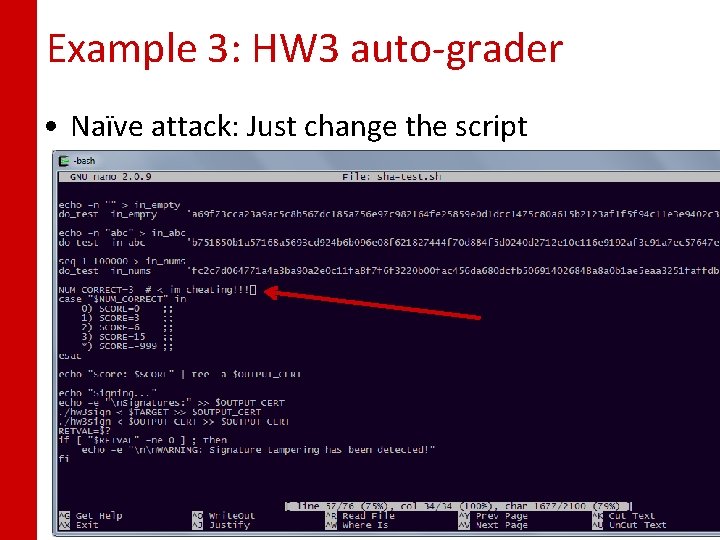
Example 3: HW 3 auto-grader • Naïve attack: Just change the script 10
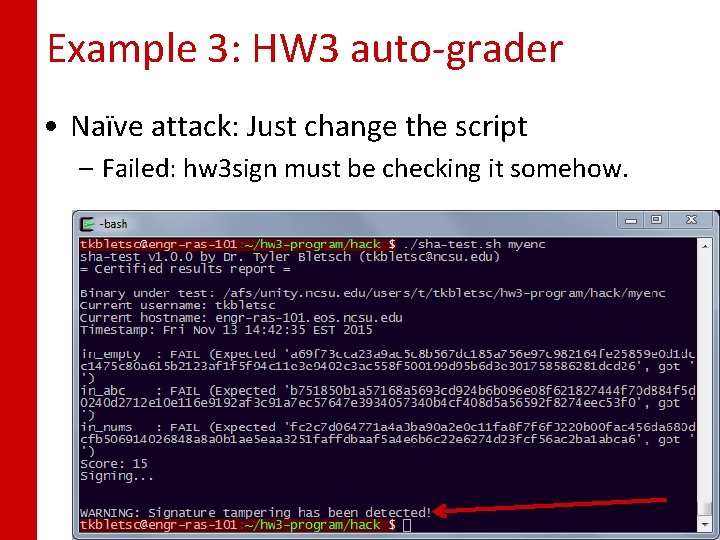
Example 3: HW 3 auto-grader • Naïve attack: Just change the script – Failed: hw 3 sign must be checking it somehow. 11
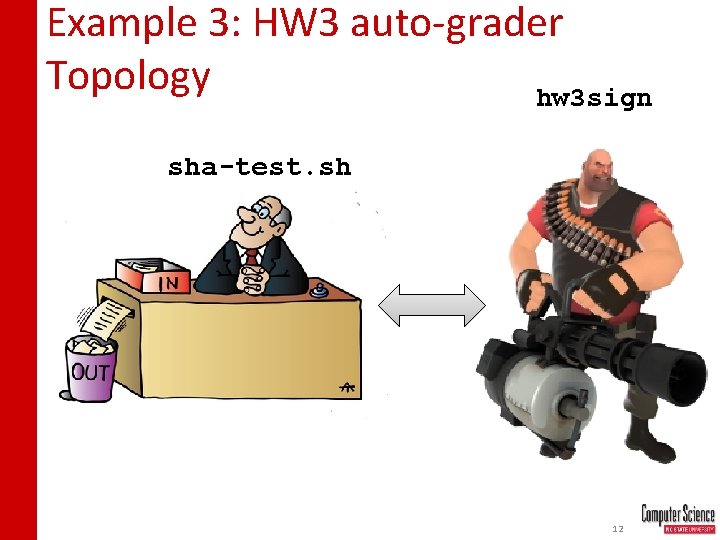
Example 3: HW 3 auto-grader Topology hw 3 sign sha-test. sh 12
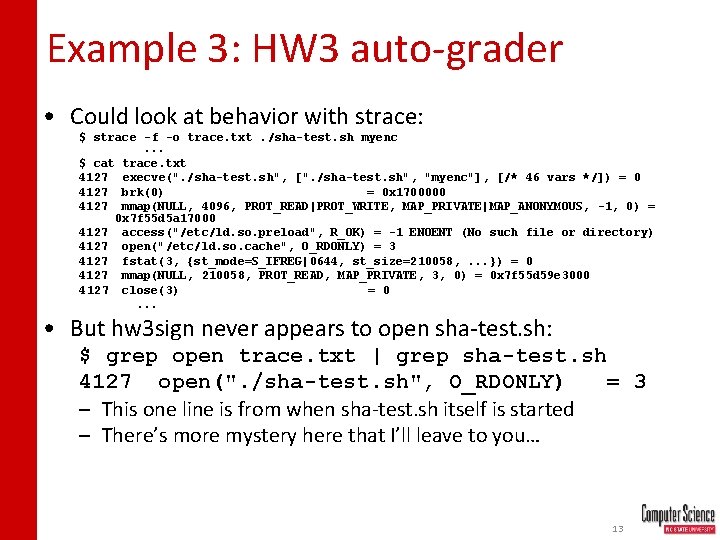
Example 3: HW 3 auto-grader • Could look at behavior with strace: $ strace -f -o trace. txt. /sha-test. sh myenc. . . $ cat trace. txt 4127 execve(". /sha-test. sh", [". /sha-test. sh", "myenc"], [/* 46 vars */]) = 0 4127 brk(0) = 0 x 1700000 4127 mmap(NULL, 4096, PROT_READ|PROT_WRITE, MAP_PRIVATE|MAP_ANONYMOUS, -1, 0) = 0 x 7 f 55 d 5 a 17000 4127 access("/etc/ld. so. preload", R_OK) = -1 ENOENT (No such file or directory) 4127 open("/etc/ld. so. cache", O_RDONLY) = 3 4127 fstat(3, {st_mode=S_IFREG|0644, st_size=210058, . . . }) = 0 4127 mmap(NULL, 210058, PROT_READ, MAP_PRIVATE, 3, 0) = 0 x 7 f 55 d 59 e 3000 4127 close(3) = 0. . . • But hw 3 sign never appears to open sha-test. sh: $ grep open trace. txt | grep sha-test. sh 4127 open(". /sha-test. sh", O_RDONLY) = 3 – This one line is from when sha-test. sh itself is started – There’s more mystery here that I’ll leave to you… 13
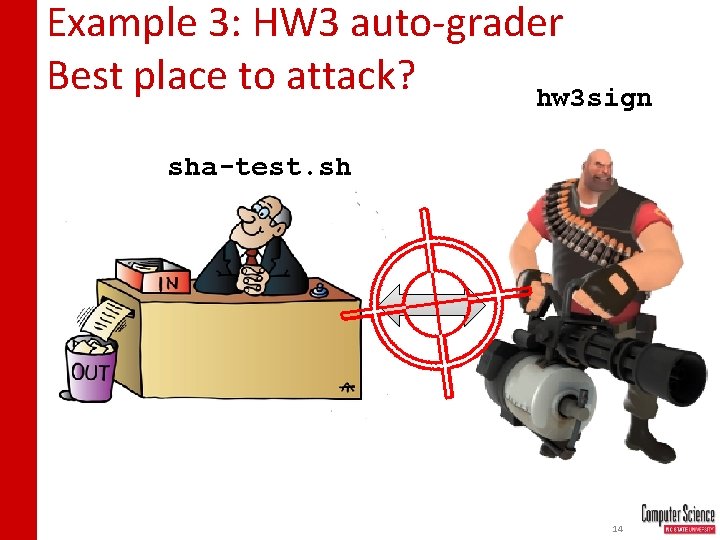
Example 3: HW 3 auto-grader Best place to attack? hw 3 sign sha-test. sh 14
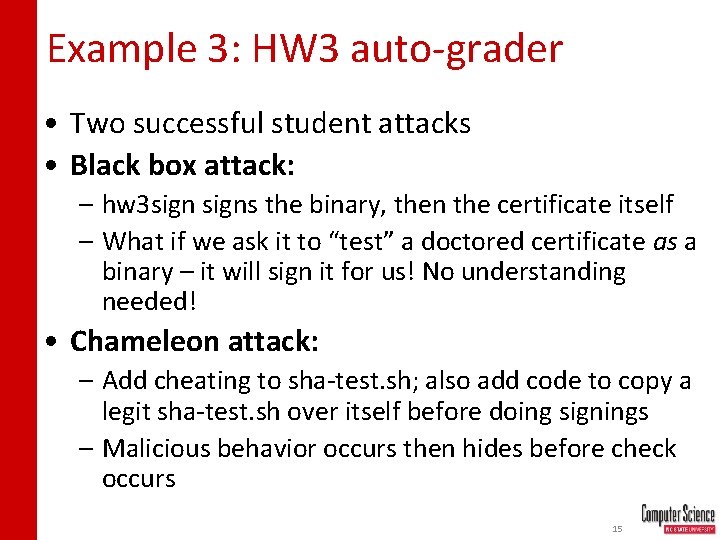
Example 3: HW 3 auto-grader • Two successful student attacks • Black box attack: – hw 3 signs the binary, then the certificate itself – What if we ask it to “test” a doctored certificate as a binary – it will sign it for us! No understanding needed! • Chameleon attack: – Add cheating to sha-test. sh; also add code to copy a legit sha-test. sh over itself before doing signings – Malicious behavior occurs then hides before check occurs 15
Example 4: NSA Codebreaker challenge • Scenario: – Terrorists using a cryptography program to decrypt/authenticate messages from leadership – What we have: • The program: codebreaker 3. exe • A member’s key: tier 1_key. pem • A text file with a hidden message: tier 1_msg. txt – At first glance, the program appears to simply check stock information, but that’s a ruse. – Need to reverse engineer it: Challenge has 4 tasks, we’ll do 2. 16
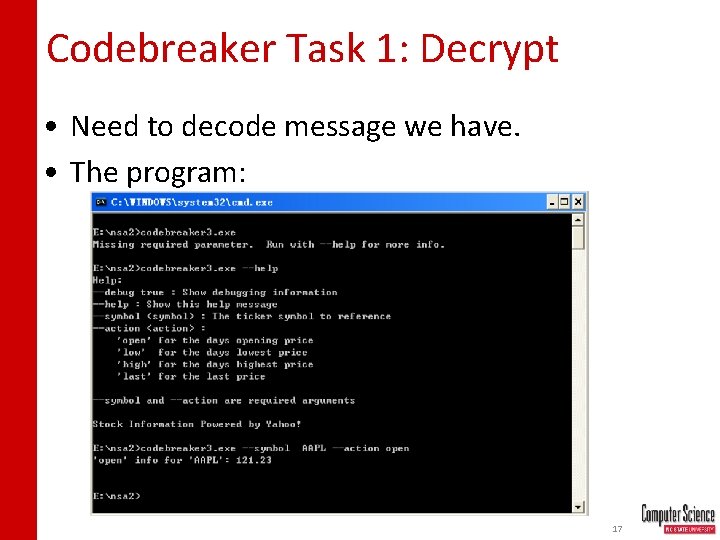
Codebreaker Task 1: Decrypt • Need to decode message we have. • The program: 17
Codebreaker Task 1: Decrypt • Do static analysis with IDA Pro – Load binary – Confirm binary format options – Process: • Code is disassembled • Call graph of assembly code built • All memory references are cross-referenced, especially string literals 18
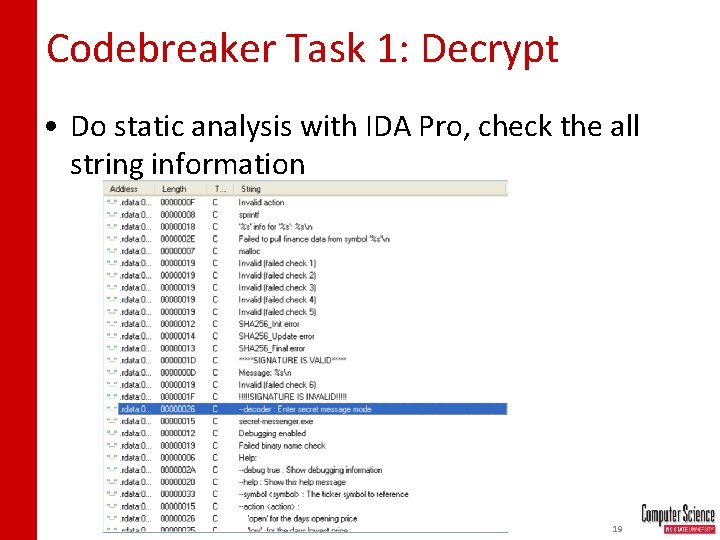
Codebreaker Task 1: Decrypt • Do static analysis with IDA Pro, check the all string information 19
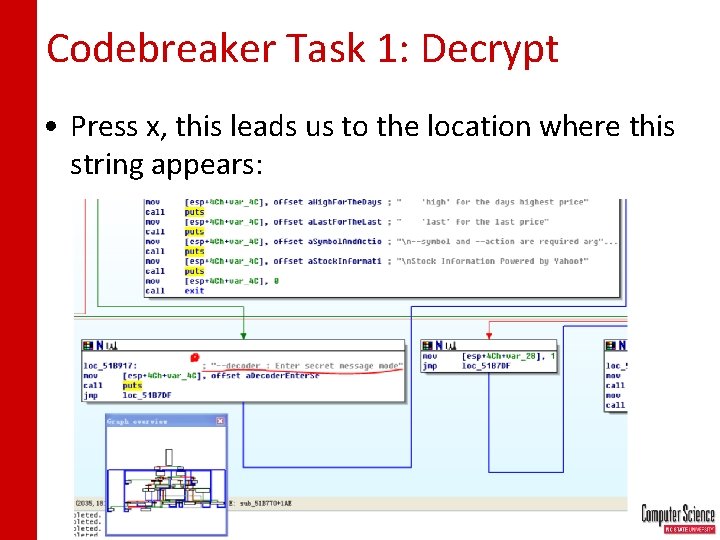
Codebreaker Task 1: Decrypt • Press x, this leads us to the location where this string appears: 20
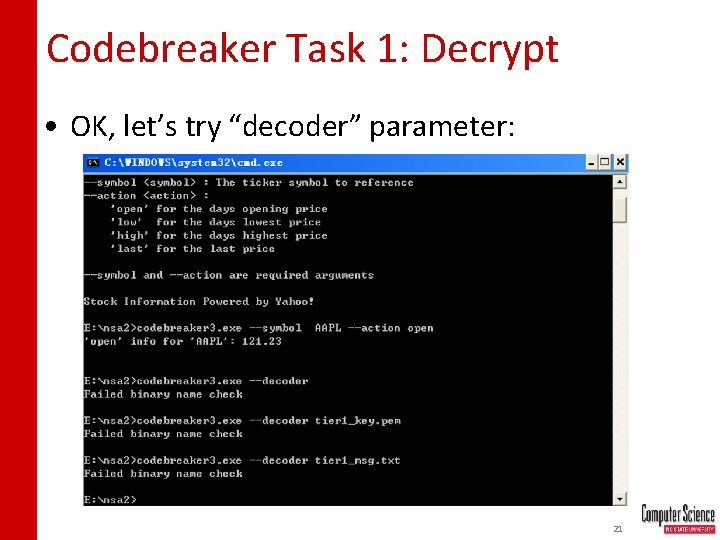
Codebreaker Task 1: Decrypt • OK, let’s try “decoder” parameter: 21
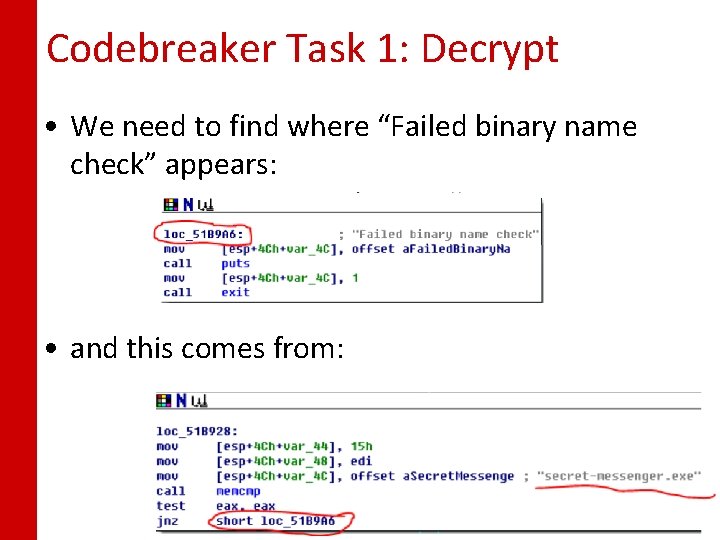
Codebreaker Task 1: Decrypt • We need to find where “Failed binary name check” appears: • and this comes from: 22
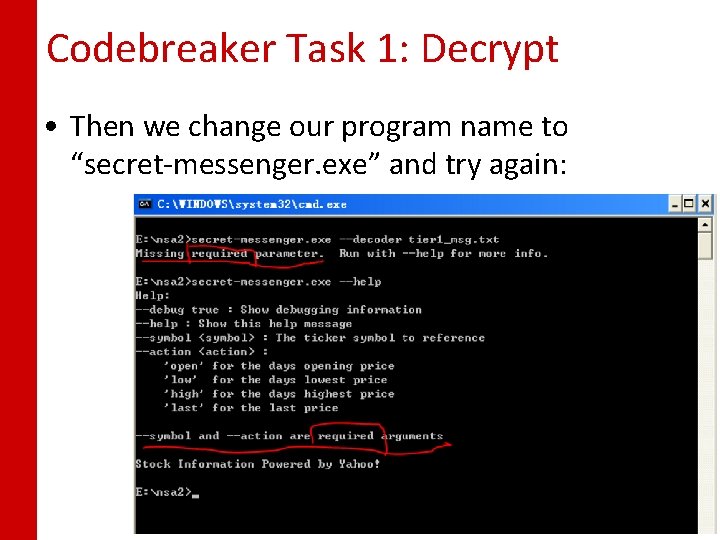
Codebreaker Task 1: Decrypt • Then we change our program name to “secret-messenger. exe” and try again: 23
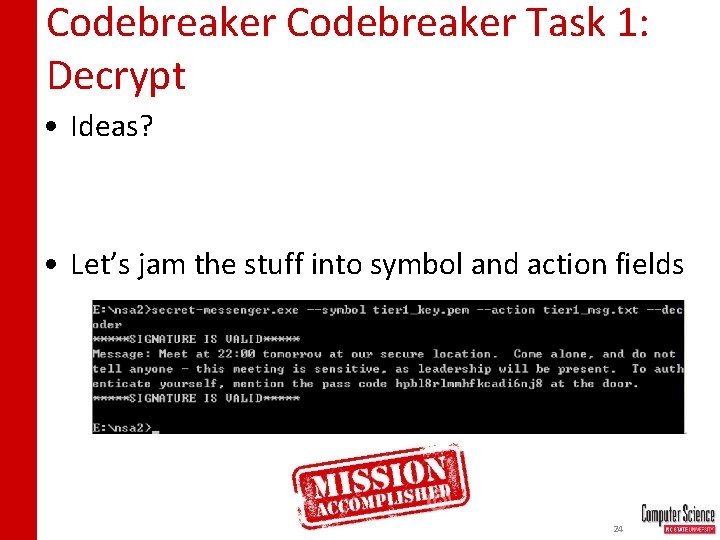
Codebreaker Task 1: Decrypt • Ideas? • Let’s jam the stuff into symbol and action fields 24
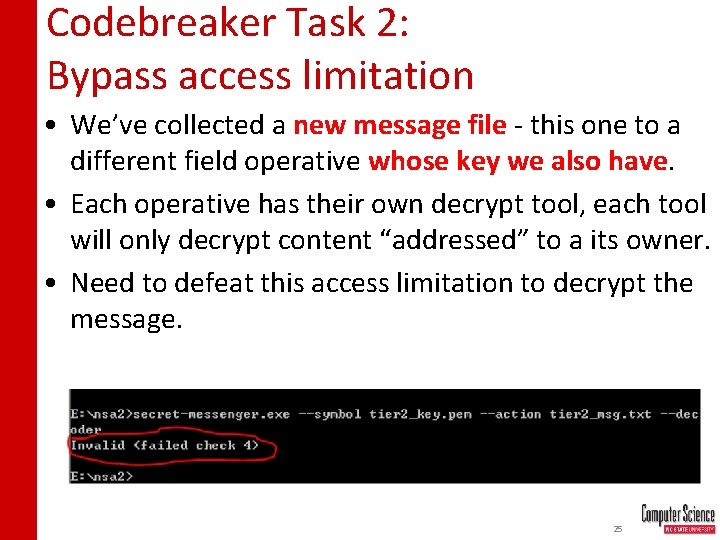
Codebreaker Task 2: Bypass access limitation • We’ve collected a new message file - this one to a different field operative whose key we also have. • Each operative has their own decrypt tool, each tool will only decrypt content “addressed” to a its owner. • Need to defeat this access limitation to decrypt the message. 25
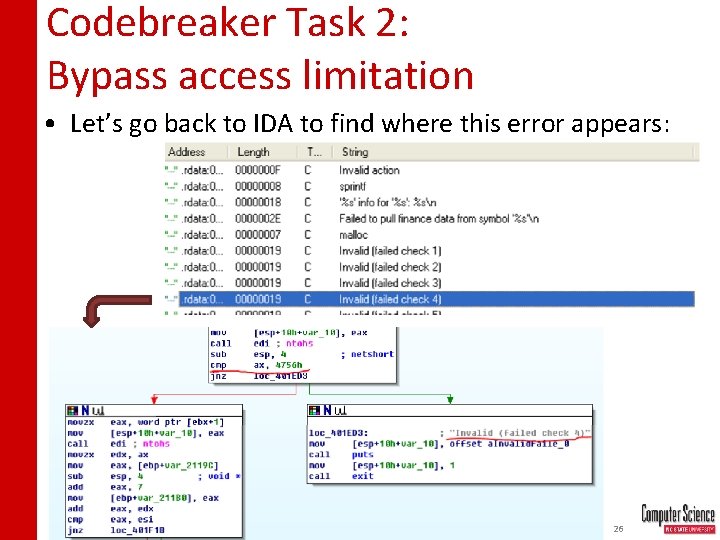
Codebreaker Task 2: Bypass access limitation • Let’s go back to IDA to find where this error appears: 26
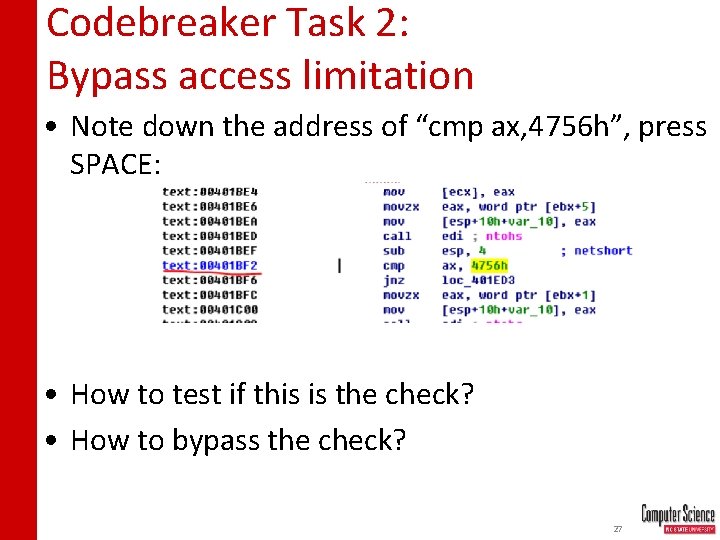
Codebreaker Task 2: Bypass access limitation • Note down the address of “cmp ax, 4756 h”, press SPACE: • How to test if this is the check? • How to bypass the check? 27
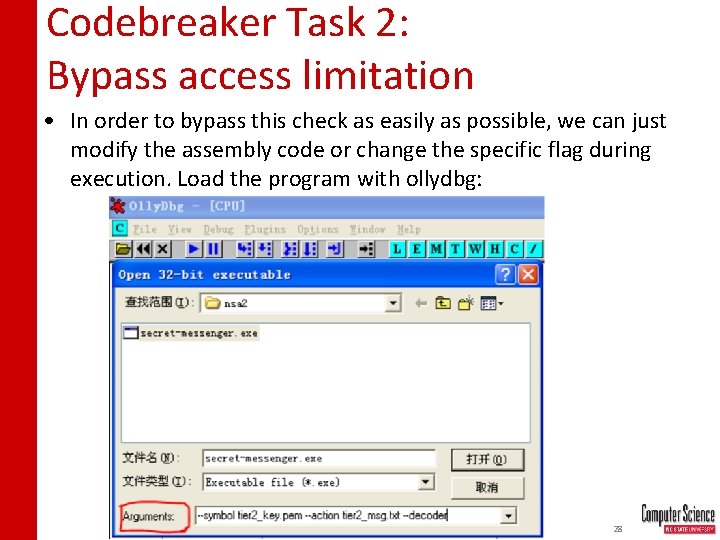
Codebreaker Task 2: Bypass access limitation • In order to bypass this check as easily as possible, we can just modify the assembly code or change the specific flag during execution. Load the program with ollydbg: 28
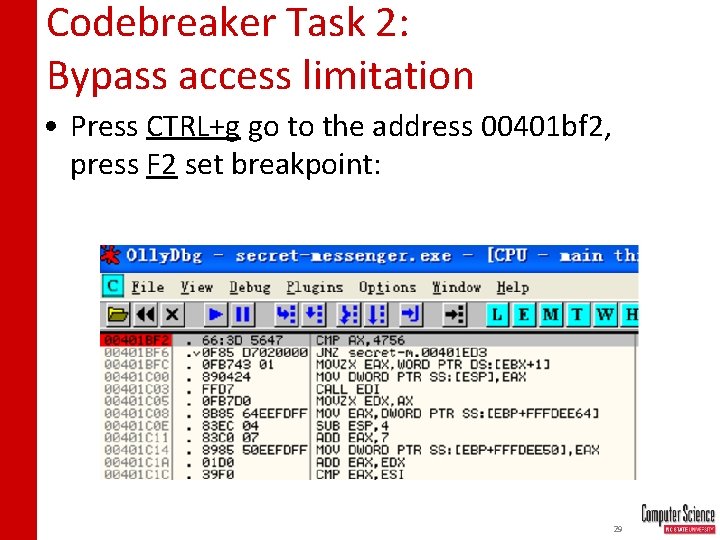
Codebreaker Task 2: Bypass access limitation • Press CTRL+g go to the address 00401 bf 2, press F 2 set breakpoint: 29
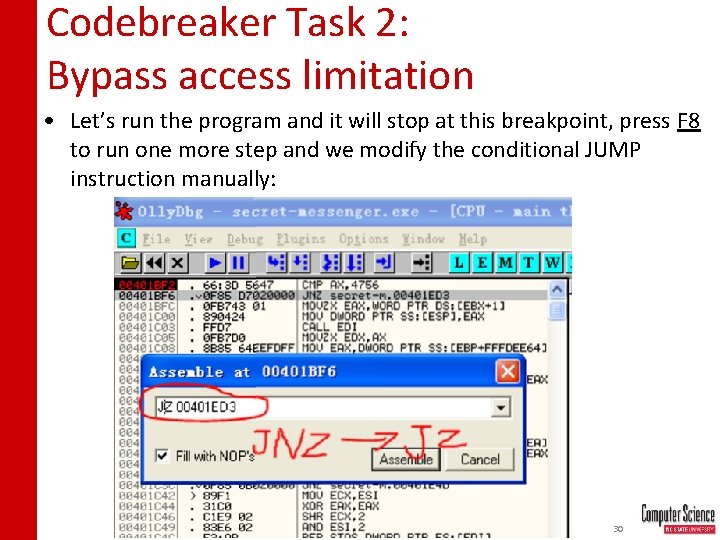
Codebreaker Task 2: Bypass access limitation • Let’s run the program and it will stop at this breakpoint, press F 8 to run one more step and we modify the conditional JUMP instruction manually: 30
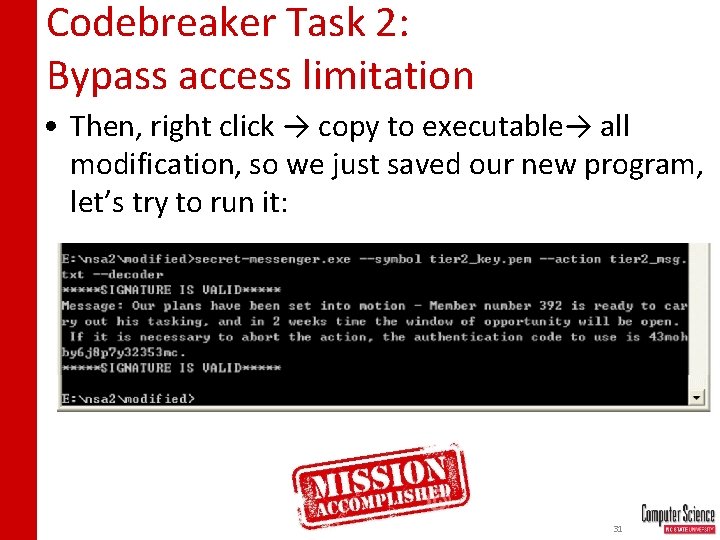
Codebreaker Task 2: Bypass access limitation • Then, right click → copy to executable→ all modification, so we just saved our new program, let’s try to run it: 31
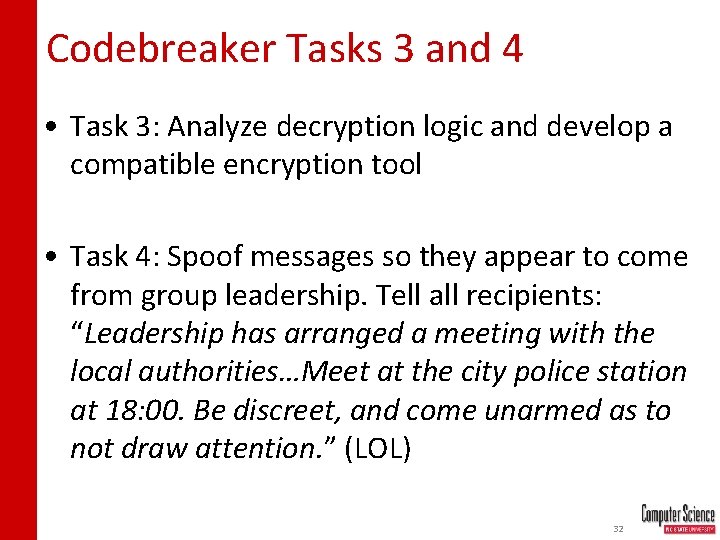
Codebreaker Tasks 3 and 4 • Task 3: Analyze decryption logic and develop a compatible encryption tool • Task 4: Spoof messages so they appear to come from group leadership. Tell all recipients: “Leadership has arranged a meeting with the local authorities…Meet at the city police station at 18: 00. Be discreet, and come unarmed as to not draw attention. ” (LOL) 32
Anti-reverse engineering • Basics: – Turn off debug symbols (-g) – Strip other symbols (e. g. “strip” tool on *NIX) – Consider static linking (no external calls to standard libraries to trace) • Anti-disassembly: – Encrypted or self-modifying code – Code riddled with junk that is jumped over • Can especially confuse x 86 assemblers due to variable-length instructions • Anti-debugging: – Identify if debugger is in use (effects on real time, use of debug registers, etc. ) and act differently – Use threads in complex ways to get less deterministic behavior • Tamper resistance: – Hash parts of ones own code/data and verify periodically – The verification code is also code, though… • Obfuscation: – Include lots of unreachable code to increase work the reverse engineer must do 33
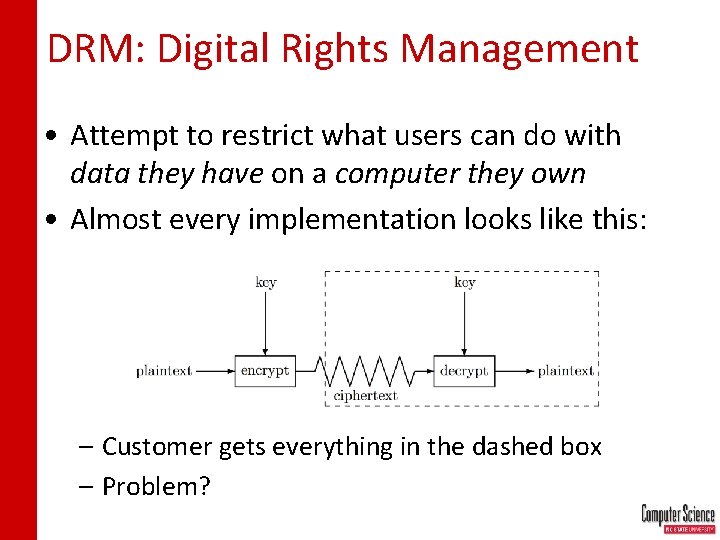
DRM: Digital Rights Management • Attempt to restrict what users can do with data they have on a computer they own • Almost every implementation looks like this: – Customer gets everything in the dashed box – Problem?
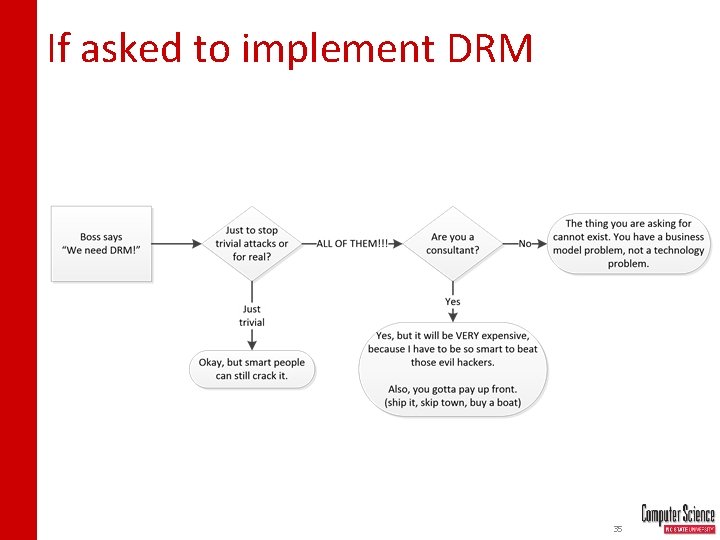
If asked to implement DRM 35
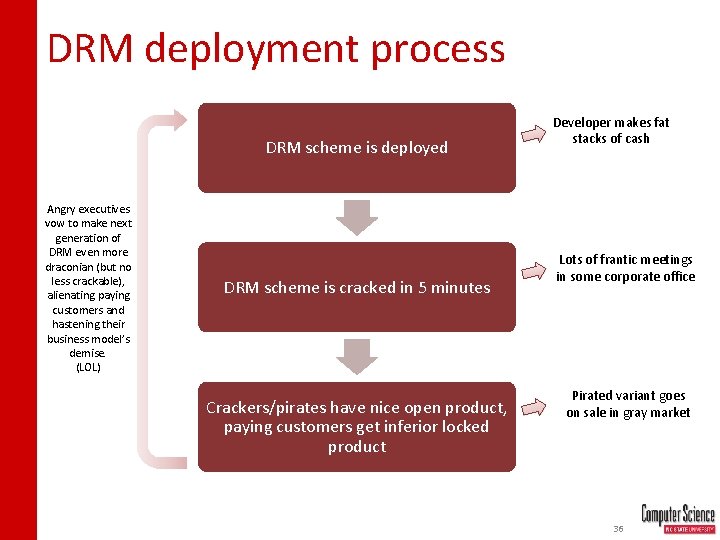
DRM deployment process DRM scheme is deployed Angry executives vow to make next generation of DRM even more draconian (but no less crackable), alienating paying customers and hastening their business model’s demise. (LOL) DRM scheme is cracked in 5 minutes Crackers/pirates have nice open product, paying customers get inferior locked product Developer makes fat stacks of cash Lots of frantic meetings in some corporate office Pirated variant goes on sale in gray market 36
- Slides: 36