
Reverberated sound field modelling in coupled rooms using
Reverberated sound field modelling in coupled rooms using a diffusion equation Alexis Billona, Vincent Valeaua, Anas Sakouta, Judicaël Picautb a LEPTAB, University of La Rochelle, France b LCPC, Nantes, France 148 th Meeting of Acoustical Society of America San Diego, 17 th november 2004 ASA San Diego
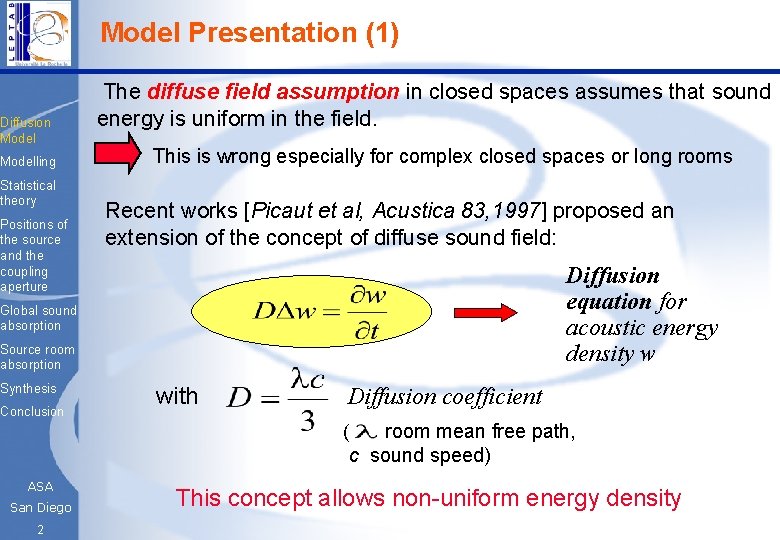
Model Presentation (1) Diffusion Modelling Statistical theory Positions of the source and the coupling aperture The diffuse field assumption in closed spaces assumes that sound energy is uniform in the field. This is wrong especially for complex closed spaces or long rooms Recent works [Picaut et al, Acustica 83, 1997] proposed an extension of the concept of diffuse sound field: Diffusion equation for acoustic energy density w Global sound absorption Source room absorption Synthesis Conclusion with Diffusion coefficient ( room mean free path, c sound speed) ASA San Diego 2 This concept allows non-uniform energy density
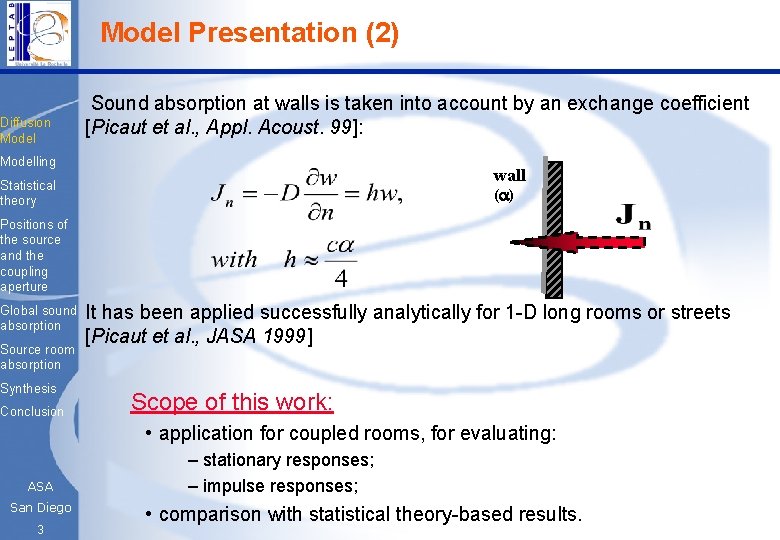
Model Presentation (2) Diffusion Model Sound absorption at walls is taken into account by an exchange coefficient [Picaut et al. , Appl. Acoust. 99]: Modelling wall Statistical theory (a) Positions of the source and the coupling aperture Global sound absorption Source room absorption Synthesis Conclusion It has been applied successfully analytically for 1 -D long rooms or streets [Picaut et al. , JASA 1999] Scope of this work: • application for coupled rooms, for evaluating: ASA San Diego 3 – stationary responses; – impulse responses; • comparison with statistical theory-based results.
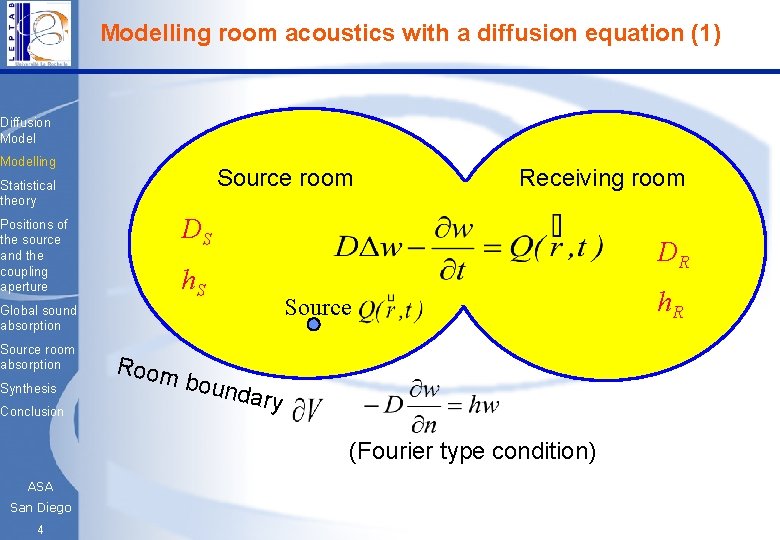
Modelling room acoustics with a diffusion equation (1) Diffusion Modelling Source room Statistical theory DS Positions of the source and the coupling aperture DR h. S Source Global sound absorption Source room absorption Synthesis Conclusion Receiving room Room boun dary (Fourier type condition) ASA San Diego 4 h. R

Modelling room acoustics with a diffusion equation (2) Diffusion Modelling Statistical theory Positions of the source and the coupling aperture Global sound absorption Source room absorption Synthesis Conclusion ASA San Diego 5 Simulated geometry (dimensions in cm) Simulations characteristics: - Unstructured mesh with about 3000 nodes; - stationnary response Sound intensity Level Computing time: less than 1 minute; - impulse response Sound decay Computing time: less than 8 minutes.
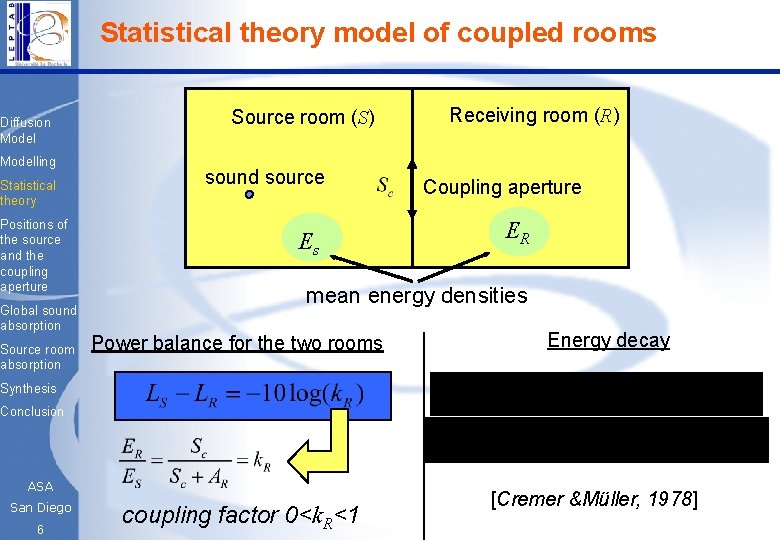
Statistical theory model of coupled rooms Diffusion Modelling Statistical theory Positions of the source and the coupling aperture Global sound absorption Source room (S) sound source Es Receiving room (R) Coupling aperture ER mean energy densities Power balance for the two rooms Energy decay Synthesis Conclusion ASA San Diego 6 coupling factor 0<k. R<1 [Cremer &Müller, 1978]
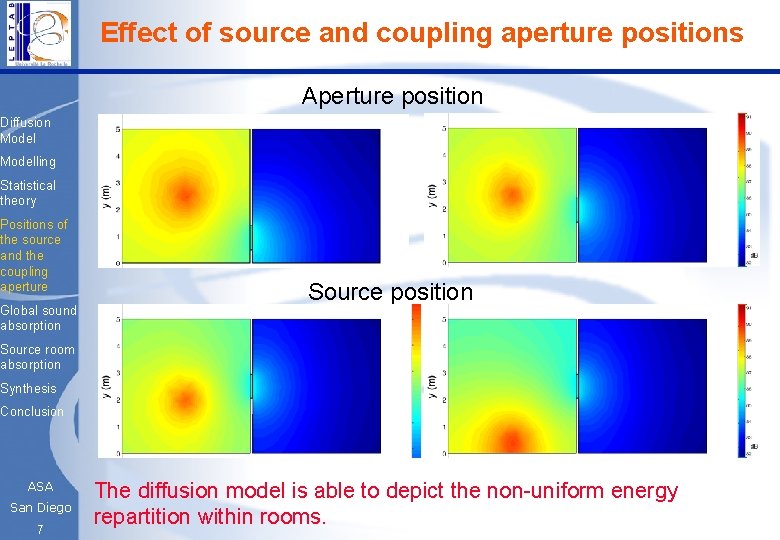
Effect of source and coupling aperture positions Aperture position Diffusion Modelling Statistical theory Positions of the source and the coupling aperture Global sound absorption Source position Source room absorption Synthesis Conclusion ASA San Diego 7 The diffusion model is able to depict the non-uniform energy repartition within rooms.
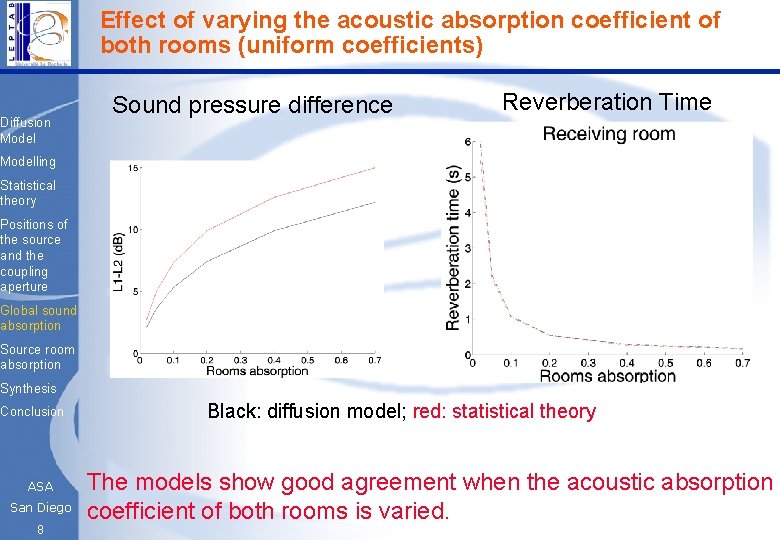
Effect of varying the acoustic absorption coefficient of both rooms (uniform coefficients) Diffusion Model Sound pressure difference Reverberation Time Modelling Statistical theory Positions of the source and the coupling aperture Global sound absorption Source room absorption Synthesis Conclusion ASA San Diego 8 Black: diffusion model; red: statistical theory The models show good agreement when the acoustic absorption coefficient of both rooms is varied.
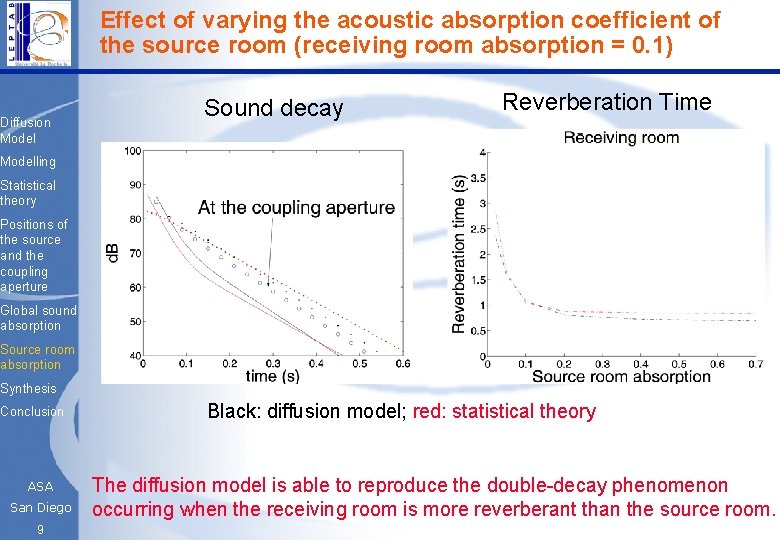
Effect of varying the acoustic absorption coefficient of the source room (receiving room absorption = 0. 1) Diffusion Model Sound decay Reverberation Time Modelling Statistical theory Positions of the source and the coupling aperture Global sound absorption Source room absorption Synthesis Conclusion ASA San Diego 9 Black: diffusion model; red: statistical theory The diffusion model is able to reproduce the double-decay phenomenon occurring when the receiving room is more reverberant than the source room.
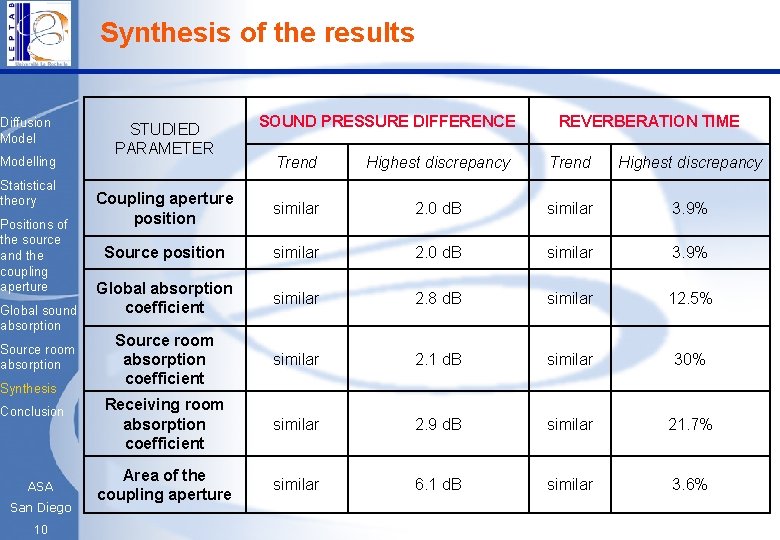
Synthesis of the results Diffusion Modelling Statistical theory Positions of the source and the coupling aperture Global sound absorption Source room absorption Synthesis Conclusion ASA San Diego 10 STUDIED PARAMETER SOUND PRESSURE DIFFERENCE REVERBERATION TIME Trend Highest discrepancy Coupling aperture position similar 2. 0 d. B similar 3. 9% Source position similar 2. 0 d. B similar 3. 9% Global absorption coefficient similar 2. 8 d. B similar 12. 5% Source room absorption coefficient similar 2. 1 d. B similar 30% Receiving room absorption coefficient similar 2. 9 d. B similar 21. 7% Area of the coupling aperture similar 6. 1 d. B similar 3. 6%
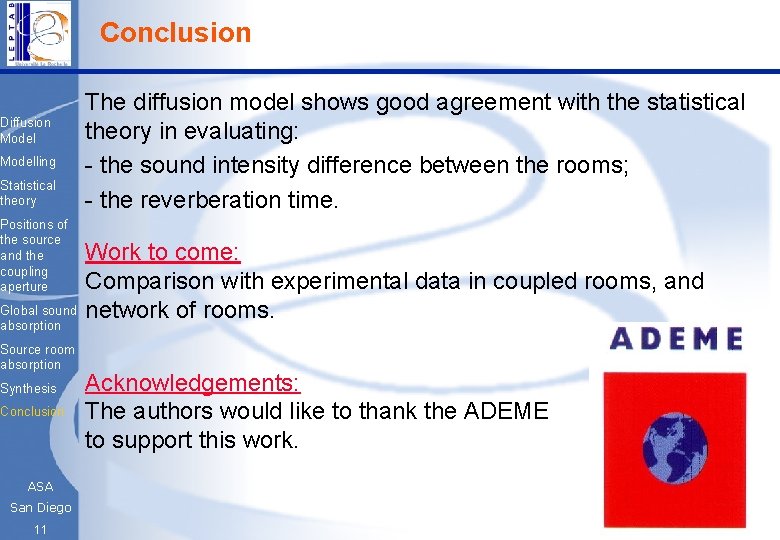
Conclusion Diffusion Modelling Statistical theory Positions of the source and the coupling aperture Global sound absorption Source room absorption Synthesis Conclusion ASA San Diego 11 The diffusion model shows good agreement with the statistical theory in evaluating: - the sound intensity difference between the rooms; - the reverberation time. Work to come: Comparison with experimental data in coupled rooms, and network of rooms. Acknowledgements: The authors would like to thank the ADEME to support this work.
- Slides: 11