
REVENUE RECOGNITION ADVISORY FORUM Stig Enevoldsen 18 October
REVENUE RECOGNITION ADVISORY FORUM Stig Enevoldsen 18 October 2006 1 © 2006 EFRAG
Revenue recognition IAS 18 problems • Very little specific guidance • Inconsistent guidance • Somewhat based on matching • Examples not always consistent with the standard • Little guidance on multiple-element contracts 2 © 2006 EFRAG
Revenue recognition IAS 11 and 18 problems • The two standards are inconsistent • Somewhat based on matching • Little guidance on more complex transactions • Little guidance on new sophisticated transactions such as multiple-element contracts related to construction 3 © 2006 EFRAG
Revenue recognition USA has a big number of rules • The rules are in many different pronouncements • Specific guidance to specific transactions • SEC has issued SAB 104 somewhat based on an earnings principle • US GAAP also urgently needed improvement 4 © 2006 EFRAG
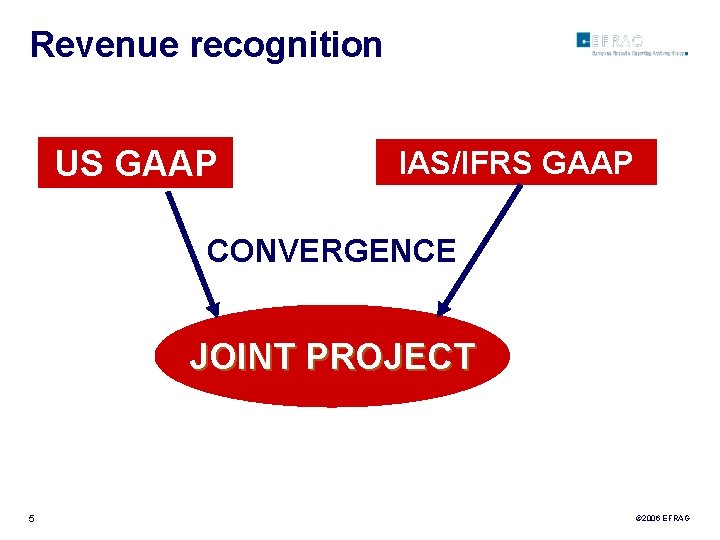
Revenue recognition US GAAP IAS/IFRS GAAP CONVERGENCE JOINT PROJECT 5 © 2006 EFRAG
IASB/FASB joint project IASB/FASB could have chosen • Amendments to the present standards and rules • Ad hoc changes to facilitate new types of transactions IASB/FASB decided to undertake a comprehensive project with fundamental rethink 6 © 2006 EFRAG
Proactive Accounting Activities in Europe PAAin. E! 7 © 2006 EFRAG
EFRAG – PAAin. E OBJECTIVES: • Partnership with National standard setters • High quality proactive input to IASB(+FASB) • More consistent messages to IASB • Create debates in Europe • Involvement in the convergence work • Monitor work of IASB & FASB • Thought leadership 8 © 2006 EFRAG
PAAin. E - projects Revenue Recognition Framework Pensions Equity/ liability split Performance Reporting 9 © 2006 EFRAG
PAAin. E project Revenue Recognition • Top-line figure – Turnover – Revenue • Revenue is a gross number • Revenue is a measure of activity pursuant to a contract with a customer (reflects the activity of supplying goods and services to customers) • Based on the asset liability approach – like the Framework Is it strange to start Revenue based on assets and liabilities? 10 © 2006 EFRAG
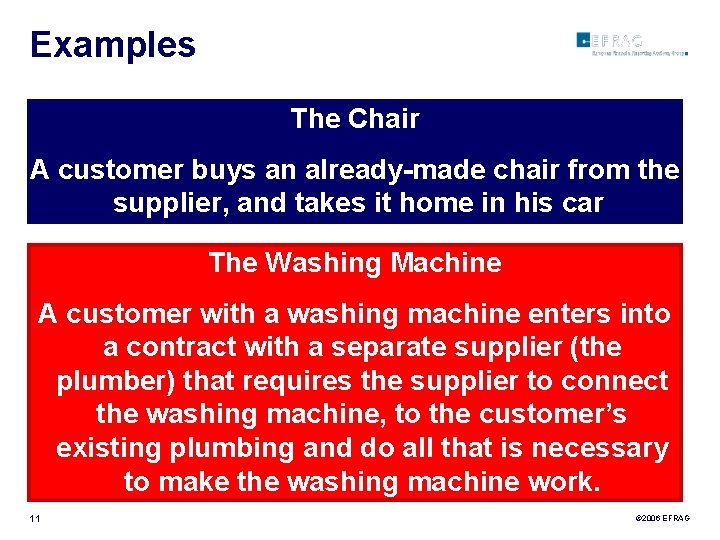
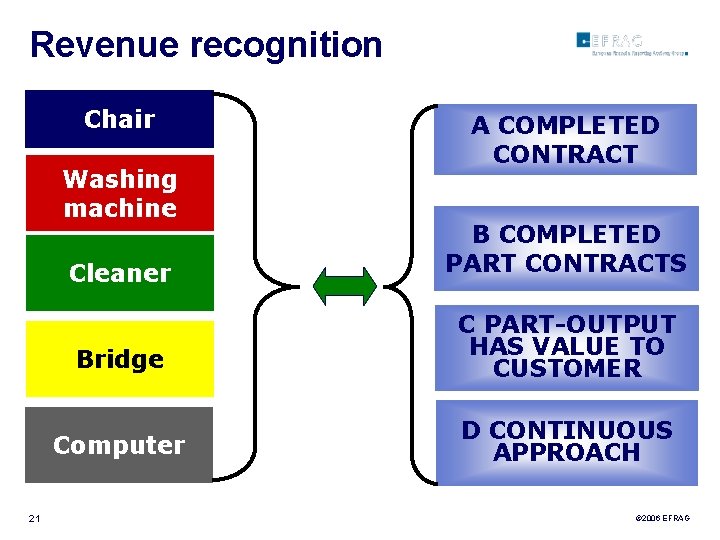
Examples The Chair A customer buys an already-made chair from the supplier, and takes it home in his car. The Washing Machine A customer with a washing machine enters into a contract with a separate supplier (the plumber) that requires the supplier to connect the washing machine, to the customer’s existing plumbing and do all that is necessary to make the washing machine work. 11 © 2006 EFRAG
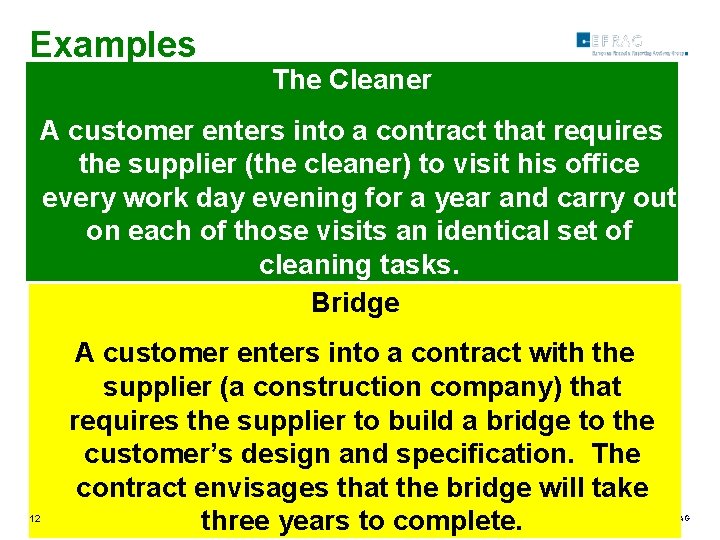
Examples The Cleaner A customer enters into a contract that requires the supplier (the cleaner) to visit his office every work day evening for a year and carry out on each of those visits an identical set of cleaning tasks. Bridge 12 A customer enters into a contract with the supplier (a construction company) that requires the supplier to build a bridge to the customer’s design and specification. The contract envisages that the bridge will take three years to complete. © 2006 EFRAG
Examples The Computer A customer orders from the supplier a particular specification of computer along with a specified package of off-the-shelf software. The supplier is required to supply and deliver the computer with the software already loaded, connect up all the wires and make sure everything works, and provide the customer with ten hours of tuition on how best to use the computer and its software. 13 © 2006 EFRAG
Revenue recognition THE DRAFT DISCUSSION PAPER DISCUSSES FOUR DIFFERENT APPROACHES TO RECOGNITION 14 © 2006 EFRAG
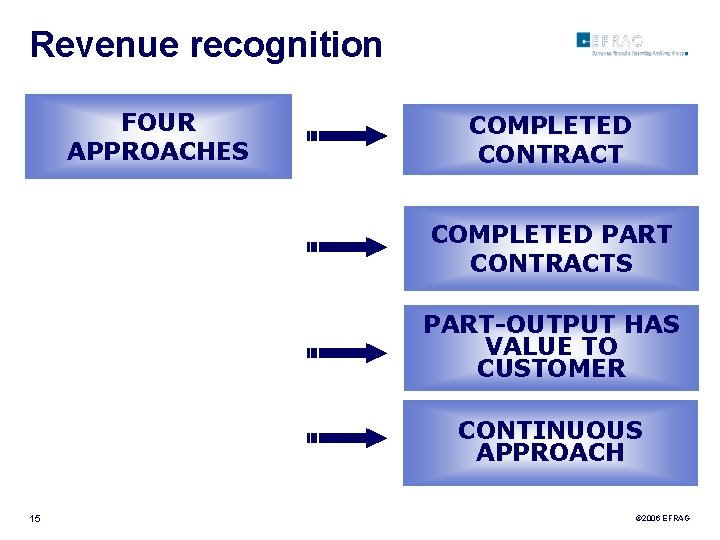
Revenue recognition FOUR APPROACHES COMPLETED CONTRACT COMPLETED PART CONTRACTS PART-OUTPUT HAS VALUE TO CUSTOMER CONTINUOUS APPROACH 15 © 2006 EFRAG
A Completed contract Revenue arises when the supplier fulfils the performance obligations arising under a contract with a customer. The supplier gets a right to consideration when it has met its performance obligation. The consideration constitutes a new asset either cash or receivable 16 © 2006 EFRAG
B Completed part contract Revenue arises when the entity fulfils all the performance obligations arising under a partcontract with a customer. (A part-contract comprises one or more of the performance obligations required by the whole contract that, when fulfilled, will result in a right to consideration arising). The contractual terms allows the supplier to get right to consideration before full completion. 17 © 2006 EFRAG
C Part-output has value to customer Revenue arises when the entity fulfils all the performance obligations arising under a partcontract with a customer. Each part-contract comprises the work necessary to produce an item of output that the customer can either use for its intended purpose or can be sold at an amount that reflects its worth when used for that intended purpose. 18 © 2006 EFRAG
C Part-output/value to customer Revenue arises when the entity has produced comprises the work necessary to produce an item of output that the customer can either use for its intended purpose or can be sold at an amount that reflects its worth when used for that intended purpose. Necessary to establish criteria for “intended purpose” and “can be sold” (as outlined in C 60) Seems suitable for multiple elements contracts 19 © 2006 EFRAG
D Continuous approach Revenue should be recognised when activity undertaken pursuant to a contract with a customer gives rise to an asset that reflects performance towards completion. The supplier must expect the contract to be fully completed Disaggregating also important here because of potential different margins of the elements 20 © 2006 EFRAG
Revenue recognition Chair Washing machine 21 A COMPLETED CONTRACT Cleaner B COMPLETED PART CONTRACTS Bridge C PART-OUTPUT HAS VALUE TO CUSTOMER Computer D CONTINUOUS APPROACH © 2006 EFRAG
Matters considered • Critical events approach • Who’s perspective – Supplier versus customer • Customer acceptance • Contingent customer acceptance • Exchange 22 © 2006 EFRAG
Other examples • Service concessions? • Customer loyalty programmes? 23 © 2006 EFRAG
Revenue recognition Measurement might influence conclusions!!! 24 © 2006 EFRAG
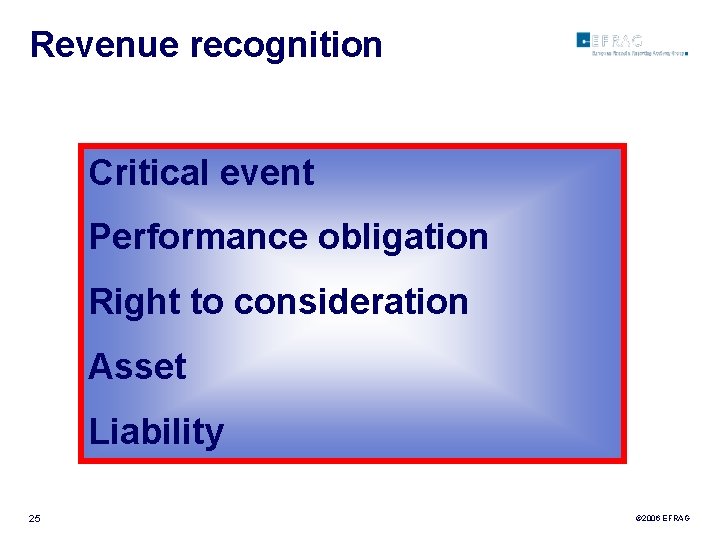
Revenue recognition Critical event Performance obligation Right to consideration Asset Liability 25 © 2006 EFRAG
THE EUROPEAN VOICE WWW. EFRAG. ORG 26 © 2006 EFRAG
- Slides: 26