
Revamp of High Energy Physics Labs Computer Systems
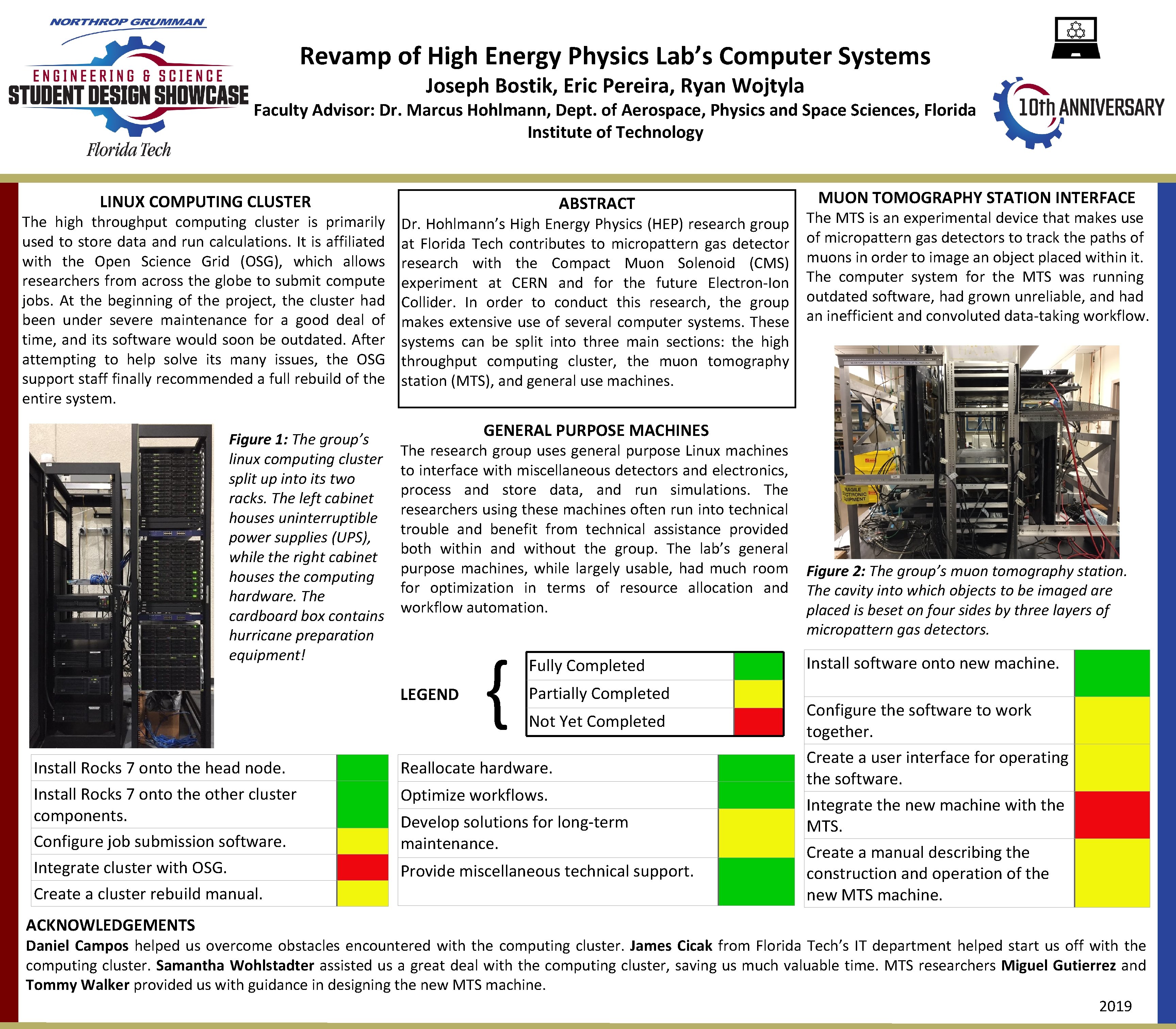
Revamp of High Energy Physics Lab’s Computer Systems Joseph Bostik, Eric Pereira, Ryan Wojtyla Faculty Advisor: Dr. Marcus Hohlmann, Dept. of Aerospace, Physics and Space Sciences, Florida Institute of Technology LINUX COMPUTING CLUSTER The high throughput computing cluster is primarily used to store data and run calculations. It is affiliated with the Open Science Grid (OSG), which allows researchers from across the globe to submit compute jobs. At the beginning of the project, the cluster had been under severe maintenance for a good deal of time, and its software would soon be outdated. After attempting to help solve its many issues, the OSG support staff finally recommended a full rebuild of the entire system. Figure 1: The group’s linux computing cluster split up into its two racks. The left cabinet houses uninterruptible power supplies (UPS), while the right cabinet houses the computing hardware. The cardboard box contains hurricane preparation equipment! ABSTRACT Dr. Hohlmann’s High Energy Physics (HEP) research group at Florida Tech contributes to micropattern gas detector research with the Compact Muon Solenoid (CMS) experiment at CERN and for the future Electron-Ion Collider. In order to conduct this research, the group makes extensive use of several computer systems. These systems can be split into three main sections: the high throughput computing cluster, the muon tomography station (MTS), and general use machines. ACKNOWLEDGEMENTS The MTS is an experimental device that makes use of micropattern gas detectors to track the paths of muons in order to image an object placed within it. The computer system for the MTS was running outdated software, had grown unreliable, and had an inefficient and convoluted data-taking workflow. GENERAL PURPOSE MACHINES The research group uses general purpose Linux machines to interface with miscellaneous detectors and electronics, process and store data, and run simulations. The researchers using these machines often run into technical trouble and benefit from technical assistance provided both within and without the group. The lab’s general purpose machines, while largely usable, had much room for optimization in terms of resource allocation and workflow automation. LEGEND Install Rocks 7 onto the head node. Install Rocks 7 onto the other cluster components. Configure job submission software. Integrate cluster with OSG. Create a cluster rebuild manual. MUON TOMOGRAPHY STATION INTERFACE { Fully Completed Partially Completed Not Yet Completed Reallocate hardware. Optimize workflows. Develop solutions for long-term maintenance. Provide miscellaneous technical support. Figure 2: The group’s muon tomography station. The cavity into which objects to be imaged are placed is beset on four sides by three layers of micropattern gas detectors. Install software onto new machine. Configure the software to work together. Create a user interface for operating the software. Integrate the new machine with the MTS. Create a manual describing the construction and operation of the new MTS machine. Daniel Campos helped us overcome obstacles encountered with the computing cluster. James Cicak from Florida Tech’s IT department helped start us off with the computing cluster. Samantha Wohlstadter assisted us a great deal with the computing cluster, saving us much valuable time. MTS researchers Miguel Gutierrez and Tommy Walker provided us with guidance in designing the new MTS machine. 2019
- Slides: 1