
REV 00 Chapter 2 Database Environment DDC 2483
REV 00 Chapter 2 Database Environment DDC 2483 DATABASE SYSTEM 1
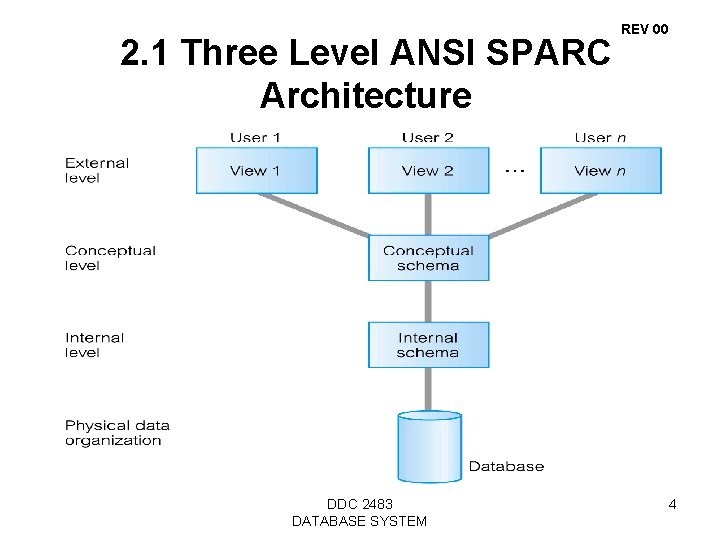
REV 00 2. 1 Three Level ANSI SPARC Architecture Objectives of Three-Level Architecture • All users should be able to access same data. • A user’s view is immune to changes made in other views. • Users should not need to know physical database storage details. DDC 2483 DATABASE SYSTEM 2
2. 1 Three Level ANSI SPARC Architecture REV 00 Objectives of Three-Level Architecture • DBA should be able to change database storage structures without affecting the users’ views. • Internal structure of database should be unaffected by changes to physical aspects of storage. • DBA should be able to change conceptual structure of database without affecting all users. DDC 2483 DATABASE SYSTEM 3
2. 1 Three Level ANSI SPARC Architecture DDC 2483 DATABASE SYSTEM REV 00 4
2. 1 Three Level ANSI SPARC Architecture REV 00 • External Level – Users’ view of the database. – Describes that part of database that is relevant to a particular user. • Conceptual Level – Community view of the database. – Describes what data is stored in database and relationships among the data. • Internal Level – Physical representation of the database on the computer. – Describes how the data is stored in the database. DDC 2483 DATABASE SYSTEM 5
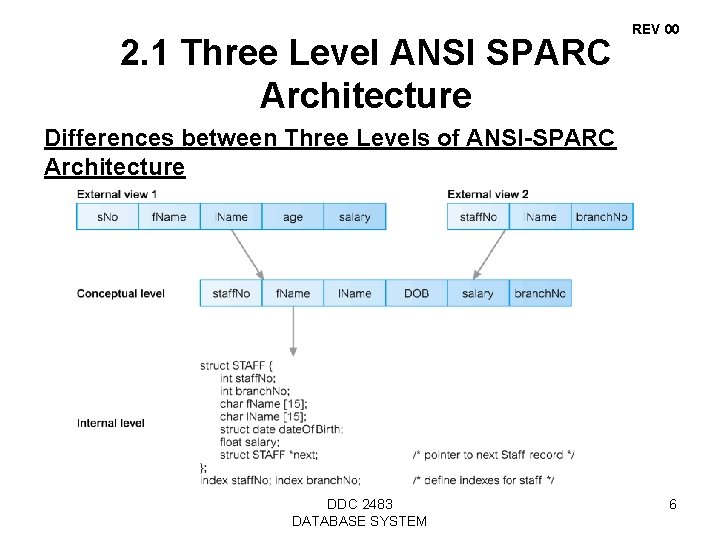
2. 1 Three Level ANSI SPARC Architecture REV 00 Differences between Three Levels of ANSI-SPARC Architecture DDC 2483 DATABASE SYSTEM 6
2. 2 Data Independence REV 00 • Logical Data Independence – Refers to immunity of external schemas to changes in conceptual schema. – Conceptual schema changes (e. g. addition/removal of entities). – Should not require changes to external schema or rewrites of application programs. • Physical Data Independence – Refers to immunity of conceptual schema to changes in the internal schema. – Internal schema changes (e. g. using different file organizations, storage structures/devices). – Should not require change to conceptual or external schemas. DDC 2483 DATABASE SYSTEM 7
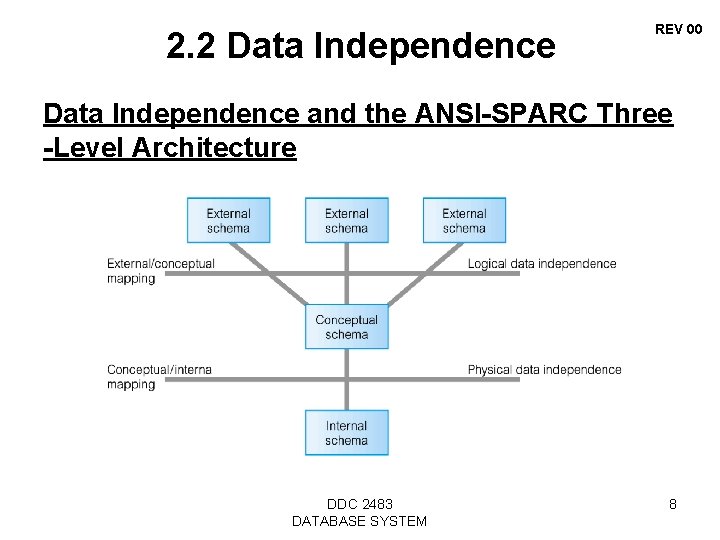
2. 2 Data Independence REV 00 Data Independence and the ANSI-SPARC Three -Level Architecture DDC 2483 DATABASE SYSTEM 8
2. 3 Database Languages REV 00 • Data Definition Language (DDL) – Allows the DBA or user to describe and name entities, attributes, and relationships required for the application – plus any associated integrity and security constraints. DDC 2483 DATABASE SYSTEM 9

2. 3 Database Languages REV 00 • Data Manipulation Language (DML) – Provides basic data manipulation operations on data held in the database. • Procedural DML – Allows user to tell system exactly how to manipulate data. • Non-Procedural DML – Allows user to state what data is needed rather than how it is to be retrieved. • Fourth Generation Languages (4 GLs) DDC 2483 DATABASE SYSTEM 10
2. 4 Fourth Generation Language DDC 2483 DATABASE SYSTEM 11
2. 5 Data Models and Conceptual Modeling REV 00 • Integrated collection of concepts for describing data, relationships between data, and constraints on the data in an organization. • Data Model comprises: – a structural part; – a manipulative part; – possibly a set of integrity rules. DDC 2483 DATABASE SYSTEM 12
REV 00 2. 5 Data Models and Conceptual Modeling • Purpose – To represent data in an understandable way. • Categories of data models include: – Object-based – Record-based – Physical. DDC 2483 DATABASE SYSTEM 13
REV 00 2. 5 Data Models and Conceptual Modeling • Object-Based Data Models – Entity-Relationship – Semantic – Functional – Object-Oriented. • Record-Based Data Models – Relational Data Model – Network Data Model – Hierarchical Data Model. • Physical Data Models DDC 2483 DATABASE SYSTEM 14
2. 5 Data Models and Conceptual Modeling REV 00 Conceptual Modeling • Conceptual schema is the core of a system supporting all user views. • Should be complete and accurate representation of an organization’s data requirements. • Conceptual modelling is process of developing a model of information use that is independent of implementation details. • Result is a conceptual data model. DDC 2483 DATABASE SYSTEM 15
2. 6 Functions of a DBMS REV 00 • Data Storage, Retrieval, and Update. • A User-Accessible Catalog. • Transaction Support. • Concurrency Control Services. • Recovery Services. DDC 2483 DATABASE SYSTEM 16
2. 6 Functions of a DBMS REV 00 • Authorization Services. • Support for Data Communication. • Integrity Services. • Services to Promote Data Independence. • Utility Services. DDC 2483 DATABASE SYSTEM 17
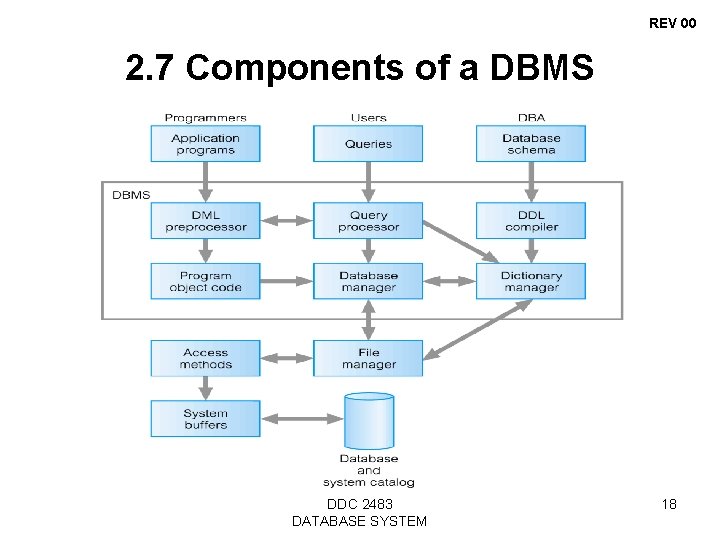
REV 00 2. 7 Components of a DBMS DDC 2483 DATABASE SYSTEM 18
REV 00 2. 8 Multi-User DBMS Architectures • Teleprocessing • File-server • Client-server DDC 2483 DATABASE SYSTEM 19
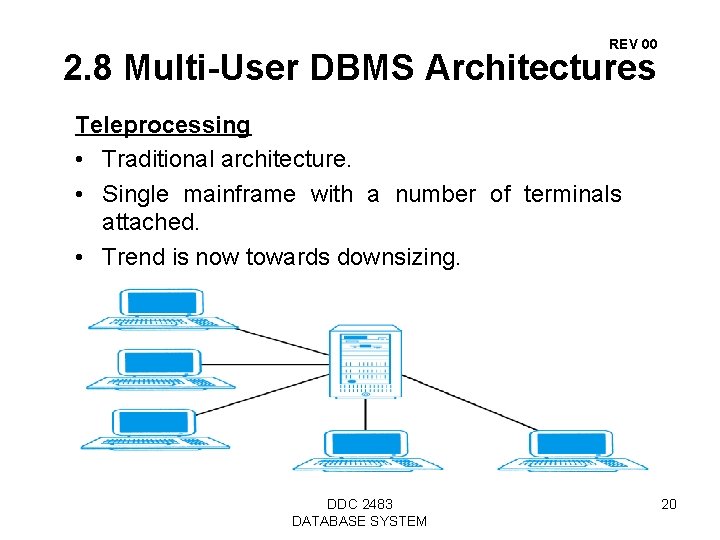
REV 00 2. 8 Multi-User DBMS Architectures Teleprocessing • Traditional architecture. • Single mainframe with a number of terminals attached. • Trend is now towards downsizing. DDC 2483 DATABASE SYSTEM 20
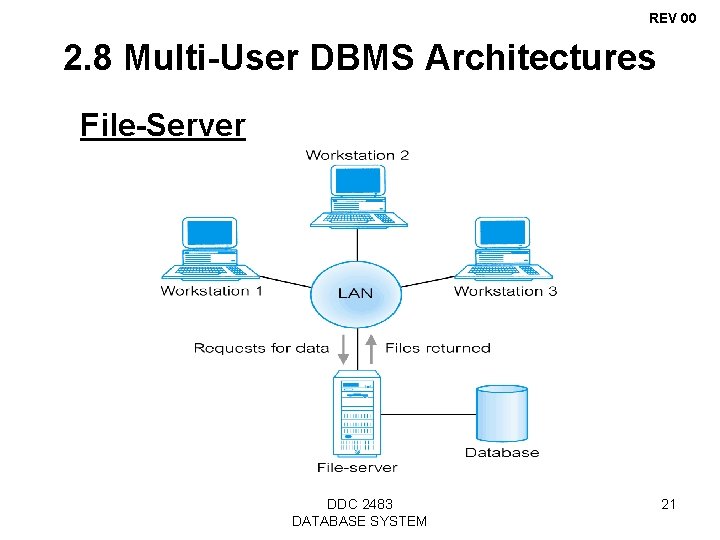
REV 00 2. 8 Multi-User DBMS Architectures File-Server DDC 2483 DATABASE SYSTEM 21
- Slides: 21