
Return to Work RTW and Stay at Work
- Slides: 48
Return to Work (RTW) and Stay at Work (SAW) Programs Lisa Mathess, SHRM-CP, JAN Lead Consultant Matthew Mc. Cord, CRC, JAN Senior Consultant (800) 526 -7234 (Voice) (877) 781 -9403 (TTY) jan@Ask. JAN. org JAN is funded by a contract with the Office of Disability Employment Policy, U. S. Department of Labor. 1
Agenda § Stay-at-Work/Return-to-Work Programs § Background § Benefits § Best Business Practices § Situations and Solutions § Questions 2
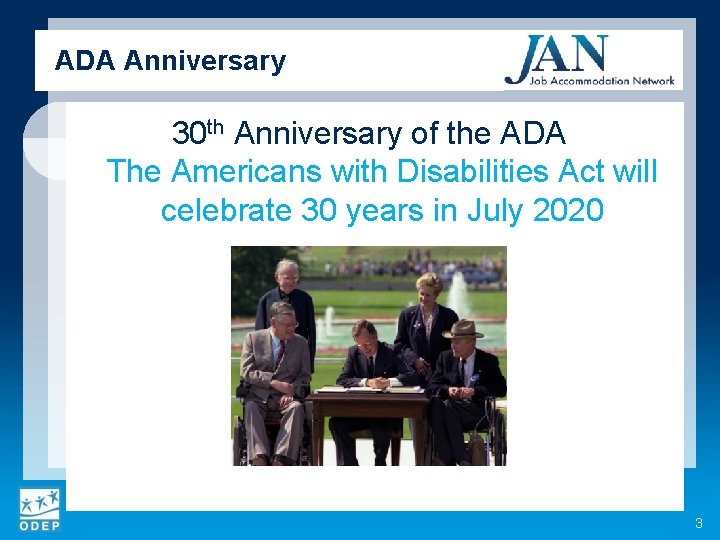
ADA Anniversary 30 th Anniversary of the ADA The Americans with Disabilities Act will celebrate 30 years in July 2020 3
Purpose of SAW/RTW programs § Early intervention is the key to preventing disability § Short window of opportunity to prevent disability § Cost of retaining an employee is lower than often thought § RTW program helps ensure compliance with disabilityrelated legislation JAN’s Return-to-Work Programs https: //Ask. JAN. org/topics/return. cfm 4
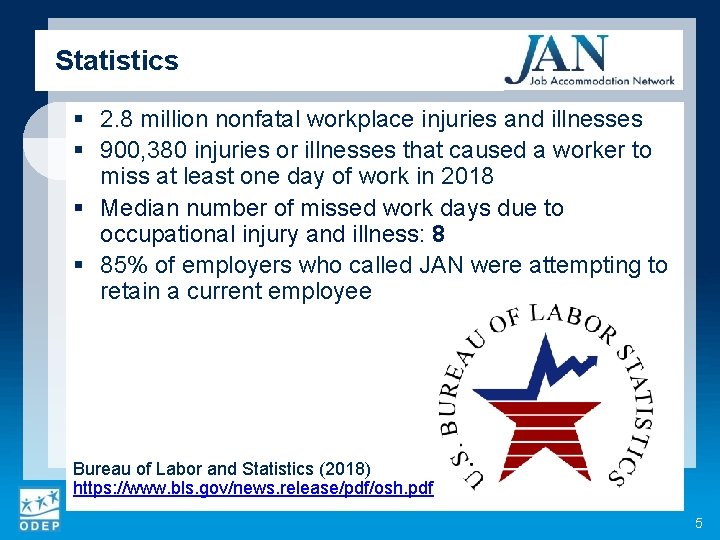
Statistics § 2. 8 million nonfatal workplace injuries and illnesses § 900, 380 injuries or illnesses that caused a worker to miss at least one day of work in 2018 § Median number of missed work days due to occupational injury and illness: 8 § 85% of employers who called JAN were attempting to retain a current employee Bureau of Labor and Statistics (2018) https: //www. bls. gov/news. release/pdf/osh. pdf 5
Stay at Work Goal of SAW: To keep an injured, disabled, or temporarily impaired worker on the job, if medically feasible. Employees who have a temporary impairment that does not necessitate time away from the worksite may need accommodations in order to stay at work. Employers: Ø Ø Should involve the physician throughout the process Should involve the employee throughout the process May be able to take advantage of incentives for SAW initiatives Call JAN! 6
Stay at Work Benefits of SAW programs: § Reduce number of lost workdays § Maintain workforce productivity § Lower risk of condition becoming long-term or permanent disability § Reduce WC costs 7
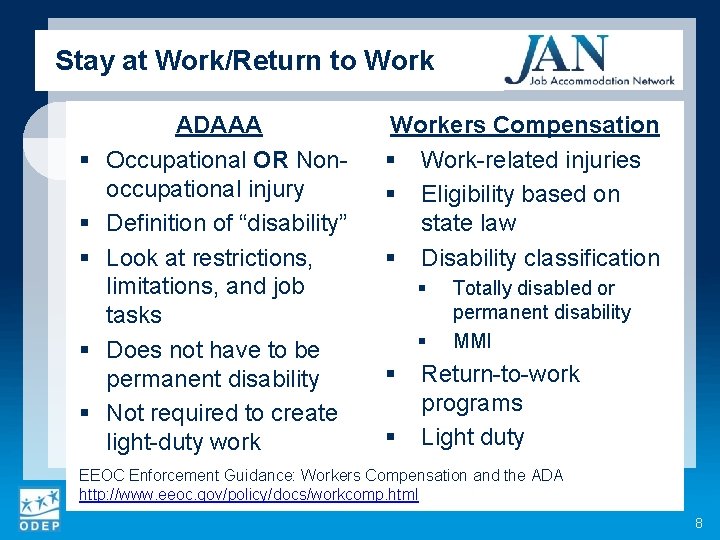
Stay at Work/Return to Work § § § ADAAA Occupational OR Nonoccupational injury Definition of “disability” Look at restrictions, limitations, and job tasks Does not have to be permanent disability Not required to create light-duty work Workers Compensation § Work-related injuries § Eligibility based on state law § Disability classification § § Totally disabled or permanent disability MMI Return-to-work programs Light duty EEOC Enforcement Guidance: Workers Compensation and the ADA http: //www. eeoc. gov/policy/docs/workcomp. html 8
Stay at Work/Return to Work Other Laws Are the ADA and Workers Compensation Laws the only laws employers need to consider? No § § State civil rights/human rights laws State disability benefits programs Department of Labor laws Family and Medical Leave Act (FMLA) 9
Stay at Work/Return to Work Temporary Impairments Under the ADAAA and its regulations, are temporary impairments now covered? § Neither the ADAAA or its regulations indicate whether temporary impairments are covered or excluded § Duration of an impairment is not that important anymore § Don’t rule out coverage solely based on how long impairment lasts § Err on side of caution 10
Return to Work Goal of RTW: To return an injured, disabled, or temporarily impaired worker to the workplace as soon as medically feasible. Employees who have been on leave (FMLA, STD/LTD, ADA, Workers Compensation, etc. ) may need accommodations in order to return to work. Employers: Ø Ø Can ask for a limited amount of medical documentation Should involve the employee throughout the process Should consider modifying any “ 100% restriction-free” policies Call JAN! 11
Return to Work Benefits of RTW programs: § § Retain valued employees Enhance workforce productivity Save on recruiting/training costs Reduce WC costs 12
Stay at Work/Return to Work Medical Documentation: Employee requests accommodation and the disability and/or need for accommodation is not known or obvious Definition of disability: an impairment that substantially limits one or more major life activities Verify need for accommodation ADA confidentiality rules 13
Direct Threat to Health & Safety § Significant risk of substantial harm § The specific risk must be identified § It must be a current risk, not one that is speculative or remote § The assessment of risk must be based on objective medical or other factual evidence § Even if a genuine significant risk of substantial harm exists, the employer must consider whether the risk can be eliminated or reduced by reasonable accommodation 14
Stay at Work/Return to Work Administrative modifications for RTW: Do’s § Transitional employment plans § Implement a light duty program § Train on ergonomic techniques § Consider temporary accommodations Don’ts § “ 100% Healed Policy” § Make assumptions 15
Stay at Work/Return to Work Best Practices 16
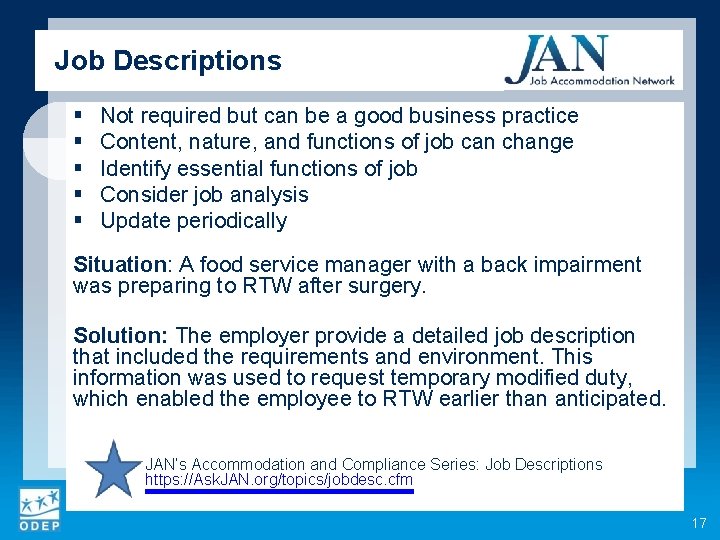
Job Descriptions § § § Not required but can be a good business practice Content, nature, and functions of job can change Identify essential functions of job Consider job analysis Update periodically Situation: A food service manager with a back impairment was preparing to RTW after surgery. Solution: The employer provide a detailed job description that included the requirements and environment. This information was used to request temporary modified duty, which enabled the employee to RTW earlier than anticipated. JAN’s Accommodation and Compliance Series: Job Descriptions https: //Ask. JAN. org/topics/jobdesc. cfm 17
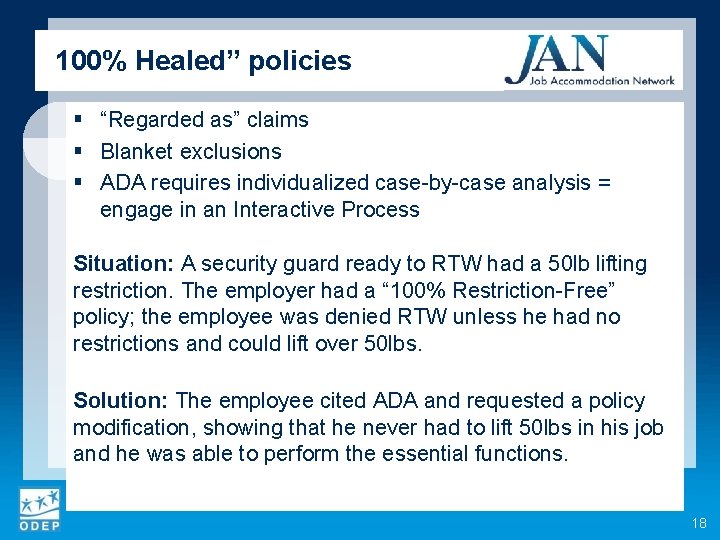
100% Healed” policies § “Regarded as” claims § Blanket exclusions § ADA requires individualized case-by-case analysis = engage in an Interactive Process Situation: A security guard ready to RTW had a 50 lb lifting restriction. The employer had a “ 100% Restriction-Free” policy; the employee was denied RTW unless he had no restrictions and could lift over 50 lbs. Solution: The employee cited ADA and requested a policy modification, showing that he never had to lift 50 lbs in his job and he was able to perform the essential functions. 18
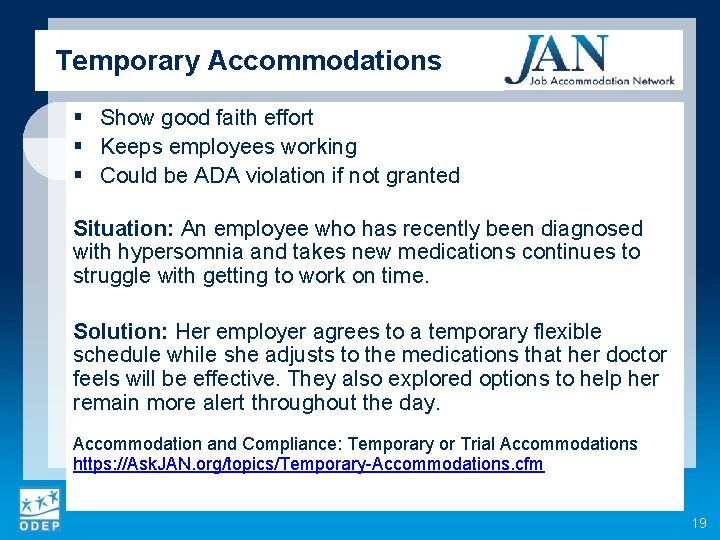
Temporary Accommodations § Show good faith effort § Keeps employees working § Could be ADA violation if not granted Situation: An employee who has recently been diagnosed with hypersomnia and takes new medications continues to struggle with getting to work on time. Solution: Her employer agrees to a temporary flexible schedule while she adjusts to the medications that her doctor feels will be effective. They also explored options to help her remain more alert throughout the day. Accommodation and Compliance: Temporary or Trial Accommodations https: //Ask. JAN. org/topics/Temporary-Accommodations. cfm 19
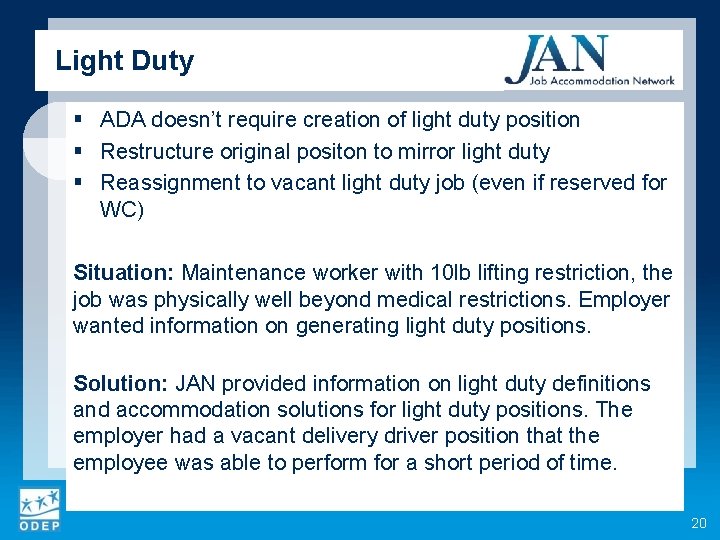
Light Duty § ADA doesn’t require creation of light duty position § Restructure original positon to mirror light duty § Reassignment to vacant light duty job (even if reserved for WC) Situation: Maintenance worker with 10 lb lifting restriction, the job was physically well beyond medical restrictions. Employer wanted information on generating light duty positions. Solution: JAN provided information on light duty definitions and accommodation solutions for light duty positions. The employer had a vacant delivery driver position that the employee was able to perform for a short period of time. 20
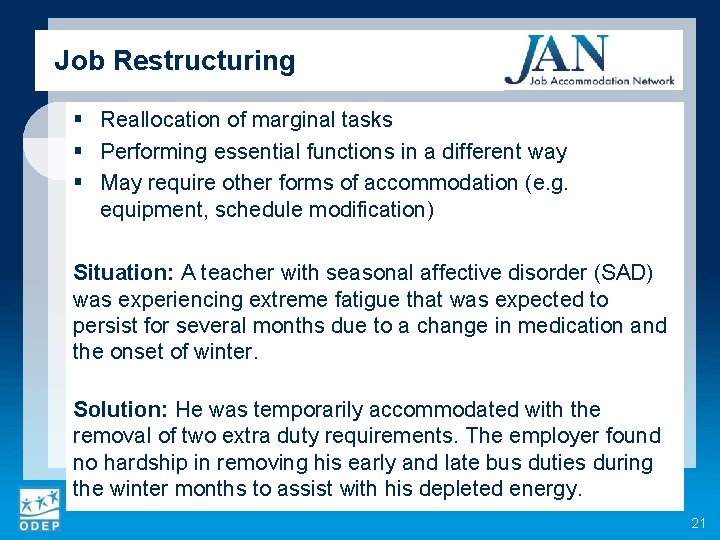
Job Restructuring § Reallocation of marginal tasks § Performing essential functions in a different way § May require other forms of accommodation (e. g. equipment, schedule modification) Situation: A teacher with seasonal affective disorder (SAD) was experiencing extreme fatigue that was expected to persist for several months due to a change in medication and the onset of winter. Solution: He was temporarily accommodated with the removal of two extra duty requirements. The employer found no hardship in removing his early and late bus duties during the winter months to assist with his depleted energy. 21
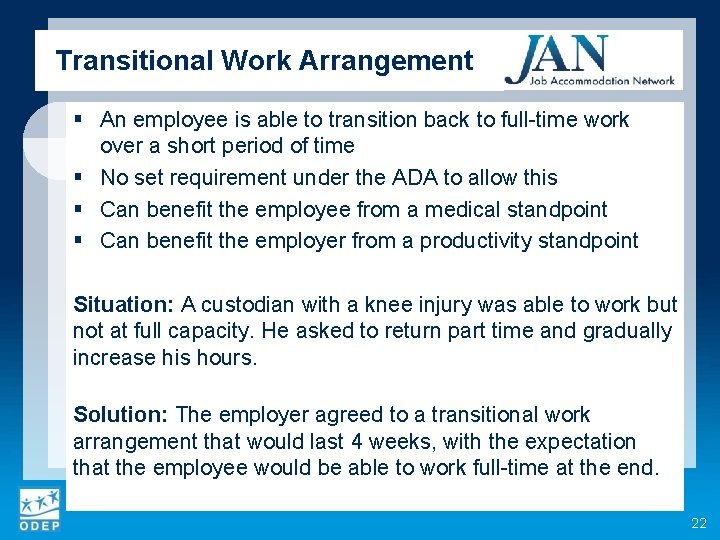
Transitional Work Arrangement § An employee is able to transition back to full-time work over a short period of time § No set requirement under the ADA to allow this § Can benefit the employee from a medical standpoint § Can benefit the employer from a productivity standpoint Situation: A custodian with a knee injury was able to work but not at full capacity. He asked to return part time and gradually increase his hours. Solution: The employer agreed to a transitional work arrangement that would last 4 weeks, with the expectation that the employee would be able to work full-time at the end. 22
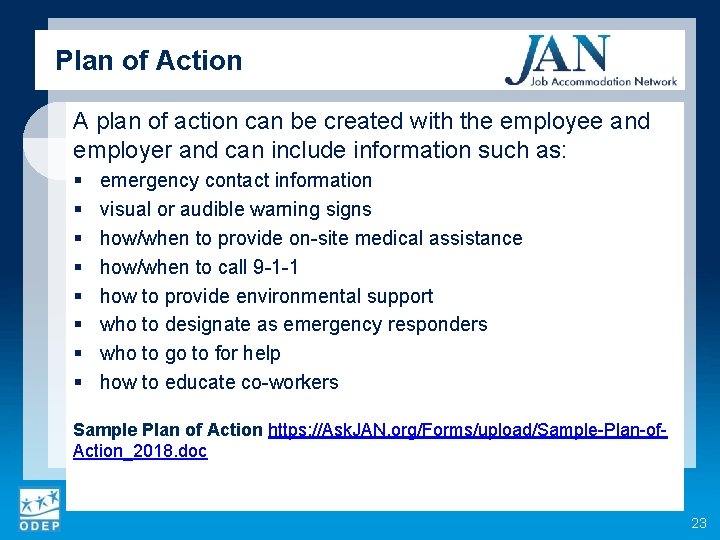
Plan of Action A plan of action can be created with the employee and employer and can include information such as: § § § § emergency contact information visual or audible warning signs how/when to provide on-site medical assistance how/when to call 9 -1 -1 how to provide environmental support who to designate as emergency responders who to go to for help how to educate co-workers Sample Plan of Action https: //Ask. JAN. org/Forms/upload/Sample-Plan-of. Action_2018. doc 23
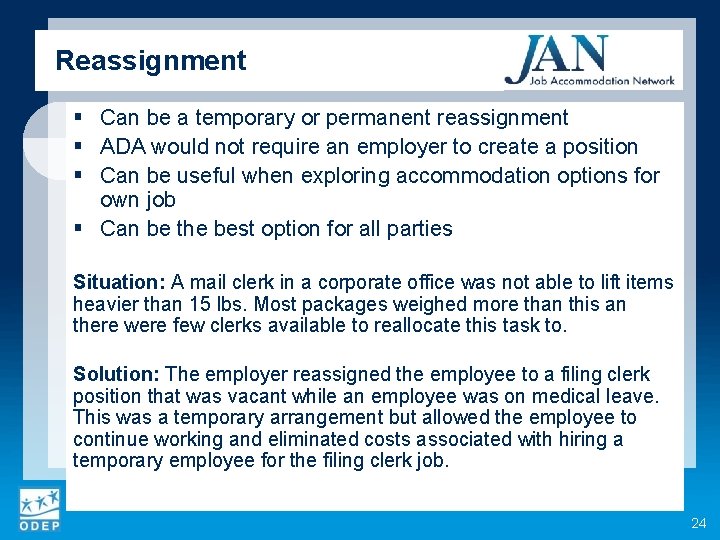
Reassignment § Can be a temporary or permanent reassignment § ADA would not require an employer to create a position § Can be useful when exploring accommodation options for own job § Can be the best option for all parties Situation: A mail clerk in a corporate office was not able to lift items heavier than 15 lbs. Most packages weighed more than this an there were few clerks available to reallocate this task to. Solution: The employer reassigned the employee to a filing clerk position that was vacant while an employee was on medical leave. This was a temporary arrangement but allowed the employee to continue working and eliminated costs associated with hiring a temporary employee for the filing clerk job. 24
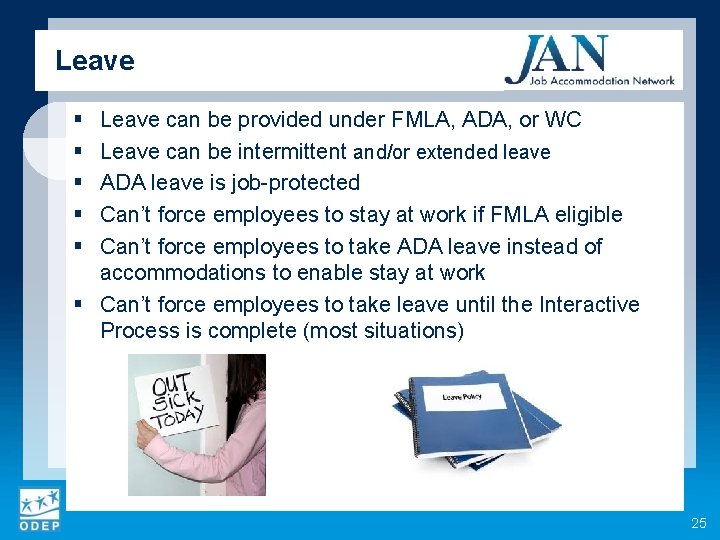
Leave § § § Leave can be provided under FMLA, ADA, or WC Leave can be intermittent and/or extended leave ADA leave is job-protected Can’t force employees to stay at work if FMLA eligible Can’t force employees to take ADA leave instead of accommodations to enable stay at work § Can’t force employees to take leave until the Interactive Process is complete (most situations) 25
Leave Do employers have to grant indefinite leave as a reasonable accommodation to employees with disabilities? § May have to grant extended leave § No obligation to grant indefinite leave § Frequent § Unpredictable requests § No fixed date of return 26
Leave Hardship § § The chronic, frequent, and unpredictable nature of absences may put a strain on the employer’s operations for a variety of reasons, such as the following: an inability to ensure a sufficient number of employees to accomplish the work required; a failure to meet work goals or to serve customers/clients adequately; a need to shift work to other employees, thus preventing them from doing their own work or imposing significant additional burdens on them; incurring significant additional costs when other employees work overtime or when temporary workers must be hired. 27
Leave Situation: An employee originally accommodated with a 12 -week leave for depression asked for an 8 -week extension which the employer provided. Now that it is time for the employee to return to work, the employer receives a doctor’s note stating the employee is not ready to return, and no date is provided by which the employee will be able to. 28
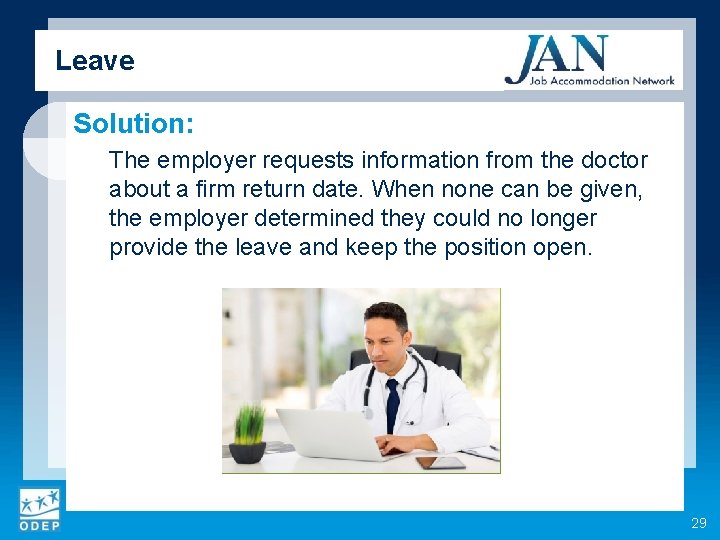
Leave Solution: The employer requests information from the doctor about a firm return date. When none can be given, the employer determined they could no longer provide the leave and keep the position open. 29
Stay at Work/Return to Work Situations & Solutions 30
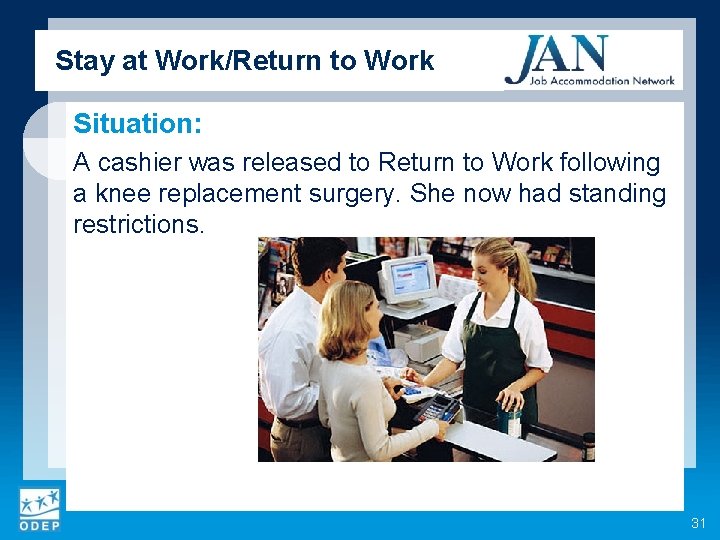
Stay at Work/Return to Work Situation: A cashier was released to Return to Work following a knee replacement surgery. She now had standing restrictions. 31
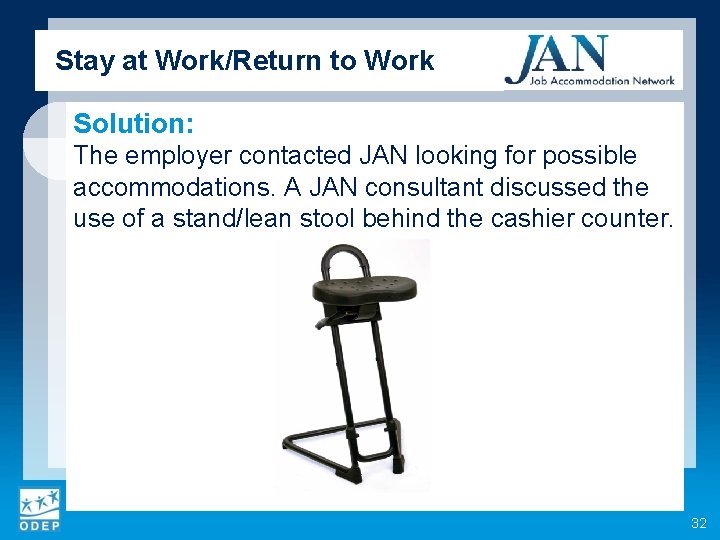
Stay at Work/Return to Work Solution: The employer contacted JAN looking for possible accommodations. A JAN consultant discussed the use of a stand/lean stool behind the cashier counter. 32
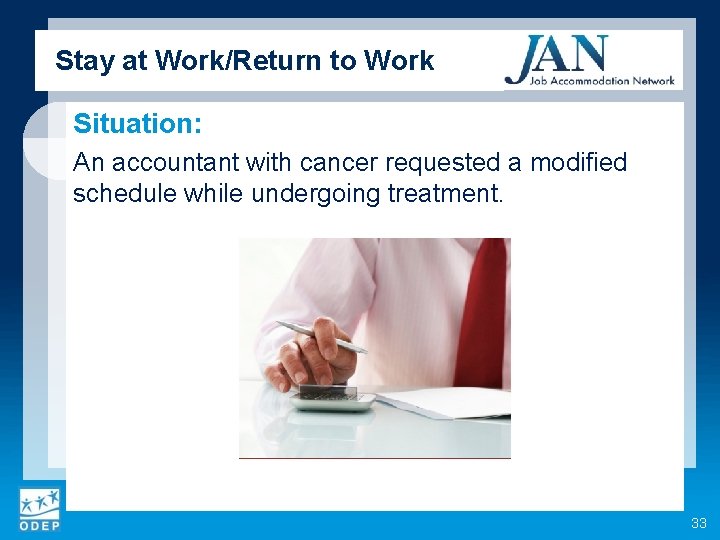
Stay at Work/Return to Work Situation: An accountant with cancer requested a modified schedule while undergoing treatment. 33
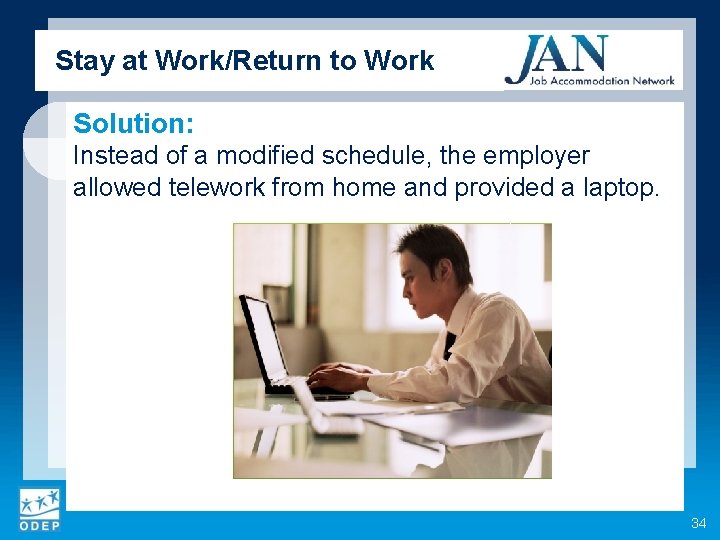
Stay at Work/Return to Work Solution: Instead of a modified schedule, the employer allowed telework from home and provided a laptop. 34
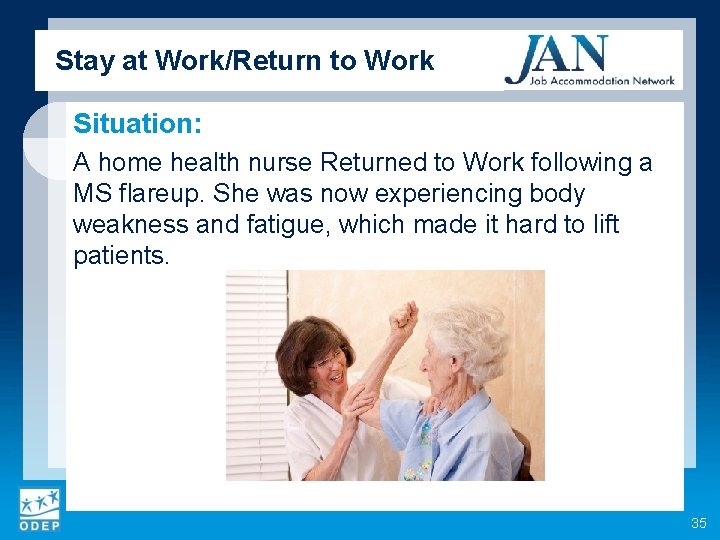
Stay at Work/Return to Work Situation: A home health nurse Returned to Work following a MS flareup. She was now experiencing body weakness and fatigue, which made it hard to lift patients. 35
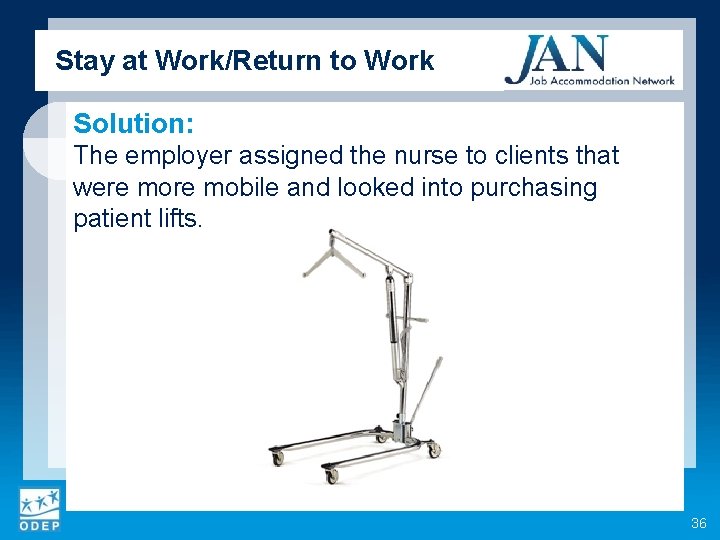
Stay at Work/Return to Work Solution: The employer assigned the nurse to clients that were mobile and looked into purchasing patient lifts. 36
Stay at Work/Return to Work Situation: A certified nurse assistant with depression was on leave for 4 months. Her doctor released her to Return to Work with light duty. Her medications caused muscle weakness and concentration issues. The employer told her to resign or return to work full capacity. 37
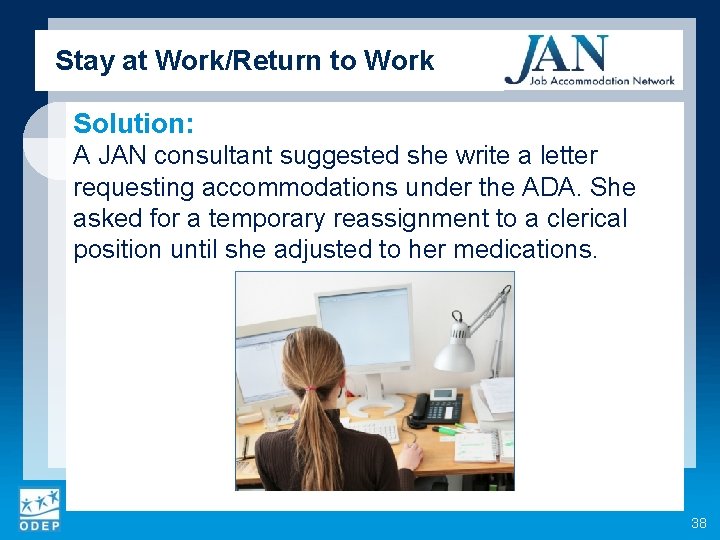
Stay at Work/Return to Work Solution: A JAN consultant suggested she write a letter requesting accommodations under the ADA. She asked for a temporary reassignment to a clerical position until she adjusted to her medications. 38
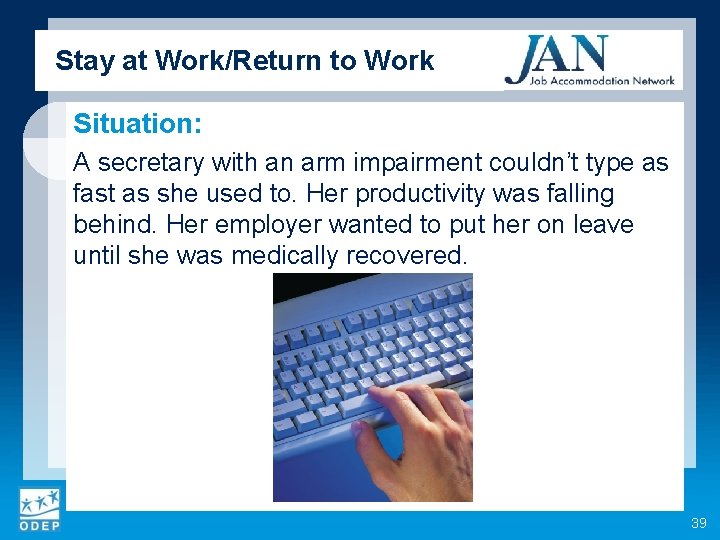
Stay at Work/Return to Work Situation: A secretary with an arm impairment couldn’t type as fast as she used to. Her productivity was falling behind. Her employer wanted to put her on leave until she was medically recovered. 39
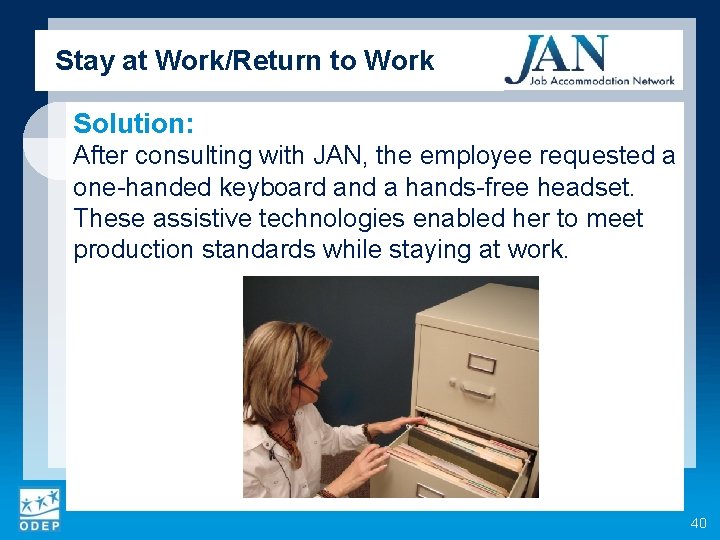
Stay at Work/Return to Work Solution: After consulting with JAN, the employee requested a one-handed keyboard and a hands-free headset. These assistive technologies enabled her to meet production standards while staying at work. 40
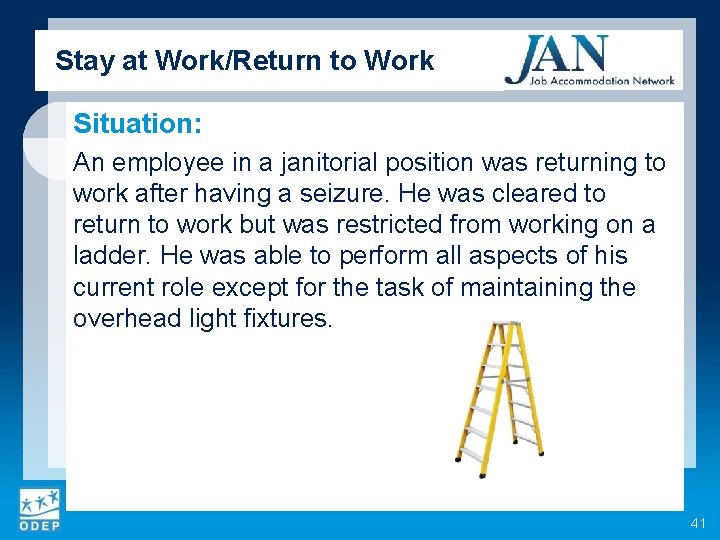
Stay at Work/Return to Work Situation: An employee in a janitorial position was returning to work after having a seizure. He was cleared to return to work but was restricted from working on a ladder. He was able to perform all aspects of his current role except for the task of maintaining the overhead light fixtures. 41
Stay at Work/Return to Work Solution: The job tasks of a second employee included cleaning a small kitchen in the employee lounge, which is a task that the first employee would be able to perform. The employer found no hardship in switching these specific tasks among the employees. 42
Stay at Work/Return to Work Situation: An employee voluntarily admitted herself to a hospital inpatient unit due to severe depression. 43
Stay at Work/Return to Work Solution: The employee’s mother called the employer to let them know what had happened and to tell them her return date was uncertain at this time. The employer provided leave under the ADA for the employee and requested that her mother keep them informed about the employee’s progress and an approximate return-to-work date as soon as possible. 44
Other Partnerships § Disability-related benefits programs § Employee assistance programs § Wellness or health care benefits programs https: //Ask. JAN. org/topics/return. cfm 45
ODEP Resources EARN's Employer Financial Incentives Campaign for Disability Employment "Working Works" PSA 46
Stay at Work/Return to Work Questions? JAN is still available to YOU! Chat available online at Ask. JAN. org https: //Ask. JAN. org/JANon. Demand. cfm Email: jan@Ask. JAN. org JAN Consultants can be reached M-F 9 am-5 pm ET Phone: (800) 526 -7234 (V); (877) 781 -9403 (TTY) 47
Contact JAN § § (800)526 -7234 (V) & (877)781 -9403 (TTY) Ask. JAN. org & jan@Ask. JAN. org (304)216 -8189 via Text janconsultants via Skype 48