
Return to Work Planning What We Should Consider
- Slides: 23
Return to Work Planning What We Should Consider April 28, 2020
Return to Work Planning Organizations planning to reintegrate back into their regular business premises need to develop a plan that: 1. Maintains Safety 2. Manages Resources 3. Rebuilds Morale 7 essential considerations to ensure a successful transition back to work.
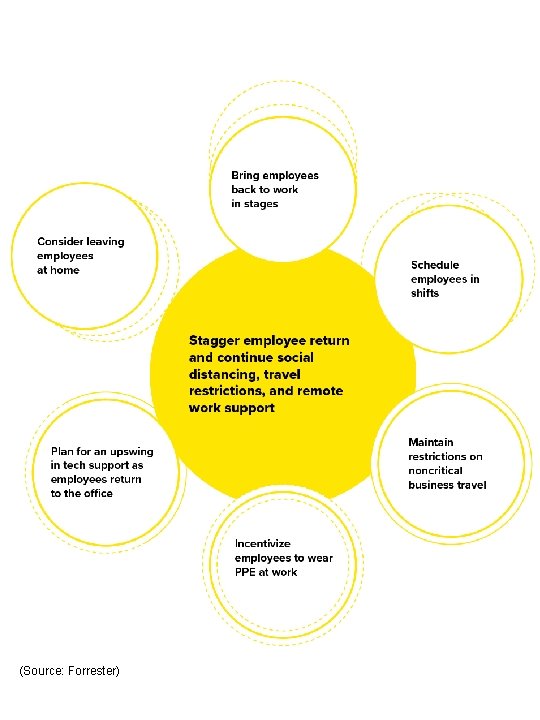
1. Manage Employee Numbers: A. Large volumes of employees returning to a shared workplace represents a huge risk for spreading and contracting a virus. B. Managing the number of workers will be critical to protecting workplace health. C. The higher the number, the higher the risk. When it comes to COVID-19, it really is a numbers game.
Suggestions: • Plan a staggered reintroduction to the office. • Establish a process such that a rotating group of employees work from the office every few days. • Create these groups across functional lines, both to ensure coverage across roles and to support employee distancing. • Resist the temptation to open the doors to everyone on the same day – the risk isn’t worth the grand gesture.
(Source: Forrester)
2. Maintain Remote Working: A. Despite the availability of regular workplaces, it’s prudent for businesses to continue some form of remote working for several months (at least). B. The reasons for this are both financial and practical. C. Rolling lockdowns and exits may continue for some time in regions where threat of COVID-19 remains high.
D. Seesawing back and forth between central and remote working states is hugely disruptive but minimized by a workforce accustomed to and practicing it throughout. E. Many organizations will elect to keep staff working from home for economic reasons. F. Others may have a return to remote working forced upon them if a staff member suddenly contracts the virus.
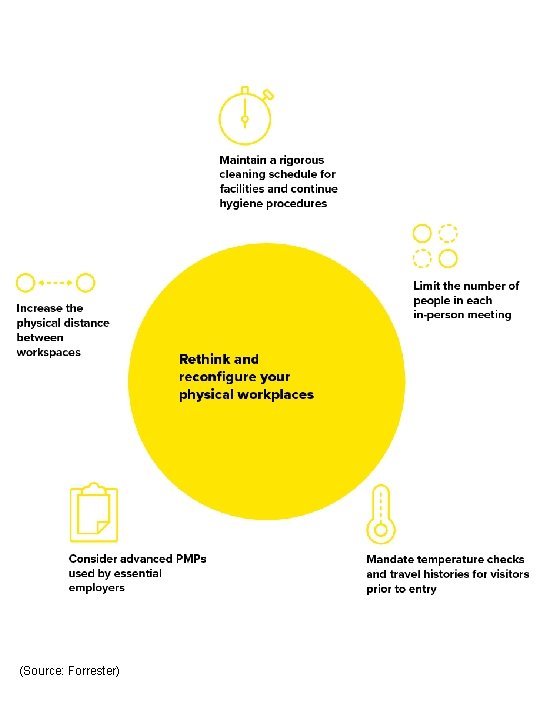
3. Rethink Physical Setup & Enhance Cleaning Practices: Reopening of workplaces won’t entirely remove all restrictions imposed during COVID-19. Businesses will still need to observe regulations governing: 1. Social Distancing 2. Employee Gatherings 3. Hygiene Practices It’s likely that pre-virus working environments are unsuited to these new restrictions.
Businesses will need to be proactive in reconfiguring their office spaces. Considerations: • The requirement for 6 feet between employees will impact both individual seating arrangements and shared spaces like cafeterias. • Use of transparent shields dividing desks where necessary. • Consider floor markers directing foot traffic. • How do we keep workspaces clean and sanitized?
(Source: Forrester)
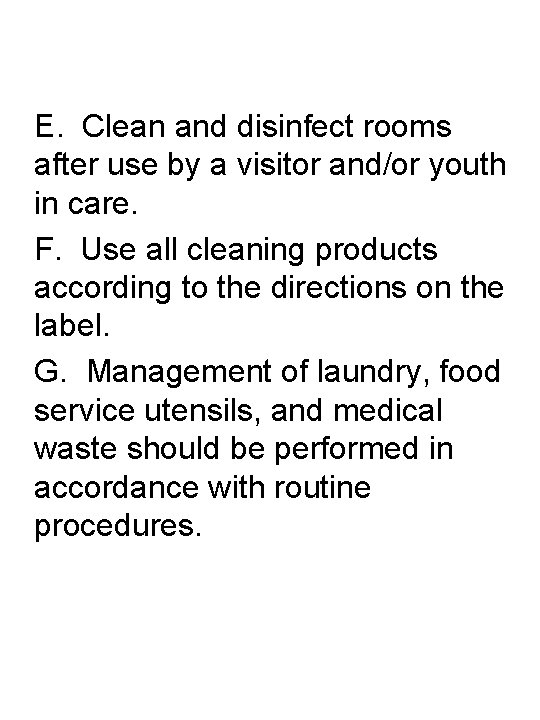
*Continue to enhance cleaning and disinfection in your facility consistent with CDC guidelines. In addition, use the following best practices: A. Encourage hand washing by youth, staff or family members for at least 20 seconds through education, scheduling time for handwashing, and the provision of adequate supplies. B. Provide alcohol-based hand sanitizers to supplement routine hand washing.
C. Require all staff, youth returning to the facility, and visitors entering the facility to wash their hands upon entry or utilize hand sanitizers. D. Clean and disinfect frequently touched objects and surfaces following the manufacturer’s guidance. *Frequently touched surfaces include, but are not limited to, toilets, faucets, dispensers, hand railings, telephones, door handles and knobs, computer equipment, TV remotes, copiers, keypads, and kitchen food preparation surfaces.
E. Clean and disinfect rooms after use by a visitor and/or youth in care. F. Use all cleaning products according to the directions on the label. G. Management of laundry, food service utensils, and medical waste should be performed in accordance with routine procedures.
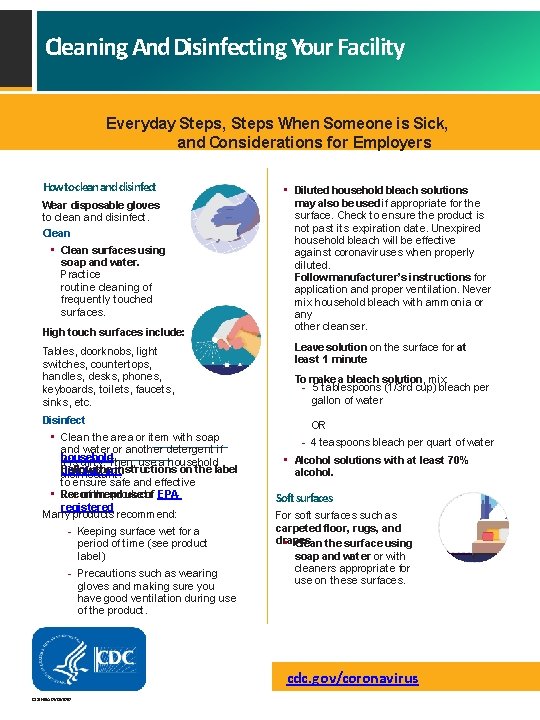
Cleaning And Disinfecting Your Facility Everyday Steps, Steps When Someone is Sick, and Considerations for Employers Howtoclean and disinfect Wear disposable gloves to clean and disinfect. Clean • Clean surfaces using soap and water. Practice routine cleaning of frequently touched surfaces. High touch surfaces include: Tables, doorknobs, light switches, countertops, handles, desks, phones, keyboards, toilets, faucets, sinks, etc. Disinfect • Clean the area or item with soap and water or another detergent if household it is dirty. Then, use a household Follow the instructions on the label disinfectant. to ensure safe and effective • use Recommend use of EPAof the product. registered Many products recommend: - Keeping surface wet for a period of time (see product label) - Precautions such as wearing gloves and making sure you have good ventilation during use of the product. • Diluted household bleach solutions may also be used if appropriate for the surface. Check to ensure the product is not past its expiration date. Unexpired household bleach will be effective against coronaviruses when properly diluted. Follow manufacturer’s instructions for application and proper ventilation. Never mix household bleach with ammonia or any other cleanser. Leave solution on the surface for at least 1 minute To make a bleach solution, mix: - 5 tablespoons (1/3 rd cup) bleach per gallon of water OR - 4 teaspoons bleach per quart of water • Alcohol solutions with at least 70% alcohol. Soft surfaces For soft surfaces such as carpeted floor, rugs, and drapes • Clean the surface using soap and water or with cleaners appropriate for use on these surfaces. cdc. gov/coronavirus CS 316248 A 04/01/2020
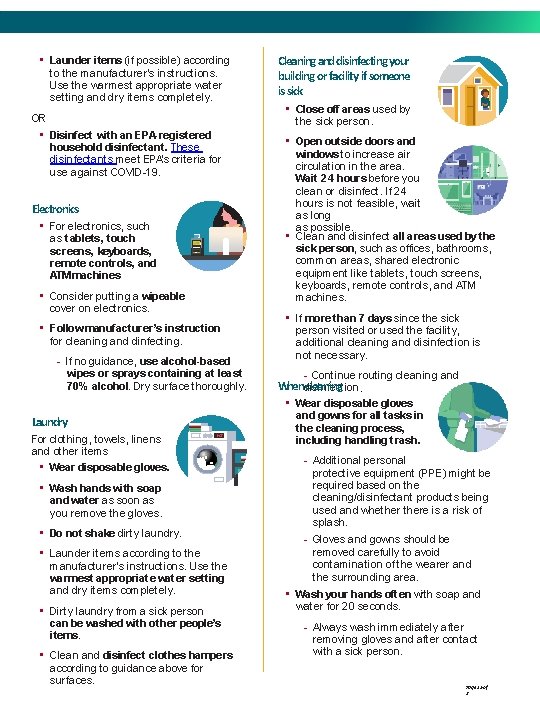
• Launder items (if possible) according to the manufacturer’s instructions. Use the warmest appropriate water setting and dry items completely. OR • Disinfect with an EPA-registered household disinfectant. These disinfectants meet EPA’s criteria for use against COVID-19. Electronics • For electronics, such as tablets, touch screens, keyboards, remote controls, and ATM machines • Consider putting a wipeable cover on electronics. • Follow manufacturer’s instruction for cleaning and dinfecting. - If no guidance, use alcohol-based wipes or sprays containing at least 70% alcohol. Dry surface thoroughly. Laundry For clothing, towels, linens and other items HOT • Wear disposable gloves. • Wash hands with soap and water as soon as you remove the gloves. • Do not shake dirty laundry. • Launder items according to the manufacturer’s instructions. Use the warmest appropriate water setting and dry items completely. • Dirty laundry from a sick person can be washed with other people’s items. • Clean and disinfect clothes hampers according to guidance above for surfaces. Cleaning and disinfecting your building or facility if someone is sick • Close off areas used by the sick person. • Open outside doors and windows to increase air circulation in the area. Wait 24 hours before you clean or disinfect. If 24 hours is not feasible, wait as long as possible. • Clean and disinfect all areas used by the sick person, such as offices, bathrooms, common areas, shared electronic equipment like tablets, touch screens, keyboards, remote controls, and ATM machines. • If more than 7 days since the sick person visited or used the facility, additional cleaning and disinfection is not necessary. - Continue routing cleaning and Whendisinfection cleaning. • Wear disposable gloves and gowns for all tasks in the cleaning process, including handling trash. - Additional personal protective equipment (PPE) might be required based on the cleaning/disinfectant products being used and whethere is a risk of splash. - Gloves and gowns should be removed carefully to avoid contamination of the wearer and the surrounding area. • Wash your hands often with soap and water for 20 seconds. - Always wash immediately after removing gloves and after contact with a sick person. Page 15 of 3
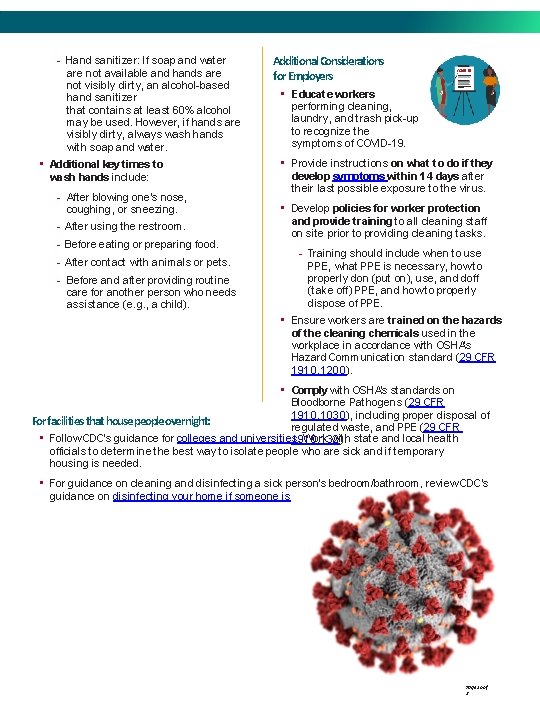
- Hand sanitizer: If soap and water are not available and hands are not visibly dirty, an alcohol-based hand sanitizer that contains at least 60% alcohol may be used. However, if hands are visibly dirty, always wash hands with soap and water. • Additional key times to wash hands include: - After blowing one’s nose, coughing, or sneezing. - After using the restroom. - Before eating or preparing food. - After contact with animals or pets. - Before and after providing routine care for another person who needs assistance (e. g. , a child). Additional Considerations for Employers COVID-19 • Educate workers performing cleaning, laundry, and trash pick-up to recognize the symptoms of COVID-19. • Provide instructions on what to do if they develop symptoms within 14 days after their last possible exposure to the virus. • Develop policies for worker protection and provide training to all cleaning staff on site prior to providing cleaning tasks. - Training should include when to use PPE, what PPE is necessary, how to properly don (put on), use, and doff (take off) PPE, and how to properly dispose of PPE. • Ensure workers are trained on the hazards of the cleaning chemicals used in the workplace in accordance with OSHA’s Hazard Communication standard (29 CFR 1910. 1200). • Comply with OSHA’s standards on Bloodborne Pathogens (29 CFR 1910. 1030), including proper disposal of For facilities that house people overnight: regulated waste, and PPE (29 CFR • Follow CDC’s guidance for colleges and universities. Work with state and local health 1910. 132). officials to determine the best way to isolate people who are sick and if temporary housing is needed. • For guidance on cleaning and disinfecting a sick person’s bedroom/bathroom, review CDC’s guidance on disinfecting your home if someone is sick. Page 16 of 3
4. Rebuild Workplace Morale: A. The human component of returning to office life requires as much focus as the practical one. B. For staff who have been away from their workplaces for weeks or months, returning will feel unsettling. C. Much may have changed in the interim. D. Successful businesses thrive on motivated workforces, so its important leaders invest efforts to rebuild workplace morale.
E. Acknowledge any employee concerns and/or dispiritedness. F. Treat announcements regarding the new operating environment with sensitivity. *Ideas to improve workplace culture: 1. Promoting achievements 2. Encouraging cross-functional collaboration 3. Painting a positive vision of the future 4. When the time is right, and regulations permit, consider a fun team-building event to lift spirits and let off some steam.
5. Review Infrastructure Needs: A. For most businesses, the nature of how they work will take many months to return to what it was prior to COVID-19 disruption – if it returns at all. B. That means there are now likely to be deficiencies in the infrastructure and support that employees need to perform their jobs.
Keep in mind: • Effective platforms to enable employee communication, connectivity and collaboration are essential to sustain business success. Suggestions: • Every department should review their operations and identify any areas of deficiency – especially in technology and communication infrastructure. • Research, evaluation and implementation should be fasttracked to avoid a crippling loss of productivity.
6. Maintain Communication: A. The COVID-19 situation has forced organizations to step-up their communications. B. Many have communicated with their staff more in the last couple of months than they traditionally do under normal conditions. C. Returning to usual workplace isn’t the time to relax this communication path.
7. Embed Your Learnings: A. The changes to work enforced by COVID-19 have delivered some benefits to businesses. B. Many have uncovered stronger collaboration within and across teams, more productive working routines and a reinforcement of positive health practices. C. Smart businesses will now seek to embed the lessons learned into how they conduct business in the future.
Suggestions: • Foster virtual collaboration in person by encouraging crossfunctional committees and rearranging seating arrangements to enable this. • Break down silos by regularly communicating the status of key projects for each functional area. • Maintain healthy workplace hygiene by reminding sick staff to stay home – particularly important with the continued risk of COVID-19 infection.