
RETURN FROM EXILE FROM BABYLON TO JUDAH Historical

RETURN FROM EXILE
FROM BABYLON TO JUDAH Historical Context Issues with Returning In 539 BCE, the Persian Empire defeated 1. Since it was pillaged, Jerusalem would have to Babylon In 538, King Cyrus of Persia issued an edict allowing Judahites to return to Judah from Babylon At this point, the Judahites had been in exile in Babylon for around 50 years be rebuilt 2. The journey from Babylon to Jerusalem was ~1, 000 miles through a barren desert and would have to be made on foot 3. Other people had settled in and around Judah; this new situation could lead to conflict
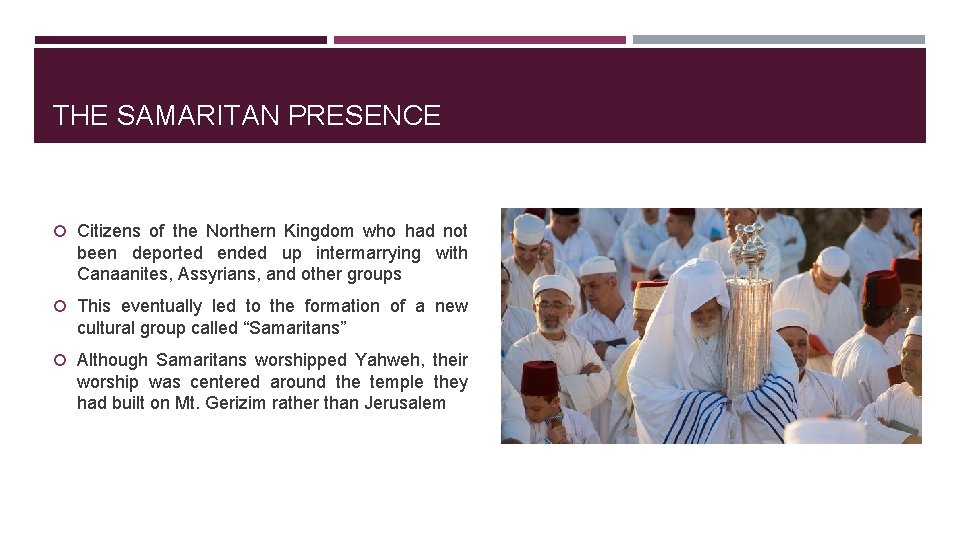
THE SAMARITAN PRESENCE Citizens of the Northern Kingdom who had not been deported ended up intermarrying with Canaanites, Assyrians, and other groups This eventually led to the formation of a new cultural group called “Samaritans” Although Samaritans worshipped Yahweh, their worship was centered around the temple they had built on Mt. Gerizim rather than Jerusalem
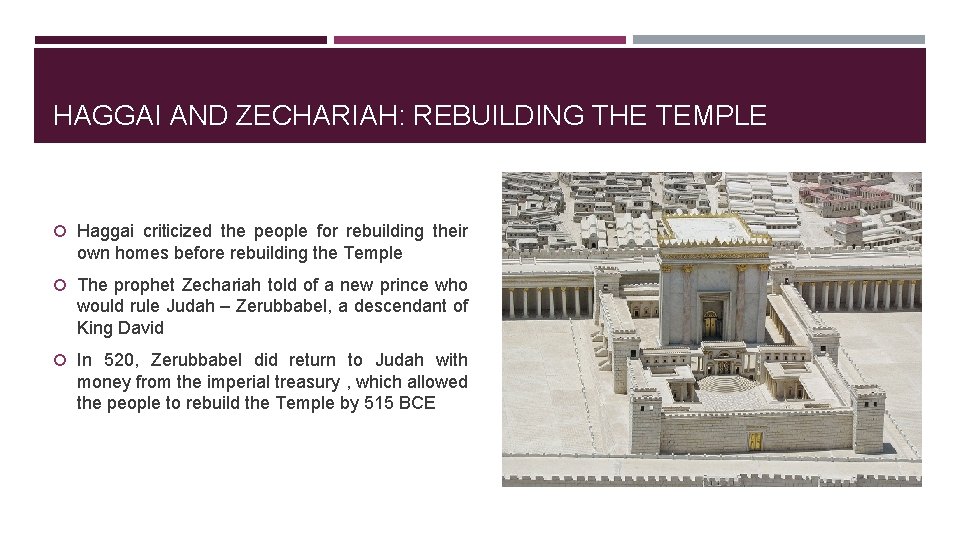
HAGGAI AND ZECHARIAH: REBUILDING THE TEMPLE Haggai criticized the people for rebuilding their own homes before rebuilding the Temple The prophet Zechariah told of a new prince who would rule Judah – Zerubbabel, a descendant of King David In 520, Zerubbabel did return to Judah with money from the imperial treasury , which allowed the people to rebuild the Temple by 515 BCE
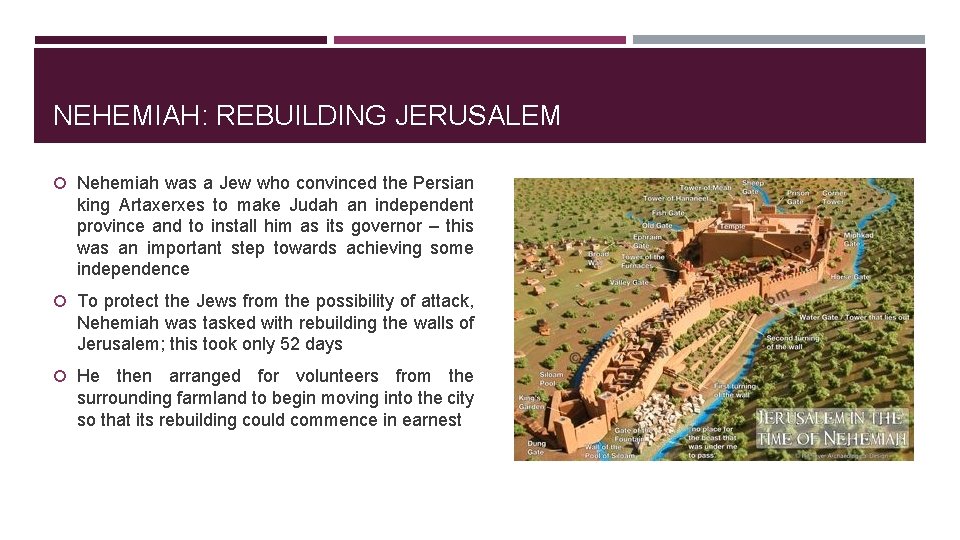
NEHEMIAH: REBUILDING JERUSALEM Nehemiah was a Jew who convinced the Persian king Artaxerxes to make Judah an independent province and to install him as its governor – this was an important step towards achieving some independence To protect the Jews from the possibility of attack, Nehemiah was tasked with rebuilding the walls of Jerusalem; this took only 52 days He then arranged for volunteers from the surrounding farmland to begin moving into the city so that its rebuilding could commence in earnest
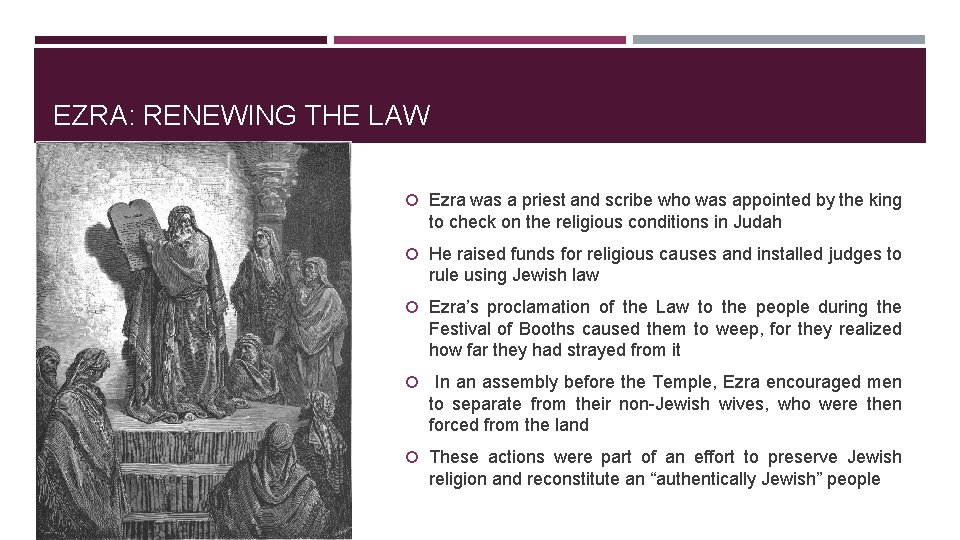
EZRA: RENEWING THE LAW Ezra was a priest and scribe who was appointed by the king to check on the religious conditions in Judah He raised funds for religious causes and installed judges to rule using Jewish law Ezra’s proclamation of the Law to the people during the Festival of Booths caused them to weep, for they realized how far they had strayed from it In an assembly before the Temple, Ezra encouraged men to separate from their non-Jewish wives, who were then forced from the land These actions were part of an effort to preserve Jewish religion and reconstitute an “authentically Jewish” people
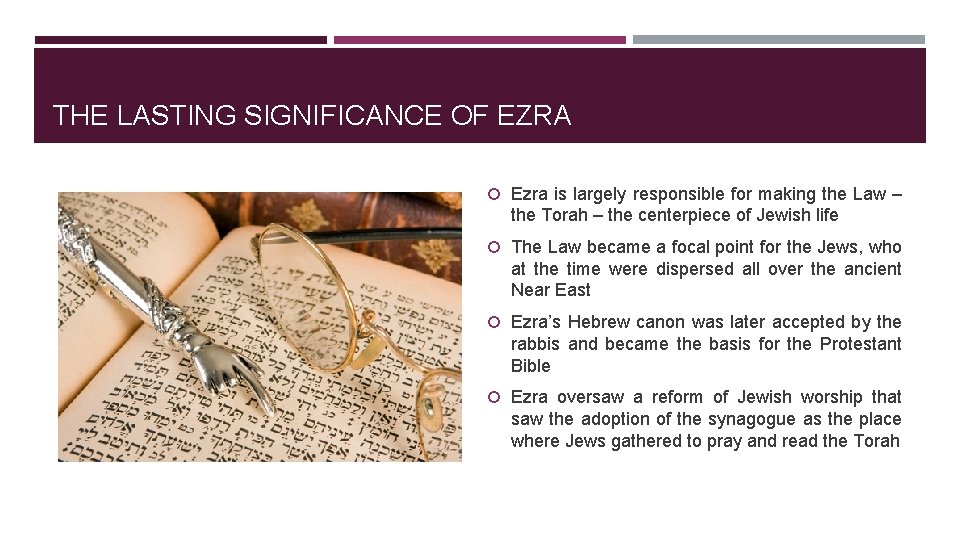
THE LASTING SIGNIFICANCE OF EZRA Ezra is largely responsible for making the Law – the Torah – the centerpiece of Jewish life The Law became a focal point for the Jews, who at the time were dispersed all over the ancient Near East Ezra’s Hebrew canon was later accepted by the rabbis and became the basis for the Protestant Bible Ezra oversaw a reform of Jewish worship that saw the adoption of the synagogue as the place where Jews gathered to pray and read the Torah
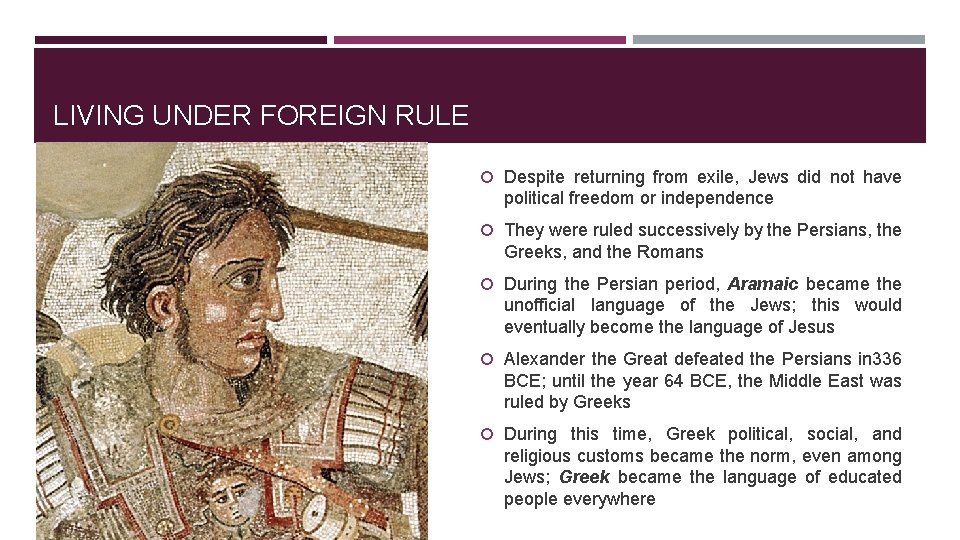
LIVING UNDER FOREIGN RULE Despite returning from exile, Jews did not have political freedom or independence They were ruled successively by the Persians, the Greeks, and the Romans During the Persian period, Aramaic became the unofficial language of the Jews; this would eventually become the language of Jesus Alexander the Great defeated the Persians in 336 BCE; until the year 64 BCE, the Middle East was ruled by Greeks During this time, Greek political, social, and religious customs became the norm, even among Jews; Greek became the language of educated people everywhere
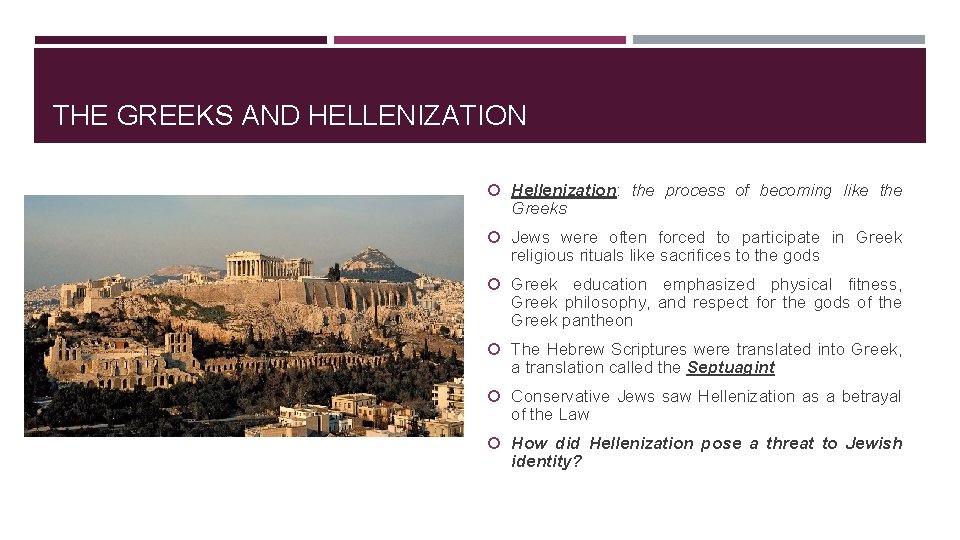
THE GREEKS AND HELLENIZATION Hellenization: the process of becoming like the Greeks Jews were often forced to participate in Greek religious rituals like sacrifices to the gods Greek education emphasized physical fitness, Greek philosophy, and respect for the gods of the Greek pantheon The Hebrew Scriptures were translated into Greek, a translation called the Septuagint Conservative Jews saw Hellenization as a betrayal of the Law How did Hellenization pose a threat to Jewish identity?
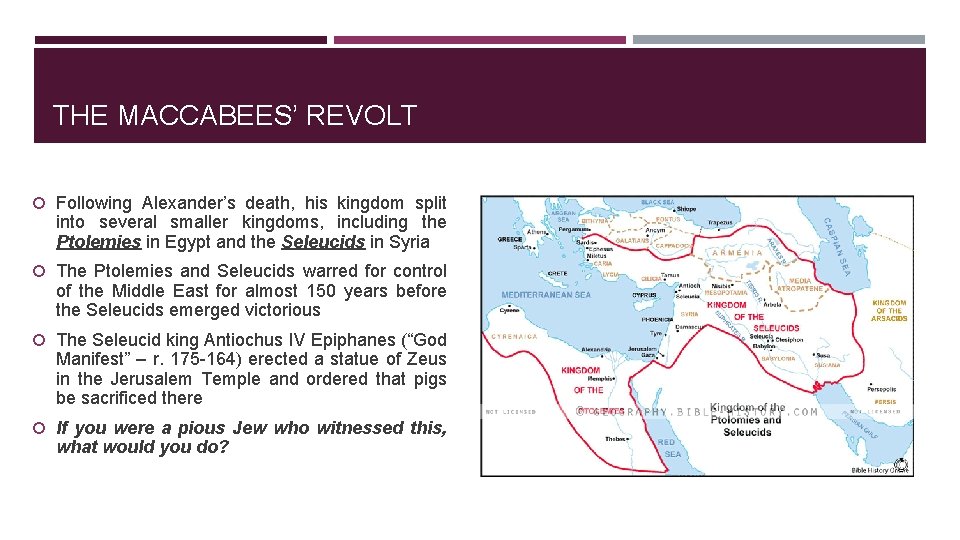
THE MACCABEES’ REVOLT Following Alexander’s death, his kingdom split into several smaller kingdoms, including the Ptolemies in Egypt and the Seleucids in Syria The Ptolemies and Seleucids warred for control of the Middle East for almost 150 years before the Seleucids emerged victorious The Seleucid king Antiochus IV Epiphanes (“God Manifest” – r. 175 -164) erected a statue of Zeus in the Jerusalem Temple and ordered that pigs be sacrificed there If you were a pious Jew who witnessed this, what would you do?
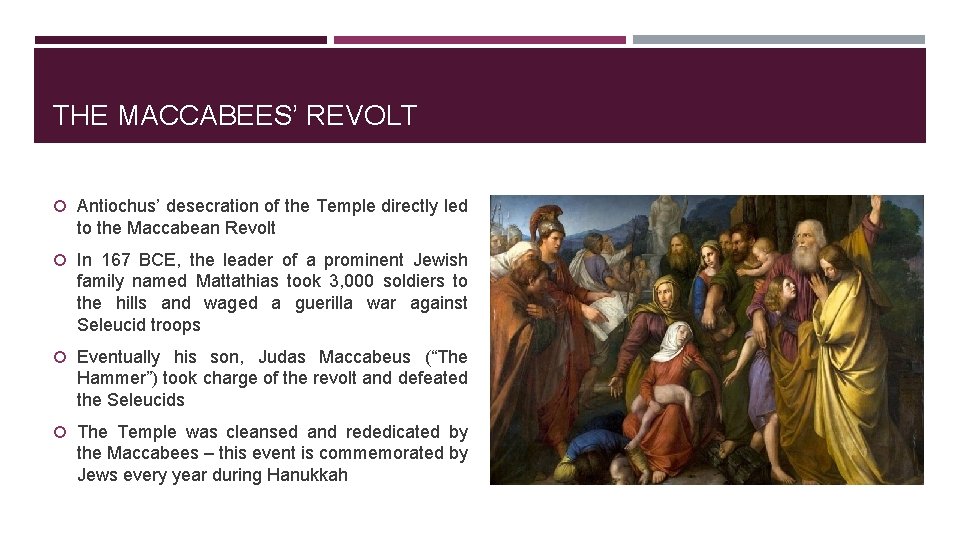
THE MACCABEES’ REVOLT Antiochus’ desecration of the Temple directly led to the Maccabean Revolt In 167 BCE, the leader of a prominent Jewish family named Mattathias took 3, 000 soldiers to the hills and waged a guerilla war against Seleucid troops Eventually his son, Judas Maccabeus (“The Hammer”) took charge of the revolt and defeated the Seleucids The Temple was cleansed and rededicated by the Maccabees – this event is commemorated by Jews every year during Hanukkah
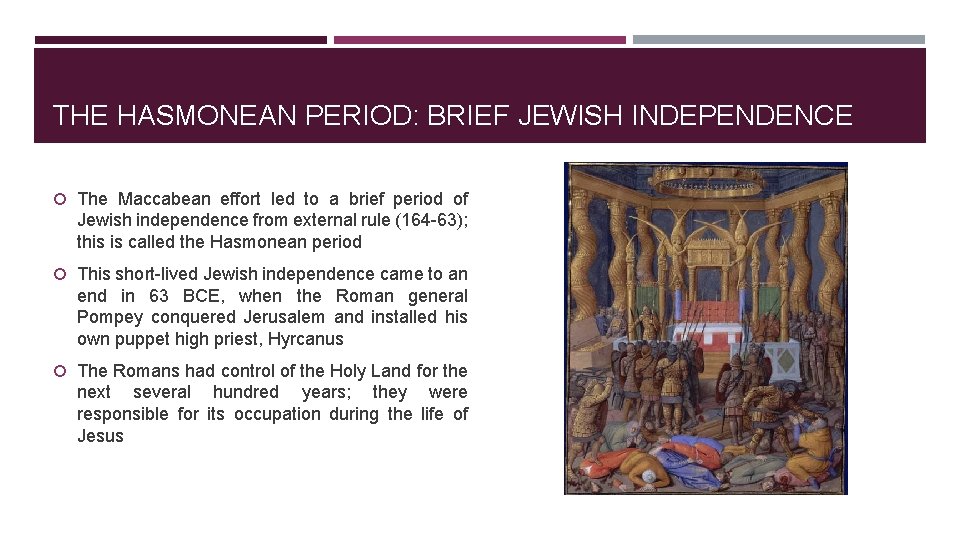
THE HASMONEAN PERIOD: BRIEF JEWISH INDEPENDENCE The Maccabean effort led to a brief period of Jewish independence from external rule (164 -63); this is called the Hasmonean period This short-lived Jewish independence came to an end in 63 BCE, when the Roman general Pompey conquered Jerusalem and installed his own puppet high priest, Hyrcanus The Romans had control of the Holy Land for the next several hundred years; they were responsible for its occupation during the life of Jesus
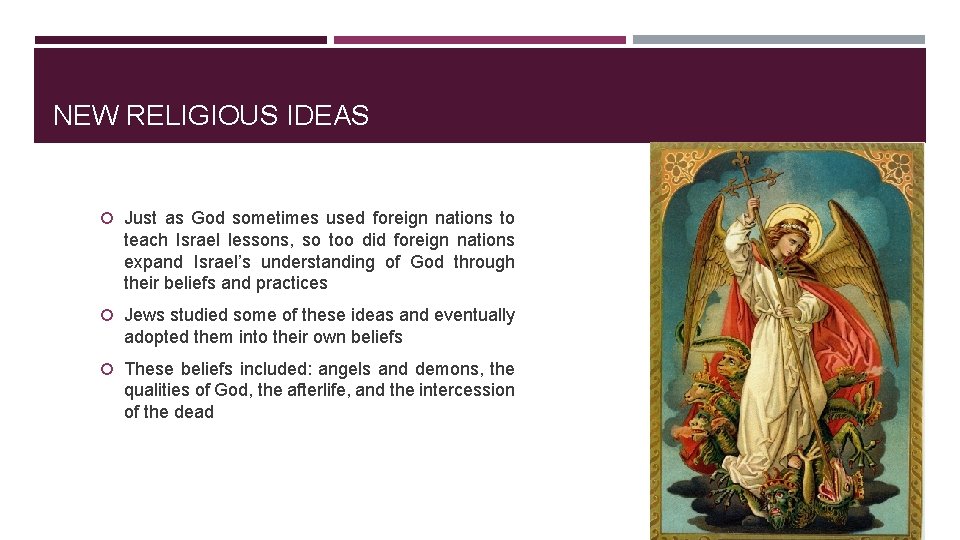
NEW RELIGIOUS IDEAS Just as God sometimes used foreign nations to teach Israel lessons, so too did foreign nations expand Israel’s understanding of God through their beliefs and practices Jews studied some of these ideas and eventually adopted them into their own beliefs These beliefs included: angels and demons, the qualities of God, the afterlife, and the intercession of the dead
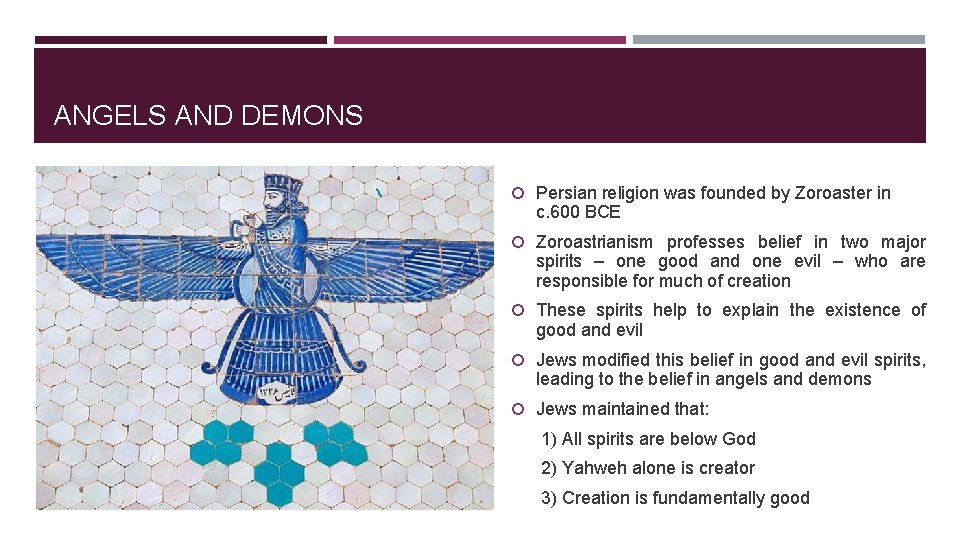
ANGELS AND DEMONS Persian religion was founded by Zoroaster in c. 600 BCE Zoroastrianism professes belief in two major spirits – one good and one evil – who are responsible for much of creation These spirits help to explain the existence of good and evil Jews modified this belief in good and evil spirits, leading to the belief in angels and demons Jews maintained that: 1) All spirits are below God 2) Yahweh alone is creator 3) Creation is fundamentally good
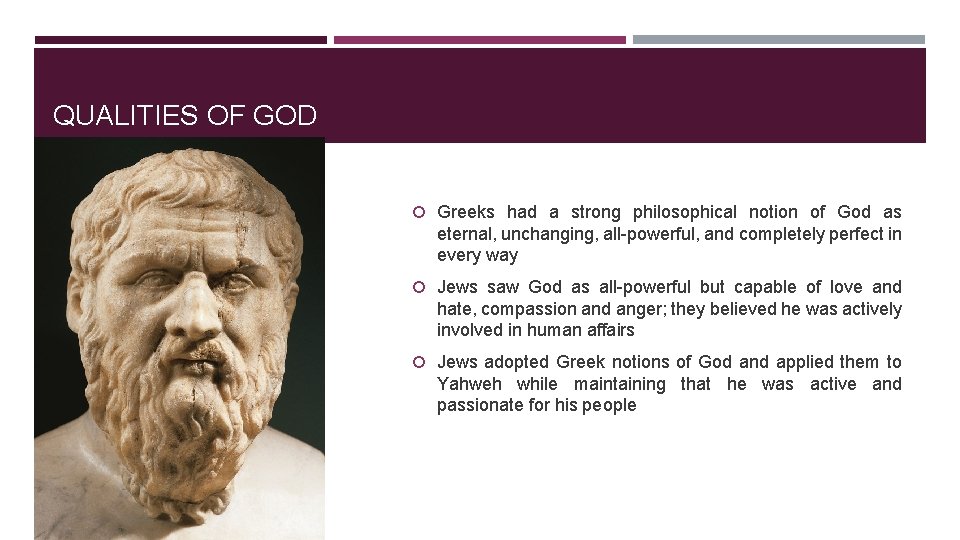
QUALITIES OF GOD Greeks had a strong philosophical notion of God as eternal, unchanging, all-powerful, and completely perfect in every way Jews saw God as all-powerful but capable of love and hate, compassion and anger; they believed he was actively involved in human affairs Jews adopted Greek notions of God and applied them to Yahweh while maintaining that he was active and passionate for his people
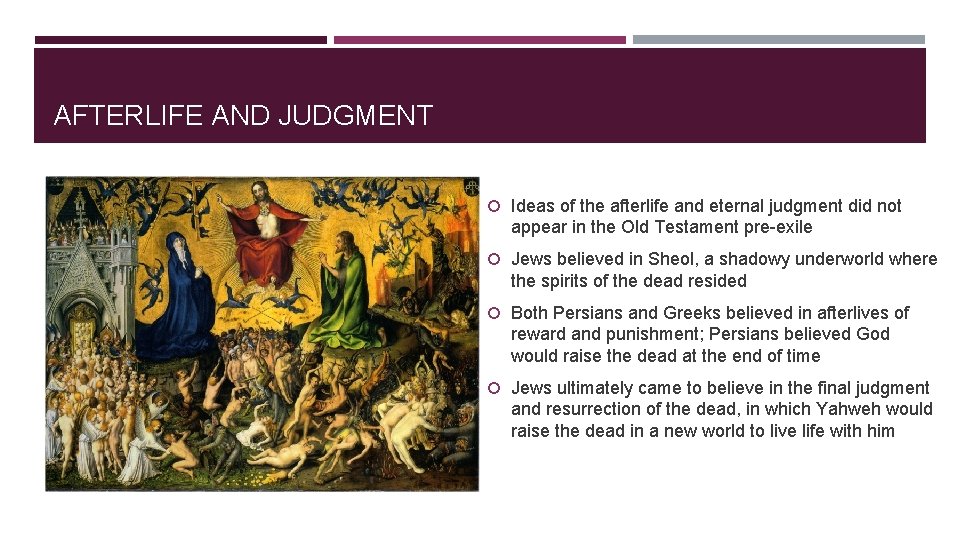
AFTERLIFE AND JUDGMENT Ideas of the afterlife and eternal judgment did not appear in the Old Testament pre-exile Jews believed in Sheol, a shadowy underworld where the spirits of the dead resided Both Persians and Greeks believed in afterlives of reward and punishment; Persians believed God would raise the dead at the end of time Jews ultimately came to believe in the final judgment and resurrection of the dead, in which Yahweh would raise the dead in a new world to live life with him
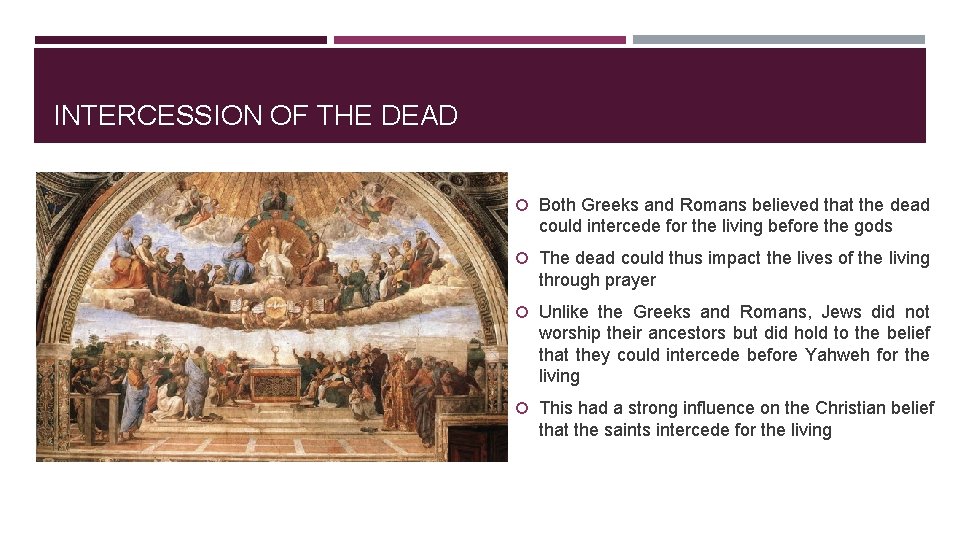
INTERCESSION OF THE DEAD Both Greeks and Romans believed that the dead could intercede for the living before the gods The dead could thus impact the lives of the living through prayer Unlike the Greeks and Romans, Jews did not worship their ancestors but did hold to the belief that they could intercede before Yahweh for the living This had a strong influence on the Christian belief that the saints intercede for the living
- Slides: 17