
RETSINA MAS Architecture with Service Discovery Reusable Environment
RETSINA MAS Architecture with Service Discovery Reusable Environment for Task-Structured Intelligent Networked Agents Multi-Agent System Architecture With Local and Wide Area Service Discovery
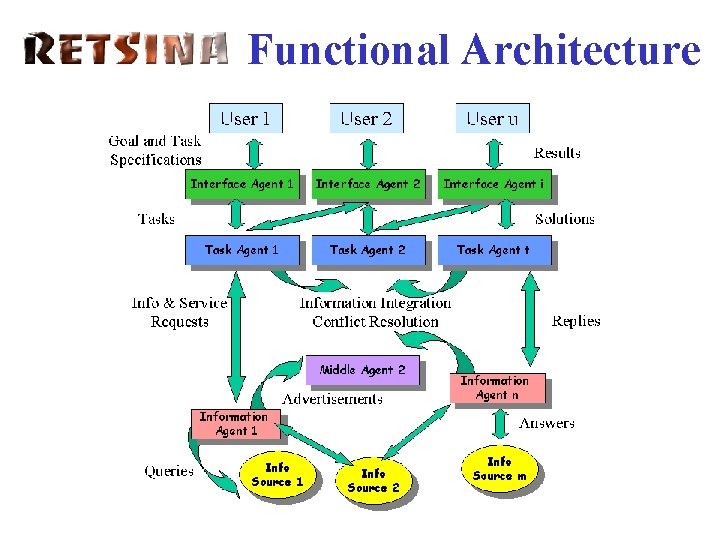
Functional Architecture

Agent Architecture Four parallel threads: • Communicator • for conversing with other agents • Planner • matches “sensory” input and “beliefs” to possible plan actions • Scheduler • schedules “enabled” plans for execution • Execution Monitor • executes scheduled plan • swaps-out plans for those with higher priorities

MAS Infrastructure Individual Agent Infrastructure MAS Interoperation Translation Services Interoperator Services Interoperation Modules Capability to Agent Mapping Middle Agents Middle Agent Components Name to Location Mapping Agent Name Service ANS Component Security Certificate Authority Cryptographic Service Security Module Private/Public Keys Performance Services MAS Monitoring Reputation Services Performance Service Modules Multi-Agent Management Services Logging Activity Visualization Launching Logging and Visualization Components ACL Infrastructure Public Ontology Protocol Servers Parser, Private Ontology, Protocol Engine Communications Infrastructure Communication Modules Discovery Message Transfer Modules Operating Environment Machines, OS, Network, Multicast Transport Layer, TCP/IP, Wireless, Infrared, SSL

RETSINA Architecture Agents, Middle Agents, and Infrastructure RETSINA Intelligent Software Agent Planner Scheduler Execution Monitor Resource Protocols Svcs Security/Authentication/Encryption Resource Discovery Vocabulary Management & Management. Resource Dialog Community Point-to-Point Discovery Aggregation Communications and Peer-to-Peer Communications And Interactions Mgt. Communications MAS Infrastructure Name Services White Pages Capability Lookup Services Yellow Pages Agent Name Service (ANS) Matchmaker Capability Mediation Broker Services Inter. Operator Services Resource Protocols. Services Security/Authentication/Encryption Resource Discovery Vocabulary Management & Management. Resource Dialog Community Point-to-Point Discovery Aggregation Communications and Peer-to-Peer Communications And Interactions Mgt. Communications

Local Dynamic Discovery • Simple Service Discovery Protocol (SSDP) from the Universal Plug-n-Play (UPn. P) initiative – Multicast search requests to populate lists of infrastructure service provider alternatives – Receive Multicast Alive & Byebye messages to automatically update discovered-provider lists. – Service-specific reactions to Discovery Events • Register with one or more services and optionally automatically register with newly “alive” systems • Auto fail-over and pruning of services lists to maintain list of “viable” service providers

SSDP Communications Announcement of Availability Multicast with Limited TTL Search for Available Services Discontinuance of Availability Multicast with Limited TTL HTTP NOTIFY (GENA) Multicast Query Contains: with Service Type or wildcard for “all” Limited Host/Port for response TTL Unicast point to point HTTP NOTIFY (GENA) HTTP M-Search Response Contains: Unique Service Name Service’s Type Service’s IP Address Service’s Socket/Port Note: Unlike SLP & Jini, SSDP does not require (or define) a separate Directory/Registry entity.

An example of an SSDP discovery-enabled application: The RETSINA Agent Name Service Server And Clients

ANS peer-server discovery • ANS-x comes online with no other servers visible • ANS-y comes online ANS-x – Sends Alive packet (now ANS-x knows about ANS-y) – Sends Discovery/Search packet to find other ANS servers (now ANS-y knows about ANS-x) • ANS-z has been online; however its network connection was detached, but has now been repaired. – Periodic “Alive” packets from each ANS inform others of their presence. – If another ANS wanted to talk to a peer, but knew of known, it would send out a Discovery Search packet, to which the others would respond ANS-y ANS-z
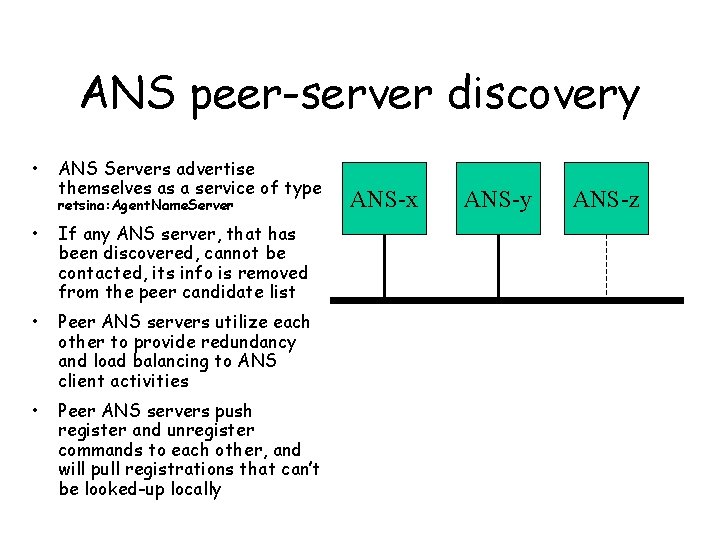
ANS peer-server discovery • ANS Servers advertise themselves as a service of type retsina: Agent. Name. Server • If any ANS server, that has been discovered, cannot be contacted, its info is removed from the peer candidate list • Peer ANS servers utilize each other to provide redundancy and load balancing to ANS client activities • Peer ANS servers push register and unregister commands to each other, and will pull registrations that can’t be looked-up locally ANS-x ANS-y ANS-z

ANS Client discovery of Peer-Server cluster • ANS Client comes online and does a Discovery/Search for services of type ANS-x retsina: Agent. Name. Server • ANS Client makes a list of all responding ANS servers and selects one to connect to. • ANS Client knows to roll over to alternate server upon failure to connect or interact with any server ANS Client ANS-y ANS-z
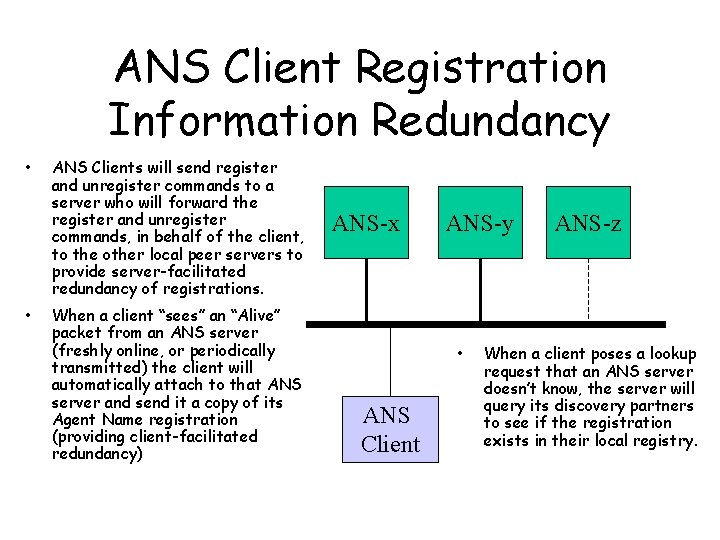
ANS Client Registration Information Redundancy • • ANS Clients will send register and unregister commands to a server who will forward the register and unregister commands, in behalf of the client, to the other local peer servers to provide server-facilitated redundancy of registrations. When a client “sees” an “Alive” packet from an ANS server (freshly online, or periodically transmitted) the client will automatically attach to that ANS server and send it a copy of its Agent Name registration (providing client-facilitated redundancy) ANS-x ANS-y • ANS Client ANS-z When a client poses a lookup request that an ANS server doesn’t know, the server will query its discovery partners to see if the registration exists in their local registry.

Islands of ANS Server Peer Groups • When an ANS Server can’t resolve a “lookup” request locally, or via its local discovery peergroup, it can access its “hierarchy -list” of remote ANS servers, and attempt to perform a longdistance pull of the desired registry information. • A forwarded lookup query will propagate from one realm of peer servers to the next until a max hop count is reached. • Each hierarchy ANS server will lookup the entry locally, with its local peer group, and then to its own hierarchy partners. • ANS Client Each ANS server along the successful lookup trail will learn the registration for ease of future lookups.
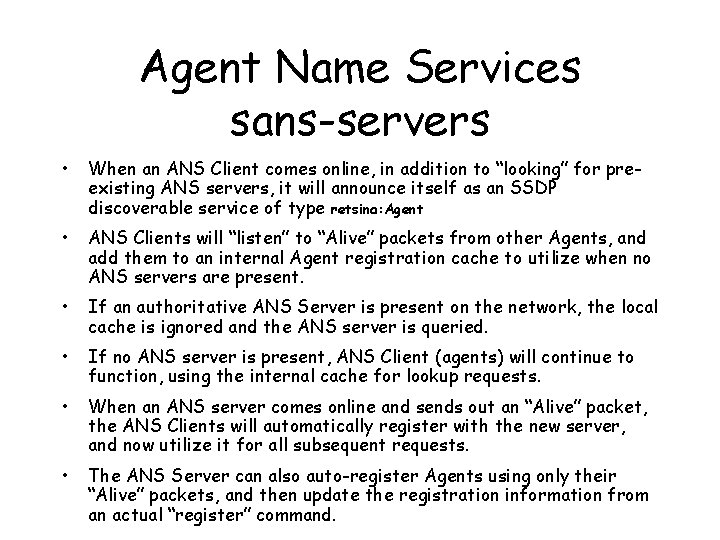
Agent Name Services sans-servers • When an ANS Client comes online, in addition to “looking” for preexisting ANS servers, it will announce itself as an SSDP discoverable service of type retsina: Agent • ANS Clients will “listen” to “Alive” packets from other Agents, and add them to an internal Agent registration cache to utilize when no ANS servers are present. • If an authoritative ANS Server is present on the network, the local cache is ignored and the ANS server is queried. • If no ANS server is present, ANS Client (agents) will continue to function, using the internal cache for lookup requests. • When an ANS server comes online and sends out an “Alive” packet, the ANS Clients will automatically register with the new server, and now utilize it for all subsequent requests. • The ANS Server can also auto-register Agents using only their “Alive” packets, and then update the registration information from an actual “register” command.

ANS Registration Leases • Registrations can contain a lease/ttl request • The default lease request is 900 seconds = 15 minutes. • Agents can request longer leases. • Agents can periodically re-register to renew leases. • The ANS Server is set to periodically send out an Alive packet at 75% of the default lease time (approximately every 11 minutes) to which all discovery-enabled ANS clients will respond to by sending a registration request that will renew their lease. • Any lookup after the lease expires will remove the entry from the registry and fail in the local search
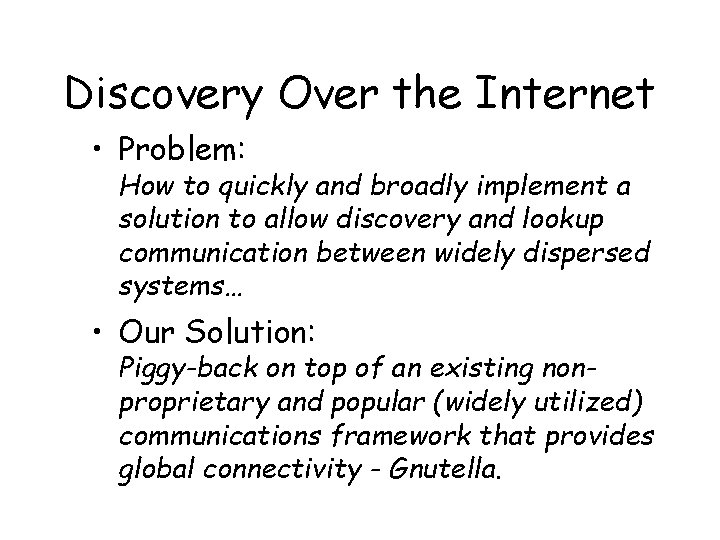
Discovery Over the Internet • Problem: How to quickly and broadly implement a solution to allow discovery and lookup communication between widely dispersed systems… • Our Solution: Piggy-back on top of an existing nonproprietary and popular (widely utilized) communications framework that provides global connectivity - Gnutella.
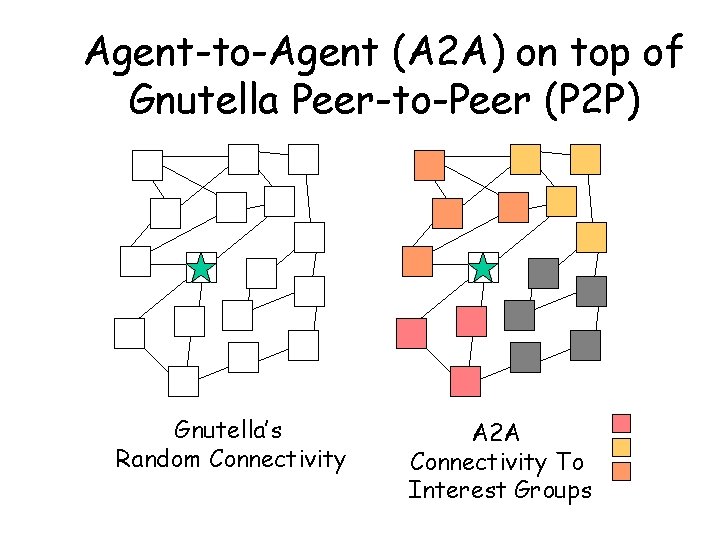
Agent-to-Agent (A 2 A) on top of Gnutella Peer-to-Peer (P 2 P) Gnutella’s Random Connectivity A 2 A Connectivity To Interest Groups

Agent-to-Agent Enhancements Categorize Confidence Query Modification Community Query’s Seen Prime Q-Hit’s Seen Min Speed=Encoded Community Identifier Alt Activity Level Local Bad Packets Home Dup Queries Cache Dup Msgs Bad Dup Pkts - Quick Check: see if worthwhile to check - Hide from “standard” Gnutella Servents Prefix Query with Community Identifier - Absolute Check (appropriate to process) Encrypt Query and Responses - Further Hide Query from Gnutella Protect conversation Used Repeat Pkt Type Task-Structure New Sequential Pkts - Query & Query. Hit Packets escalated to A 2 A Task Objects for Handling
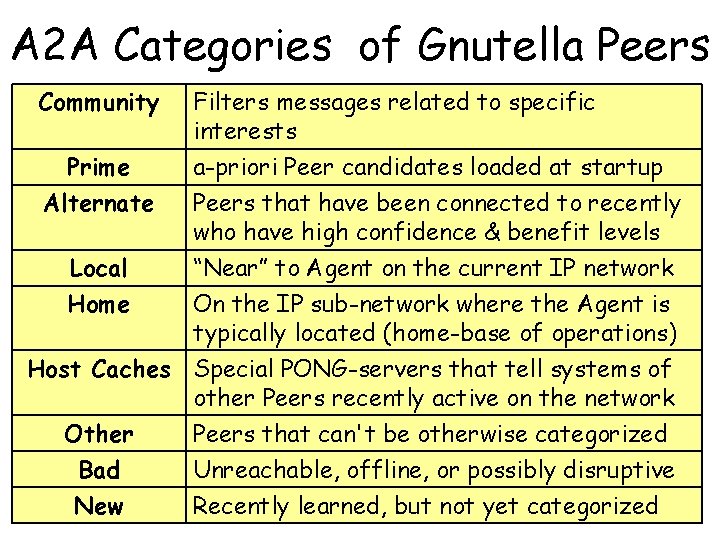
A 2 A Categories of Gnutella Peers Community Prime Alternate Local Home Filters messages related to specific interests a-priori Peer candidates loaded at startup Peers that have been connected to recently who have high confidence & benefit levels “Near” to Agent on the current IP network On the IP sub-network where the Agent is typically located (home-base of operations) Host Caches Special PONG-servers that tell systems of other Peers recently active on the network Other Peers that can't be otherwise categorized Bad Unreachable, offline, or possibly disruptive New Recently learned, but not yet categorized
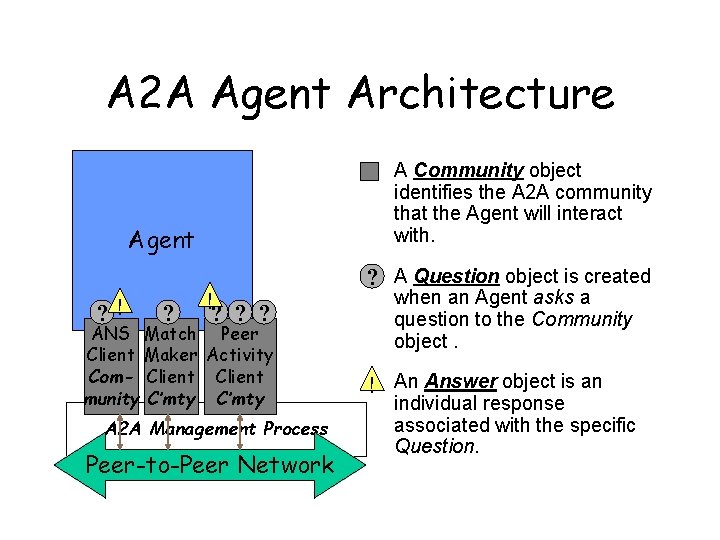
A 2 A Agent Architecture • A Community object identifies the A 2 A community that the Agent will interact with. Agent ? ! ? ? ? ANS Match Peer Client Maker Activity Com- Client munity C’mty A 2 A Management Process Peer-to-Peer Network ? • A Question object is created when an Agent asks a question to the Community object. • ! An Answer object is an individual response associated with the specific Question.
A 2 A Discovery • When a Community object is created, it can be marked as a “Discoverable” Community. • Discoverable Communities automatically create a discovery Question object to periodically attempt to discover other Agents that support the same Community type. • Discoverable Communities create an Auto-Answer that watches incoming Questions to see if they are discovery queries. If so, the Agent’s location is automatically replied. • Discovery replies are maintained by the Communities as a list of known community peers, and utilized by the A 2 A state management process to ensure adequate connectivity to each peer community.
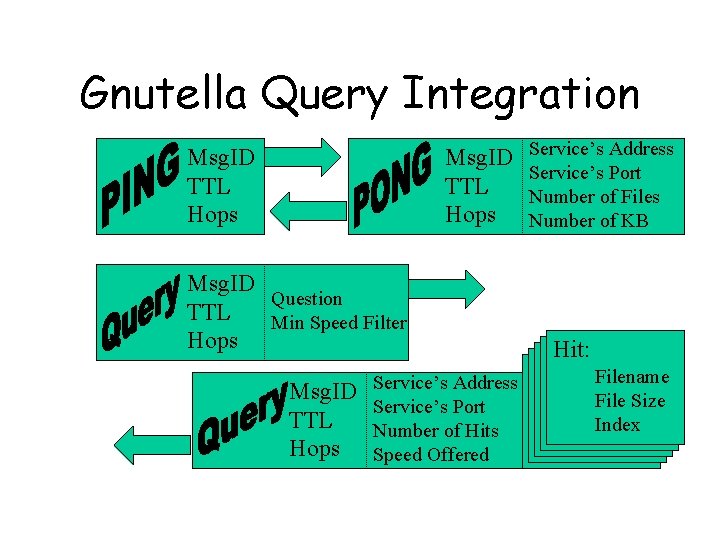
Gnutella Query Integration Msg. ID TTL Hops Msg. ID Question TTL Min Speed Filter Hops Msg. ID TTL Hops Service’s Address Service’s Port Number of Hits Speed Offered Service’s Address Service’s Port Number of Files Number of KB Hit: Filename File Size Index

Gnutella Query Integration Msg. ID Question = Matchmaker: discover TTL Min Speed Filter = 10, 850, 000 Hops Community Identifier: Matchmaker Encoded Identifier: 10, 850, 000 Agent Query: discover Msg. ID TTL Hops Service’s Address Service’s Port Number of Hits Speed Offered Hit: Filename File Size Index
Agent Name Service Clients on A 2 A/P 2 P • A Discoverable Task to automatically form communities with other retsina: Agent. Name. Service peers. • register agent-name commands create Auto-Answers for future lookup agent-name and listall queries • unregister agent-name commands remove local Auto. Answers of appropriate lookup and listall queries • Agents can lookup other Agents without the use of an ANS server. • Agents can cache previously found lookup information and facilitate lookups by other peers.

A 2 A Functionality Agent Point-of-View Agent-to-Agent Support Library • • Initiate steady-state of connectivity if it has not already been established • • Allow Incoming connections Multicast connection for local traffic Collect peer candidates from Host-Caches Make Outgoing Connections to the most promising candidates and track their usefulness Maintain defined levels of peer connectivity • Create Community Object for type of Communications/Interest desired; i. e. RETSINA, FIPA, Agents, Auctions, Matchmaking, etc. Client/Consumer Mode • Service/Producer Mode – Ask a Question – Get Answers and Process Responses – Receive a Question – Add Responses and Dispatch Reply • Handle Replies Discovery and Lookup Queries • • • Auto-discover Community Peers from replies Filter for appropriateness Queue response messages Encrypt/Decrypt replies Provide Call-back/Event Driven capabilities for Answer processing Begin Discovery for Community Peers Filter for task-related messages Queue messages as needed Encrypt/Decrypt messages Provide Synch/Asynchronous and Callback/Event Driven facilities for query processing
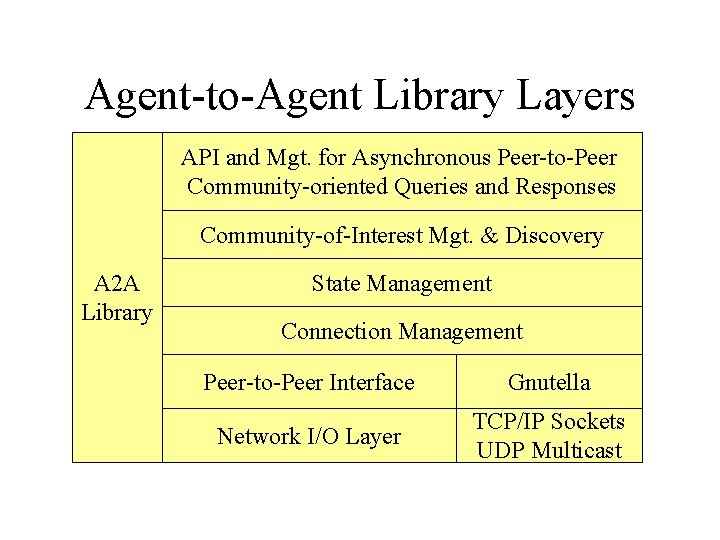
Agent-to-Agent Library Layers API and Mgt. for Asynchronous Peer-to-Peer Community-oriented Queries and Responses Community-of-Interest Mgt. & Discovery A 2 A Library State Management Connection Management Peer-to-Peer Interface Gnutella Network I/O Layer TCP/IP Sockets UDP Multicast
New Gnutella News • The base protocols for Gnutella have been updated to enhance scaling and reduce extraneous traffic • Some clients only attach to others that can support the latest protocol revisions • Like A 2 A peers, new Ultra. Peers form a more permanent and better-managed backbone between realms of dynamic client peers and can query peers for information about content/services they offer (but inter-Ultra. Peer routing techniques need to be addressed)
New Opportunities for A 2 A • Open Source Gnutella Protocol Libraries are now available and publicly maintained. • Queries and their responses can now contain both a standard “text” part, and a enhanced XML (or other) part to further describe the request/content with meta information (possibly using SOAP or DAML-S) • Ultra. Peers can filter traffic sent to a leaf node based on the leaf’s ability to handle the request. This could be used to implement content (or service) based routing using the text part of queries, with the actual request contained in the XML part. This would eliminate the need for a separate “service discovery” process.
- Slides: 28