
Retrieving Extreme wind speeds using Cband instruments GerdJan
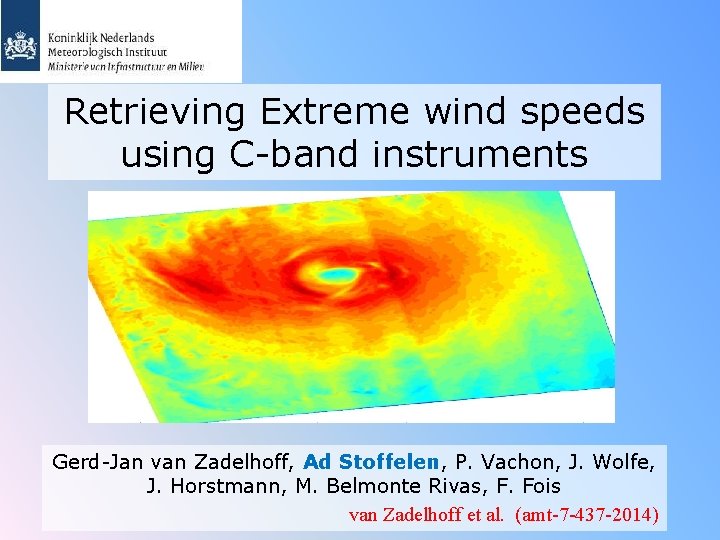
Retrieving Extreme wind speeds using C-band instruments Gerd-Jan van Zadelhoff, Ad Stoffelen, P. Vachon, J. Wolfe, J. Horstmann, M. Belmonte Rivas, F. Fois van Zadelhoff et al. (amt-7 -437 -2014)
Met. OP Second Generation • The Met. OP-SG series will be launched in 2020+ • One instrument on board is a vertical co-polarization (VV) C-band scatterometer (SCA), similar to ASCAT. • An innovation on ASCAT-SG is the inclusion of crosspolarization (VH) channels on the scatterometer mid beams to retrieve extreme winds. • The goal of the present work was to provide a scientific background to assist in the decision-making process on including the VH channels to the ASCAT-SG instrument. • We present a cross-polarization Geophysical model function (VH-GMF) based on Radar. SAT 2 SAR data. Exeter 2016
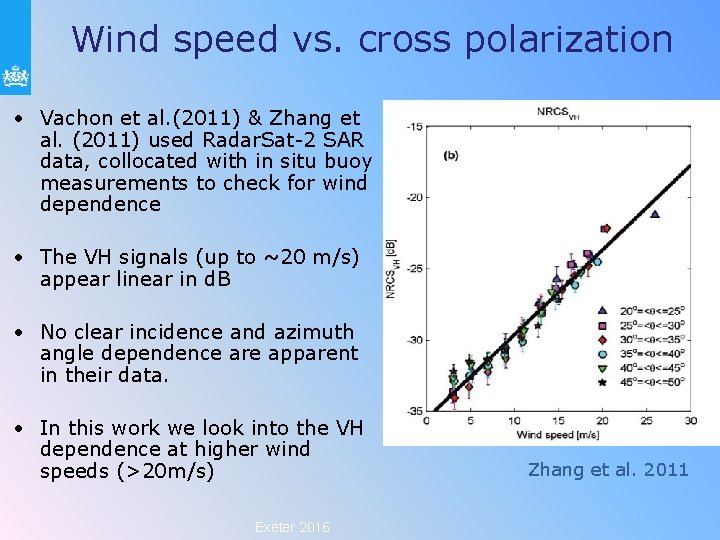
Wind speed vs. cross polarization • Vachon et al. (2011) & Zhang et al. (2011) used Radar. Sat-2 SAR data, collocated with in situ buoy measurements to check for wind dependence • The VH signals (up to ~20 m/s) appear linear in d. B • No clear incidence and azimuth angle dependence are apparent in their data. • In this work we look into the VH dependence at higher wind speeds (>20 m/s) Exeter 2016 Zhang et al. 2011
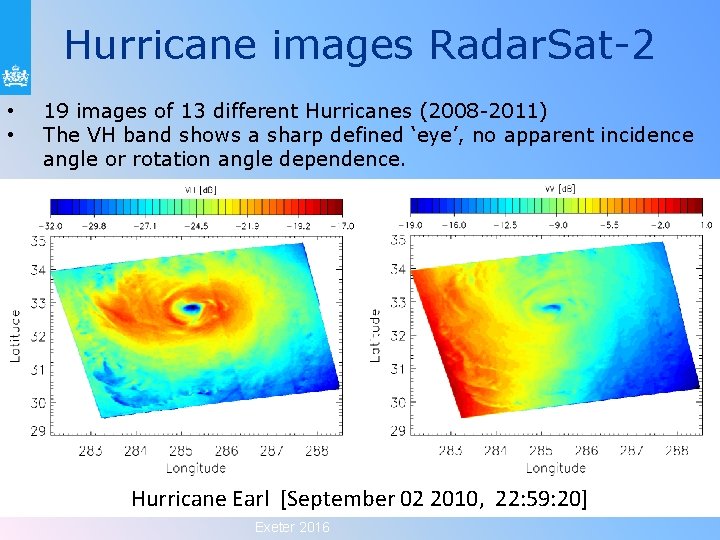
Hurricane images Radar. Sat-2 • • 19 images of 13 different Hurricanes (2008 -2011) The VH band shows a sharp defined ‘eye’, no apparent incidence angle or rotation angle dependence. Hurricane Earl [September 02 2010, 22: 59: 20] Exeter 2016
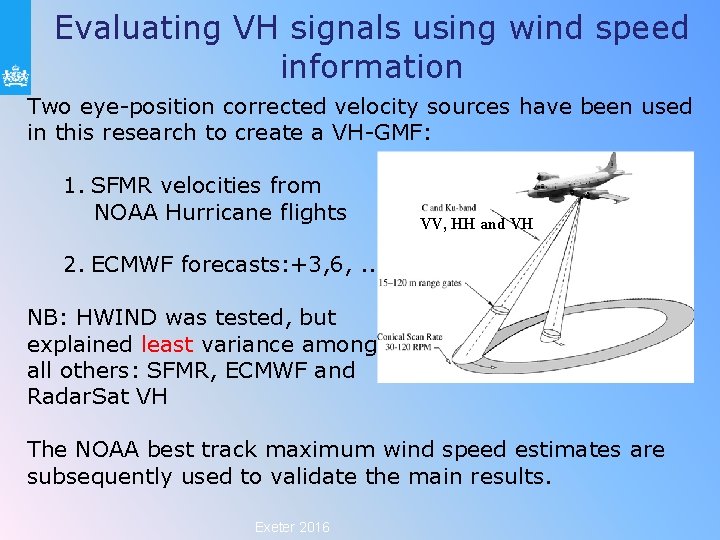
Evaluating VH signals using wind speed information Two eye-position corrected velocity sources have been used in this research to create a VH-GMF: 1. SFMR velocities from NOAA Hurricane flights VV, HH and VH 2. ECMWF forecasts: +3, 6, . . NB: HWIND was tested, but explained least variance among all others: SFMR, ECMWF and Radar. Sat VH The NOAA best track maximum wind speed estimates are subsequently used to validate the main results. Exeter 2016
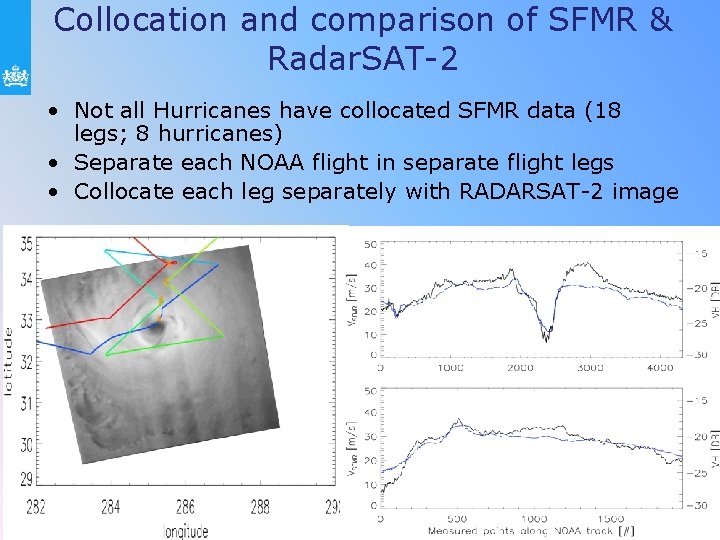
Collocation and comparison of SFMR & Radar. SAT-2 • Not all Hurricanes have collocated SFMR data (18 legs; 8 hurricanes) • Separate each NOAA flight in separate flight legs • Collocate each leg separately with RADARSAT-2 image IGARRS 2014; TH 2. 11. 5
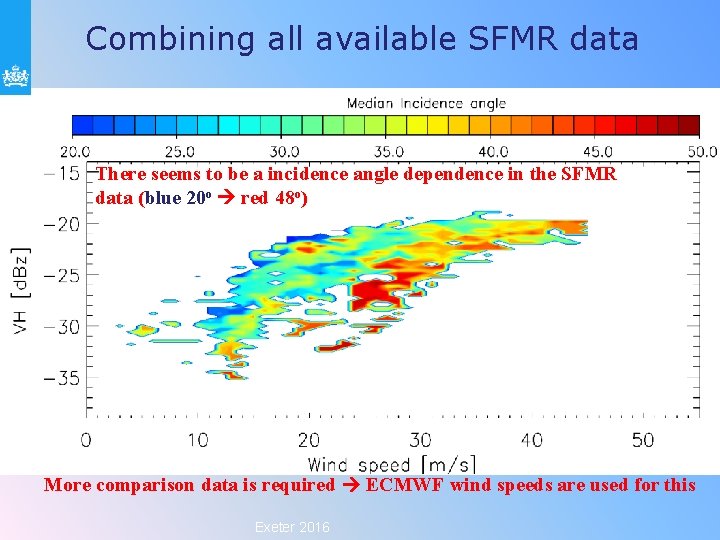
Combining all available SFMR data There seems to be a incidence angle dependence in the SFMR data (blue 20 o red 48 o) More comparison data is required ECMWF wind speeds are used for this Exeter 2016
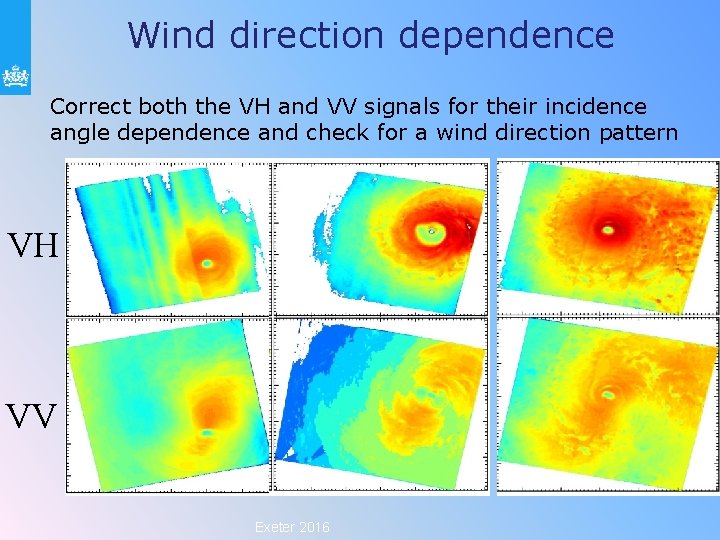
Wind direction dependence Correct both the VH and VV signals for their incidence angle dependence and check for a wind direction pattern VH VV Exeter 2016
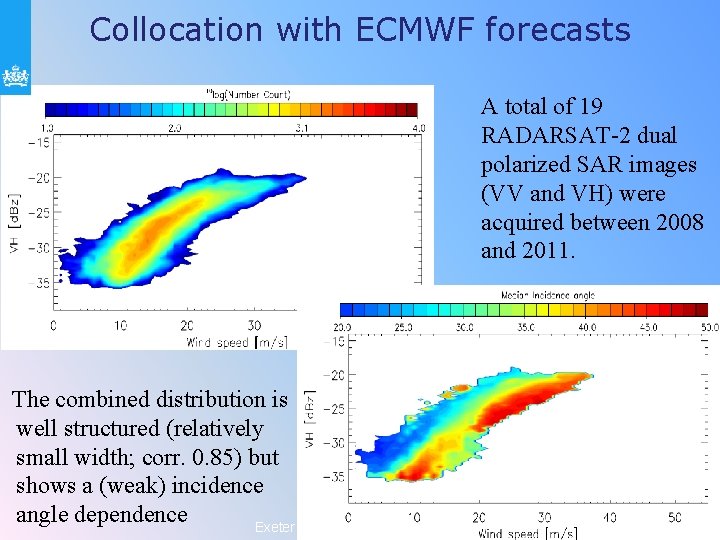
Collocation with ECMWF forecasts A total of 19 RADARSAT-2 dual polarized SAR images (VV and VH) were acquired between 2008 and 2011. The combined distribution is well structured (relatively small width; corr. 0. 85) but shows a (weak) incidence angle dependence Exeter 2016
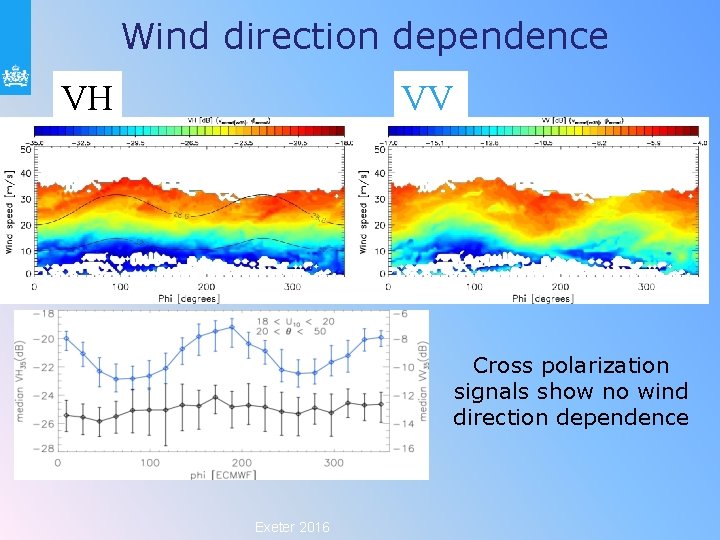
Wind direction dependence VH VV Cross polarization signals show no wind direction dependence Exeter 2016
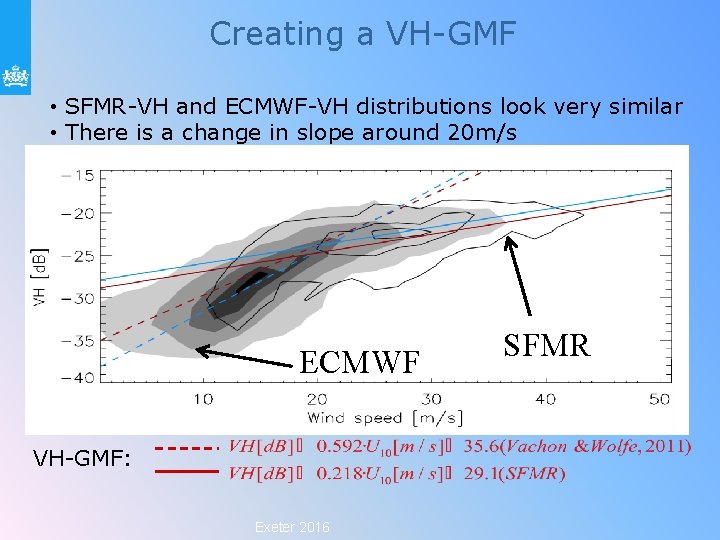
Creating a VH-GMF • SFMR-VH and ECMWF-VH distributions look very similar • There is a change in slope around 20 m/s ECMWF VH-GMF: Exeter 2016 SFMR
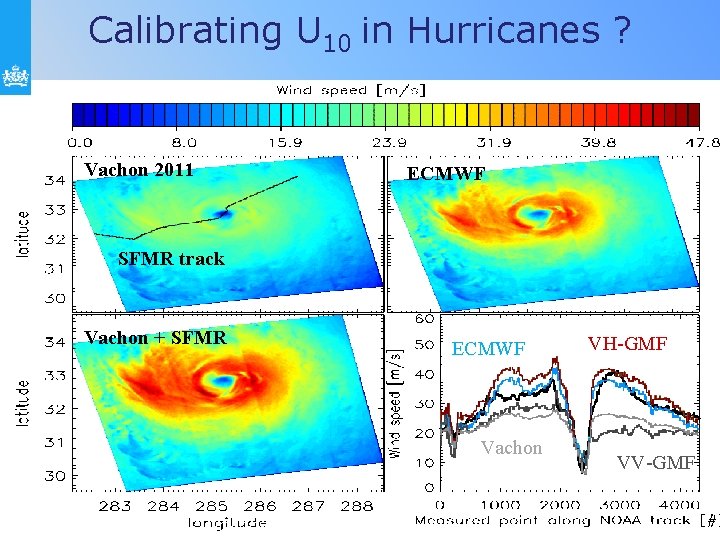
Calibrating U 10 in Hurricanes ? Vachon 2011 ECMWF SFMR track Vachon + SFMR ECMWF Vachon IGARRS 2014; TH 2. 11. 5 VH-GMF VV-GMF
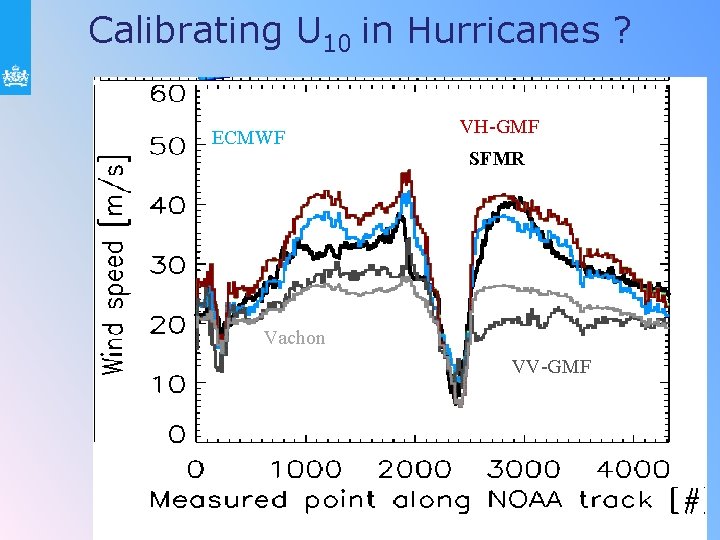
Calibrating U 10 in Hurricanes ? ECMWF VH-GMF SFMR Vachon VV-GMF IGARRS 2014; TH 2. 11. 5
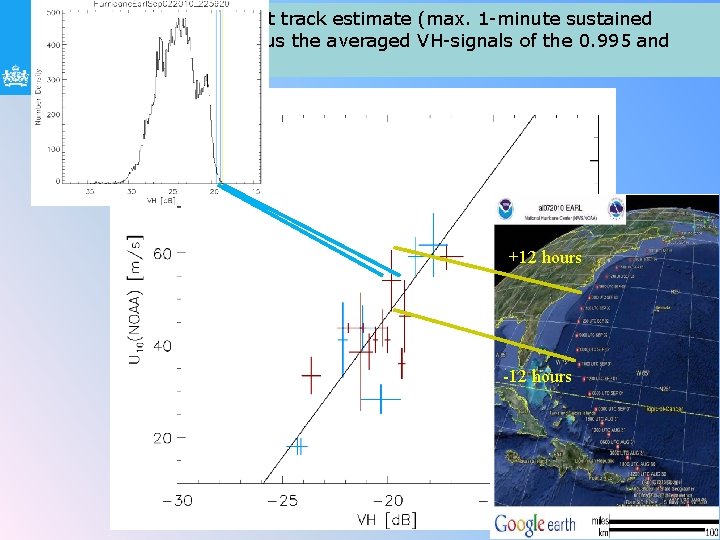
Comparing the NOAA best track estimate (max. 1 -minute sustained surface wind speed) versus the averaged VH-signals of the 0. 995 and 0. 9995 percentile values. +12 hours -12 hours
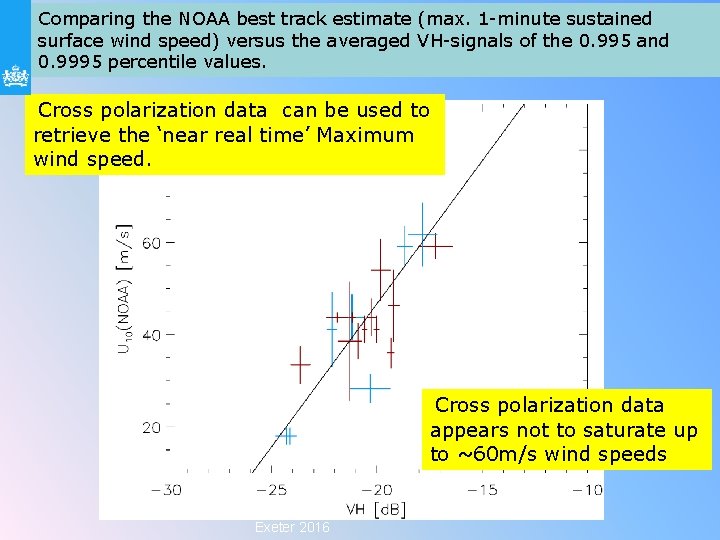
Comparing the NOAA best track estimate (max. 1 -minute sustained surface wind speed) versus the averaged VH-signals of the 0. 995 and 0. 9995 percentile values. Cross polarization data can be used to retrieve the ‘near real time’ Maximum wind speed. Cross polarization data appears not to saturate up to ~60 m/s wind speeds Exeter 2016
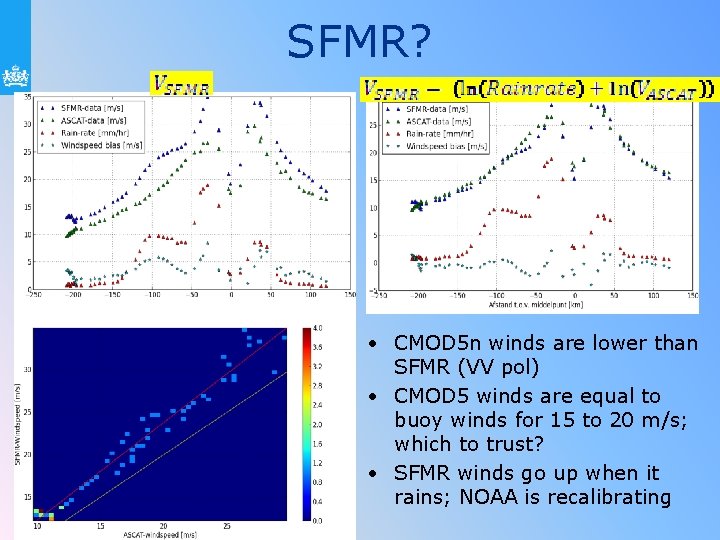
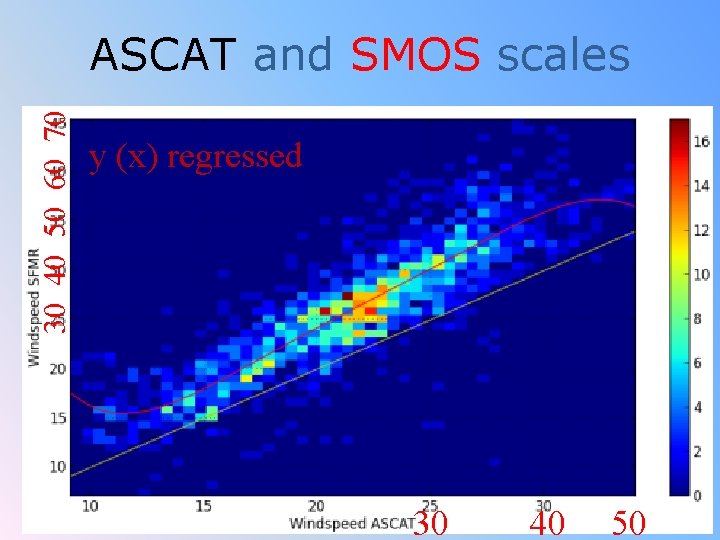
SFMR? • CMOD 5 n winds are lower than SFMR (VV pol) • CMOD 5 winds are equal to buoy winds for 15 to 20 m/s; which to trust? • SFMR winds go up when it rains; NOAA is recalibrating
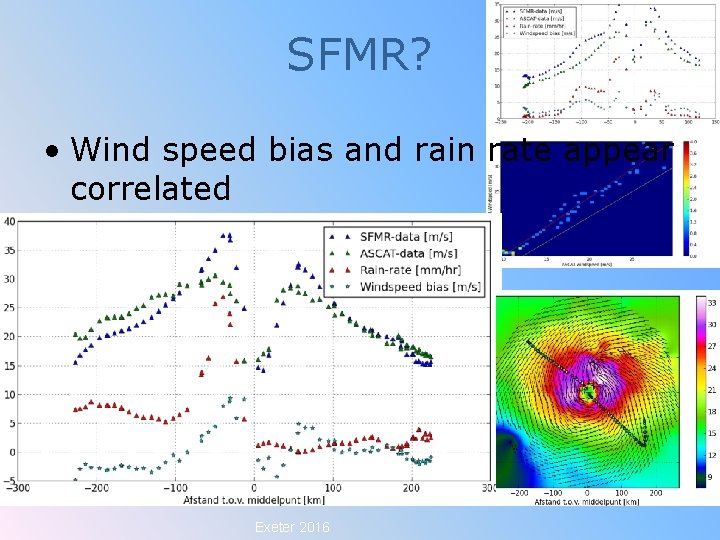
SFMR? • Wind speed bias and rain rate appear correlated Exeter 2016
30 40 50 60 70 ASCAT and SMOS scales y (x) regressed 30 40 50
ASCAT eye wall
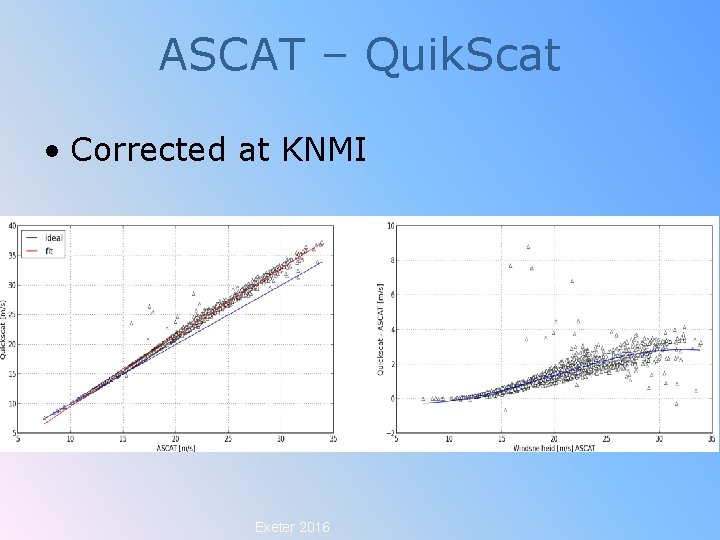
ASCAT – Quik. Scat • Corrected at KNMI Exeter 2016
Conclusions 1. An additional cross polarization (VH) channel on ASCAT-SG will retrieve wind speeds up to at least 45 m/s (based on available SFMR data) 2. The VH wind speed dependence shows a different relationship in the low&strong wind speed regime(U 10<20 m/s) compared to the strong&severe wind speed regime(U 10>20 m/s) 3. The VH signals show a modest incidence angle dependence and negligible wind direction dependence in the VH signals 4. There is a strong correlation between the highest VH measurements within a hurricane SAR image and the oneminute maximum sustained wind speeds from the NOAA best track product up to 60 m/s. This correlation can be described by a linear relationship and can be used for TC guidance 5. An operational satellite with a VH channel will be able to retrieve in near real time the one-minute maximum sustained wind speed from a hurricane or typhoon, and an assessment of the spatial wind speed distribution 6. Both VH and extreme wind measurements need more attention in calibration at appropriate spatial resolution Exeter 2016
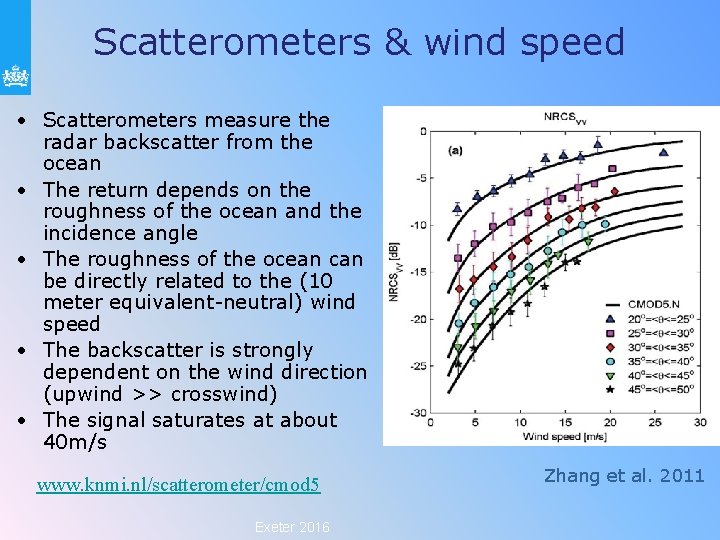
Scatterometers & wind speed • Scatterometers measure the radar backscatter from the ocean • The return depends on the roughness of the ocean and the incidence angle • The roughness of the ocean can be directly related to the (10 meter equivalent-neutral) wind speed • The backscatter is strongly dependent on the wind direction (upwind >> crosswind) • The signal saturates at about 40 m/s www. knmi. nl/scatterometer/cmod 5 Exeter 2016 Zhang et al. 2011
- Slides: 22