
Retirement Basics An Overview of the Retirement Planning
Retirement Basics An Overview of the Retirement Planning Process

When You Imagine Your Retirement, What Do You See?
The Retirement Planning Road Map Implement Plan Crunching Numbers Annuities Start Now Tax-advantaged Retirement Vehicles Investment Considerations Basic Questions Protect Against Undue Risk
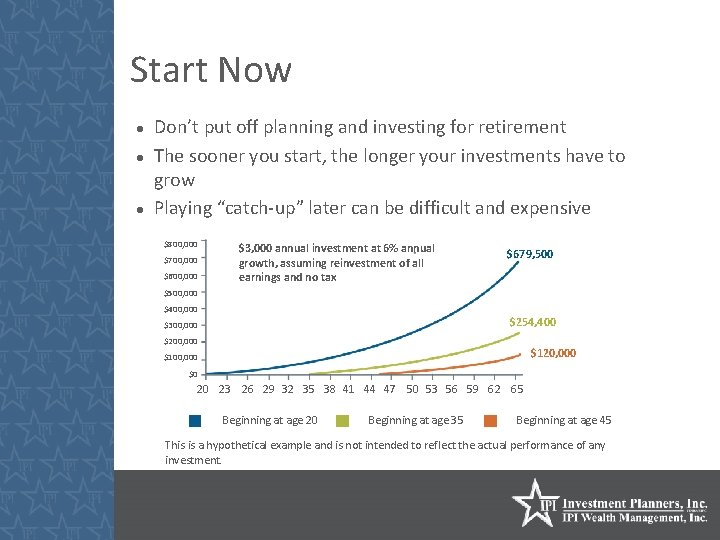
Start Now Don’t put off planning and investing for retirement The sooner you start, the longer your investments have to grow Playing “catch-up” later can be difficult and expensive $800, 000 $700, 000 $600, 000 $3, 000 annual investment at 6% annual growth, assuming reinvestment of all earnings and no tax $679, 500 $500, 000 $400, 000 $254, 400 $300, 000 $200, 000 $120, 000 $100, 000 $0 20 23 26 29 32 35 38 41 44 47 50 53 56 59 62 65 Beginning at age 20 Beginning at age 35 Beginning at age 45 This is a hypothetical example and is not intended to reflect the actual performance of any investment.

Basic Considerations What kind of retirement do you want? When do you want to retire? How long will retirement last?
Basic Considerations – What Kind of Retirement Do You Want? Financial independence Freedom to travel, pursue hobbies Ability to live where you want (e. g. , in current home, vacation home) Opportunity to provide financially for children or grandchildren
Basic Considerations – When Do You Want to Retire? The earlier you retire, the shorter the period of time you have to accumulate funds and the longer those dollars will need to last Social Security isn’t available until age 62 Medicare eligibility begins at age 65
Basic Considerations – How Long Will Retirement Last? Average 65 -year-old American expect to live another 19. 5 years* Average life expectancy is likely to continue to increase Retirement may last 25 years or more * NCHS Data Brief, Number 328, November 2018
Crunching the Numbers Estimate retirement expenses Estimate retirement income Identify the “gap” Calculate your retirement investment goal Account for inflation
Crunching the Numbers – Estimating Retirement Expenses General guidelines (e. g. , you’ll need 60% to 90% of pre-retirement income) are easy but often not helpful Think about how your actual expenses will change (e. g. , mortgage may decrease, health-care costs may increase) Include estimates for special retirement pursuits (e. g. , travel, hobbies)
Crunching the Numbers – Estimating Retirement Income The three-legged retirement income stool: • Social Security • Traditional employer pension • Individual savings & investments An individual born in 1959 who currently earns $70, 000 can expect to receive roughly $23, 000 each year (today’s dollars) in Social Security retirement benefits at full retirement age. * *www. ssa. gov Quick Calculator (accessed February 18, 2019)
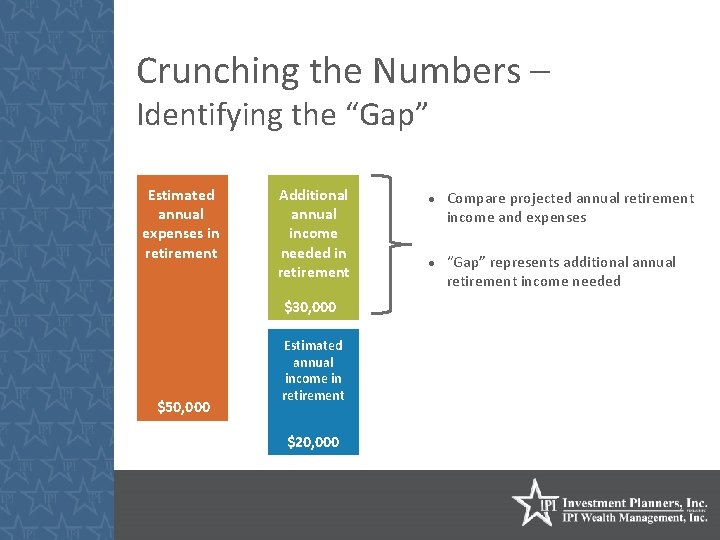
Crunching the Numbers – Identifying the “Gap” Estimated annual expenses in retirement Additional annual income needed in retirement $30, 000 $50, 000 Estimated annual income in retirement $20, 000 Compare projected annual retirement income and expenses “Gap” represents additional annual retirement income needed
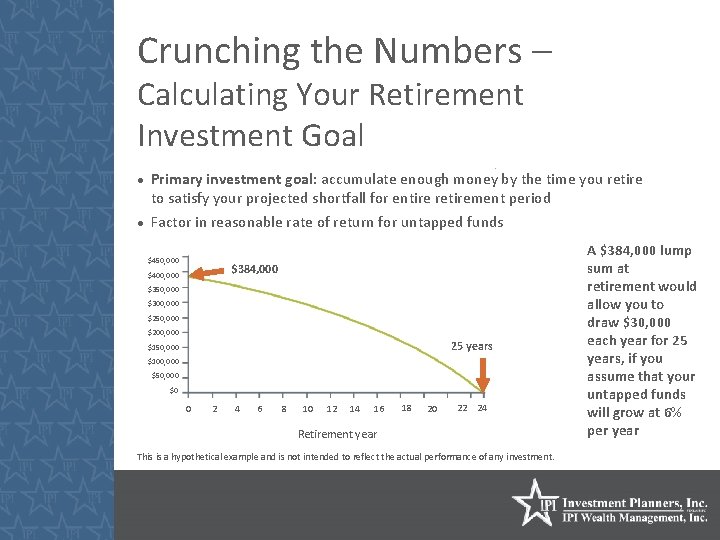
Crunching the Numbers – Calculating Your Retirement Investment Goal Primary investment goal: accumulate enough money by the time you retire to satisfy your projected shortfall for entire retirement period Factor in reasonable rate of return for untapped funds $450, 000 $384, 000 $400, 000 $350, 000 $300, 000 $250, 000 $200, 000 25 years $150, 000 $100, 000 $50, 000 $0 0 2 4 6 8 10 12 14 16 18 20 22 24 Retirement year This is a hypothetical example and is not intended to reflect the actual performance of any investment. A $384, 000 lump sum at retirement would allow you to draw $30, 000 each year for 25 years, if you assume that your untapped funds will grow at 6% per year
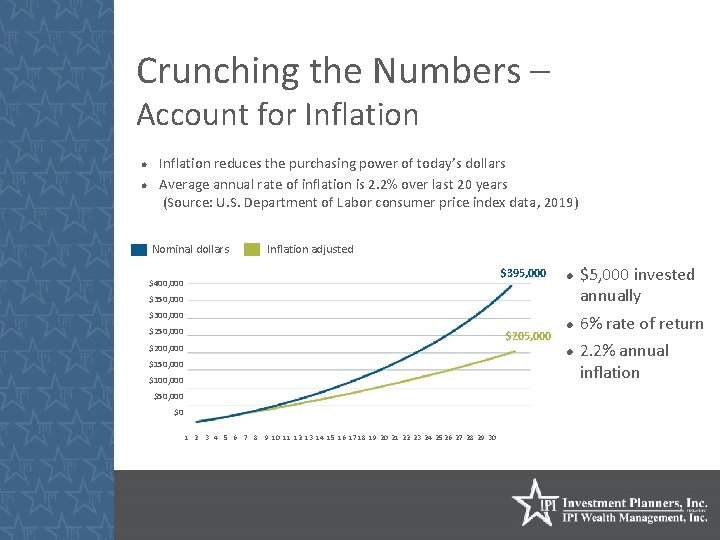
Crunching the Numbers – Account for Inflation reduces the purchasing power of today’s dollars Average annual rate of inflation is 2. 2% over last 20 years (Source: U. S. Department of Labor consumer price index data, 2019) Nominal dollars Inflation adjusted $395, 000 $400, 000 $350, 000 $300, 000 $250, 000 $205, 000 $200, 000 $150, 000 $100, 000 $50, 000 $0 1 2 3 4 5 6 7 8 9 10 11 12 13 14 15 16 17 18 19 20 21 22 23 24 25 26 27 28 29 30 $5, 000 invested annually 6% rate of return 2. 2% annual inflation
Tax-Advantaged Savings Vehicles Tax deferral can help your money grow Take full advantage of 401(k)s and other employersponsored retirement plans Contribute to a traditional or Roth IRA if you qualify
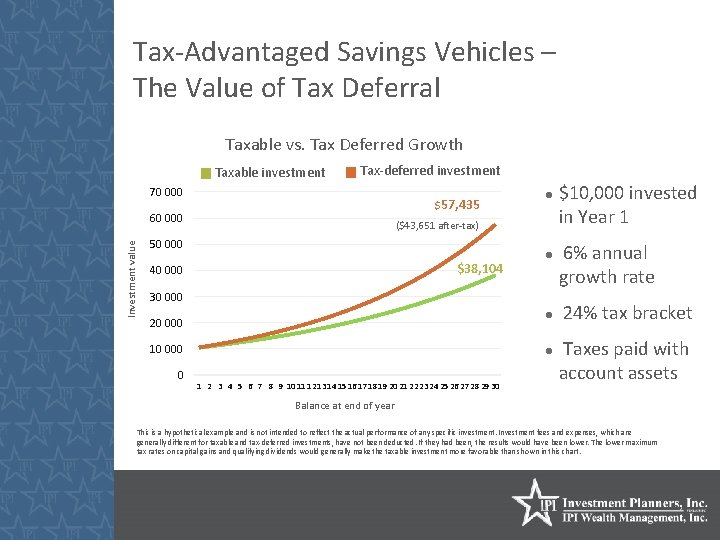
Tax-Advantaged Savings Vehicles – The Value of Tax Deferral Taxable vs. Tax Deferred Growth Taxable investment Tax-deferred investment 70 000 $57, 435 Investment value 60 000 ($43, 651 after-tax) 50 000 $38, 104 40 000 30 000 20 000 10 000 0 1 2 3 4 5 6 7 8 9 10 11 12 13 14 15 16 17 18 19 20 21 22 23 24 25 26 27 28 29 30 $10, 000 invested in Year 1 6% annual growth rate 24% tax bracket Taxes paid with account assets Balance at end of year This is a hypothetical example and is not intended to reflect the actual performance of any specific investment. Investment fees and expenses, which are generally different for taxable and tax-deferred investments, have not been deducted. If they had been, the results would have been lower. The lower maximum tax rates on capital gains and qualifying dividends would generally make the taxable investment more favorable than shown in this chart.
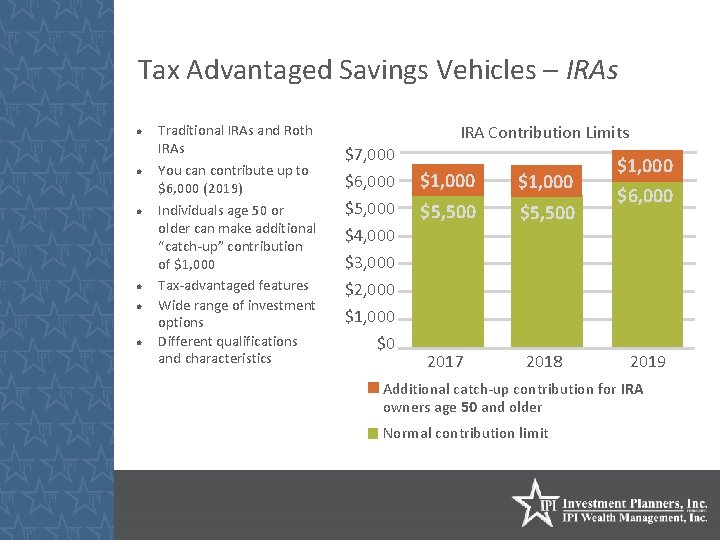
Tax Advantaged Savings Vehicles – IRAs Traditional IRAs and Roth IRAs You can contribute up to $6, 000 (2019) Individuals age 50 or older can make additional “catch-up” contribution of $1, 000 Tax-advantaged features Wide range of investment options Different qualifications and characteristics IRA Contribution Limits $7, 000 $6, 000 $5, 000 $4, 000 $3, 000 $2, 000 $1, 000 $5, 500 2017 2018 $1, 000 $6, 000 2019 Additional catch-up contribution for IRA owners age 50 and older Normal contribution limit
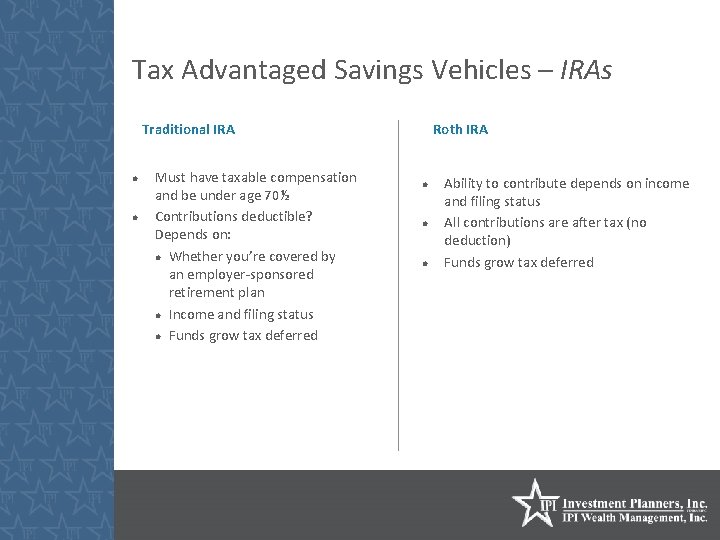
Tax Advantaged Savings Vehicles – IRAs Traditional IRA Must have taxable compensation and be under age 70½ Contributions deductible? Depends on: Whether you’re covered by an employer-sponsored retirement plan Income and filing status Funds grow tax deferred Roth IRA Ability to contribute depends on income and filing status All contributions are after tax (no deduction) Funds grow tax deferred
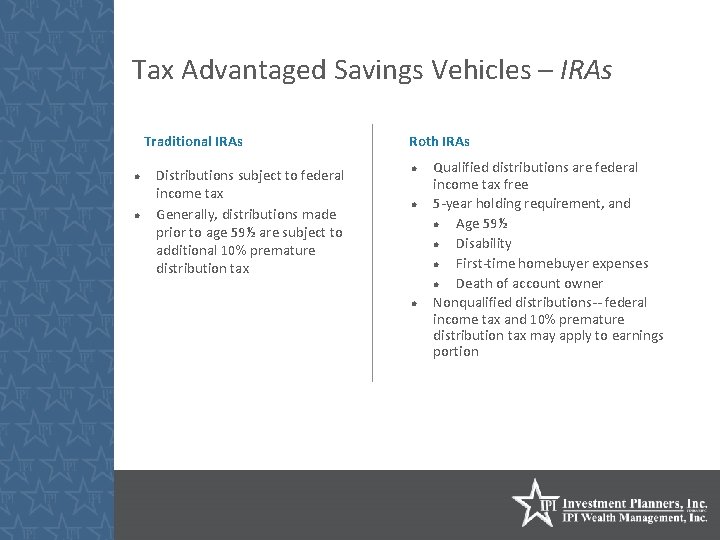
Tax Advantaged Savings Vehicles – IRAs Traditional IRAs Distributions subject to federal income tax Generally, distributions made prior to age 59½ are subject to additional 10% premature distribution tax Roth IRAs Qualified distributions are federal income tax free 5 -year holding requirement, and Age 59½ Disability First-time homebuyer expenses Death of account owner Nonqualified distributions-- federal income tax and 10% premature distribution tax may apply to earnings portion
Tax Advantaged Savings Vehicles – IRAs If you can do both, should you make deductible contributions to a traditional IRA or contribute to a Roth IRA? Roth IRA may make more sense if you want to minimize taxes during retirement and preserve assets for your beneficiaries Traditional IRA may make more sense if you want to lower your tax bill while you’re still working and you expect to be in a lower tax bracket when you retire
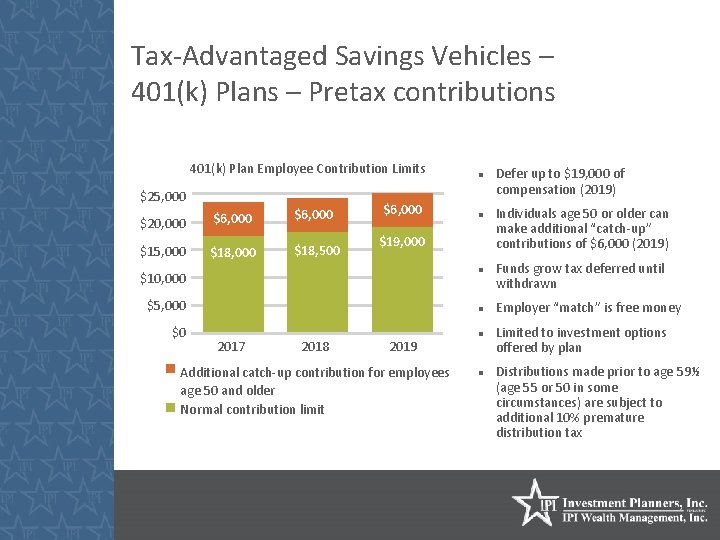
Tax-Advantaged Savings Vehicles – 401(k) Plans – Pretax contributions 401(k) Plan Employee Contribution Limits $25, 000 $20, 000 $6, 000 $15, 000 $18, 500 $6, 000 $19, 000 $10, 000 $5, 000 $0 2017 2018 2019 Additional catch-up contribution for employees age 50 and older Normal contribution limit Defer up to $19, 000 of compensation (2019) Individuals age 50 or older can make additional “catch-up” contributions of $6, 000 (2019) Funds grow tax deferred until withdrawn Employer “match” is free money Limited to investment options offered by plan Distributions made prior to age 59½ (age 55 or 50 in some circumstances) are subject to additional 10% premature distribution tax
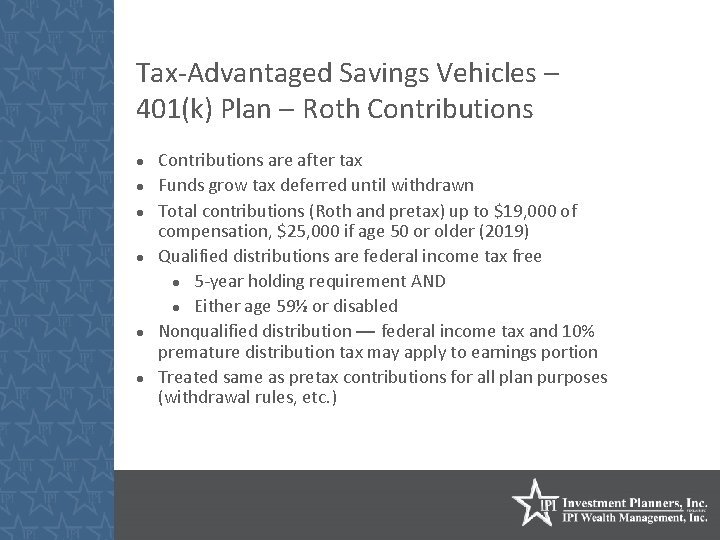
Tax-Advantaged Savings Vehicles – 401(k) Plan – Roth Contributions are after tax Funds grow tax deferred until withdrawn Total contributions (Roth and pretax) up to $19, 000 of compensation, $25, 000 if age 50 or older (2019) Qualified distributions are federal income tax free 5 -year holding requirement AND Either age 59½ or disabled Nonqualified distribution — federal income tax and 10% premature distribution tax may apply to earnings portion Treated same as pretax contributions for all plan purposes (withdrawal rules, etc. )
Annuities An annuity is an investment contract You invest money in return for insurer’s promise to make payments in future (e. g. , retirement)* Funds grow tax deferred May provide death benefit (insurance features such as a death benefit are generally accompanied by higher costs) No limit on amount you can contribute Distributions subject to ordinary federal income tax on earnings portion Additional 10% premature distribution tax may apply if withdrawals made prior to age 59½ (exceptions apply) No required minimum distributions after age 70½ Can elect to convert annuity into guaranteed lifetime income stream* Typically impose a surrender fee in addition to other fees and charges *A company’s promises and guarantees are dependent on the financial ability of the company to meet its obligations.
General Investment Considerations Timeline Risk/return considerations Inflation Return needed to achieve accumulation goal Risk tolerance Diversification Periodically reevaluate

Protecting Against Risk – The Role of Insurance Shifts financial risk to insurer Working years: Disability income insurance Life insurance Retirement years: Health insurance Long-term care insurance
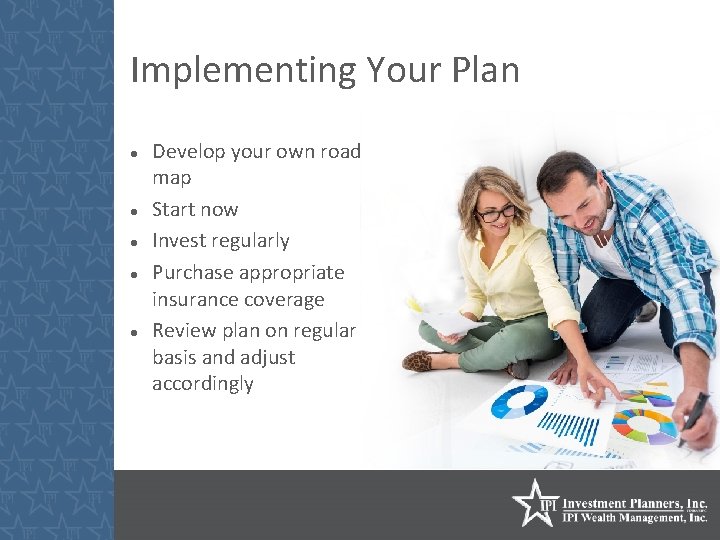
Implementing Your Plan Develop your own road map Start now Invest regularly Purchase appropriate insurance coverage Review plan on regular basis and adjust accordingly

Thank You
Disclaimer IMPORTANT DISCLOSURES Broadridge Investor Communication Solutions, Inc. does not provide investment, tax, or legal advice. The information presented here is not specific to any individual's personal circumstances. To the extent that this material concerns tax matters, it is not intended or written to be used, and cannot be used, by a taxpayer for the purpose of avoiding penalties that may be imposed by law. Each taxpayer should seek independent advice from a tax professional based on his or her individual circumstances. These materials are provided for general information and educational purposes based upon publicly available information from sources believed to be reliable—we cannot assure the accuracy or completeness of these materials. The information in these materials may change at any time and without notice. Securities and investment advice offered through Investment Planners, Inc. (Member FINRA/SIPC) and IPI Wealth Management, Inc. , 226 W. Eldorado Street, Decatur, IL 62522. 217 -425 -6340.
- Slides: 28