
RETIREMENT 101 MASSACHUSETTS PUBLIC PENSION LAW Judith A

RETIREMENT 101: MASSACHUSETTS PUBLIC PENSION LAW Judith A. Corrigan | Deputy General Counsel PERAC NOVEMBER 4, 2016
How Does This Work? § Retirement allowances are provided for under M. G. L. c. 32. § Your retirement allowance will be calculated based upon your group classification, salary, years of creditable service & age. § In addition, the date you entered service will play key role in determining when you will be entitled to a retirement allowance and what the amount will be. 2
Assumptions For This Presentation § Everyone here is in “Group 1. ” § Most of you contribute 9% of your salary to your retirement system, + 2% for all amounts over $30, 000, but some of you contribute 8% of your salary, + 2% for all amounts over $30, 000. § You are not in “Retirement. Plus” or the “Teachers’ Alternate Retirement Program” (“TARP”). 3
Retirement. Plus & Teachers’ Alternate Retirement Program § These are an alternative retirement benefit, which allows for an earlier retirement date but requires a higher contribution rate. § Available to (and now mandatory for) members of the Massachusetts Teachers’ Retirement System (“MTRS”) and teachers in the Boston Retirement System (“BRS”) 4

Group 1 M. G. L. c. 32, Section 3(2)(g): Group 1. – Officials and general employees including clerical, administrative and technical workers, laborers, mechanics and all others not otherwise classified. 5

Retirement Allowances — Group 1 § Maximum retirement allowance = 80% of a person’s three (or five) year highest salary average. § Minimum retirement allowance = We usually don’t speak in terms of a minimum retirement allowance, as there are many variables to this particular formula. 6
Chapter 176 of the Acts of 2011 § On November 16, 2011, Governor Patrick signed Chapter 176 of the Acts of 2011, An Act Providing for Pension Reform and Benefit Modernization. § This Act has some impact on those who were members on April 1, 2012 and before, but in essence creates a new plan for those becoming members on or after April 2, 2012. 7
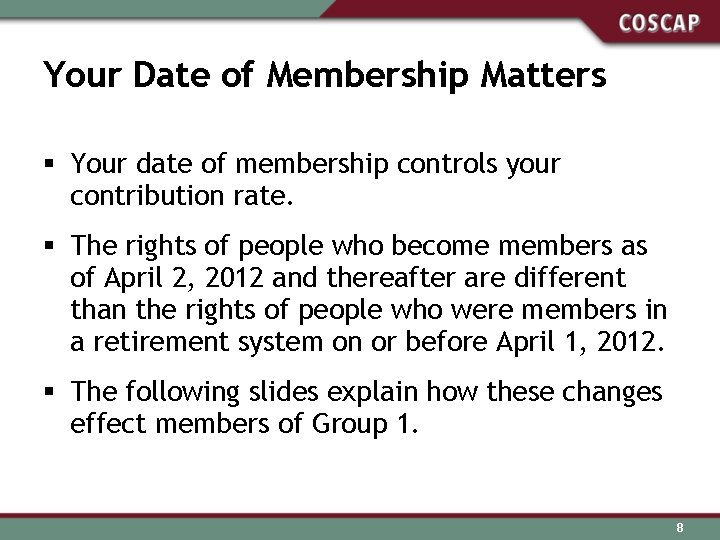
Your Date of Membership Matters § Your date of membership controls your contribution rate. § The rights of people who become members as of April 2, 2012 and thereafter are different than the rights of people who were members in a retirement system on or before April 1, 2012. § The following slides explain how these changes effect members of Group 1. 8
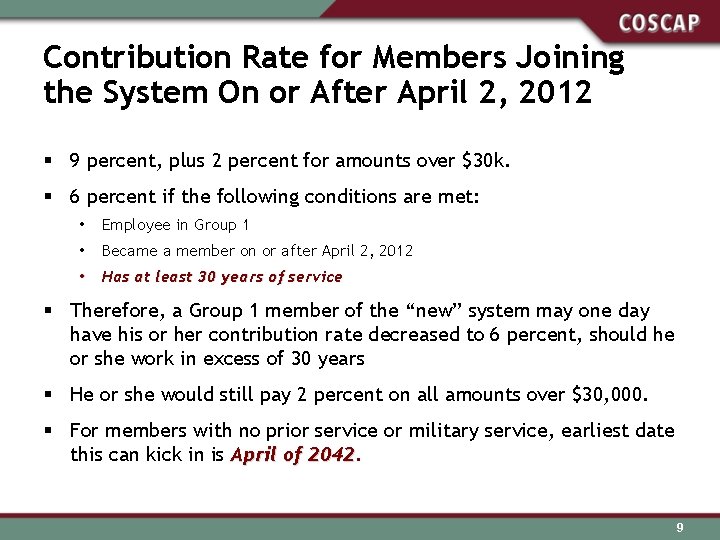
Contribution Rate for Members Joining the System On or After April 2, 2012 § 9 percent, plus 2 percent for amounts over $30 k. § 6 percent if the following conditions are met: • Employee in Group 1 • Became a member on or after April 2, 2012 • Has at least 30 years of service § Therefore, a Group 1 member of the “new” system may one day have his or her contribution rate decreased to 6 percent, should he or she work in excess of 30 years § He or she would still pay 2 percent on all amounts over $30, 000. § For members with no prior service or military service, earliest date this can kick in is April of 2042 9
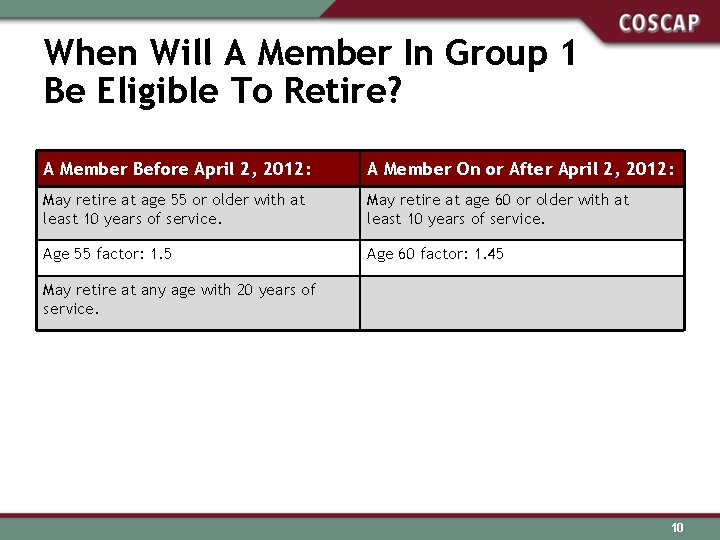
When Will A Member In Group 1 Be Eligible To Retire? A Member Before April 2, 2012: A Member On or After April 2, 2012: May retire at age 55 or older with at least 10 years of service. May retire at age 60 or older with at least 10 years of service. Age 55 factor: 1. 5 Age 60 factor: 1. 45 May retire at any age with 20 years of service. 10
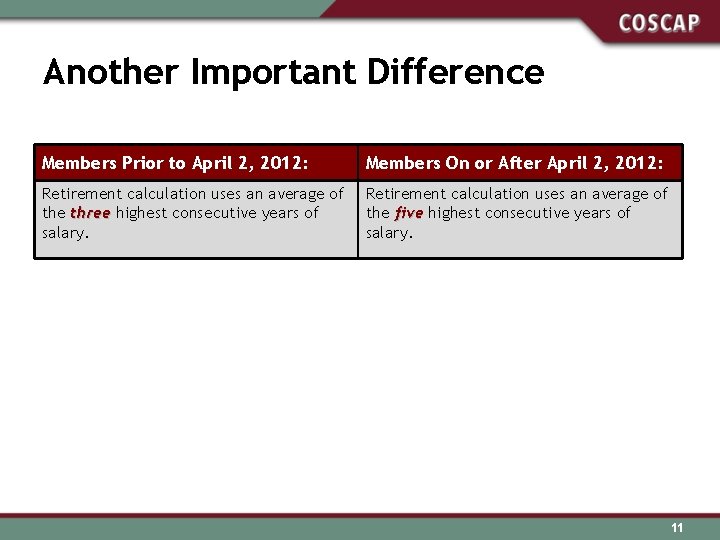
Another Important Difference Members Prior to April 2, 2012: Members On or After April 2, 2012: Retirement calculation uses an average of the three highest consecutive years of salary. Retirement calculation uses an average of the five highest consecutive years of salary. 11
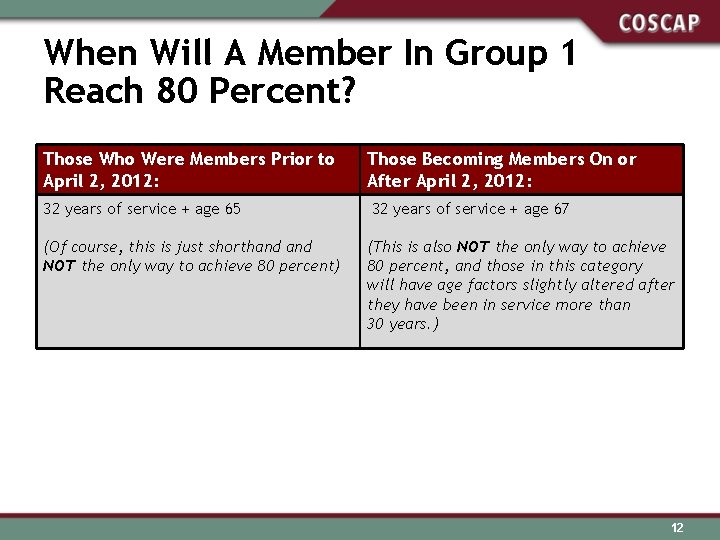
When Will A Member In Group 1 Reach 80 Percent? Those Who Were Members Prior to April 2, 2012: 32 years of service + age 65 (Of course, this is just shorthand NOT the only way to achieve 80 percent) Those Becoming Members On or After April 2, 2012: 32 years of service + age 67 (This is also NOT the only way to achieve 80 percent, and those in this category will have age factors slightly altered after they have been in service more than 30 years. ) 12
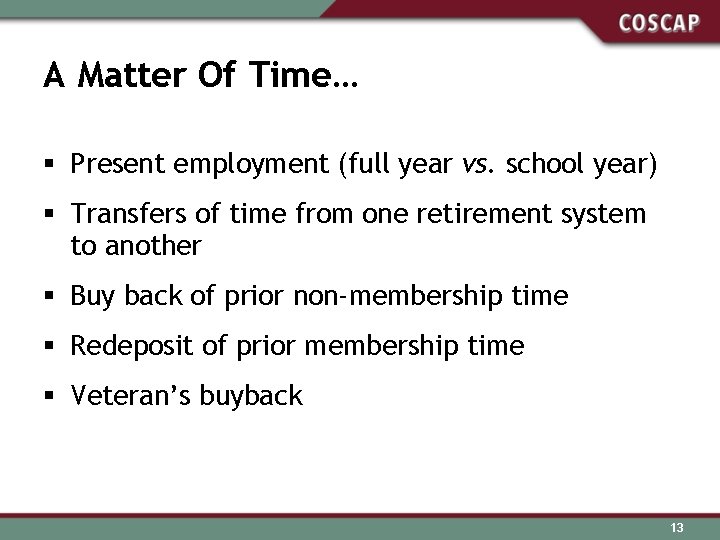
A Matter Of Time… § Present employment (full year vs. school year) § Transfers of time from one retirement system to another § Buy back of prior non-membership time § Redeposit of prior membership time § Veteran’s buyback 13
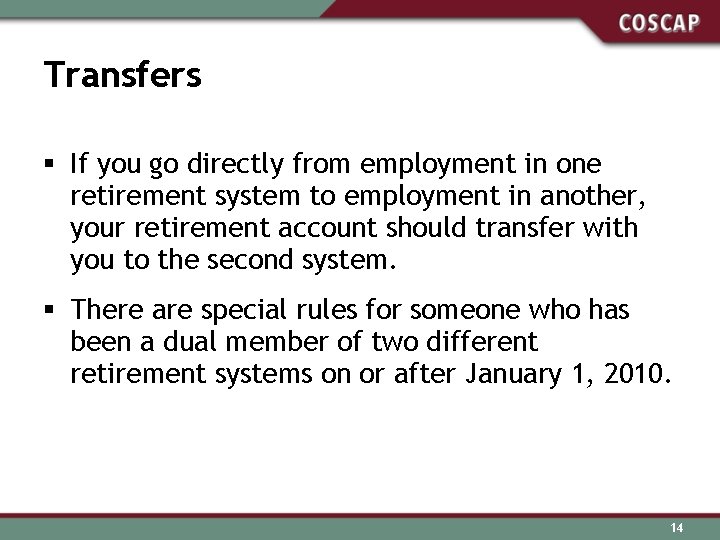
Transfers § If you go directly from employment in one retirement system to employment in another, your retirement account should transfer with you to the second system. § There are special rules for someone who has been a dual member of two different retirement systems on or after January 1, 2010. 14
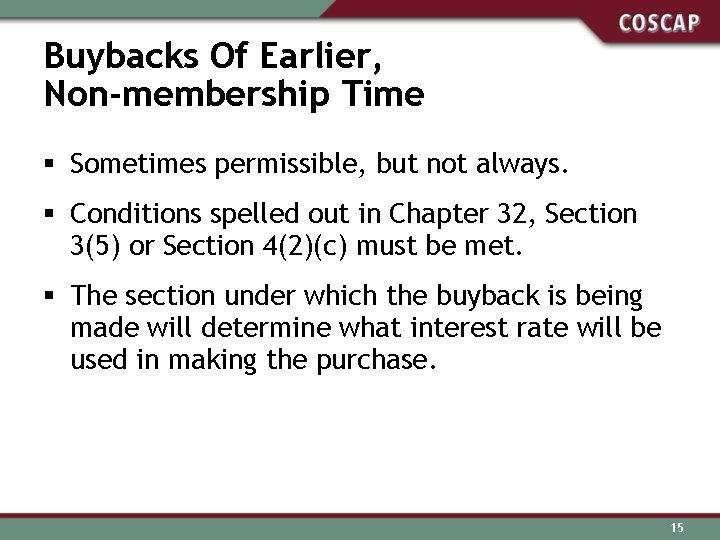
Buybacks Of Earlier, Non-membership Time § Sometimes permissible, but not always. § Conditions spelled out in Chapter 32, Section 3(5) or Section 4(2)(c) must be met. § The section under which the buyback is being made will determine what interest rate will be used in making the purchase. 15
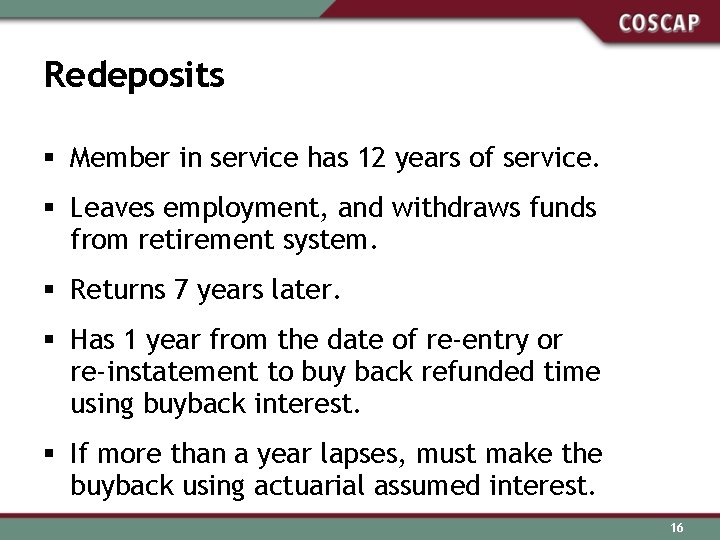
Redeposits § Member in service has 12 years of service. § Leaves employment, and withdraws funds from retirement system. § Returns 7 years later. § Has 1 year from the date of re-entry or re-instatement to buy back refunded time using buyback interest. § If more than a year lapses, must make the buyback using actuarial assumed interest. 16
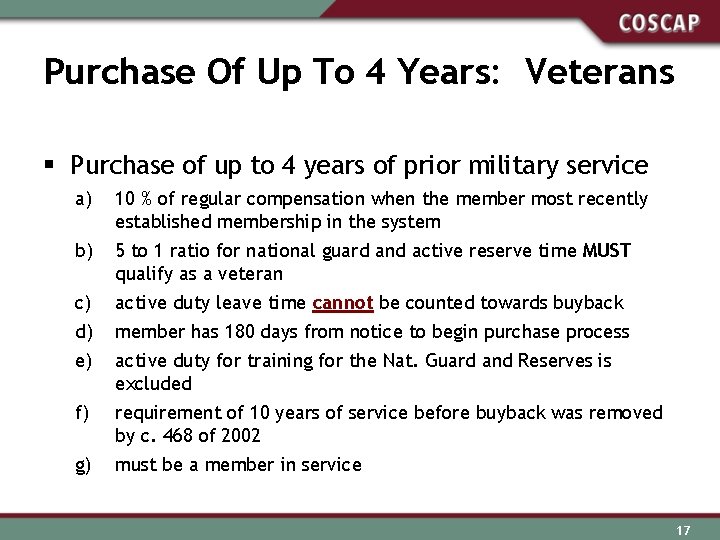
Purchase Of Up To 4 Years: Veterans § Purchase of up to 4 years of prior military service a) 10 % of regular compensation when the member most recently established membership in the system b) 5 to 1 ratio for national guard and active reserve time MUST qualify as a veteran c) d) e) active duty leave time cannot be counted towards buyback f) requirement of 10 years of service before buyback was removed by c. 468 of 2002 g) must be a member in service member has 180 days from notice to begin purchase process active duty for training for the Nat. Guard and Reserves is excluded 17
Making It To Retirement: 3 Possible Options § Option A § Option B § Option C § These options are available to superannuation, termination, ordinary disability retirement and accidental disability retirement. 18
Option A § Gets the largest possible retirement allowance, known as “Life Annuity” § Upon his death, no money payable to anyone except: • If he dies on the 16 th of September, for example, his estate will be due 16 days of retirement allowance 19
Option B § May be selected by retiree. § But also the “default” option to which those who fail to select an option are assigned. § Option B provides a lifetime allowance that is 1% to 5% less per month than Option A. § The member’s annuity account is gradually depleted by an amount equal to the annuity portion of your retirement allowance. 20
Option B (Continued) § Usually, the annuity account will be depleted generally between 10 -12 years after retirement. § Member still gets full allowance after depletion. § Upon member’s death, beneficiary gets whatever amount is remaining in the annuity account, if anything. 21
Who May Be Designated As An Option B Beneficiary? § Any person or entity § More than one person or entity may be designated. • For example, “ 50% to Luke Mc. Gluke and 50% to the Boy Scouts of America” § The Option B beneficiary may be changed by the member at any point prior to death 22
Option C § A/k/a “the joint and last survivor allowance” § Amount of benefit depends on the life expectancies of member and beneficiary § Allowance will be generally 7% to 15% less than that which a person would receive under Option A. § Upon the retiree’s death the beneficiary will be paid a monthly allowance for life. § See PERAC Memo #37/2004 for more information 23
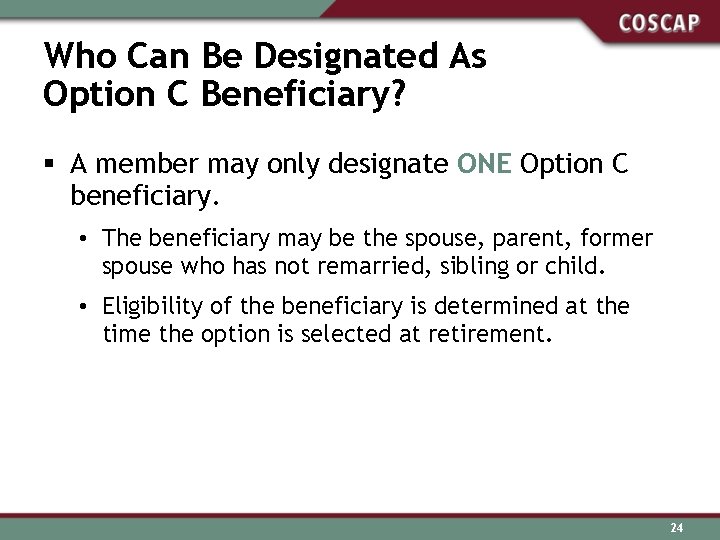
Who Can Be Designated As Option C Beneficiary? § A member may only designate ONE Option C beneficiary. • The beneficiary may be the spouse, parent, former spouse who has not remarried, sibling or child. • Eligibility of the beneficiary is determined at the time the option is selected at retirement. 24
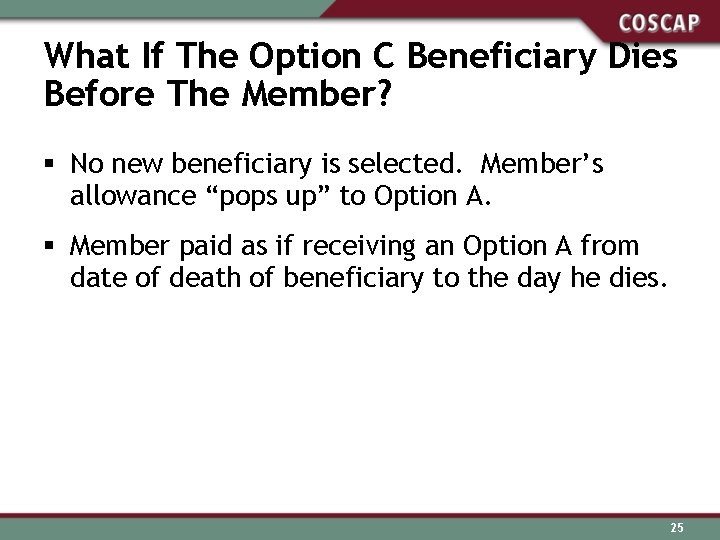
What If The Option C Beneficiary Dies Before The Member? § No new beneficiary is selected. Member’s allowance “pops up” to Option A. § Member paid as if receiving an Option A from date of death of beneficiary to the day he dies. 25
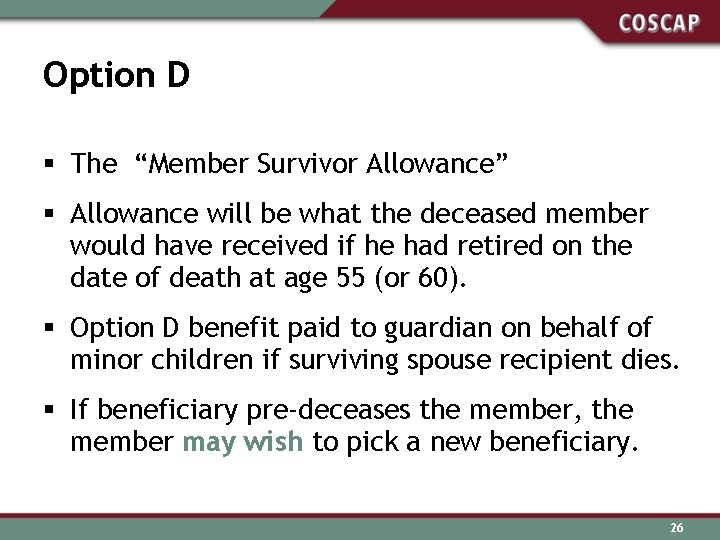
Option D § The “Member Survivor Allowance” § Allowance will be what the deceased member would have received if he had retired on the date of death at age 55 (or 60). § Option D benefit paid to guardian on behalf of minor children if surviving spouse recipient dies. § If beneficiary pre-deceases the member, the member may wish to pick a new beneficiary. 26
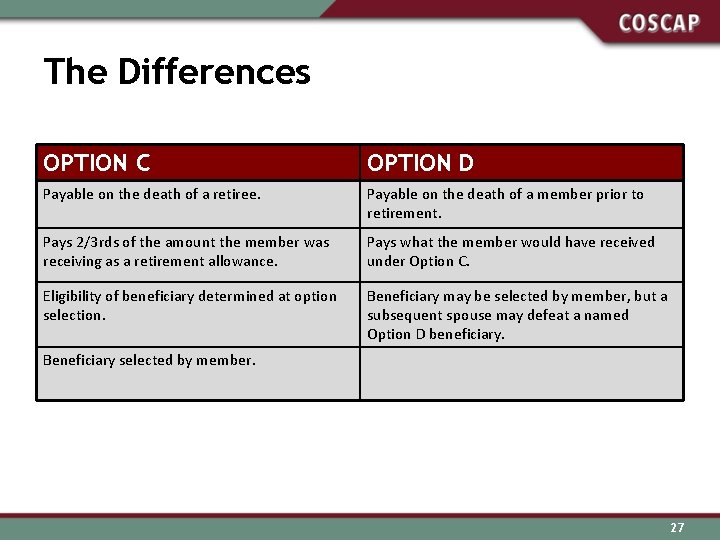
The Differences OPTION C OPTION D Payable on the death of a retiree. Payable on the death of a member prior to retirement. Pays 2/3 rds of the amount the member was receiving as a retirement allowance. Pays what the member would have received under Option C. Eligibility of beneficiary determined at option selection. Beneficiary may be selected by member, but a subsequent spouse may defeat a named Option D beneficiary. Beneficiary selected by member. 27
How Retirement Allowances are Paid Out § A retirement allowance consists of two parts, the annuity portion and the pension portion. The annuity portion is basically a repayment to the member of the contributions (Annuity Savings Fund balance) they’ve made throughout their working career. The ASF gets drawn down each month based only on the monthly annuity portion of the benefit. 28

How Long Will It Take for You to Receive Your First Payment? § Retirement allowances are paid on the last business day of each month. § When you will get your first payment depends greatly on the size of the retirement system and when you applied for the allowance. (Statute permits filing for the benefit up to four months in advance). 29
What will the Retirement Allowance Look Like? § A superannuation retirement allowance will be subject to Federal Income taxation, but will not be taxed by Massachusetts. § PERAC does not deal with taxes or other deductions taken from retirement checks, and this is unique for each individual. The Retirement Board should be able to answer this question for the members as they would have the specific information on each member. 30

Social Security Questions § These are outside of PERAC’s area of expertise and questions about this should be directed to your local Social Security office. § Two Social Security issues which may impact Massachusetts public employees: • Windfall Elimination Provision (“WEP”) • Governmental Pension Offset (“GPO”) 31
And Moving On To Post-Retirement Earnings… The formula: § No public retiree may work more than 960 hours for a Massachusetts governmental unit in a calendar year. § Such employment is limited by hours and compensation. § Compensation when added to the retirement benefit cannot exceed the salary being paid for the position from which he/she retired, plus $15, 000. (The $15, 000 will not be added into this formula until at least one calendar year following your retirement. ) 32

Finally § Our public pension plan in Massachusetts is statutory, and all retirement allowances are calculated in accordance with Chapter 32 of the Massachusetts General Laws. § Specific questions about this, including any aspect of the retirement law we have not already covered? 33
- Slides: 33