
RETINAL DETACHMENT Dr Ajai Agrawal Additional Professor Department








- Slides: 58
RETINAL DETACHMENT Dr. Ajai Agrawal Additional Professor Department of Ophthalmology A. I. I. M. S, Rishikesh
Acknowledgement • Photographs in this presentation are courtesy of Dr. Freund. K. Bailey (The Retinal Atlas, 2 nd Ed. ) and Dr. Brad Bowling (Kanski’s Clinical Ophthalmology, 8 th. Ed. )
Learning Objectives At the end of the class, students shall be able to • Define and classify the various types of retinal detachments (R. D. ) • Understand the pathophysiology and signs and symptoms of retinal detachments • Have a basic understanding of the management of various types of retinal detachments
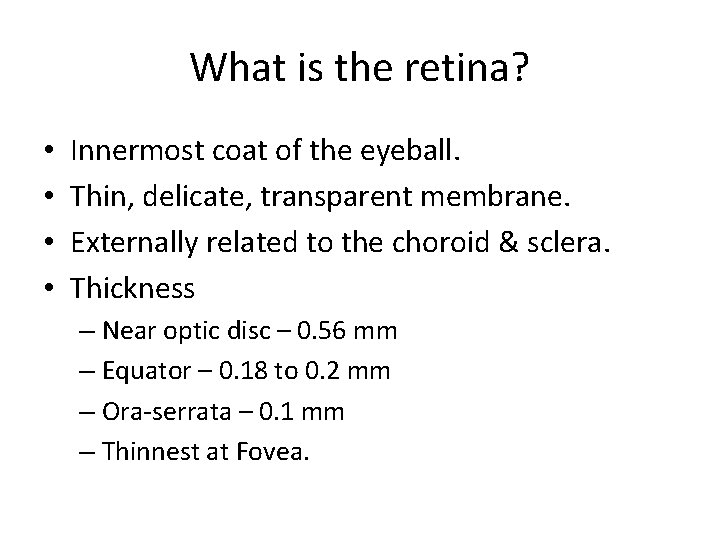
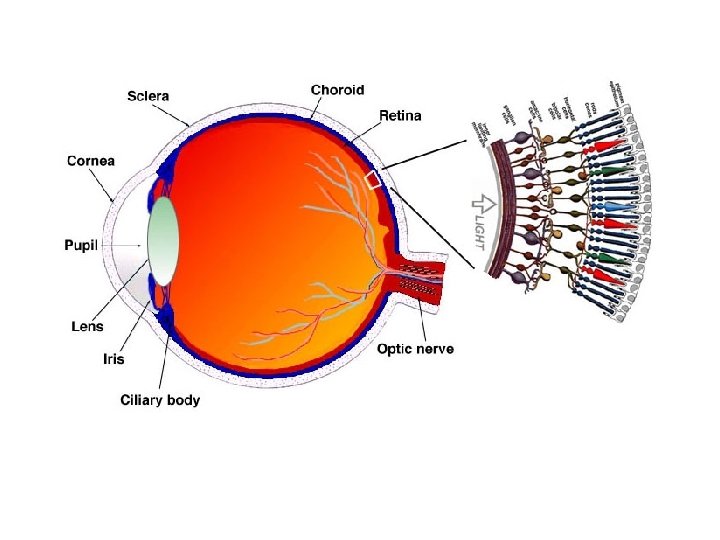
What is the retina? • • Innermost coat of the eyeball. Thin, delicate, transparent membrane. Externally related to the choroid & sclera. Thickness – Near optic disc – 0. 56 mm – Equator – 0. 18 to 0. 2 mm – Ora-serrata – 0. 1 mm – Thinnest at Fovea.
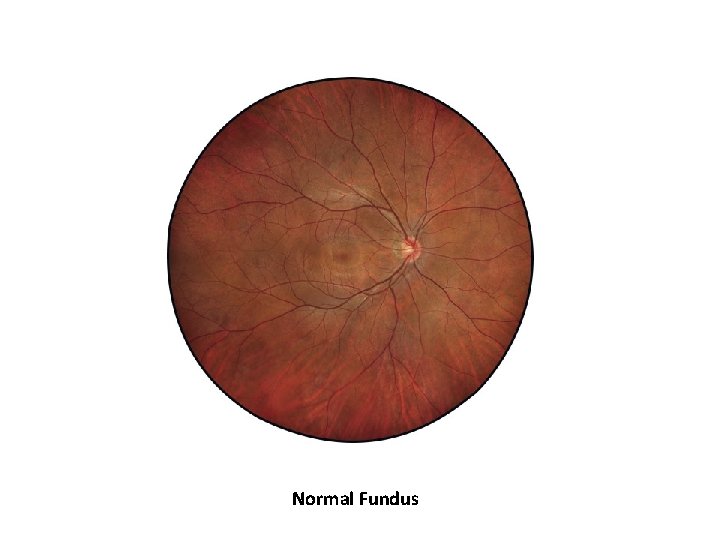
Normal Fundus
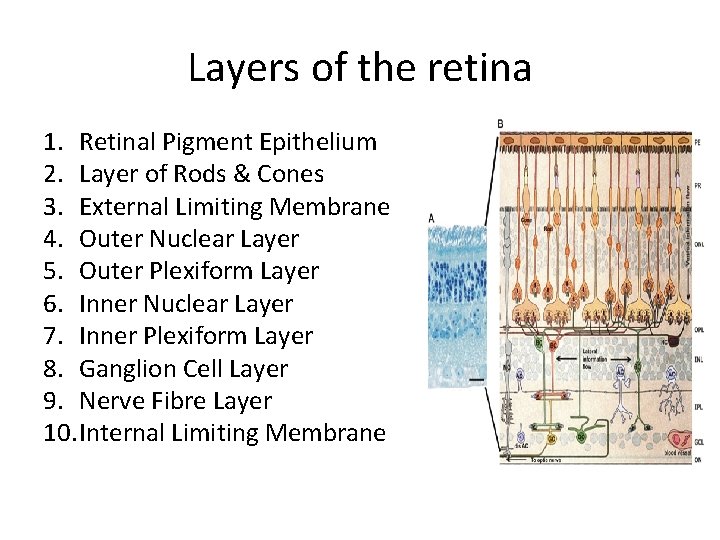
Layers of the retina 1. Retinal Pigment Epithelium 2. Layer of Rods & Cones 3. External Limiting Membrane 4. Outer Nuclear Layer 5. Outer Plexiform Layer 6. Inner Nuclear Layer 7. Inner Plexiform Layer 8. Ganglion Cell Layer 9. Nerve Fibre Layer 10. Internal Limiting Membrane
RETINAL DETACHMENT (RD) 1. Definitions and classifications • Retinal breaks • Retinal detachment
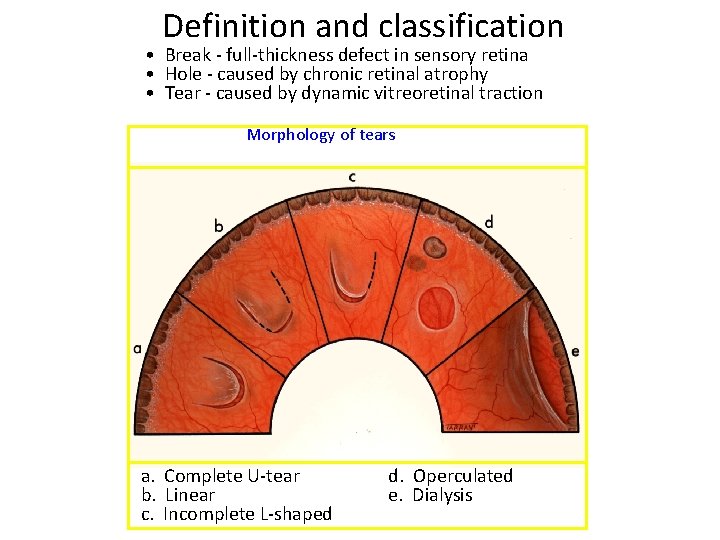
Definition and classification • Break - full-thickness defect in sensory retina • Hole - caused by chronic retinal atrophy • Tear - caused by dynamic vitreoretinal traction Morphology of tears a. Complete U-tear b. Linear c. Incomplete L-shaped d. Operculated e. Dialysis
DEFINITION • RETINAL DETACHMENT (R. D. ) is defined as the separation of neurosensory retina (NSR) from retinal pigment epithelium (RPE) caused by breakdown of forces that attach the NSR to RPE resulting in accumulation of sub retinal fluid (SRF) in the potential space between the NSR and RPE.
Retinal detachment (RD) Separation of sensory retina from RPE by subretinal fluid (SRF) Rhegmatogenous - caused by a retinal break Non-rhegmatogenous - tractional or exudative
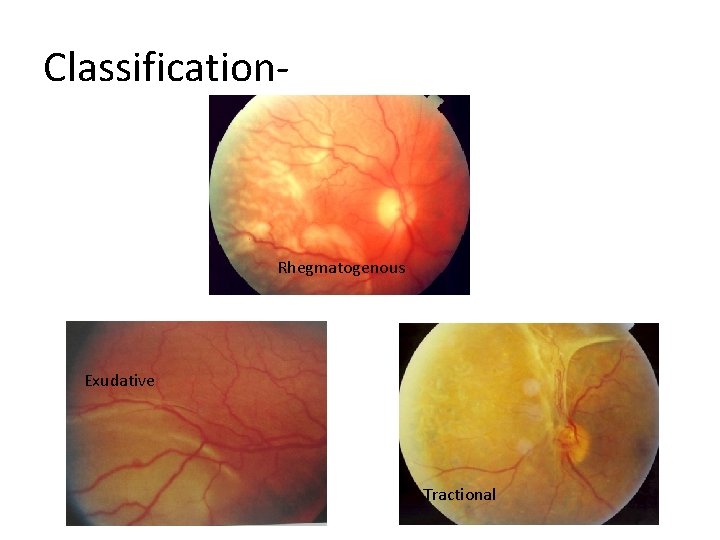
Classification • Clinico-etiologically – Three types of retinal detachment 1. Rhegmatogenous(or primary) retinal detachment 2. Tractional retinal detachment 3. Exudative retinal detachment
Classification- Rhegmatogenous Exudative Tractional
Predisposing factors for RD • • • Myopia Aphakia (& Pseudophakia) Trauma Retinal Degenerations PVD
Rhegmatogenous retinal detachment • Is usually associated with a retinal break (hole/tear) • Sub retinal fluid(SRF) seeps and separates the neurosensory retina from the retinal pigment epithelium(RPE)
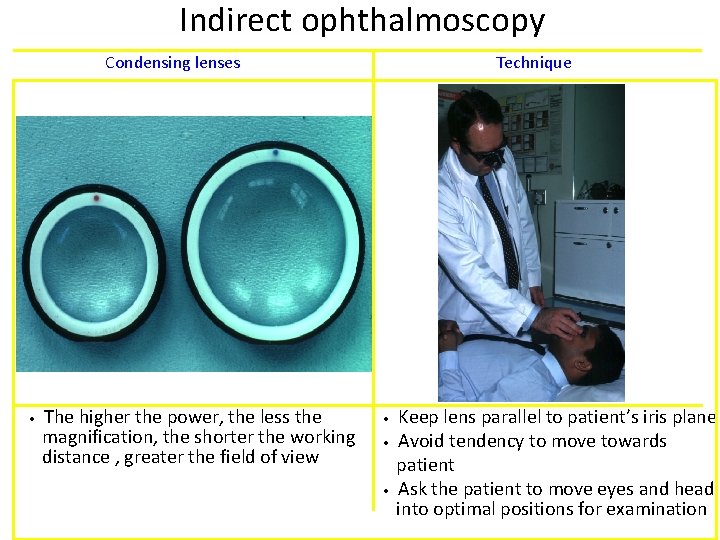
Indirect ophthalmoscopy Condensing lenses • The higher the power, the less the magnification, the shorter the working distance , greater the field of view Technique • • • Keep lens parallel to patient’s iris plane Avoid tendency to move towards patient Ask the patient to move eyes and head into optimal positions for examination
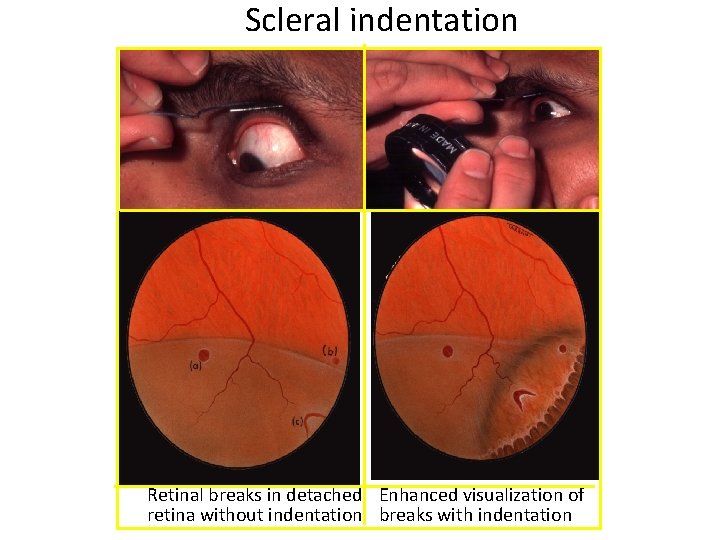
Scleral indentation Retinal breaks in detached Enhanced visualization of retina without indentation breaks with indentation
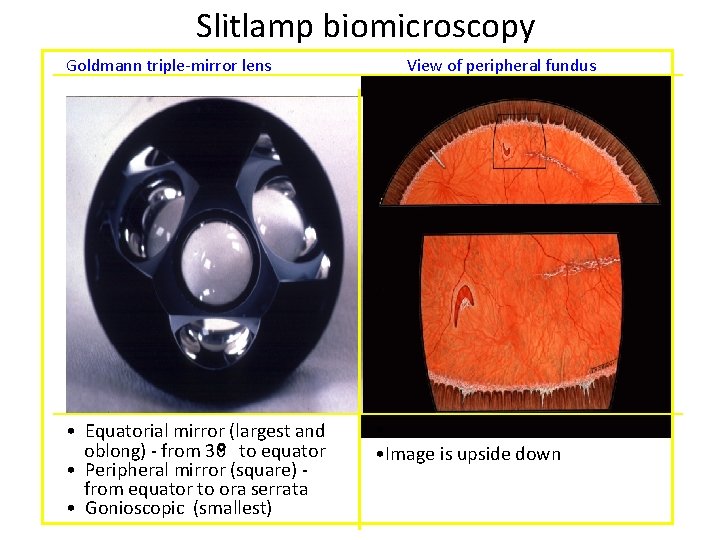
Slitlamp biomicroscopy Goldmann triple-mirror lens • Equatorial mirror (largest and oblong) - from 30 to equator • Peripheral mirror (square) from equator to ora serrata • Gonioscopic (smallest) View of peripheral fundus • • Image is upside down
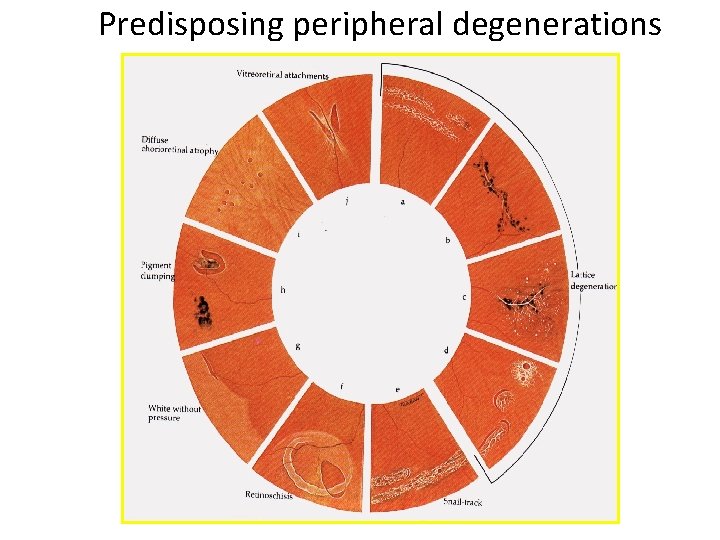
Predisposing peripheral degenerations
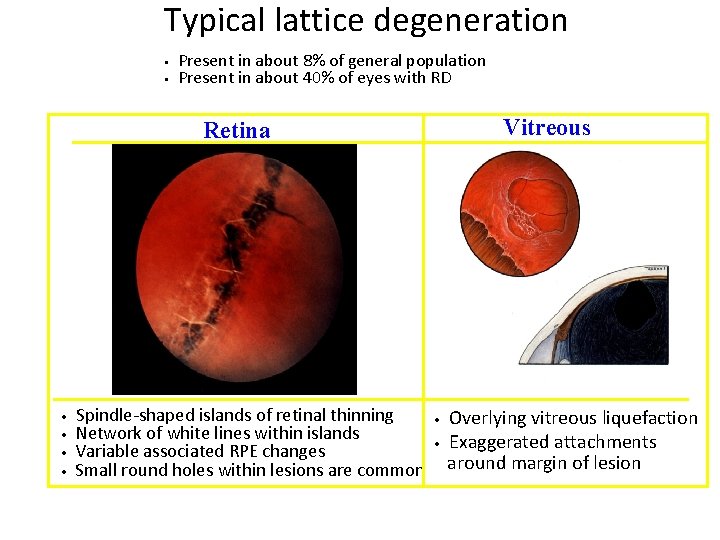
Typical lattice degeneration • • Present in about 8% of general population Present in about 40% of eyes with RD Vitreous Retina • • Spindle-shaped islands of retinal thinning Network of white lines within islands Variable associated RPE changes Small round holes within lesions are common • • Overlying vitreous liquefaction Exaggerated attachments around margin of lesion
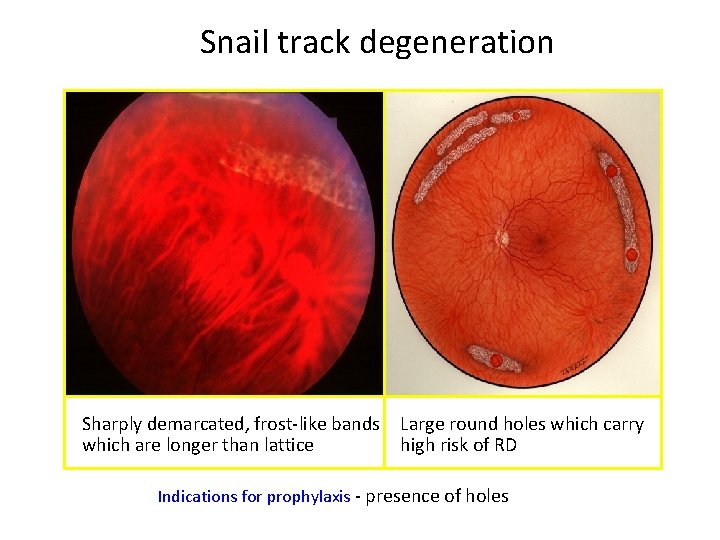
Snail track degeneration Sharply demarcated, frost-like bands which are longer than lattice Large round holes which carry high risk of RD Indications for prophylaxis - presence of holes
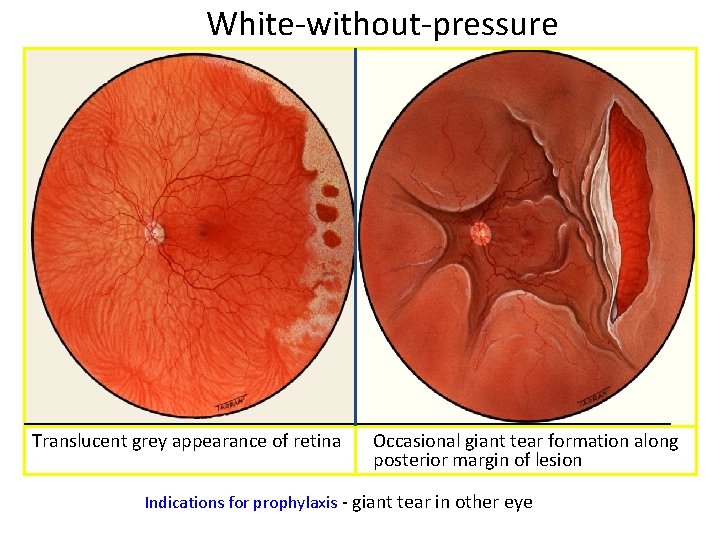
White-without-pressure Translucent grey appearance of retina Occasional giant tear formation along posterior margin of lesion Indications for prophylaxis - giant tear in other eye
Why is normal retina attached? • Vitreous tamponade • Acid mucopolysaccharides (Bio glue) • Hydrostatic pressure( Less pressure in the sub retinal space) • RPE Pump
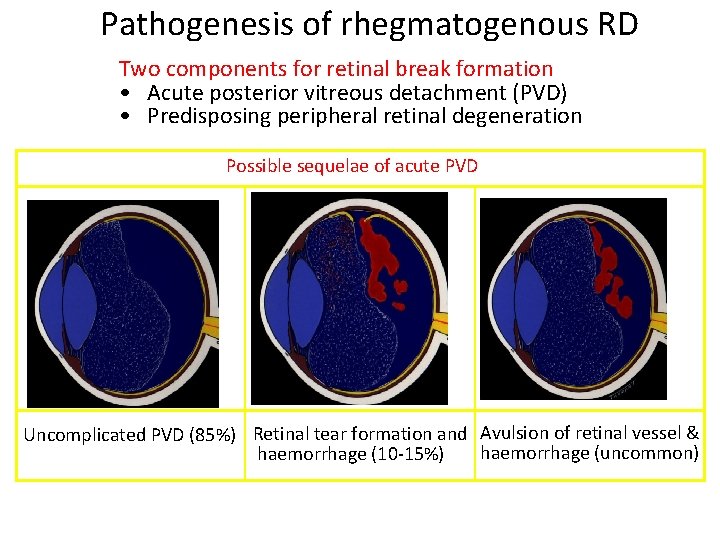
Pathogenesis • Retinal breaks are due to dynamic vitreoretinal traction and predisposing retinal degeneration • Degenerated fluid vitreous seeps through retinal break and collects as SRF between sensory retina and RPE leading to RD
Pathogenesis of rhegmatogenous RD Two components for retinal break formation • Acute posterior vitreous detachment (PVD) • Predisposing peripheral retinal degeneration Possible sequelae of acute PVD Uncomplicated PVD (85%) Retinal tear formation and Avulsion of retinal vessel & haemorrhage (uncommon) haemorrhage (10 -15%)
Clinical features • Prodromal symptoms Floaters (dark spots) Photopsia (flashes of light) • Symptoms of RD Loss in the field of vision(Localised and relative progressing to total loss) Painless loss of vision(usually rapid) with appearance of cloud/veil in front of affected eye
Signs of R. D. • External examination: Usually normal • Intra ocular pressure: Slightly lower or normal • Pupils: Normal reaction or Relative Afferent Pupillary Defect in extensive RD • Plane mirror examination: Greyish reflex
Signs of R. D. • Ophthalmoscopy: Indirect Ophthalmoscopy with scleral indentation: Tobacco dust(Shafer’s sign) • Retinal breaks • Convex configuration with folds(corrugations) • Loss of the choroidal pattern • Retinal blood vessels - darker than in flat retina
Fresh rhegmatogenous RD - signs • • Annual incidence - 1: 10, 000 of population Eventually bilateral in 10% • Convex, deep mobile elevation • Loss of choroidal pattern extending to ora serrata • Retinal breaks • Slightly opaque with dark blood vessels
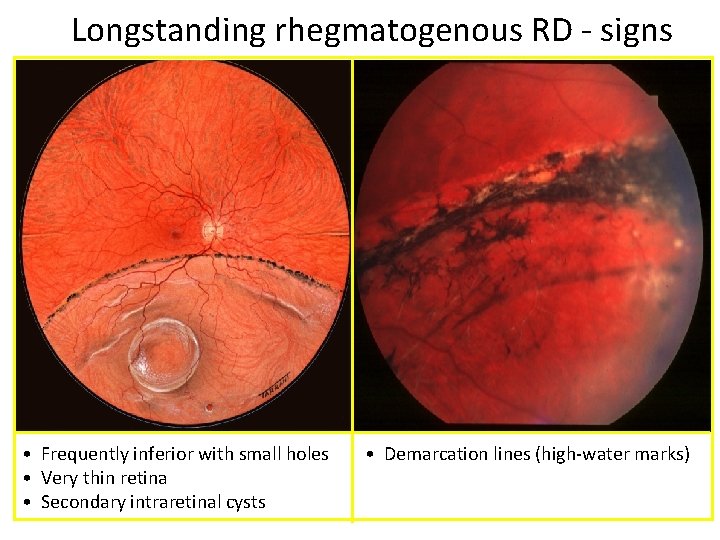
Signs of old RD • Retinal thinning (due to atrophy) • Sub retinal demarcation line/high water mark (due to RPE proliferation) • Secondary intra retinal cysts
Longstanding rhegmatogenous RD - signs • Frequently inferior with small holes • Very thin retina • Secondary intraretinal cysts • Demarcation lines (high-water marks)
Investigations • Ultrasonography confirms the diagnosis especially when media is hazy. • Visual field charting : scotomas (relative/absolute) • ERG: subnormal or absent
Complications • • Proliferative vitreo retinopathy(PVR) Complicated cataract Uveitis Phthisi bulbi
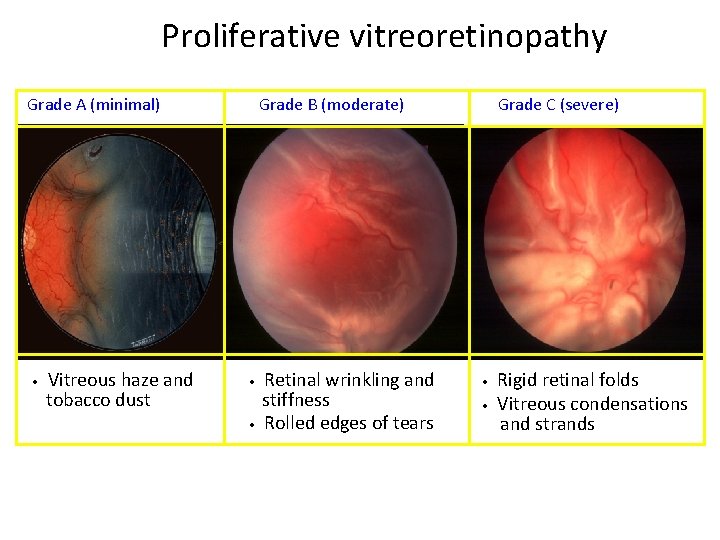
Proliferative vitreoretinopathy Grade A (minimal) • Vitreous haze and tobacco dust Grade B (moderate) • • Retinal wrinkling and stiffness Rolled edges of tears Grade C (severe) • • Rigid retinal folds Vitreous condensations and strands
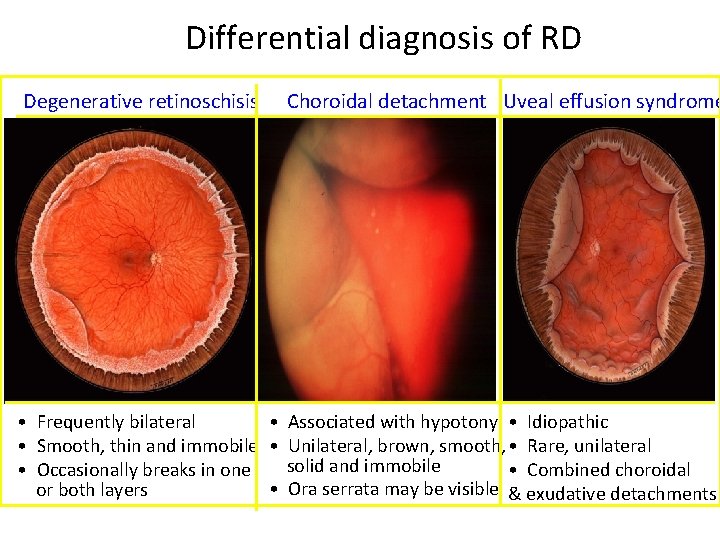
Differential diagnosis of RD Degenerative retinoschisis Choroidal detachment Uveal effusion syndrome • Frequently bilateral • Associated with hypotony • Idiopathic • Smooth, thin and immobile • Unilateral, brown, smooth, • Rare, unilateral solid and immobile • Occasionally breaks in one • Combined choroidal • Ora serrata may be visible & exudative detachments or both layers
Aims of management of RD • Seal/close retinal breaks with photocoagulation or cryotherapy (or diathermy – Jules Gonin -Ignipuncture) • Sub Retinal Fluid drainage : for immediate apposition between sensory retina and RPE (Not in all cases)
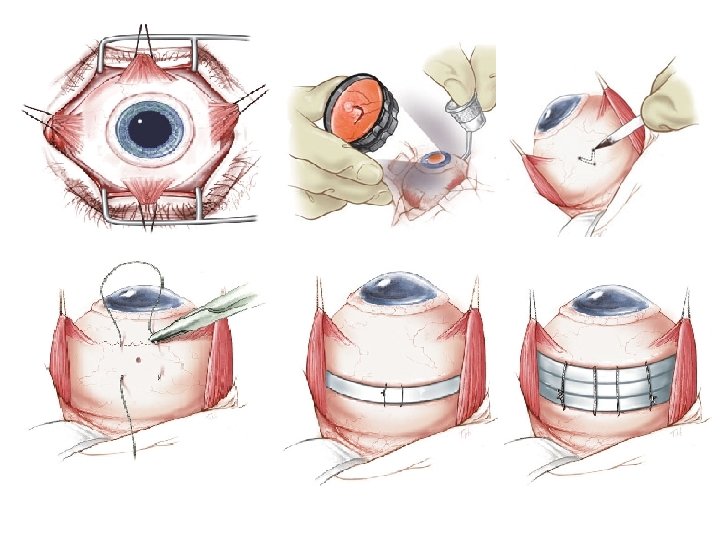
Aims of management of RD • Maintain chorioretinal apposition/adhesion by 1. Scleral Buckling to provide external tamponade 2. Pneumatic retinopexy 3. Pars plana vitrectomy (to relieve traction on retina)
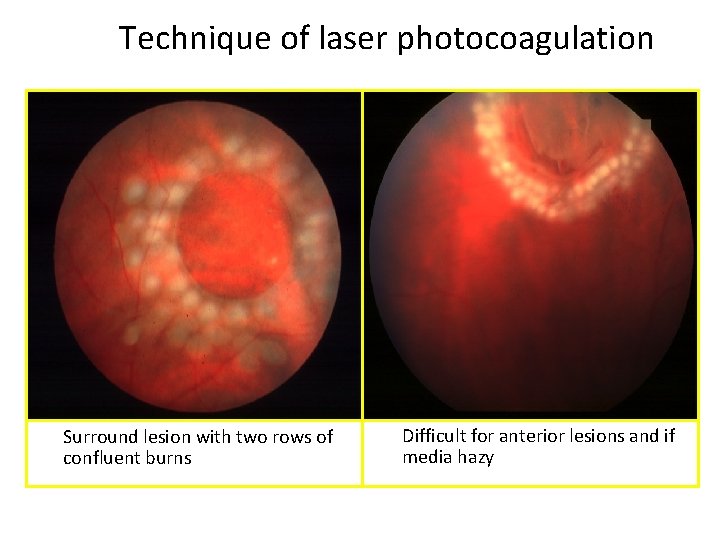
Technique of laser photocoagulation Surround lesion with two rows of confluent burns Difficult for anterior lesions and if media hazy
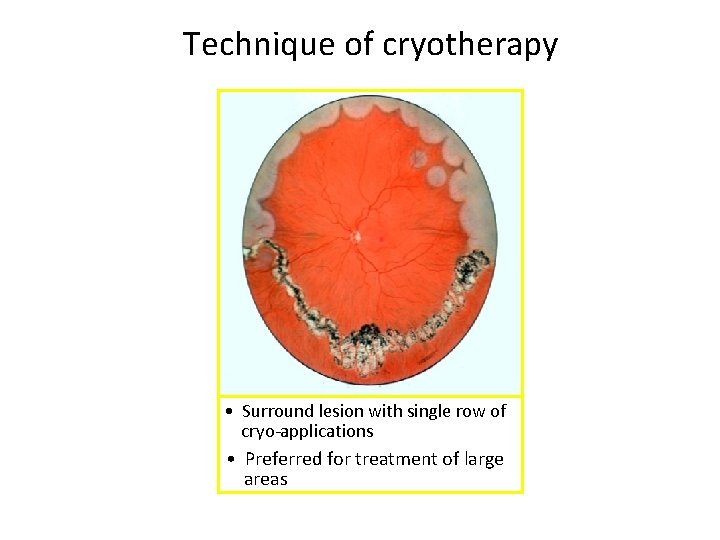
Technique of cryotherapy • Surround lesion with single row of cryo-applications • Preferred for treatment of large areas
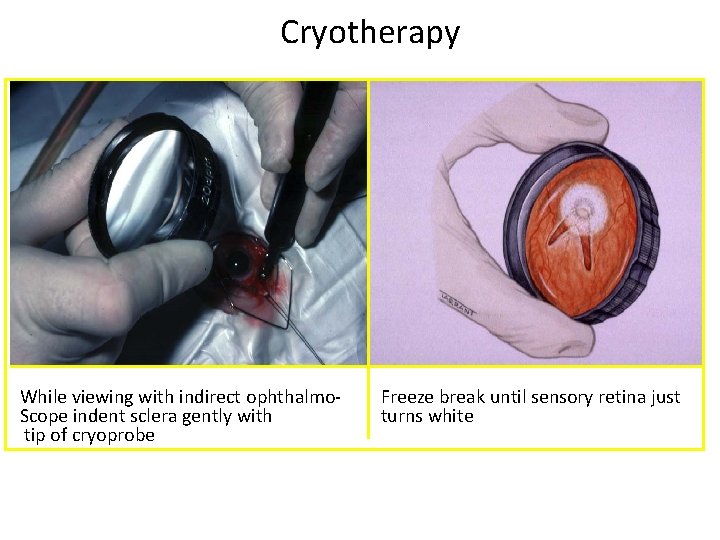
Cryotherapy While viewing with indirect ophthalmo. Scope indent sclera gently with tip of cryoprobe Freeze break until sensory retina just turns white
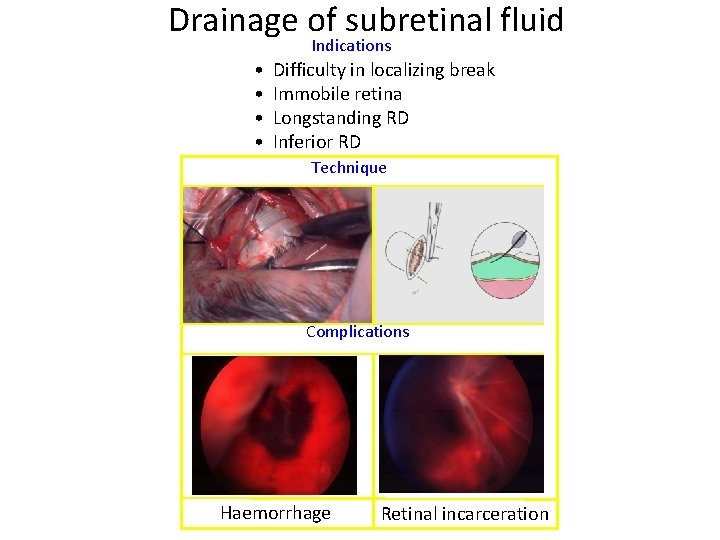
Drainage of subretinal fluid Indications • • Difficulty in localizing break Immobile retina Longstanding RD Inferior RD Technique Complications Haemorrhage Retinal incarceration
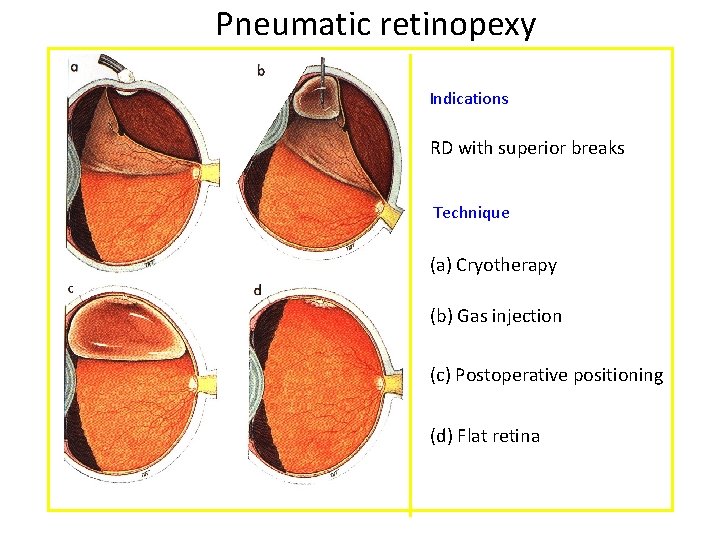
Pneumatic retinopexy Indications RD with superior breaks Technique (a) Cryotherapy (b) Gas injection (c) Postoperative positioning (d) Flat retina
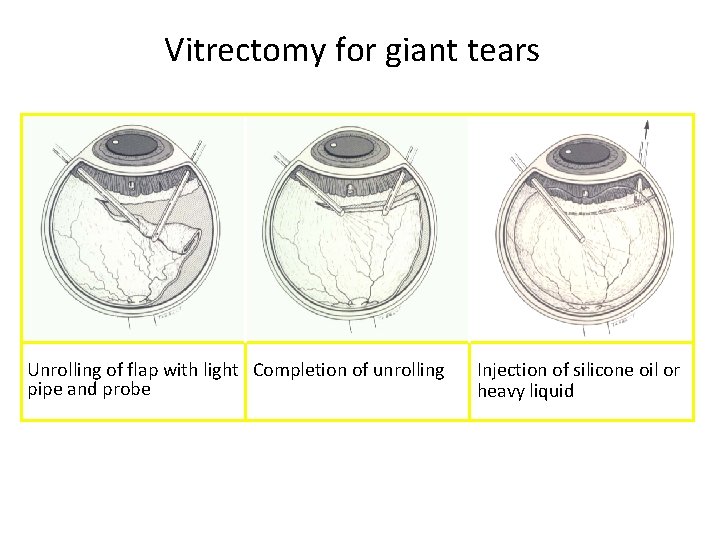
Vitrectomy for giant tears Unrolling of flap with light Completion of unrolling pipe and probe Injection of silicone oil or heavy liquid
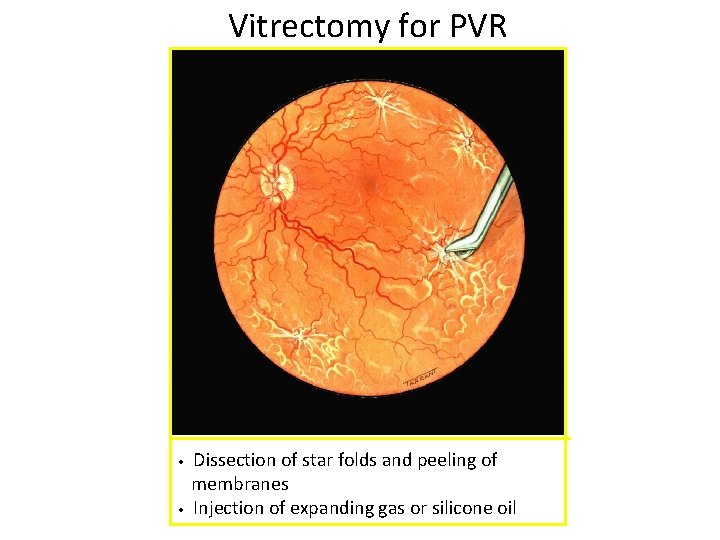
Vitrectomy for PVR • • Dissection of star folds and peeling of membranes Injection of expanding gas or silicone oil
Tractional Retinal detachment • Occurs due to mechanical pull/traction on the retina by contraction of fibrous tissue in the vitreous. • Etiology Ø Proliferative Diabetic Retinopathy (PDR) Ø Penetrating posterior segment trauma Ø Retinopathy of prematurity
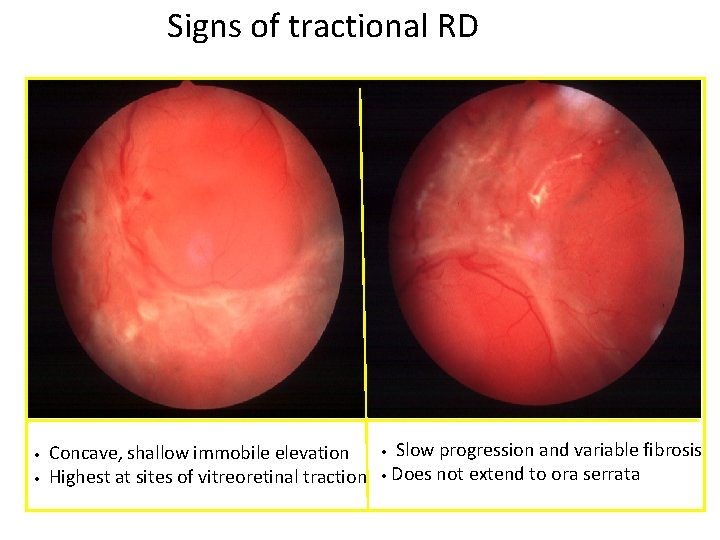
Signs of tractional RD • • Concave, shallow immobile elevation Highest at sites of vitreoretinal traction Slow progression and variable fibrosis • Does not extend to ora serrata •
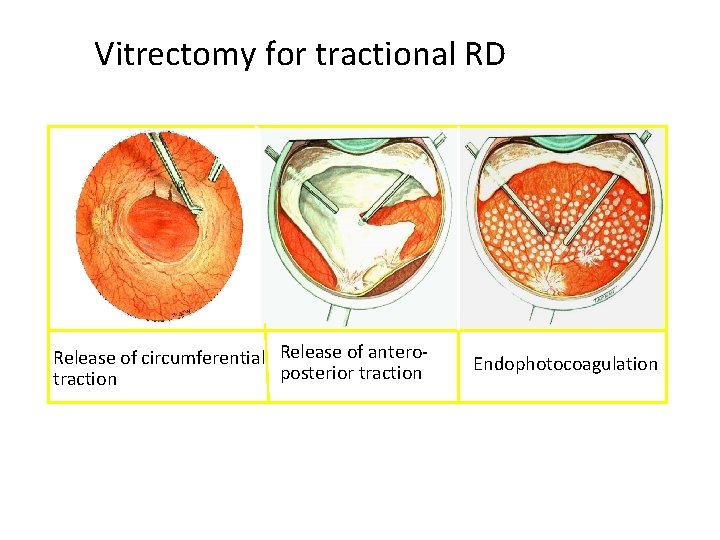
Vitrectomy for tractional RD Release of circumferential Release of anteroposterior traction Endophotocoagulation
Exudative Retinal detachment • Occurs due to the retina being pushed away by a neoplasm or fluid accumulation beneath the retina following inflammatory or vascular lesions.
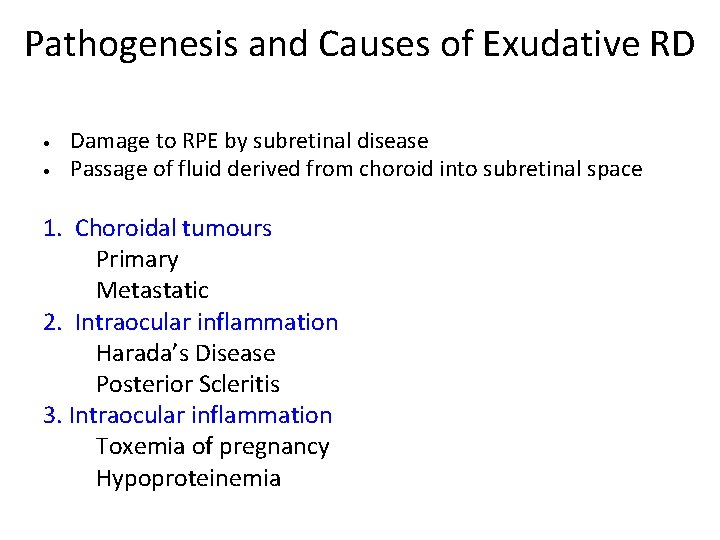
Pathogenesis and Causes of Exudative RD • • Damage to RPE by subretinal disease Passage of fluid derived from choroid into subretinal space 1. Choroidal tumours Primary Metastatic 2. Intraocular inflammation Harada’s Disease Posterior Scleritis 3. Intraocular inflammation Toxemia of pregnancy Hypoproteinemia
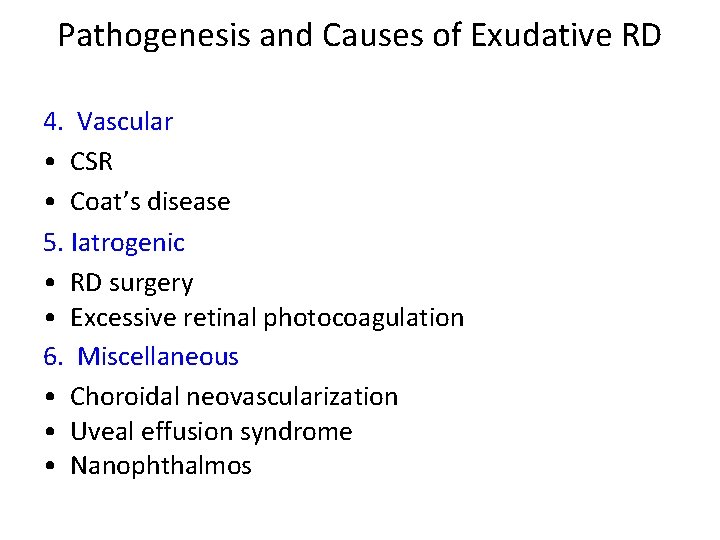
Pathogenesis and Causes of Exudative RD 4. Vascular • CSR • Coat’s disease 5. Iatrogenic • RD surgery • Excessive retinal photocoagulation 6. Miscellaneous • Choroidal neovascularization • Uveal effusion syndrome • Nanophthalmos
Signs of exudative RD • • Convex, smooth elevation May be very mobile and deep with shifting fluid • Subretinal pigment (leopard spots) after flattening
Medical Management • Inflammatory conditions (such as scleritis and Vogt-Koyanagi-Harada syndrome) anti-inflammatory agents. • Tumorsv External beam radiation therapy or brachytherapy with a plaque may be used for choroidal melanoma. v Metastatic lesions respond to chemotherapy or localized radiation therapy. v Choroidal hemangiomas may respond to laser photocoagulation or plaque brachytherapy. v Retinoblastomas may be shrunk with chemotherapy and then treated locally with heat, laser, or cryotherapy.
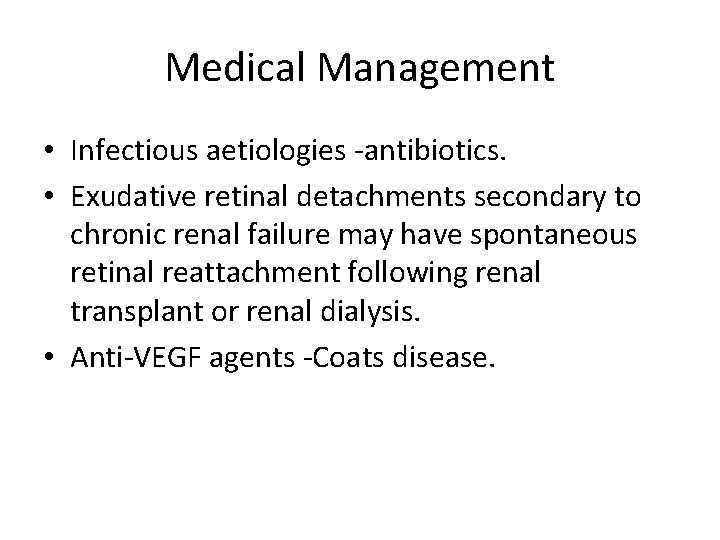
Medical Management • Infectious aetiologies -antibiotics. • Exudative retinal detachments secondary to chronic renal failure may have spontaneous retinal reattachment following renal transplant or renal dialysis. • Anti-VEGF agents -Coats disease.
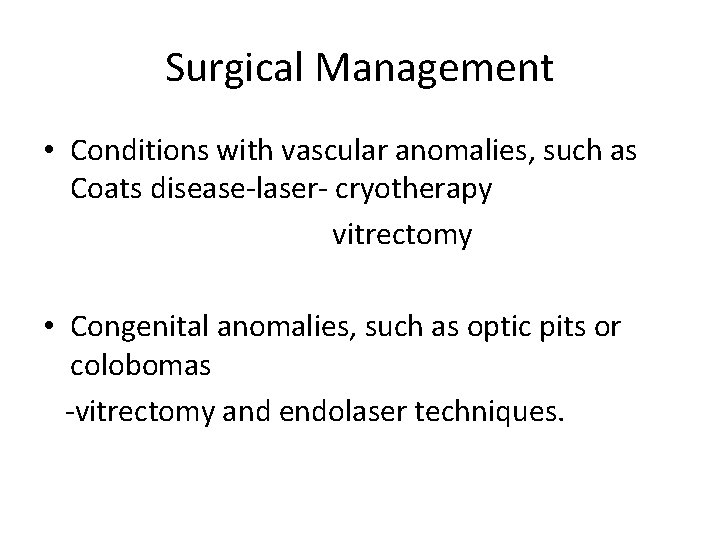
Surgical Management • Conditions with vascular anomalies, such as Coats disease-laser- cryotherapy vitrectomy • Congenital anomalies, such as optic pits or colobomas -vitrectomy and endolaser techniques.
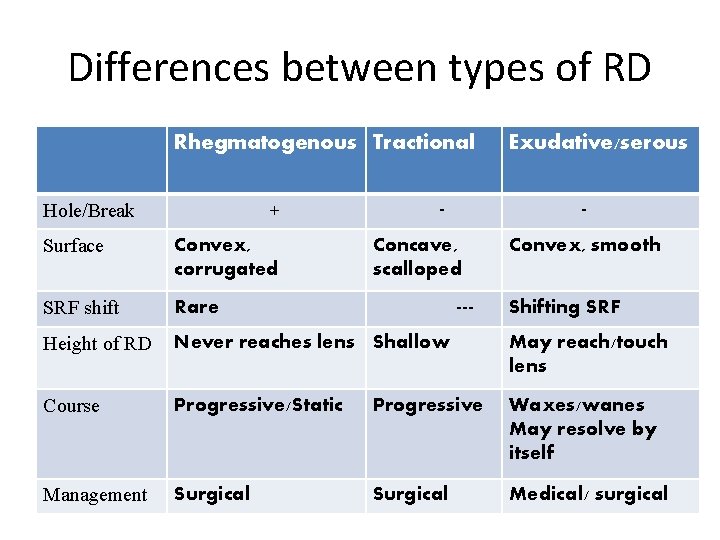
Differences between types of RD Rhegmatogenous Tractional Hole/Break + - Exudative/serous - Surface Convex, corrugated SRF shift Rare Height of RD Never reaches lens Shallow May reach/touch lens Course Progressive/Static Progressive Waxes/wanes May resolve by itself Management Surgical Medical/ surgical Concave, scalloped --- Convex, smooth Shifting SRF
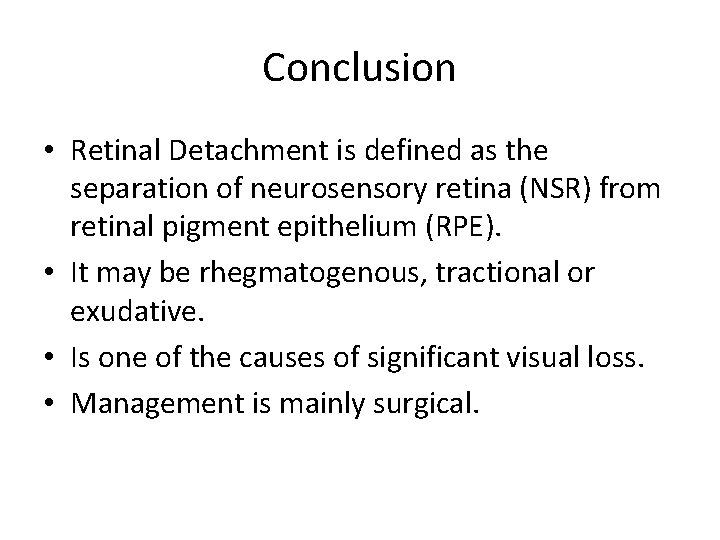
Conclusion • Retinal Detachment is defined as the separation of neurosensory retina (NSR) from retinal pigment epithelium (RPE). • It may be rhegmatogenous, tractional or exudative. • Is one of the causes of significant visual loss. • Management is mainly surgical.