
RETINAL CAVERNOUS HEMANGIOMA A SERIE OF CASES Andria
- Slides: 1
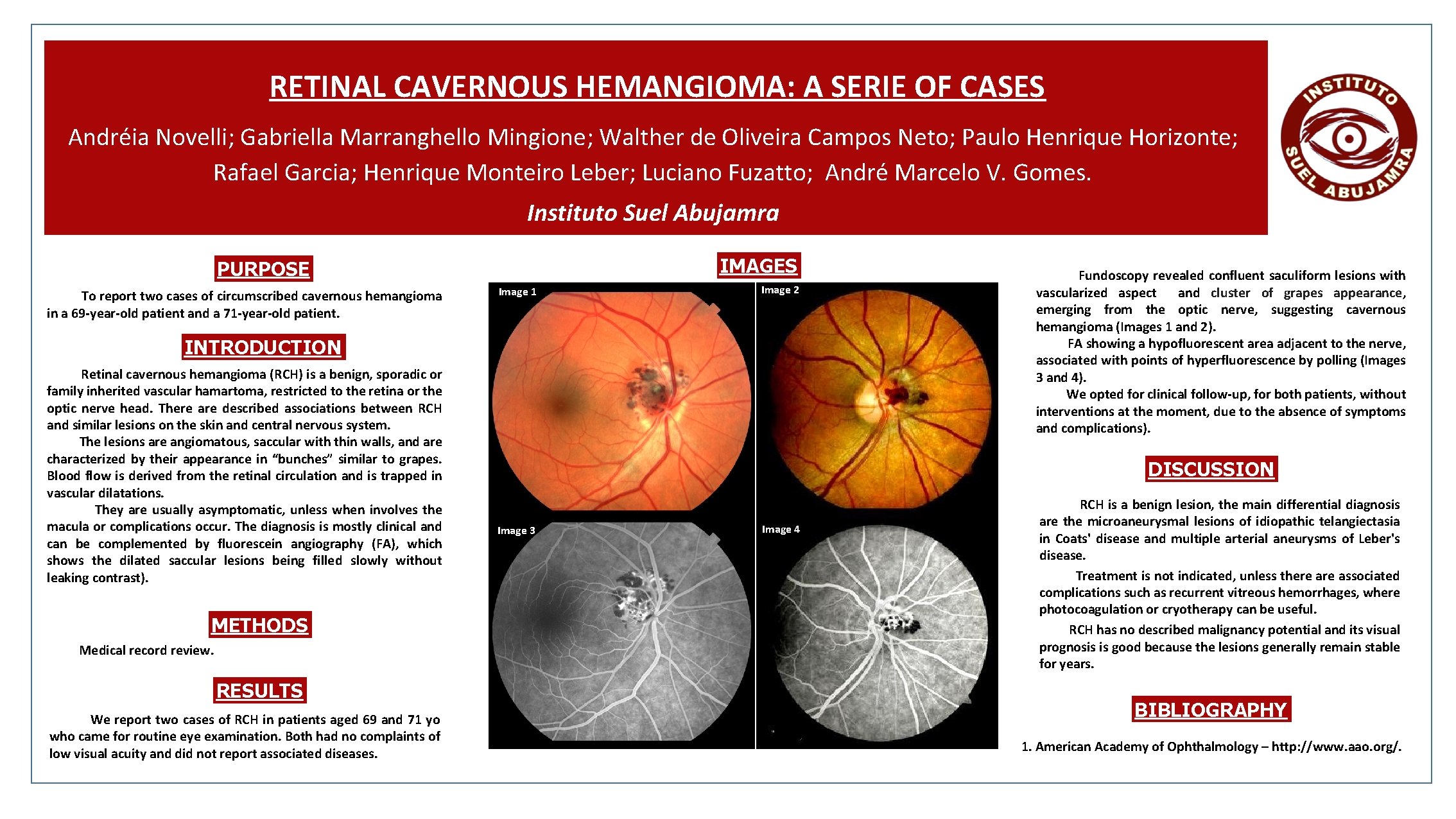
RETINAL CAVERNOUS HEMANGIOMA: A SERIE OF CASES Andréia Novelli; Gabriella Marranghello Mingione; Walther de Oliveira Campos Neto; Paulo Henrique Horizonte; Rafael Garcia; Henrique Monteiro Leber; Luciano Fuzatto; André Marcelo V. Gomes. Instituto Suel Abujamra IMAGES PURPOSE To report two cases of circumscribed cavernous hemangioma in a 69 -year-old patient and a 71 -year-old patient. Image 1 Image 2 INTRODUCTION Retinal cavernous hemangioma (RCH) is a benign, sporadic or family inherited vascular hamartoma, restricted to the retina or the optic nerve head. There are described associations between RCH and similar lesions on the skin and central nervous system. The lesions are angiomatous, saccular with thin walls, and are characterized by their appearance in “bunches” similar to grapes. Blood flow is derived from the retinal circulation and is trapped in vascular dilatations. They are usually asymptomatic, unless when involves the macula or complications occur. The diagnosis is mostly clinical and can be complemented by fluorescein angiography (FA), which shows the dilated saccular lesions being filled slowly without leaking contrast). METHODS Medical record review. RESULTS We report two cases of RCH in patients aged 69 and 71 yo who came for routine eye examination. Both had no complaints of low visual acuity and did not report associated diseases. Fundoscopy revealed confluent saculiform lesions with vascularized aspect and cluster of grapes appearance, emerging from the optic nerve, suggesting cavernous hemangioma (Images 1 and 2). FA showing a hypofluorescent area adjacent to the nerve, associated with points of hyperfluorescence by polling (Images 3 and 4). We opted for clinical follow-up, for both patients, without interventions at the moment, due to the absence of symptoms and complications). DISCUSSION Image 3 Image 4 RCH is a benign lesion, the main differential diagnosis are the microaneurysmal lesions of idiopathic telangiectasia in Coats' disease and multiple arterial aneurysms of Leber's disease. Treatment is not indicated, unless there associated complications such as recurrent vitreous hemorrhages, where photocoagulation or cryotherapy can be useful. RCH has no described malignancy potential and its visual prognosis is good because the lesions generally remain stable for years. BIBLIOGRAPHY 1. American Academy of Ophthalmology – http: //www. aao. org/.