
Rethinking the Building Envelope Weatherization Retrofit Opportunities 11252020

Rethinking the Building Envelope Weatherization Retrofit Opportunities 11/25/2020
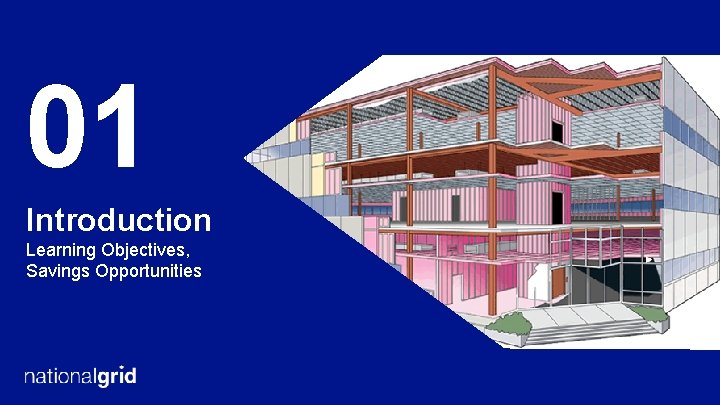
01 Introduction Learning Objectives, Savings Opportunities
Winter Weather Perfect Conditions for Slips and Falls. Winter Safety Tip • Take the safest route to your destination, and make the time for it. • Don’t use your smartphone while walking—it’s distracting. • Walk deliberately. Bending your knees a little and taking slow, short steps. • Wear boots or other slip-resistant footwear. • Look out for "black ice. " • Use caution when getting in and out of vehicles; use the vehicle for support. • When entering a building, remove as much snow and water from your boots as you can. • Avoid carrying items. Keep hands empty so arms are free to move for stabilization. • When walking on steps, always use the hand railings and plant your feet firmly on each step. National Grid | Rethinking the Building Envelope | 11/25/2020 3
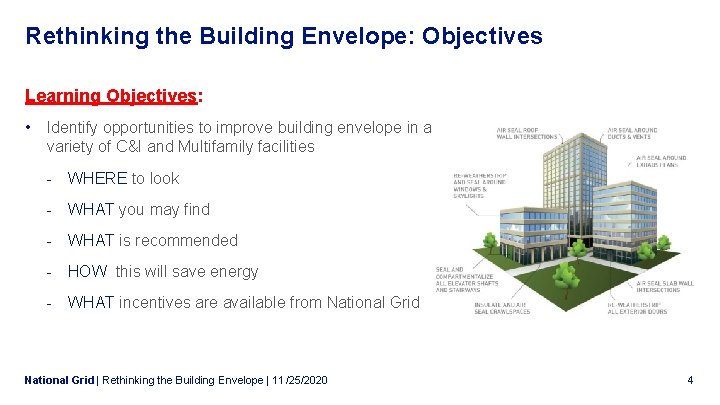
Rethinking the Building Envelope: Objectives Learning Objectives: • Identify opportunities to improve building envelope in a variety of C&I and Multifamily facilities - WHERE to look - WHAT you may find - WHAT is recommended - HOW this will save energy - WHAT incentives are available from National Grid | Rethinking the Building Envelope | 11/25/2020 4
Rethinking the Building Envelope: Weatherization Defined - Weatherization or weatherproofing is the practice of protecting a building and its interior from the elements. - Weatherization is distinct from building insulation. - In the United States, buildings use over one third of all energy consumed and two thirds of all electricity. National Grid | Rethinking the Building Envelope | 11/25/2020 5
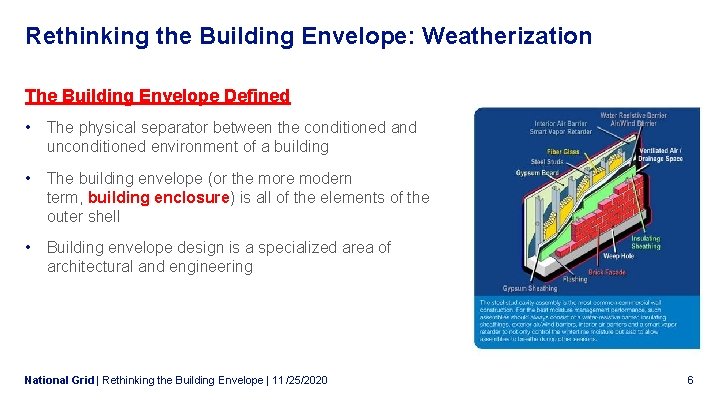
Rethinking the Building Envelope: Weatherization The Building Envelope Defined • The physical separator between the conditioned and unconditioned environment of a building • The building envelope (or the more modern term, building enclosure) is all of the elements of the outer shell • Building envelope design is a specialized area of architectural and engineering National Grid | Rethinking the Building Envelope | 11/25/2020 6
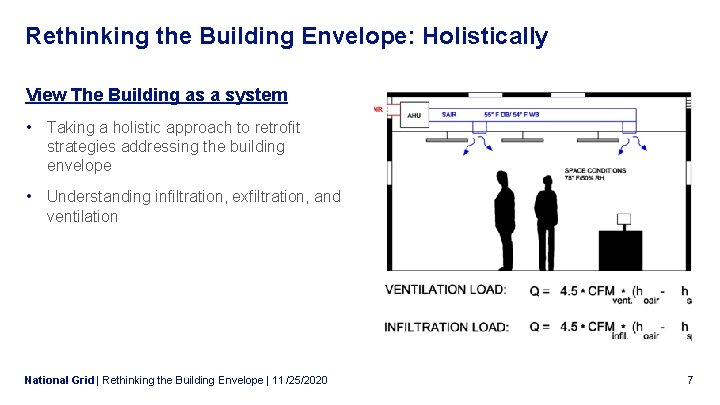
Rethinking the Building Envelope: Holistically View The Building as a system • Taking a holistic approach to retrofit strategies addressing the building envelope • Understanding infiltration, exfiltration, and ventilation National Grid | Rethinking the Building Envelope | 11/25/2020 7
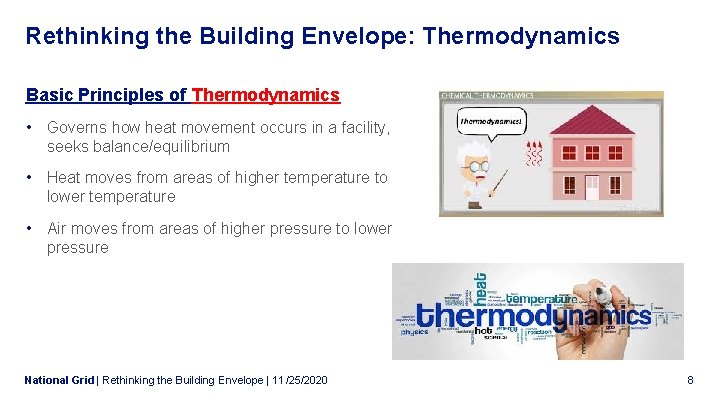
Rethinking the Building Envelope: Thermodynamics Basic Principles of Thermodynamics • Governs how heat movement occurs in a facility, seeks balance/equilibrium • Heat moves from areas of higher temperature to lower temperature • Air moves from areas of higher pressure to lower pressure National Grid | Rethinking the Building Envelope | 11/25/2020 8
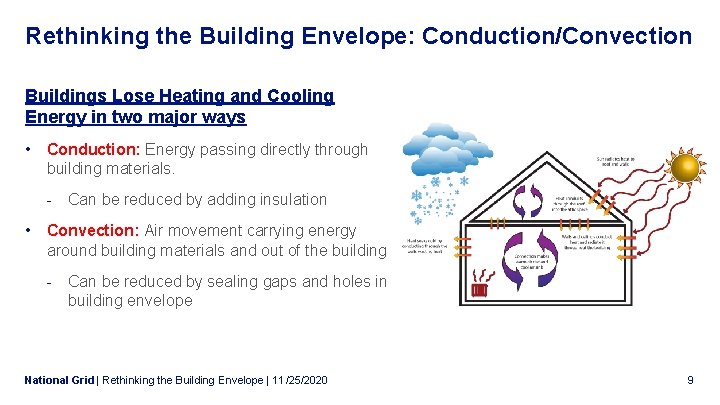
Rethinking the Building Envelope: Conduction/Convection Buildings Lose Heating and Cooling Energy in two major ways • Conduction: Energy passing directly through building materials. - Can be reduced by adding insulation • Convection: Air movement carrying energy around building materials and out of the building - Can be reduced by sealing gaps and holes in building envelope National Grid | Rethinking the Building Envelope | 11/25/2020 9
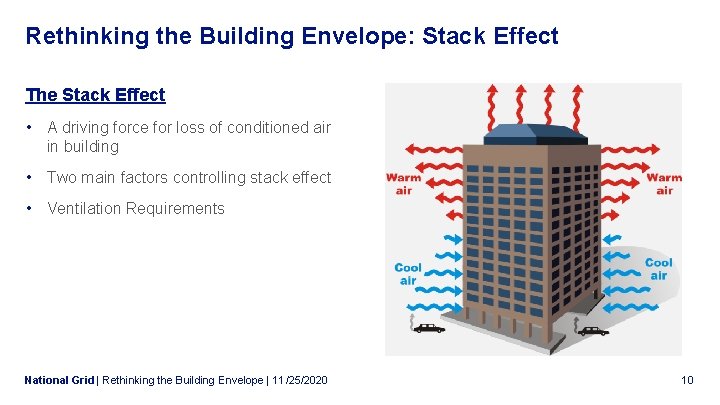
Rethinking the Building Envelope: Stack Effect The Stack Effect • A driving force for loss of conditioned air in building • Two main factors controlling stack effect • Ventilation Requirements National Grid | Rethinking the Building Envelope | 11/25/2020 10
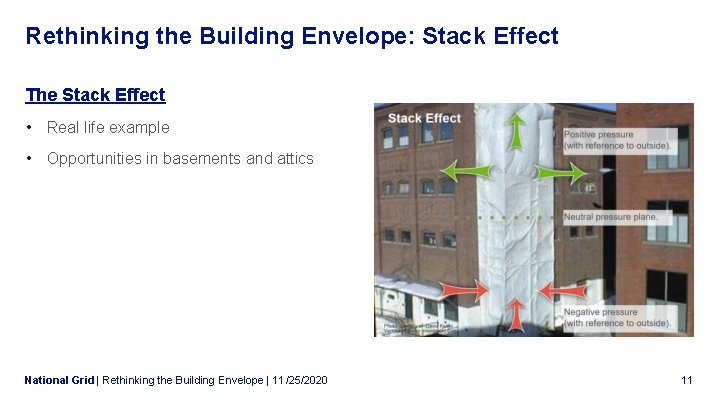
Rethinking the Building Envelope: Stack Effect The Stack Effect • Real life example • Opportunities in basements and attics National Grid | Rethinking the Building Envelope | 11/25/2020 11
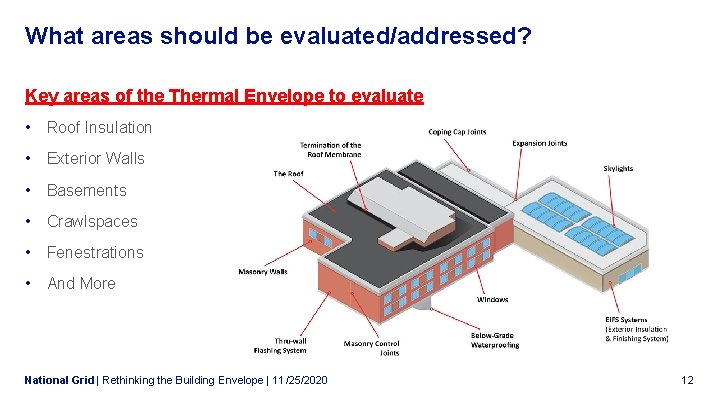
What areas should be evaluated/addressed? Key areas of the Thermal Envelope to evaluate • Roof Insulation • Exterior Walls • Basements • Crawlspaces • Fenestrations • And More National Grid | Rethinking the Building Envelope | 11/25/2020 12
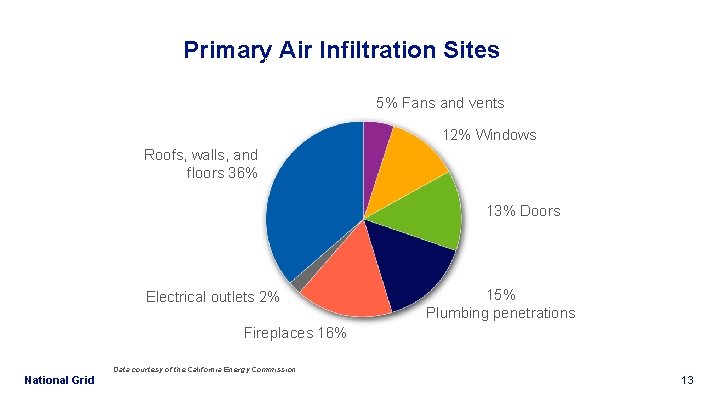
Primary Air Infiltration Sites IDENTIFYING & AIR SEALING THE BUILDING ENVELOPE 5% Fans and vents 12% Windows Roofs, walls, and floors 36% 13% Doors Electrical outlets 2% 15% Plumbing penetrations Fireplaces 16% Data courtesy of the California Energy Commission National Grid 13
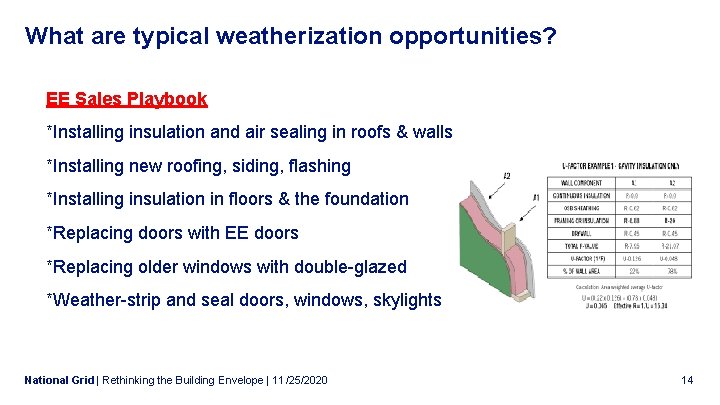
What are typical weatherization opportunities? EE Sales Playbook *Installing insulation and air sealing in roofs & walls *Installing new roofing, siding, flashing *Installing insulation in floors & the foundation *Replacing doors with EE doors *Replacing older windows with double-glazed *Weather-strip and seal doors, windows, skylights National Grid | Rethinking the Building Envelope | 11/25/2020 14
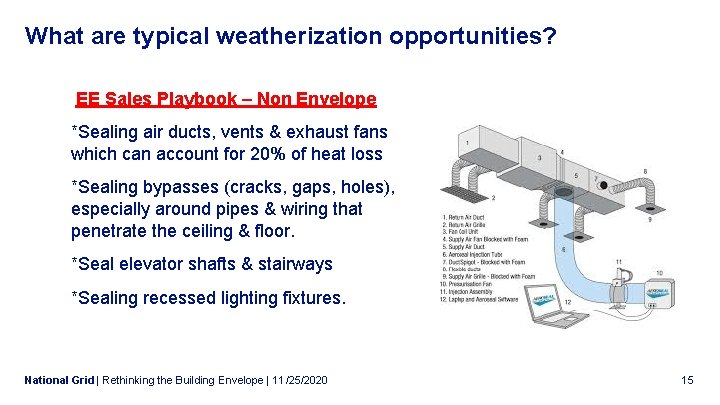
What are typical weatherization opportunities? EE Sales Playbook – Non Envelope *Sealing air ducts, vents & exhaust fans which can account for 20% of heat loss *Sealing bypasses (cracks, gaps, holes), especially around pipes & wiring that penetrate the ceiling & floor. *Seal elevator shafts & stairways *Sealing recessed lighting fixtures. National Grid | Rethinking the Building Envelope | 11/25/2020 15
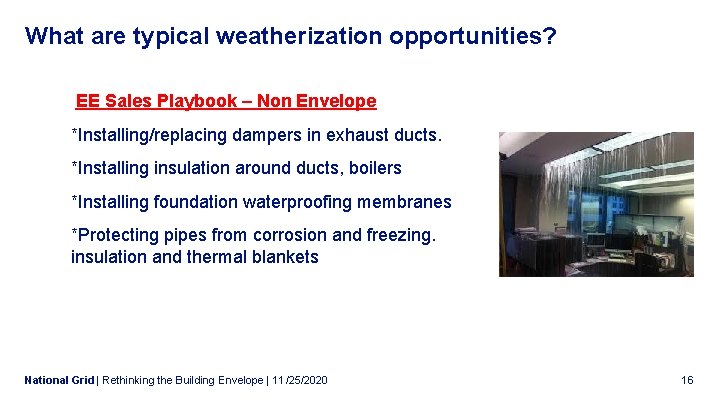
What are typical weatherization opportunities? EE Sales Playbook – Non Envelope *Installing/replacing dampers in exhaust ducts. *Installing insulation around ducts, boilers *Installing foundation waterproofing membranes *Protecting pipes from corrosion and freezing. insulation and thermal blankets National Grid | Rethinking the Building Envelope | 11/25/2020 16

02 Incentives and Savings
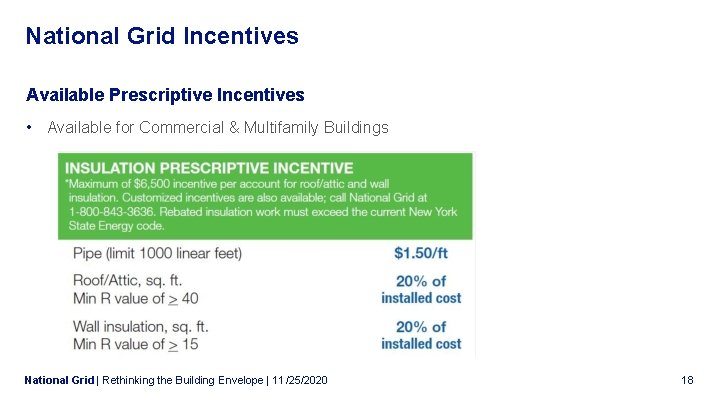
National Grid Incentives Available Prescriptive Incentives • Available for Commercial & Multifamily Buildings National Grid | Rethinking the Building Envelope | 11/25/2020 18
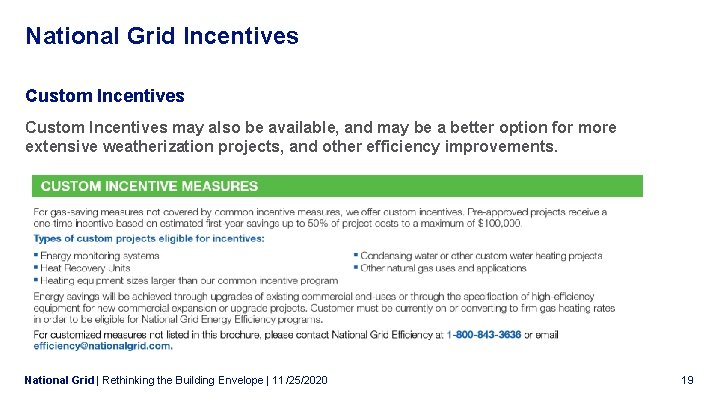
National Grid Incentives Custom Incentives may also be available, and may be a better option for more extensive weatherization projects, and other efficiency improvements. National Grid | Rethinking the Building Envelope | 11/25/2020 19
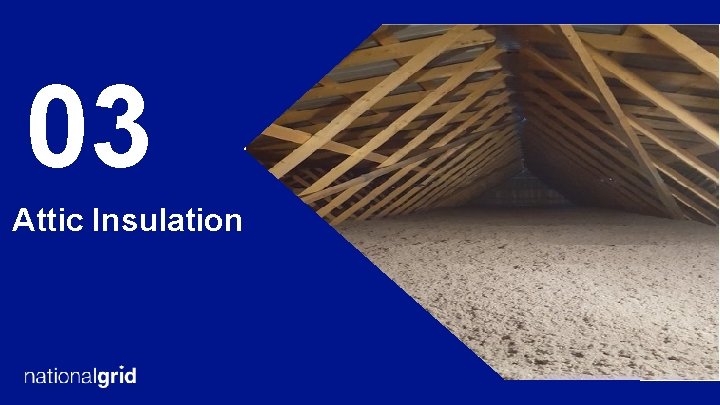
03 Attic Insulation
Attic Insulation The Low-Hanging Fruit 6” or less of existing insulation = Opportunity • Identify Existing Insulation Material/Thickness • Identify location of existing thermal boundary (attic floor or rafter slopes) - We will cover insulating rafter slopes in the next section • Determine type, quantity, and thickness of insulation required to be added • Be on lookout for uninsulated attic access panels, doors National Grid | Rethinking the Building Envelope | 11/25/2020 21
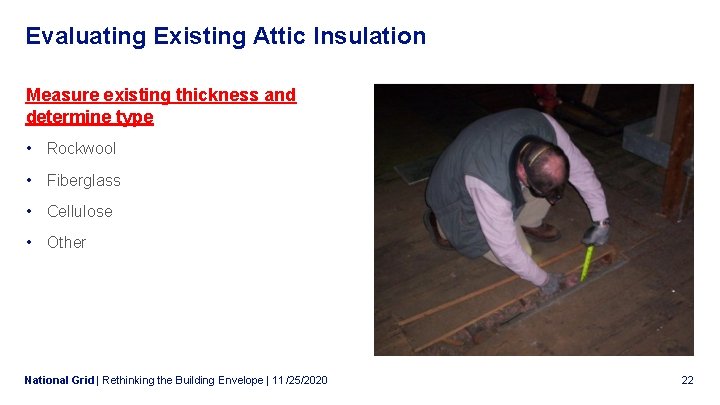
Evaluating Existing Attic Insulation Measure existing thickness and determine type • Rockwool • Fiberglass • Cellulose • Other National Grid | Rethinking the Building Envelope | 11/25/2020 22
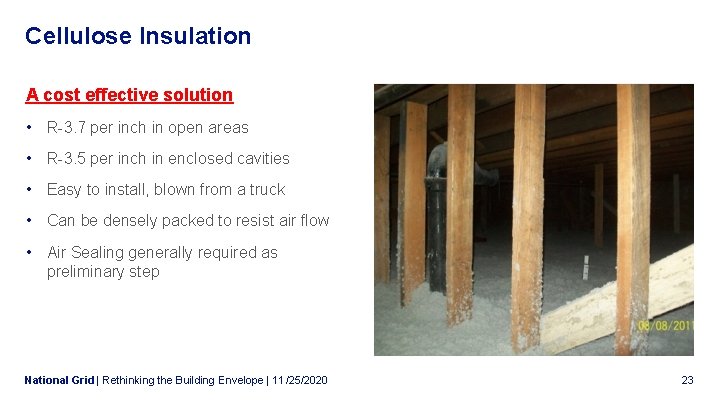
Cellulose Insulation A cost effective solution • R-3. 7 per inch in open areas • R-3. 5 per inch in enclosed cavities • Easy to install, blown from a truck • Can be densely packed to resist air flow • Air Sealing generally required as preliminary step National Grid | Rethinking the Building Envelope | 11/25/2020 23
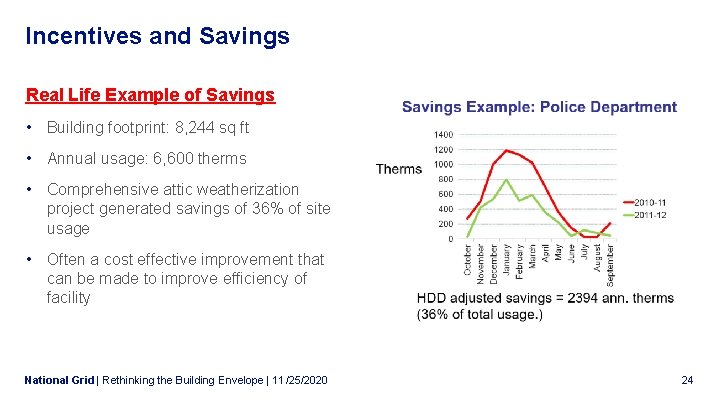
Incentives and Savings Real Life Example of Savings • Building footprint: 8, 244 sq ft • Annual usage: 6, 600 therms • Comprehensive attic weatherization project generated savings of 36% of site usage • Often a cost effective improvement that can be made to improve efficiency of facility National Grid | Rethinking the Building Envelope | 11/25/2020 24
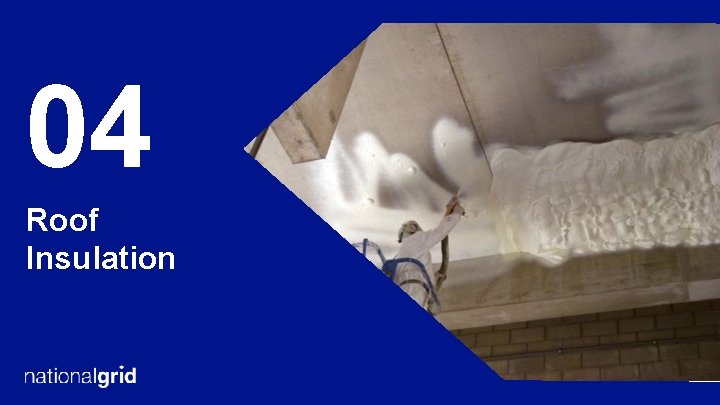
04 Roof Insulation
Roof Insulation Establishing thermal boundary on rafter slopes • In most cases, thermal boundary should be established on the attic floor • In cases where the attic contains heating/cooling mains, ductwork, mechanical equipment, it may make sense to insulate the rafter slopes National Grid | Rethinking the Building Envelope | 11/25/2020 26
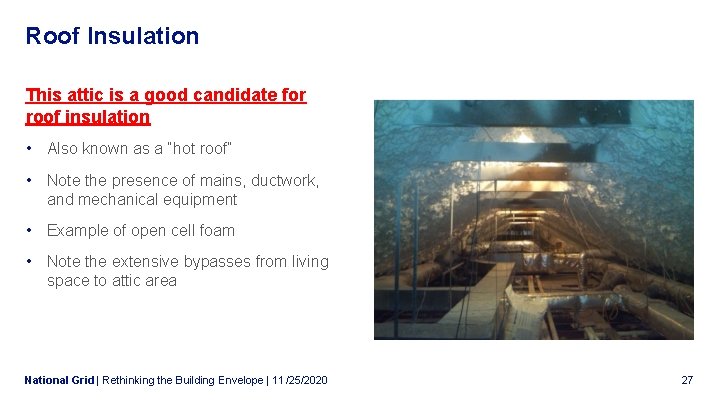
Roof Insulation This attic is a good candidate for roof insulation • Also known as a “hot roof” • Note the presence of mains, ductwork, and mechanical equipment • Example of open cell foam • Note the extensive bypasses from living space to attic area National Grid | Rethinking the Building Envelope | 11/25/2020 27
Roof Insulation Types • Spray Foam: Open and Closed Cell • Spray Applied Mineral Wool • Densely Packed Cellulose • Rigid Foam Board National Grid | Rethinking the Building Envelope | 11/25/2020 28
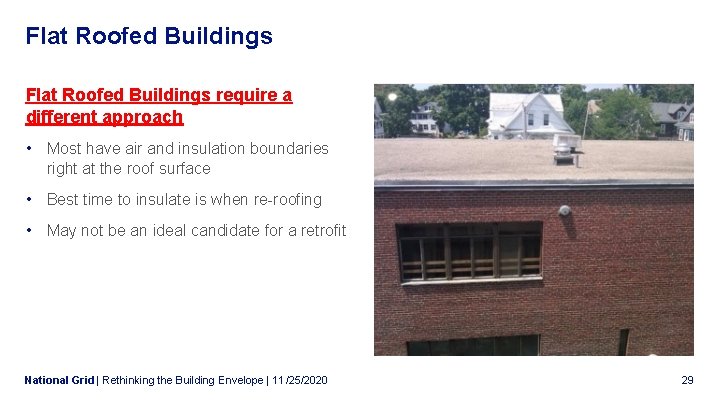
Flat Roofed Buildings require a different approach • Most have air and insulation boundaries right at the roof surface • Best time to insulate is when re-roofing • May not be an ideal candidate for a retrofit National Grid | Rethinking the Building Envelope | 11/25/2020 29

05 Air Sealing
Air Sealing What is air sealing? • Installation of foam, caulking, and other sealants to seal air leaks in building envelope • Minimizes the “stack effect” in building, which drives loss of conditioned air from the building • Must be done in conjunction with installation of additional attic insulation • Eliminate “bypasses” from conditioned to unconditioned spaces • Blower door testing can be used to determine air leakage rates and determine potential savings National Grid | Rethinking the Building Envelope | 11/25/2020 31
Air Sealing Where to recommend air sealing • Attic - Wall top plates, plumbing/wiring penetrations, open chases, air seal attic before adding insulation • Basements/Crawlspaces - Band joist, sill, open chases - Ducts in unconditioned spaces should also be sealed • Flat Roofed Buildings - Roof-wall joint, skylights, transitions National Grid | Rethinking the Building Envelope | 11/25/2020 32
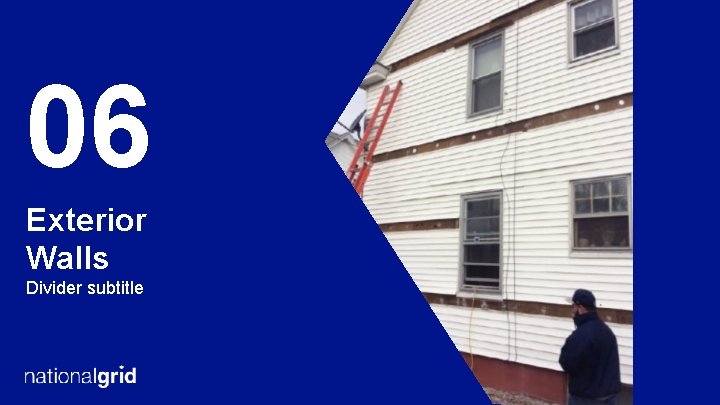
06 Exterior Walls Divider subtitle
Exterior Wall Insulation Retrofit Applications • Wood, vinyl, and aluminium sided buildings with empty wall cavities (stick-built structures) • Cellulose insulation can be blown into exterior wall cavities by temporarily removing sections of siding from exterior New Construction • Wall assemblies with R-value above IECC Code Minimum requirements, may be possible to improve when re-siding National Grid | Rethinking the Building Envelope | 11/25/2020 34
07 Basements and Crawlspaces
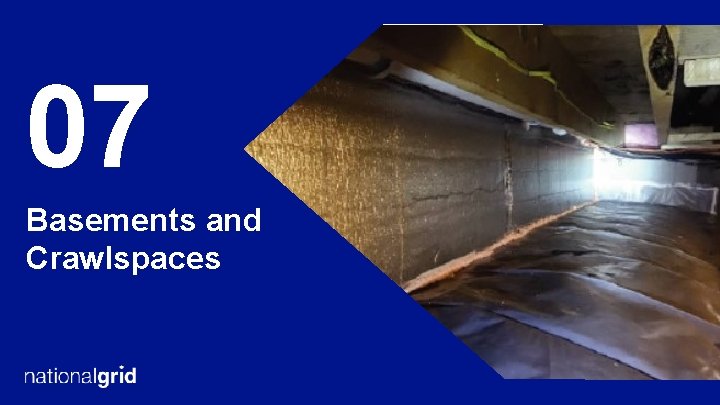
Basements and Crawlspaces Applications • Building sill and band joist, or basement ceiling • Bulkheads • Crawlspace walls • Materials include spray foam, rigid board, and fiberglass products • Pay attention to vapor barrier on earthen crawlspaces • Pipes/Fittings: Steam, Heating Hot Water (HHW), Domestic Hot Water (DHW) National Grid | Rethinking the Building Envelope | 11/25/2020 36
08 Windows and Doors
Windows and Doors Overview • Single Pane Windows and Uninsulated doors may warrant replacement • Often less cost effective than other envelope measures, but worth investigating • Weather stripping of doors and replacing worn fuzz style weather stripping on worn windows often a viable cost effective alternative to replacement National Grid | Rethinking the Building Envelope | 11/25/2020 38

39
- Slides: 39