
Rethinking Personality Disorders A Dimensional Approach to Diagnosis






- Slides: 48
Rethinking Personality Disorders A Dimensional Approach to Diagnosis and Treatment Tanya A. Freedland, MPS, LADC Robert F. Krueger, Ph. D
Introductions Name Agency & role Biggest aha moment working with someone with a personality disorder What have you always wanted to know about Personality Disorders?
Agenda • PD refresher • Current methods • History of PDs • New Directions • Using AMPD in DSM-5
PD Warmup • How do PDs show up in your work? • What diagnostic methods do you use to investigate PDs? • Which PDs do you work with most?
What is a Personality Disorder
Activity 1
PD Warmup • How did you decide on which diagnosis belonged to which person? • Which were easy? • Which did you struggle with?
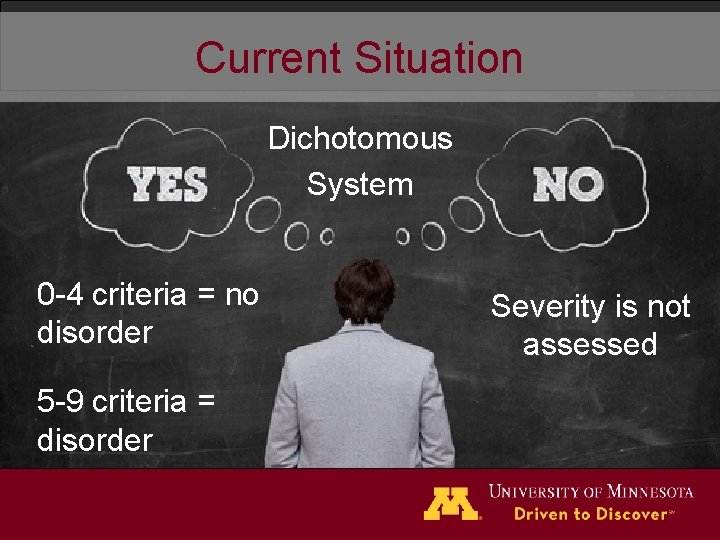
Current Situation Dichotomous System 0 -4 criteria = no disorder 5 -9 criteria = disorder Severity is not assessed
Current Situation Arbitrary cutoffs are not based in science
Current Situation Many paths to a disorder Any 5 criteria lead to same diagnosis 256 combinations of BPD criteria Rodriguez-Seijas, C. , Eaton, N. R. , & Krueger, R. F. (2015). How transdiagnostic factors of personality and psychopathology can inform clinical assessment and intervention. Journal of personality assessment, 97(5), 425 -435.
Current Situation The door for comorbidity is wide open Most people with a PD meet criteria for 3
What About the Clusters?
Evolution of the PD Changes in PDs over the DSM editions
New Directions Who checked out Section III in DSM-5 before this workshop?
AMPD in Practice • Criterion A: functional impairment – 2 groups – 4 elements • Criterion B: personality traits – 5 trait domains – 25 facets
AMPD in Practice The Self
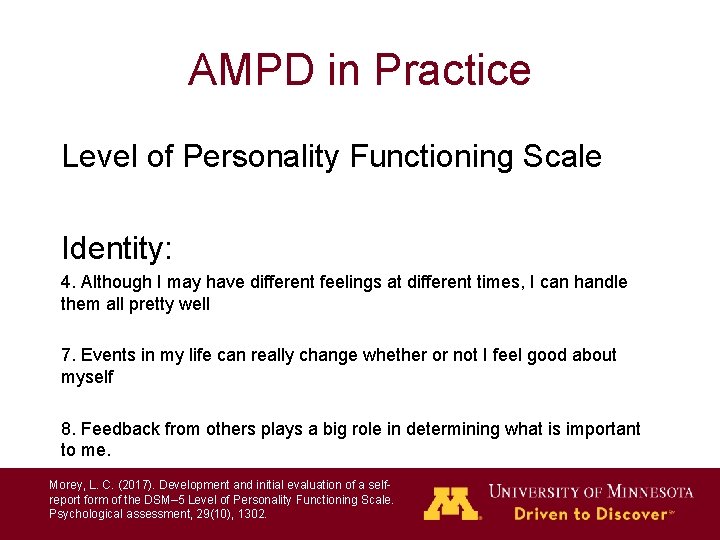
AMPD in Practice Identity • Experience the self as unique • Clear boundaries between self and others • Stability of self-esteem and accurate self appraisal • Capacity for range of emotions and ability to regulate them
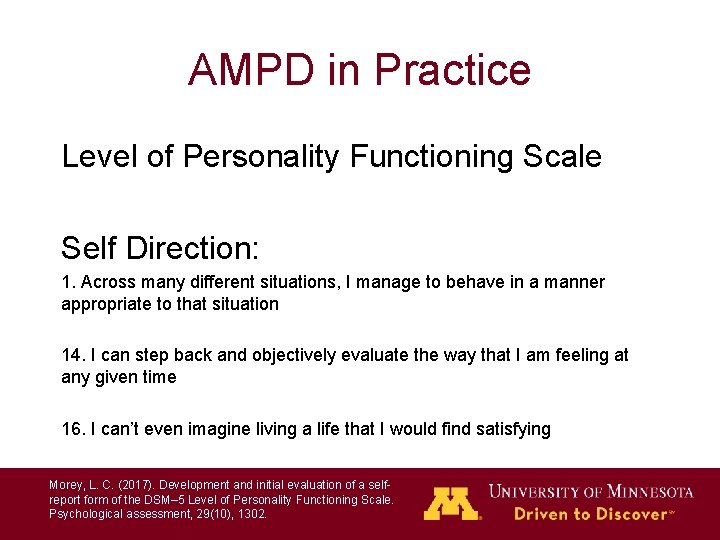
AMPD in Practice Self-direction • Pursuit of meaningful goals • Utilization of prosocial and constructive standards of behavior • Ability to productively self-reflect
AMPD in Practice Interpersonal Functioning
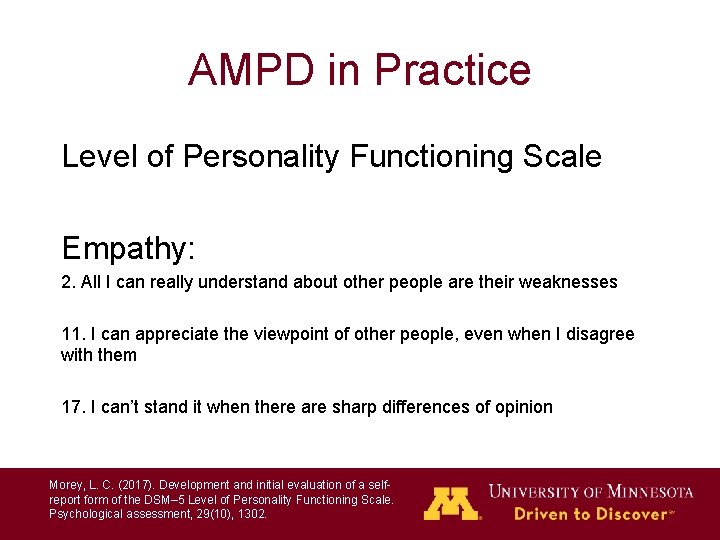
AMPD in Practice Empathy • Comprehension and understanding of the motivations and experiences of others • Toleration of different perspectives • Understanding effects of behavior on others
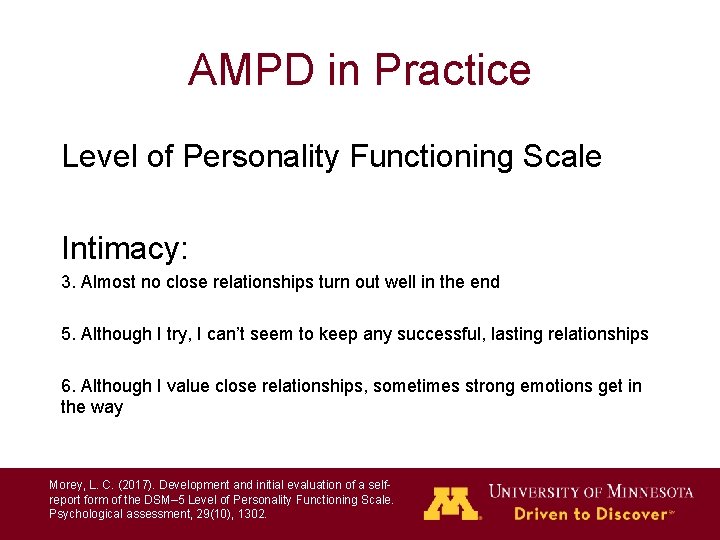
AMPD in Practice Intimacy • Depth and duration of connectedness with others • Desire and capacity for closeness • Behavior that reflects mutual regard
AMPD in Practice Levels of Impairment • 0 = little to no impairment • 1 = some impairment • 2 = moderate • 3 = severe • 4 = extreme
AMPD in Practice Do you miss the GAF?
AMPD in Practice Level of Personality Functioning Scale Standardized tool for assessing in each of the four interpersonal areas – – Identity Self-direction Empathy Intimacy Morey, L. C. (2017). Development and initial evaluation of a selfreport form of the DSM– 5 Level of Personality Functioning Scale. Psychological assessment, 29(10), 1302.
AMPD in Practice Level of Personality Functioning Scale Identity: 4. Although I may have different feelings at different times, I can handle them all pretty well 7. Events in my life can really change whether or not I feel good about myself 8. Feedback from others plays a big role in determining what is important to me. Morey, L. C. (2017). Development and initial evaluation of a selfreport form of the DSM– 5 Level of Personality Functioning Scale. Psychological assessment, 29(10), 1302.
AMPD in Practice Level of Personality Functioning Scale Self Direction: 1. Across many different situations, I manage to behave in a manner appropriate to that situation 14. I can step back and objectively evaluate the way that I am feeling at any given time 16. I can’t even imagine living a life that I would find satisfying Morey, L. C. (2017). Development and initial evaluation of a selfreport form of the DSM– 5 Level of Personality Functioning Scale. Psychological assessment, 29(10), 1302.
AMPD in Practice Level of Personality Functioning Scale Empathy: 2. All I can really understand about other people are their weaknesses 11. I can appreciate the viewpoint of other people, even when I disagree with them 17. I can’t stand it when there are sharp differences of opinion Morey, L. C. (2017). Development and initial evaluation of a selfreport form of the DSM– 5 Level of Personality Functioning Scale. Psychological assessment, 29(10), 1302.
AMPD in Practice Level of Personality Functioning Scale Intimacy: 3. Almost no close relationships turn out well in the end 5. Although I try, I can’t seem to keep any successful, lasting relationships 6. Although I value close relationships, sometimes strong emotions get in the way Morey, L. C. (2017). Development and initial evaluation of a selfreport form of the DSM– 5 Level of Personality Functioning Scale. Psychological assessment, 29(10), 1302.
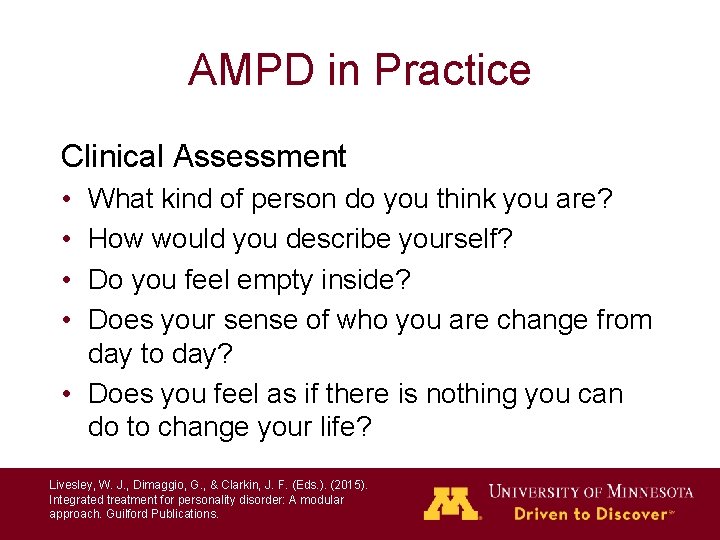
AMPD in Practice Clinical Assessment • • What kind of person do you think you are? How would you describe yourself? Do you feel empty inside? Does your sense of who you are change from day to day? • Does you feel as if there is nothing you can do to change your life? Livesley, W. J. , Dimaggio, G. , & Clarkin, J. F. (Eds. ). (2015). Integrated treatment for personality disorder: A modular approach. Guilford Publications.
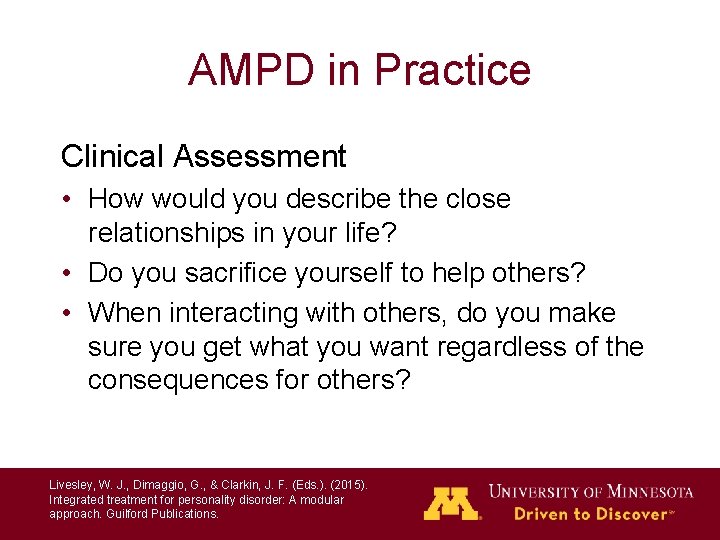
AMPD in Practice Clinical Assessment • How would you describe the close relationships in your life? • Do you sacrifice yourself to help others? • When interacting with others, do you make sure you get what you want regardless of the consequences for others? Livesley, W. J. , Dimaggio, G. , & Clarkin, J. F. (Eds. ). (2015). Integrated treatment for personality disorder: A modular approach. Guilford Publications.
Activity Functional Impairment Activity • How would you assess Criterion A? • Write own questions to assess impairment in the 4 areas • Be an archaeologist of functioning. What tools to use to dig for info?
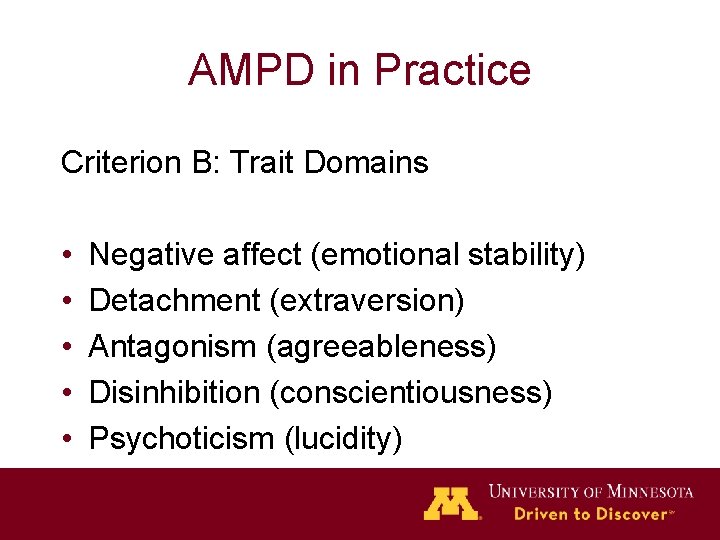
AMPD in Practice Criterion B: Trait Domains • • • Negative affect (emotional stability) Detachment (extraversion) Antagonism (agreeableness) Disinhibition (conscientiousness) Psychoticism (lucidity)
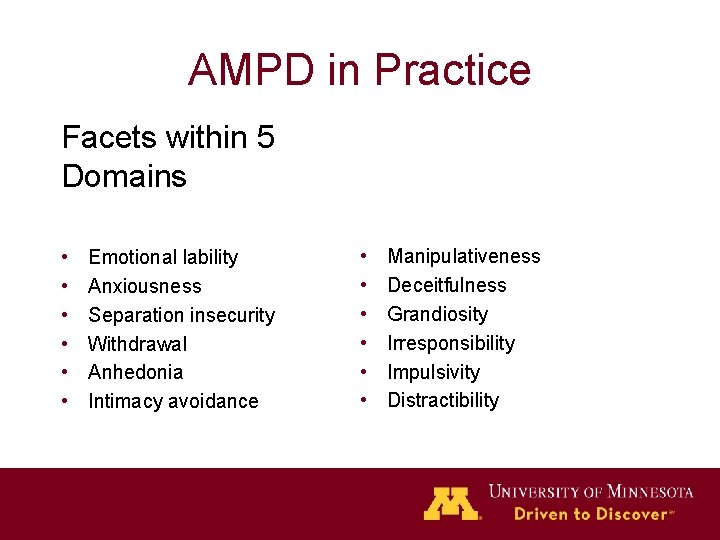
AMPD in Practice Facets within 5 Domains • • • Emotional lability Anxiousness Separation insecurity Withdrawal Anhedonia Intimacy avoidance • • • Manipulativeness Deceitfulness Grandiosity Irresponsibility Impulsivity Distractibility
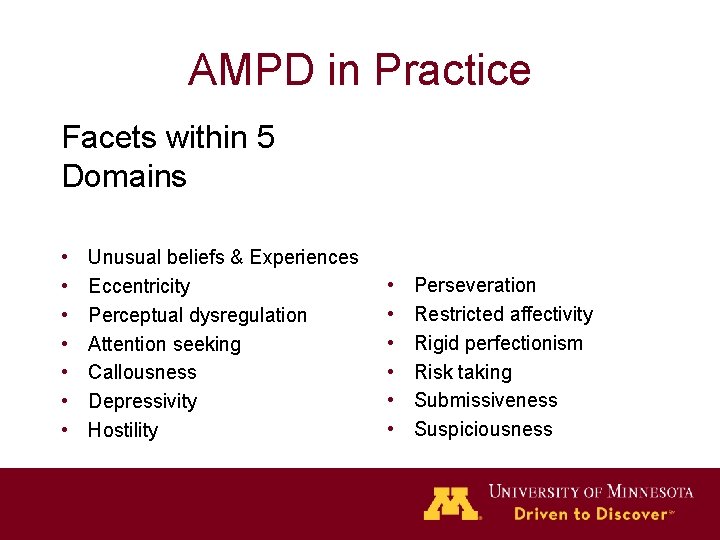
AMPD in Practice Facets within 5 Domains • • Unusual beliefs & Experiences Eccentricity Perceptual dysregulation Attention seeking Callousness Depressivity Hostility • • • Perseveration Restricted affectivity Rigid perfectionism Risk taking Submissiveness Suspiciousness
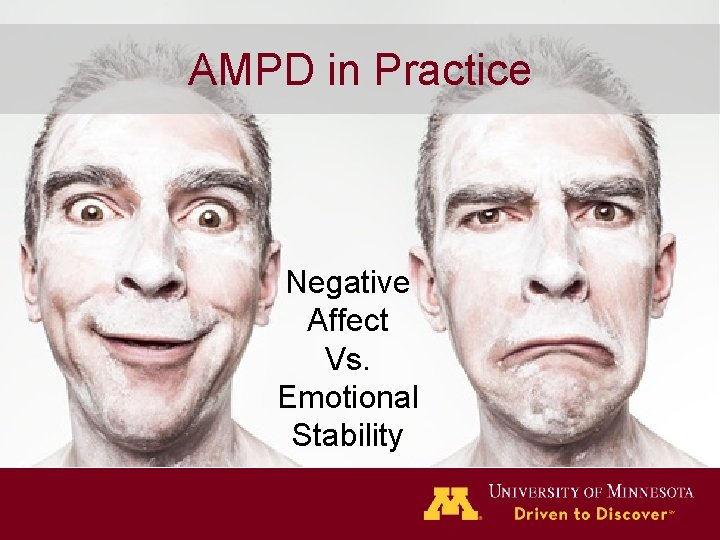
AMPD in Practice Negative Affect Vs. Emotional Stability
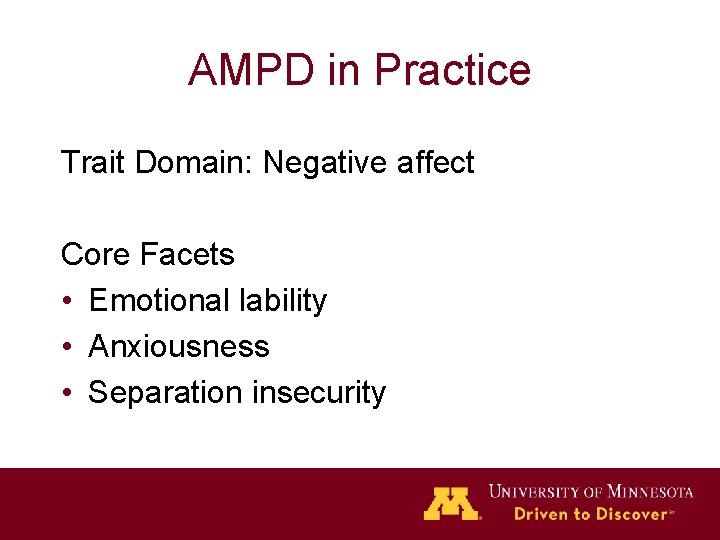
AMPD in Practice Trait Domain: Negative affect Core Facets • Emotional lability • Anxiousness • Separation insecurity
AMPD in Practice Detachment Vs. Extraversion
AMPD in Practice Trait Domain: Detachment Core Facets • Withdrawal • Anhedonia • Intimacy avoidance
AMPD in Practice Antagonism vs. Agreeableness
AMPD in Practice Trait Domain: Antagonism Core Facets • Manipulativeness • Deceitfulness • Grandiosity
AMPD in Practice Disinhibition Vs. Conscientiousness
AMPD in Practice Trait Domain: Disinhibition Core Facets • Irresponsibility • Impulsivity • Distractibility
AMPD in Practice Psychoticism Vs. Lucidity
AMPD in Practice Trait Domain: Psychoticism Core Facets • Unusual beliefs & Experiences • Eccentricity • Perceptual dysregulation
AMPD in Practice Clarifying Facets • • • Attention seeking Callousness Depressivity Hostility Perseveration • • • Restricted affectivity Rigid perfectionism Risk taking Submissiveness Suspiciousness
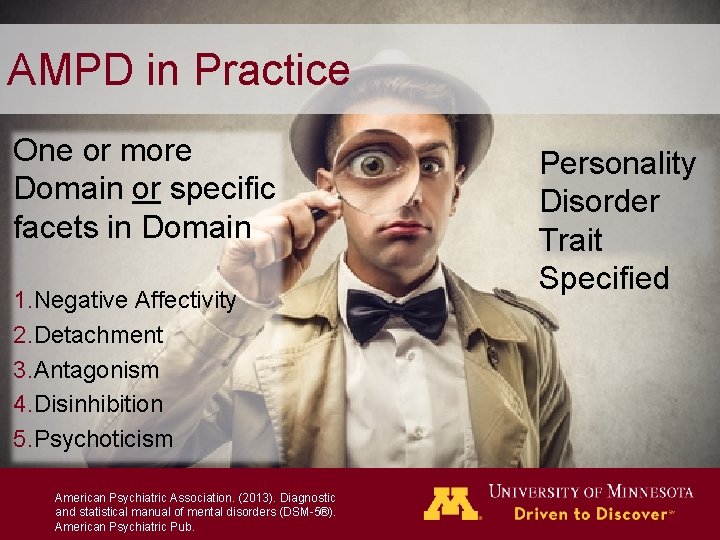
AMPD in Practice One or more Domain or specific facets in Domain 1. Negative Affectivity 2. Detachment 3. Antagonism 4. Disinhibition 5. Psychoticism American Psychiatric Association. (2013). Diagnostic and statistical manual of mental disorders (DSM-5®). American Psychiatric Pub. Personality Disorder Trait Specified
AMPD in Practice • Personality Disorder Trait Specified (PD -TS) is an option that is individualized and person-centered • If a client’s case matches one of the 6 PDs diagnosis is appropriate
free 0165@umn. edu