
Rethinking Database Algorithms for Phase Change Memory Shimin

Rethinking Database Algorithms for Phase Change Memory Shimin Chen* Phillip B. Gibbons* Suman Nath+ *Intel Labs Pittsburgh +Microsoft Research
Introduction • PCM is an emerging non-volatile memory technology – Samsung is producing a PCM chip for mobile handsets – Expected to become a common component in memory/storage hierarchy • Recent computer architecture and systems studies argue: – PCM will replace DRAM to be main memory • PCM-DB project: exploiting PCM for database systems – This paper: algorithm design on PCM-based main memory Rethinking Database Algorithms for Phase Change Memory Shimin Chen, Phillip B. Gibbons, Suman Nath 2
Outline • Phase Change Memory • PCM-Friendly Algorithm Design • B+-Tree Index • Hash Joins • Related Work • Conclusion Rethinking Database Algorithms for Phase Change Memory Shimin Chen, Phillip B. Gibbons, Suman Nath 3
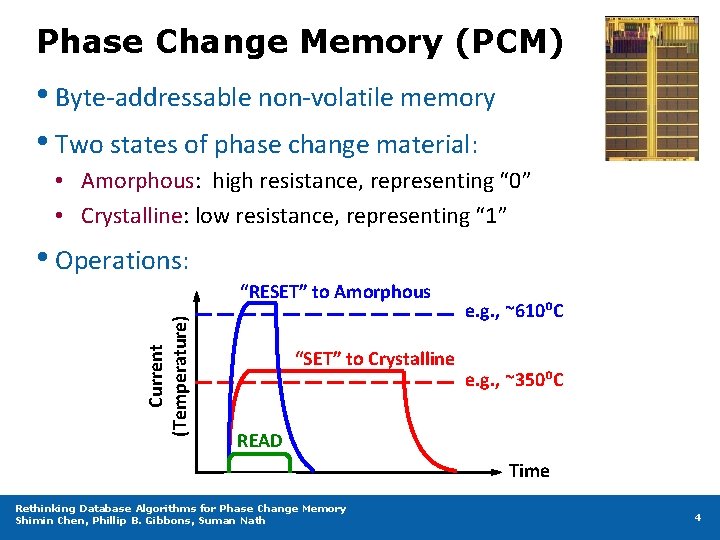
Phase Change Memory (PCM) • Byte-addressable non-volatile memory • Two states of phase change material: • Amorphous: high resistance, representing “ 0” • Crystalline: low resistance, representing “ 1” • Operations: Current (Temperature) “RESET” to Amorphous “SET” to Crystalline e. g. , ~610⁰C e. g. , ~350⁰C READ Time Rethinking Database Algorithms for Phase Change Memory Shimin Chen, Phillip B. Gibbons, Suman Nath 4
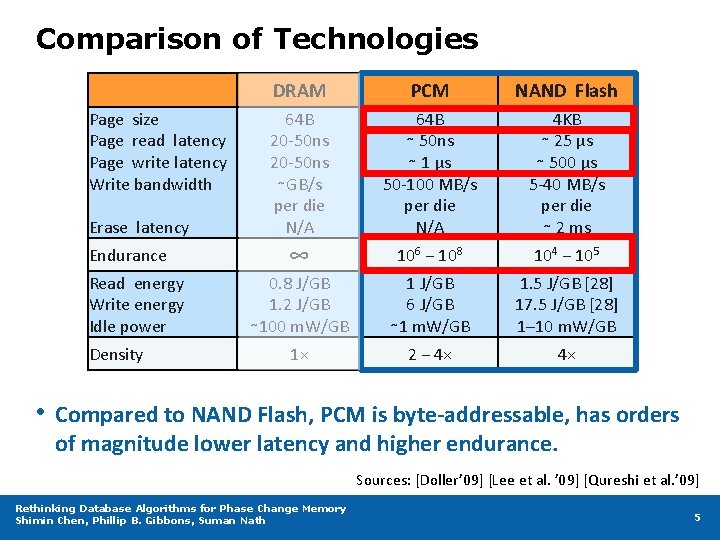
Comparison of Technologies Page size Page read latency Page write latency Write bandwidth Erase latency Endurance Read energy Write energy Idle power Density DRAM PCM NAND Flash 64 B 20 -50 ns ∼GB/s per die N/A 64 B ∼ 50 ns ∼ 1 µs 50 -100 MB/s per die N/A 4 KB ∼ 25 µs ∼ 500 µs 5 -40 MB/s per die ∼ 2 ms ∞ 106 − 108 104 − 105 0. 8 J/GB 1. 2 J/GB ∼ 100 m. W/GB 1 J/GB 6 J/GB ∼ 1 m. W/GB 1. 5 J/GB [28] 17. 5 J/GB [28] 1– 10 m. W/GB 1× 2 − 4× 4× • Compared to NAND Flash, PCM is byte-addressable, has orders of magnitude lower latency and higher endurance. Sources: [Doller’ 09] [Lee et al. ’ 09] [Qureshi et al. ’ 09] Rethinking Database Algorithms for Phase Change Memory Shimin Chen, Phillip B. Gibbons, Suman Nath 5
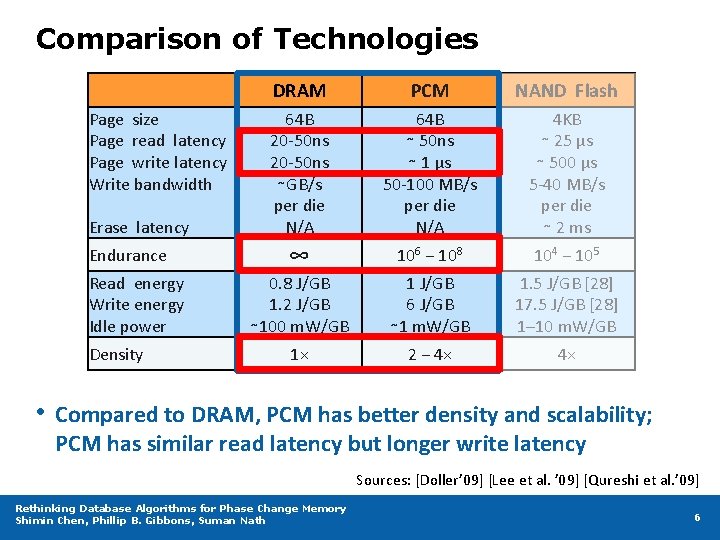
Comparison of Technologies Page size Page read latency Page write latency Write bandwidth Erase latency Endurance Read energy Write energy Idle power Density DRAM PCM NAND Flash 64 B 20 -50 ns ∼GB/s per die N/A 64 B ∼ 50 ns ∼ 1 µs 50 -100 MB/s per die N/A 4 KB ∼ 25 µs ∼ 500 µs 5 -40 MB/s per die ∼ 2 ms ∞ 106 − 108 104 − 105 0. 8 J/GB 1. 2 J/GB ∼ 100 m. W/GB 1 J/GB 6 J/GB ∼ 1 m. W/GB 1. 5 J/GB [28] 17. 5 J/GB [28] 1– 10 m. W/GB 1× 2 − 4× 4× • Compared to DRAM, PCM has better density and scalability; PCM has similar read latency but longer write latency Sources: [Doller’ 09] [Lee et al. ’ 09] [Qureshi et al. ’ 09] Rethinking Database Algorithms for Phase Change Memory Shimin Chen, Phillip B. Gibbons, Suman Nath 6
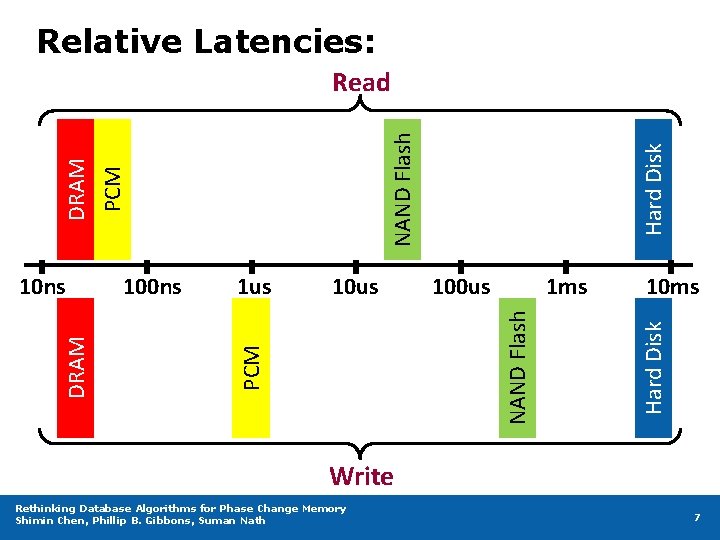
Relative Latencies: 100 us 1 ms 10 ms Hard Disk 10 us Hard Disk NAND Flash 1 us NAND Flash 100 ns PCM DRAM 10 ns PCM DRAM Read Write Rethinking Database Algorithms for Phase Change Memory Shimin Chen, Phillip B. Gibbons, Suman Nath 7
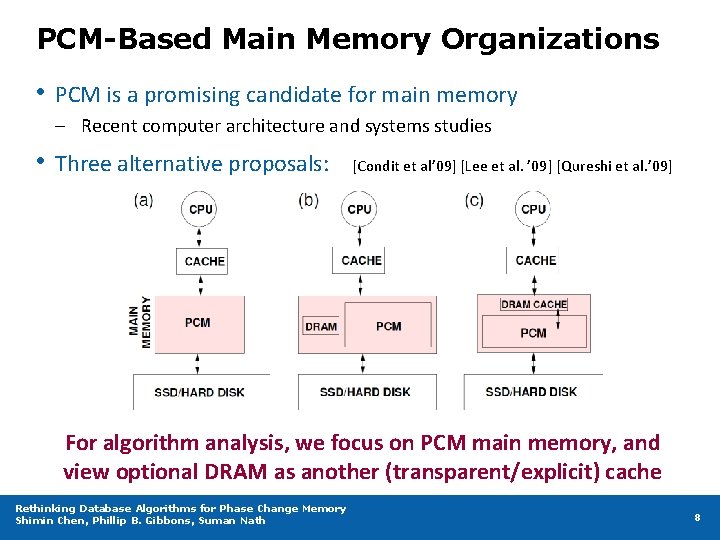
PCM-Based Main Memory Organizations • PCM is a promising candidate for main memory – Recent computer architecture and systems studies • Three alternative proposals: [Condit et al’ 09] [Lee et al. ’ 09] [Qureshi et al. ’ 09] For algorithm analysis, we focus on PCM main memory, and view optional DRAM as another (transparent/explicit) cache Rethinking Database Algorithms for Phase Change Memory Shimin Chen, Phillip B. Gibbons, Suman Nath 8
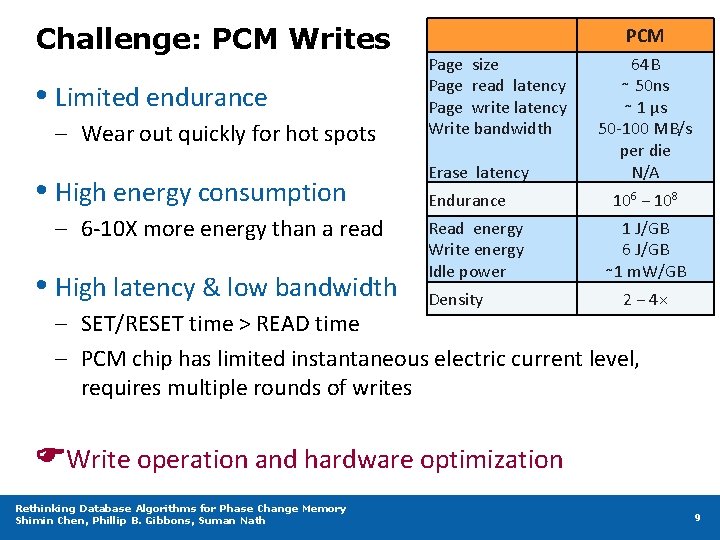
Challenge: PCM Writes • Limited endurance – Wear out quickly for hot spots • High energy consumption – 6 -10 X more energy than a read • High latency & low bandwidth PCM Page size Page read latency Page write latency Write bandwidth Erase latency Endurance Read energy Write energy Idle power Density 64 B ∼ 50 ns ∼ 1 µs 50 -100 MB/s per die N/A 106 − 108 1 J/GB 6 J/GB ∼ 1 m. W/GB 2 − 4× – SET/RESET time > READ time – PCM chip has limited instantaneous electric current level, requires multiple rounds of writes Write operation and hardware optimization Rethinking Database Algorithms for Phase Change Memory Shimin Chen, Phillip B. Gibbons, Suman Nath 9
![PCM Write Operation • Baseline: several rounds of [Cho&Lee’ 09] [Lee et al. ’](http://slidetodoc.com/presentation_image_h2/e356264bddb5e2c84604017323edaa55/image-10.jpg "PCM Write Operation • Baseline: several rounds of [Cho&Lee’ 09] [Lee et al. ’")
PCM Write Operation • Baseline: several rounds of [Cho&Lee’ 09] [Lee et al. ’ 09] [Yang et al’ 07] [Zhou et al’ 09] writes for a cache line – Which bits in which rounds are hard wired • Optimization: data comparison write – Goal: write only modified bits rather than entire cache line – Approach: read-compare-write • Skipping rounds with no modified bits Cache line 0 1 0 1 1 0 0 0 0 1 0 1 1 1 0 PCM Rounds highlighted w/ different colors 0 1 1 0 0 1 0 1 1 0 Rethinking Database Algorithms for Phase Change Memory Shimin Chen, Phillip B. Gibbons, Suman Nath 10
Outline • Phase Change Memory • PCM-Friendly Algorithm Design • B+-Tree Index • Hash Joins • Related Work • Conclusion Rethinking Database Algorithms for Phase Change Memory Shimin Chen, Phillip B. Gibbons, Suman Nath 11
Algorithm Design Goals • Algorithm design in main memory • Prior design goals: – Low computation complexity – Good CPU cache performance – Power efficiency (more recently) • New goal: minimizing PCM writes – Improve endurance, save energy, reduce latency – Unlike flash, PCM word granularity Rethinking Database Algorithms for Phase Change Memory Shimin Chen, Phillip B. Gibbons, Suman Nath 12
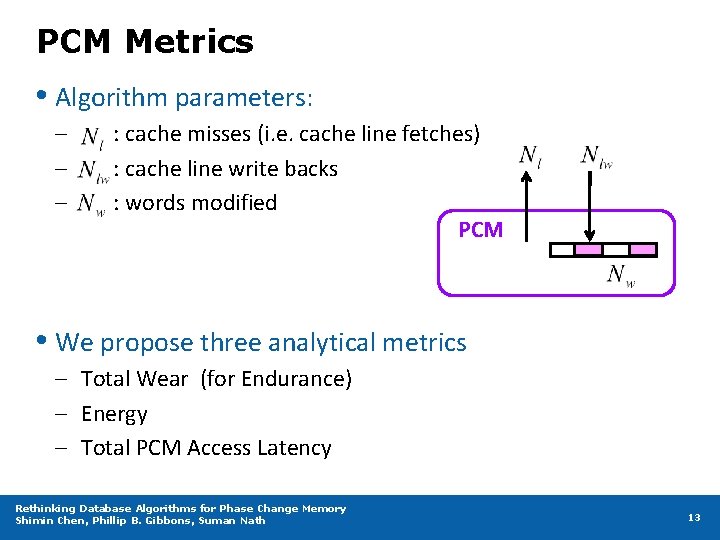
PCM Metrics • Algorithm parameters: – – – : cache misses (i. e. cache line fetches) : cache line write backs : words modified PCM • We propose three analytical metrics – Total Wear (for Endurance) – Energy – Total PCM Access Latency Rethinking Database Algorithms for Phase Change Memory Shimin Chen, Phillip B. Gibbons, Suman Nath 13
![B+-Tree Index • Cache-friendly B+-Tree: [Rao&Ross’ 00] [Chen et al’ 01] [Hankins et al.](http://slidetodoc.com/presentation_image_h2/e356264bddb5e2c84604017323edaa55/image-14.jpg "B+-Tree Index • Cache-friendly B+-Tree: [Rao&Ross’ 00] [Chen et al’ 01] [Hankins et al.")
B+-Tree Index • Cache-friendly B+-Tree: [Rao&Ross’ 00] [Chen et al’ 01] [Hankins et al. ’ 03] – Node size: one or a few cache lines large • Problem: insertion/deletion in sorted nodes – Incurs many writes! Insert/delete num keys 5 2 4 7 8 9 pointers Rethinking Database Algorithms for Phase Change Memory Shimin Chen, Phillip B. Gibbons, Suman Nath 14
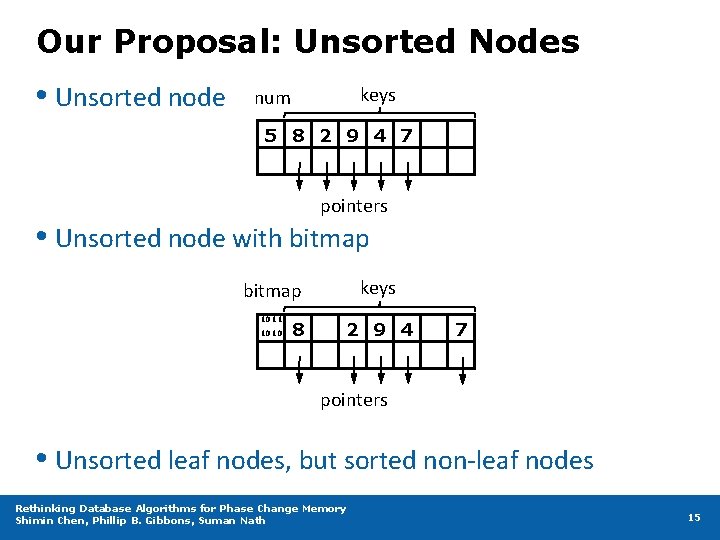
Our Proposal: Unsorted Nodes • Unsorted node keys num 5 8 2 9 4 7 pointers • Unsorted node with bitmap keys 1011 2 9 4 1010 8 7 pointers • Unsorted leaf nodes, but sorted non-leaf nodes Rethinking Database Algorithms for Phase Change Memory Shimin Chen, Phillip B. Gibbons, Suman Nath 15
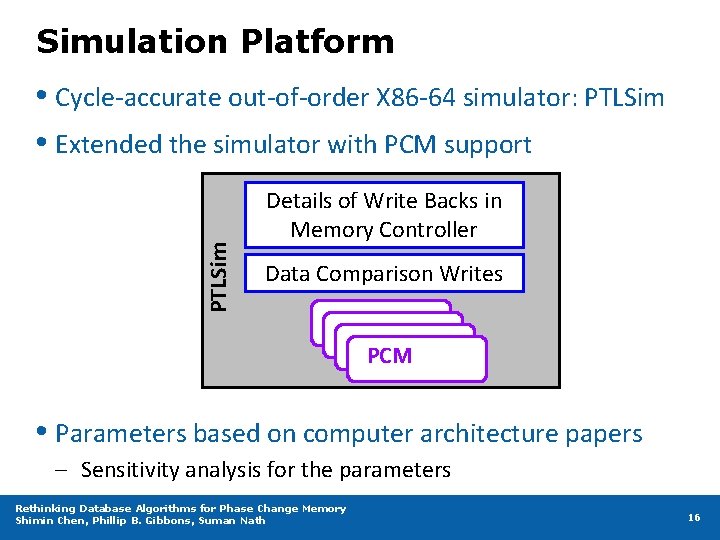
Simulation Platform PTLSim • Cycle-accurate out-of-order X 86 -64 simulator: PTLSim • Extended the simulator with PCM support Details of Write Backs in Memory Controller Data Comparison Writes PCM PCM • Parameters based on computer architecture papers – Sensitivity analysis for the parameters Rethinking Database Algorithms for Phase Change Memory Shimin Chen, Phillip B. Gibbons, Suman Nath 16
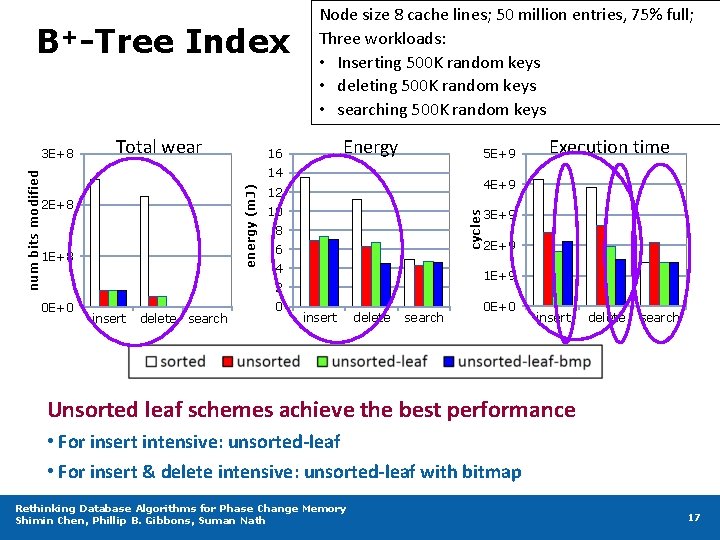
B+-Tree Index Total wear Energy 16 5 E+9 14 2 E+8 10 8 6 4 insert delete search 0 3 E+9 2 E+9 1 E+9 2 0 E+0 Execution time 4 E+9 12 cycles energy (m. J) num bits modified 3 E+8 Node size 8 cache lines; 50 million entries, 75% full; Three workloads: • Inserting 500 K random keys • deleting 500 K random keys • searching 500 K random keys insert delete search 0 E+0 insert delete search Unsorted leaf schemes achieve the best performance • For insert intensive: unsorted-leaf • For insert & delete intensive: unsorted-leaf with bitmap Rethinking Database Algorithms for Phase Change Memory Shimin Chen, Phillip B. Gibbons, Suman Nath 17
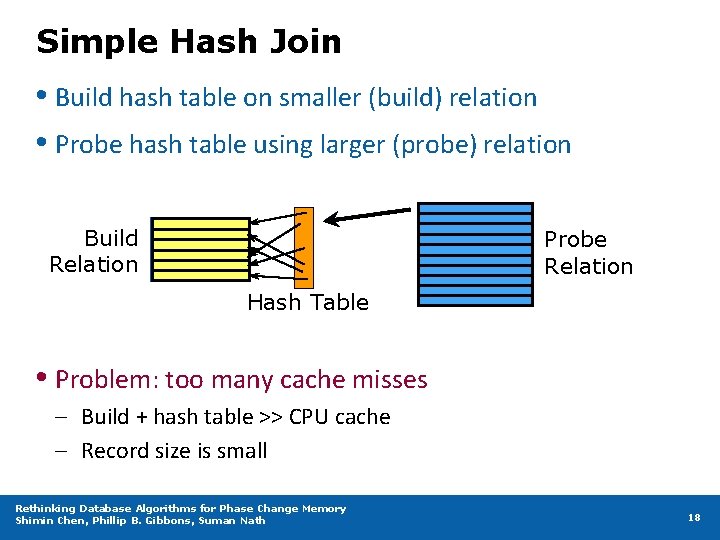
Simple Hash Join • Build hash table on smaller (build) relation • Probe hash table using larger (probe) relation Build Relation Probe Relation Hash Table • Problem: too many cache misses – Build + hash table >> CPU cache – Record size is small Rethinking Database Algorithms for Phase Change Memory Shimin Chen, Phillip B. Gibbons, Suman Nath 18
![Cache Partitioning [Shatdal et al. ’ 94] [Boncz et al. ’ 99] [Chen et](http://slidetodoc.com/presentation_image_h2/e356264bddb5e2c84604017323edaa55/image-19.jpg "Cache Partitioning [Shatdal et al. ’ 94] [Boncz et al. ’ 99] [Chen et")
Cache Partitioning [Shatdal et al. ’ 94] [Boncz et al. ’ 99] [Chen et al. ’ 04] • Partition both tables into cache-sized partitions • Join each pair of partitions • Problem: too many writes in partition phase! Rethinking Database Algorithms for Phase Change Memory Shimin Chen, Phillip B. Gibbons, Suman Nath 19
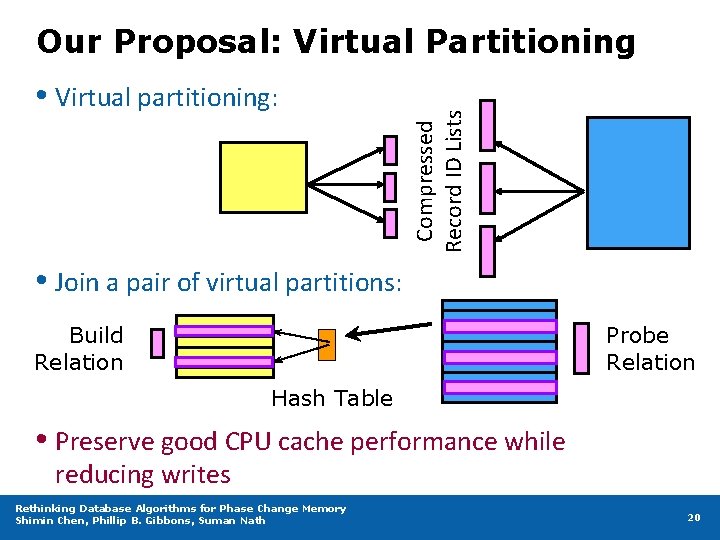
• Virtual partitioning: Compressed Record ID Lists Our Proposal: Virtual Partitioning • Join a pair of virtual partitions: Build Relation Probe Relation Hash Table • Preserve good CPU cache performance while reducing writes Rethinking Database Algorithms for Phase Change Memory Shimin Chen, Phillip B. Gibbons, Suman Nath 20
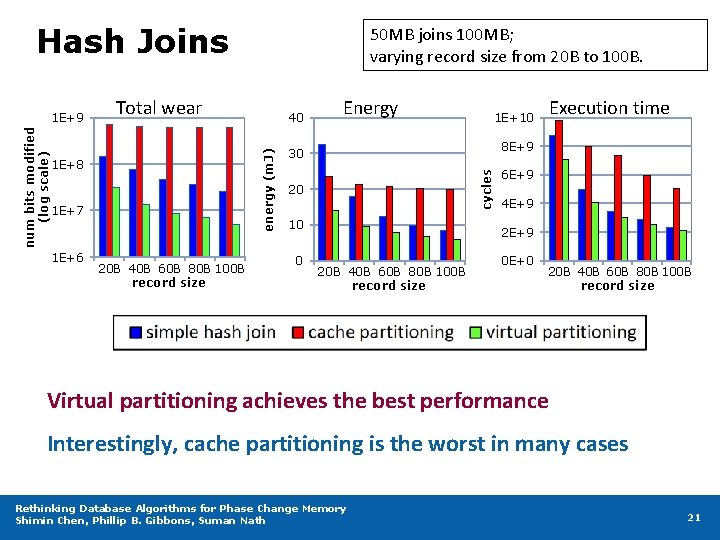
Hash Joins 1 E+8 1 E+7 1 E+6 40 20 B 40 B 60 B 80 B 100 B record size Energy 1 E+10 20 10 0 Execution time 8 E+9 30 cycles Total wear energy (m. J) num bits modified (log scale) 1 E+9 50 MB joins 100 MB; varying record size from 20 B to 100 B. 6 E+9 4 E+9 20 B 40 B 60 B 80 B 100 B record size 0 E+0 20 B 40 B 60 B 80 B 100 B record size Virtual partitioning achieves the best performance Interestingly, cache partitioning is the worst in many cases Rethinking Database Algorithms for Phase Change Memory Shimin Chen, Phillip B. Gibbons, Suman Nath 21
Related Work • PCM Architecture – Hardware design issues: endurance, write latency, error correction, etc. – Our focus: PCM friendly algorithm design • Byte-Addressable NVM-Based File Systems • Battery-Backed DRAM • Main Memory Database Systems Not considering read/write asymmetry of PCM & Cache Friendly Algorithms Rethinking Database Algorithms for Phase Change Memory Shimin Chen, Phillip B. Gibbons, Suman Nath 22
Conclusion • PCM is a promising non-volatile memory technology – Expected to replace DRAM to be future main memory • Algorithm design on PCM-based main memory – New goal: minimize PCM writes – Three analytical metrics – PCM-friendly B+-tree and hash joins • Experimental results show significant improvements Rethinking Database Algorithms for Phase Change Memory Shimin Chen, Phillip B. Gibbons, Suman Nath 23
Thank you! shimin. chen@intel. com Rethinking Database Algorithms for Phase Change Memory Shimin Chen, Phillip B. Gibbons, Suman Nath 24
- Slides: 24