
Rethinking Core Mathematics through Vertical Curriculum Alignment Cisco


- Slides: 60
Rethinking Core Mathematics through Vertical Curriculum Alignment Cisco College Core Curriculum Conference (C 5) May 15 – 17, 2013 Abilene, Texas PRESENTERS: Robin Adkins, ESC Region 16 Mary Harris, University of North Texas Paul Johnson, Del Mar College Jean Keller, University of North Texas Gregg Lawler, West Texas A&M University Ravae Shaeffer, ESC Region 20
Session Outcomes: • Gain awareness of vertical alignment guided by the Texas College and Career Readiness Standards as an important strategy to advance the success of students in learning mathematics. • Learn strategies used by teams of educators and stakeholders in assessing and improving the vertical alignment of courses and practices that affect students as they learn mathematics in secondary and postsecondary education. • Experience mathematics teaching strategies used by vertical alignment team members who are aligning mathematics courses in various regions of Texas.
What, Why and How? Jean Keller, AVATAR Co –Director University of North Texas
What Is ? AVATAR is a statewide network of regional partnerships, focused on secondary and postsecondary vertical alignment, to support students’ college and career readiness and success. AVATAR is a Texas Higher Education Coordinating Board (THECB) funded project that is implemented by the North Texas Regional P-16 Council and the University of North Texas.
Why is Needed? • Too many secondary and postsecondary leaders and educators lack shared and accurate information and understanding of what a student must know and do to be successful in postsecondary education and careers; • Too many students enter postsecondary education but do not complete in a timely fashion; and • Too many students take developmental education at the postsecondary level.
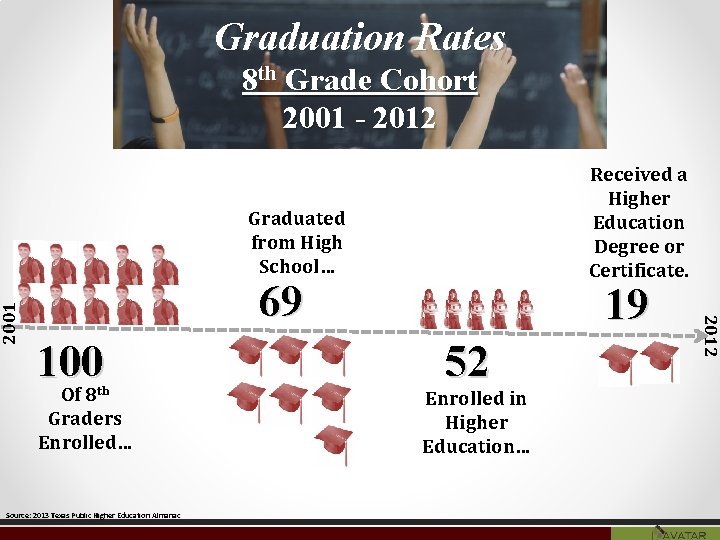
Graduation Rates 8 th Grade Cohort 2001 - 2012 Received a Higher Education Degree or Certificate. 69 100 Of 8 th Graders Enrolled… Source: 2013 Texas Public Higher Education Almanac 19 52 Enrolled in Higher Education… 2012 2001 Graduated from High School…
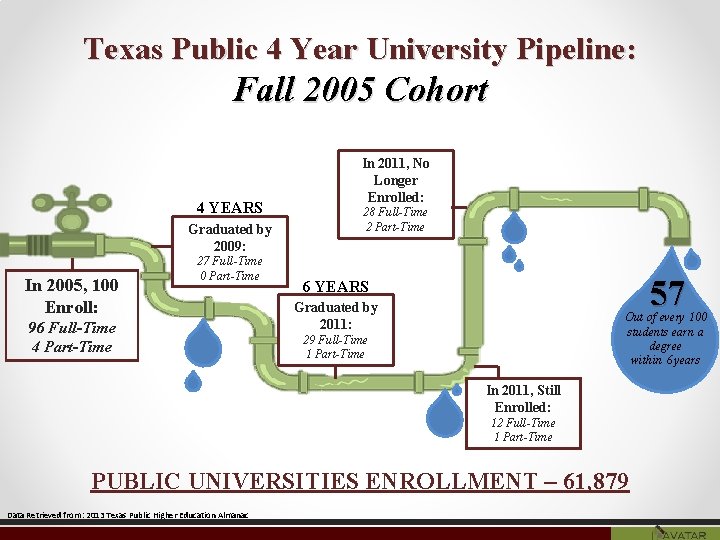
Texas Public 4 Year University Pipeline: Fall 2005 Cohort 4 YEARS Graduated by 2009: In 2005, 100 Enroll: 27 Full-Time 0 Part-Time 96 Full-Time 4 Part-Time In 2011, No Longer Enrolled: 28 Full-Time 2 Part-Time 57 6 YEARS Graduated by 2011: Out of every 100 students earn a degree within 6 years 29 Full-Time 1 Part-Time In 2011, Still Enrolled: 12 Full-Time 1 Part-Time PUBLIC UNIVERSITIES ENROLLMENT – 61, 879 Data Retrieved from: 2013 Texas Public Higher Education Almanac
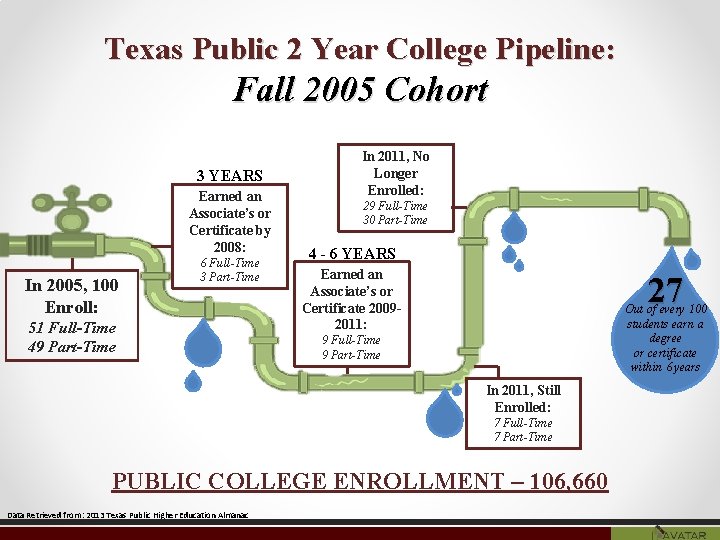
Texas Public 2 Year College Pipeline: Fall 2005 Cohort 3 YEARS Earned an Associate’s or Certificate by 2008: In 2005, 100 Enroll: 6 Full-Time 3 Part-Time 51 Full-Time 49 Part-Time In 2011, No Longer Enrolled: 29 Full-Time 30 Part-Time 4 - 6 YEARS Earned an Associate’s or Certificate 20092011: 27 Out of every 100 students earn a degree or certificate within 6 years 9 Full-Time 9 Part-Time In 2011, Still Enrolled: 7 Full-Time 7 Part-Time PUBLIC COLLEGE ENROLLMENT – 106, 660 Data Retrieved from: 2013 Texas Public Higher Education Almanac
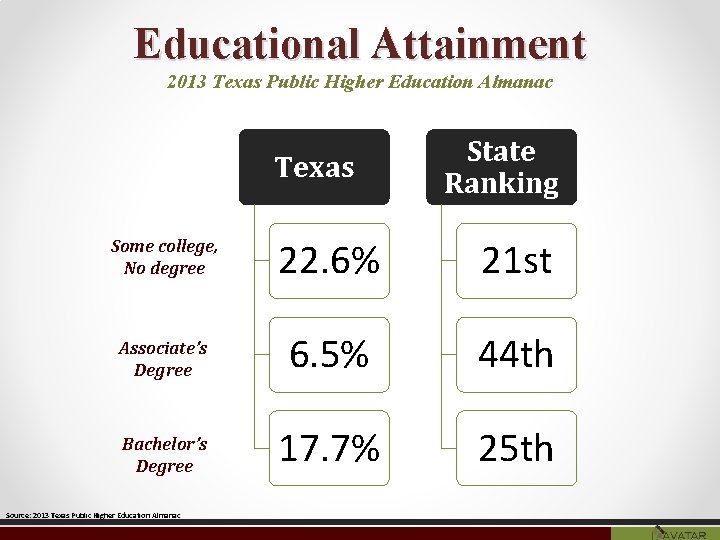
Educational Attainment 2013 Texas Public Higher Education Almanac Texas State Ranking Some college, No degree 22. 6% 21 st Associate’s Degree 6. 5% 44 th Bachelor’s Degree 17. 7% 25 th Source: 2013 Texas Public Higher Education Almanac
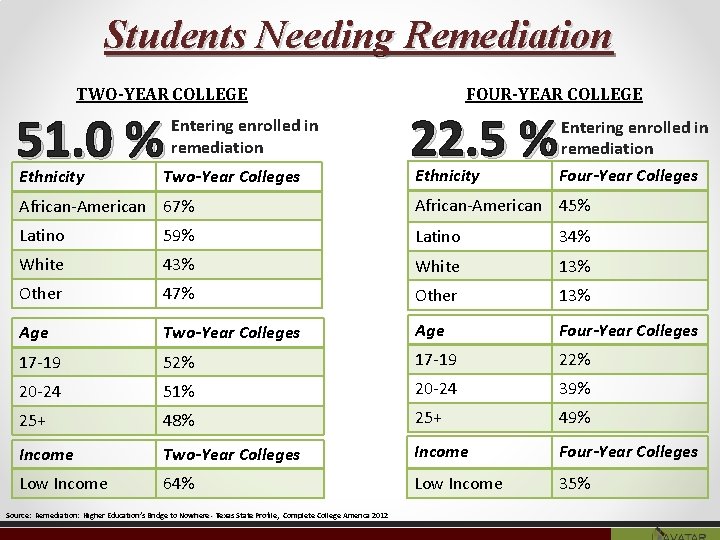
Students Needing Remediation TWO-YEAR COLLEGE 51. 0 % Ethnicity Entering enrolled in remediation Two-Year Colleges FOUR-YEAR COLLEGE 22. 5 % Ethnicity Entering enrolled in remediation Four-Year Colleges African-American 67% African-American 45% Latino 59% Latino 34% White 43% White 13% Other 47% Other 13% Age Two-Year Colleges Age Four-Year Colleges 17 -19 52% 17 -19 22% 20 -24 51% 20 -24 39% 25+ 48% 25+ 49% Income Two-Year Colleges Income Four-Year Colleges Low Income 64% Low Income 35% Source: Remediation: Higher Education’s Bridge to Nowhere - Texas State Profile, Complete College America 2012
How Does Work?
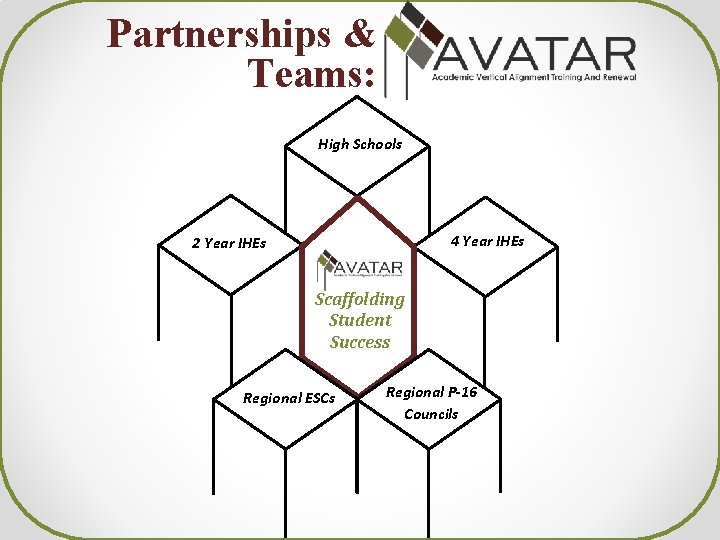
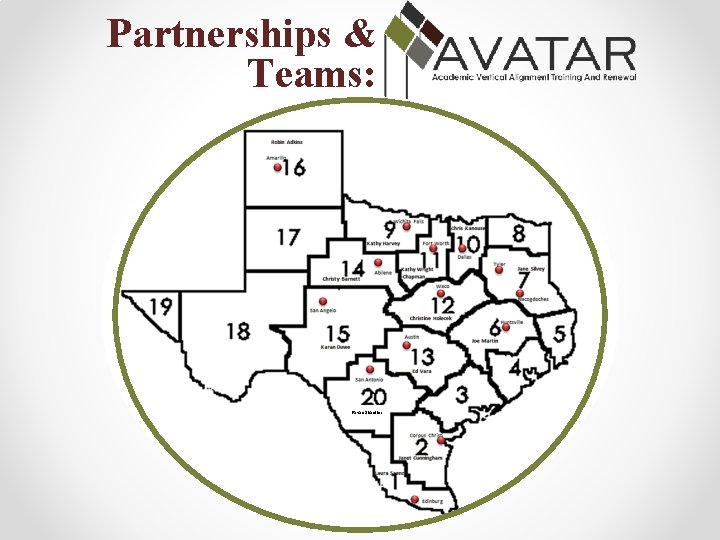
Partnerships & Teams: High Schools 4 Year IHEs 2 Year IHEs Scaffolding Student Success Regional ESCs Regional P-16 Councils
Regional Goals: 1. Establish a shared regional college and career readiness foundation and understandings. 2. Use regional data to guide decision-making. 3. Design and implement a vertical alignment action plan which includes critical conversations. 4. Design and implement a sustainability plan.
Partnerships & Teams: Ravae Shaeffer
Project Outcomes: } Enhance the success of students graduating college-ready from high schools and prepared for smooth transitions to postsecondary education with a significant decrease in the need for developmental education. } Ensure course descriptions, content learning outcomes, instructional strategies, and student and instructor expectations are aligned and communicated so that secondary students are prepared to enroll and succeed in postsecondary education at all levels. } Deliver secondary and postsecondary courses aligned to the Texas Essential Knowledge and Skills (TEKS), State of Texas Assessments of Academic Readiness (STAAR), End-of-Course (EOC) Assessments, and Texas College and Career Readiness Standards (CCRS) in Chemistry, English Language Arts, and Mathematics. } Develop materials and resources for faculty, administrators, Education Service Center personnel, and P-16 leaders to replicate the vertical alignment processes and activities statewide. http: //www. ntp 16. notlb. com/avatar
Processes & Resources Mary Harris, AVATAR Associate Director University of North Texas
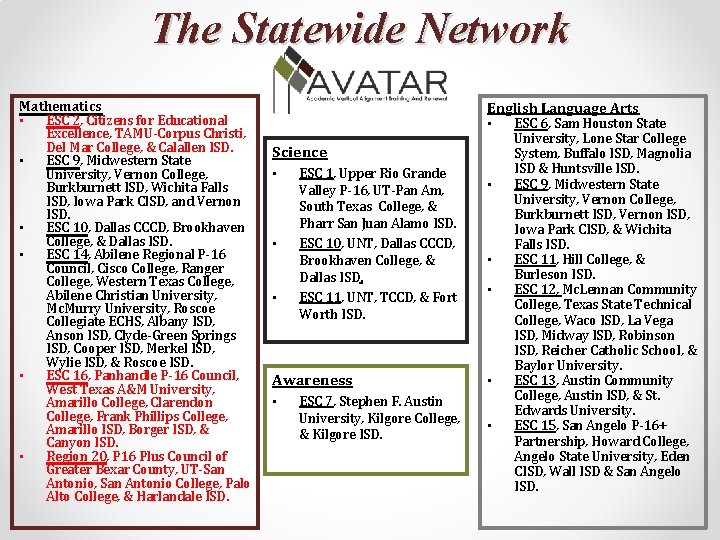
The Statewide Network Mathematics • ESC 2, Citizens for Educational Excellence, TAMU-Corpus Christi, Del Mar College, & Calallen ISD. • ESC 9, Midwestern State University, Vernon College, Burkburnett ISD, Wichita Falls ISD, Iowa Park CISD, and Vernon ISD. • ESC 10, Dallas CCCD, Brookhaven College, & Dallas ISD. • ESC 14, Abilene Regional P-16 Council, Cisco College, Ranger College, Western Texas College, Abilene Christian University, Mc. Murry University, Roscoe Collegiate ECHS, Albany ISD, Anson ISD, Clyde-Green Springs ISD, Cooper ISD, Merkel ISD, Wylie ISD, & Roscoe ISD. • ESC 16, Panhandle P-16 Council, West Texas A&M University, Amarillo College, Clarendon College, Frank Phillips College, Amarillo ISD, Borger ISD, & Canyon ISD. • Region 20, P 16 Plus Council of Greater Bexar County, UT-San Antonio, San Antonio College, Palo Alto College, & Harlandale ISD. English Language Arts • ESC 6, Sam Houston State Science • • • ESC 1, Upper Rio Grande Valley P-16, UT-Pan Am, South Texas College, & Pharr San Juan Alamo ISD. ESC 10, UNT, Dallas CCCD, Brookhaven College, & Dallas ISD. ESC 11, UNT, TCCD, & Fort Worth ISD. Awareness • ESC 7, Stephen F. Austin University, Kilgore College, & Kilgore ISD. • • • University, Lone Star College System, Buffalo ISD, Magnolia ISD & Huntsville ISD. ESC 9, Midwestern State University, Vernon College, Burkburnett ISD, Vernon ISD, Iowa Park CISD, & Wichita Falls ISD. ESC 11, Hill College, & Burleson ISD. ESC 12, Mc. Lennan Community College, Texas State Technical College, Waco ISD, La Vega ISD, Midway ISD, Robinson ISD, Reicher Catholic School, & Baylor University. ESC 13, Austin Community College, Austin ISD, & St. Edwards University. ESC 15, San Angelo P-16+ Partnership, Howard College, Angelo State University, Eden CISD, Wall ISD & San Angelo ISD.
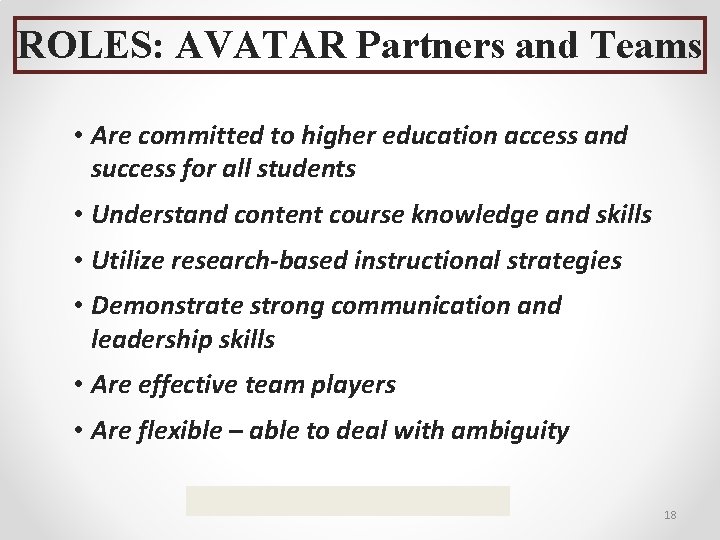
ROLES: AVATAR Partners and Teams • Are committed to higher education access and success for all students • Understand content course knowledge and skills • Utilize research-based instructional strategies • Demonstrate strong communication and leadership skills • Are effective team players • Are flexible – able to deal with ambiguity 18
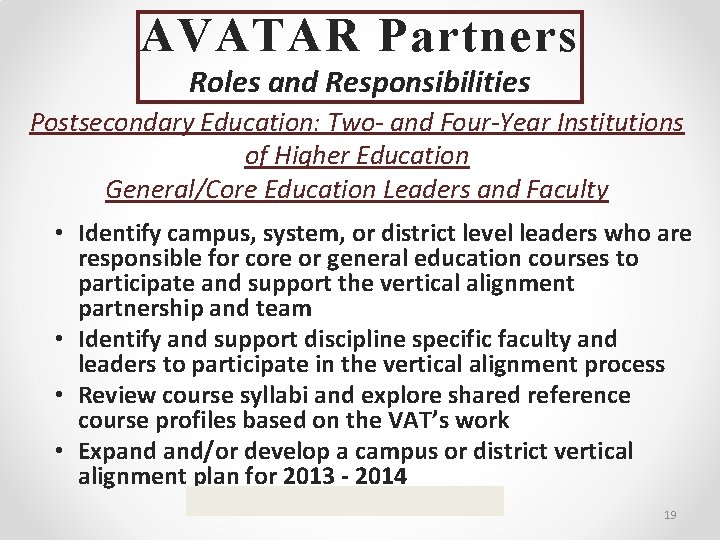
AVATAR Partners Roles and Responsibilities Postsecondary Education: Two- and Four-Year Institutions of Higher Education General/Core Education Leaders and Faculty • Identify campus, system, or district level leaders who are responsible for core or general education courses to participate and support the vertical alignment partnership and team • Identify and support discipline specific faculty and leaders to participate in the vertical alignment process • Review course syllabi and explore shared reference course profiles based on the VAT’s work • Expand and/or develop a campus or district vertical alignment plan for 2013 - 2014 19
Module 2 AVATAR Common Foundations: Understanding College and Career Readiness and Success http: //www. ntp 16. notlb. com/avatar 20
Creating a College Ready Student College and Career Ready: Helping all Students Succeed Beyond High School by David T. Conley, 2010 Participants will: 1. Read the abstract 2. Discuss the seven principles, utilizing the STEPS project discussion document Discussion Document Available on AVATAR site: http: //www. ntp 16. notlb. com/avatar/files/resources and the seven principles are discussed in more detail in Power. Point of Conley’s at https: //epiconline. org/files/pdf/20110228_ASU. pdf 21
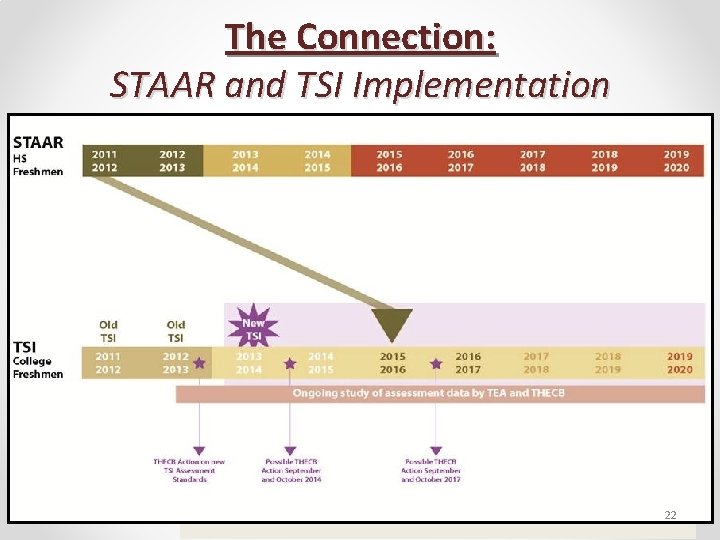
The Connection: STAAR and TSI Implementation 22
As You Examine the Data, Please Consider: • To what extent do local students progress from high school to college? • Are there differences by discipline in college readiness? • How does student readiness for college vary by ethnicity? What factors contribute to the gaps? • What colleges do local students attend? • To what extent do local students take advantage of college readiness programs (AP/IB, dual credit, core completion)? • How does developmental education influence college readiness and success locally? • How do local students fare when they transfer to other institutions? 23
Module 3 AVATAR Teams: Aligning Courses Through Critical Conversations http: //www. ntp 16. notlb. com/avatar 24
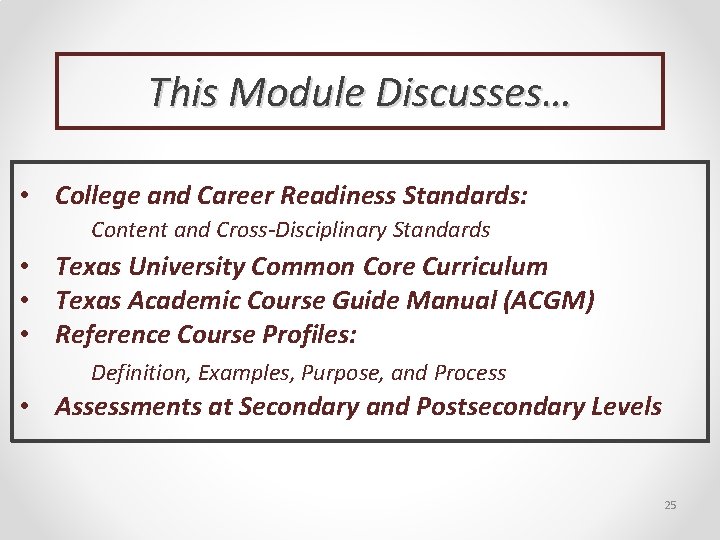
This Module Discusses… • College and Career Readiness Standards: Content and Cross-Disciplinary Standards • Texas University Common Core Curriculum • Texas Academic Course Guide Manual (ACGM) • Reference Course Profiles: Definition, Examples, Purpose, and Process • Assessments at Secondary and Postsecondary Levels 25
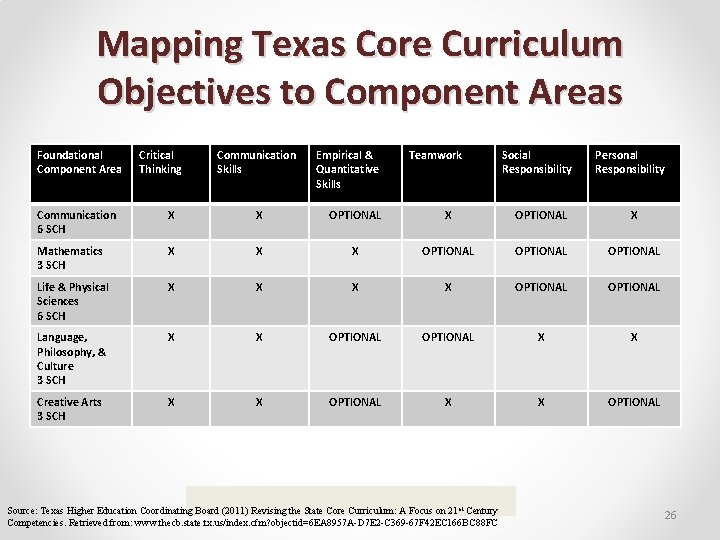
Mapping Texas Core Curriculum Objectives to Component Areas Foundational Component Area Critical Thinking Communication Skills Empirical & Quantitative Skills Teamwork Social Responsibility Personal Responsibility Communication 6 SCH X X OPTIONAL X Mathematics 3 SCH X X X OPTIONAL Life & Physical Sciences 6 SCH X X OPTIONAL Language, Philosophy, & Culture 3 SCH X X OPTIONAL X X Creative Arts 3 SCH X X OPTIONAL Source: Texas Higher Education Coordinating Board (2011) Revising the State Core Curriculum: A Focus on 21 st Century Competencies. Retrieved from: www. thecb. state. tx. us/index. cfm? objectid=6 EA 8957 A-D 7 E 2 -C 369 -67 F 42 EC 166 BC 88 FC 26
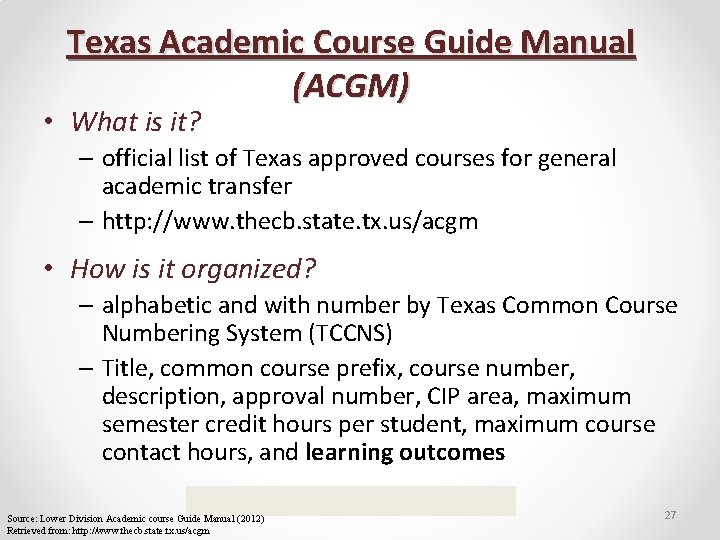
Texas Academic Course Guide Manual (ACGM) • What is it? – official list of Texas approved courses for general academic transfer – http: //www. thecb. state. tx. us/acgm • How is it organized? – alphabetic and with number by Texas Common Course Numbering System (TCCNS) – Title, common course prefix, course number, description, approval number, CIP area, maximum semester credit hours per student, maximum course contact hours, and learning outcomes Source: Lower Division Academic course Guide Manual (2012) Retrieved from: http: //www. thecb. state. tx. us/acgm 27
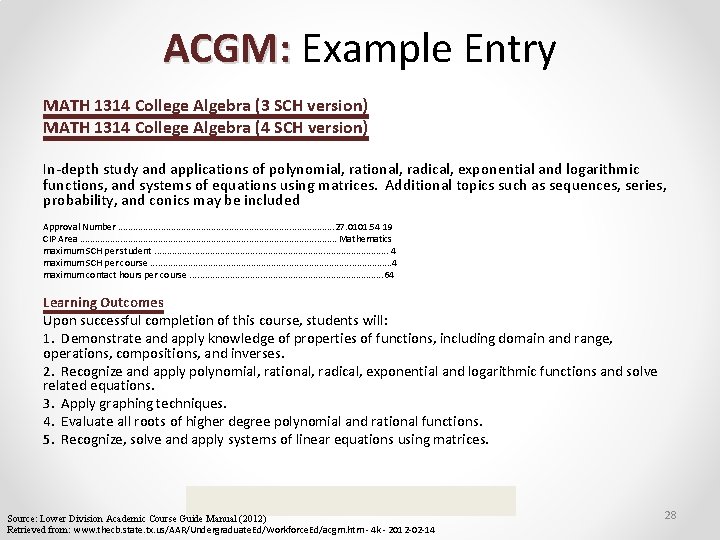
ACGM: Example Entry MATH 1314 College Algebra (3 SCH version) MATH 1314 College Algebra (4 SCH version) In-depth study and applications of polynomial, rational, radical, exponential and logarithmic functions, and systems of equations using matrices. Additional topics such as sequences, series, probability, and conics may be included Approval Number. . . . . . 27. 0101. 54 19 CIP Area. . . . . . . Mathematics maximum SCH per student. . . . . . 4 maximum SCH per course. . . . . . 4 maximum contact hours per course. . . . . 64 Learning Outcomes Upon successful completion of this course, students will: 1. Demonstrate and apply knowledge of properties of functions, including domain and range, operations, compositions, and inverses. 2. Recognize and apply polynomial, rational, radical, exponential and logarithmic functions and solve related equations. 3. Apply graphing techniques. 4. Evaluate all roots of higher degree polynomial and rational functions. 5. Recognize, solve and apply systems of linear equations using matrices. Source: Lower Division Academic Course Guide Manual (2012) Retrieved from: www. thecb. state. tx. us/AAR/Undergraduate. Ed/Workforce. Ed/acgm. htm - 4 k - 2012 -02 -14 28
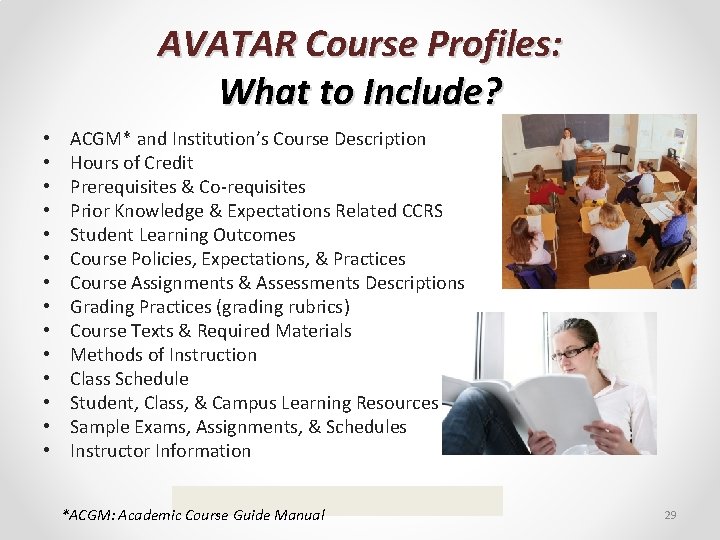
AVATAR Course Profiles: What to Include? • • • • ACGM* and Institution’s Course Description Hours of Credit Prerequisites & Co-requisites Prior Knowledge & Expectations Related CCRS Student Learning Outcomes Course Policies, Expectations, & Practices Course Assignments & Assessments Descriptions Grading Practices (grading rubrics) Course Texts & Required Materials Methods of Instruction Class Schedule Student, Class, & Campus Learning Resources Sample Exams, Assignments, & Schedules Instructor Information *ACGM: Academic Course Guide Manual 29
From a Regional Perspective Robin Adkins, Facilitator/Coordinator P-16 Specialist, ESC Region 16
AVATAR from a Regional Perspective Robin Adkins, Facilitator Coordinator Region 16 Amarillo
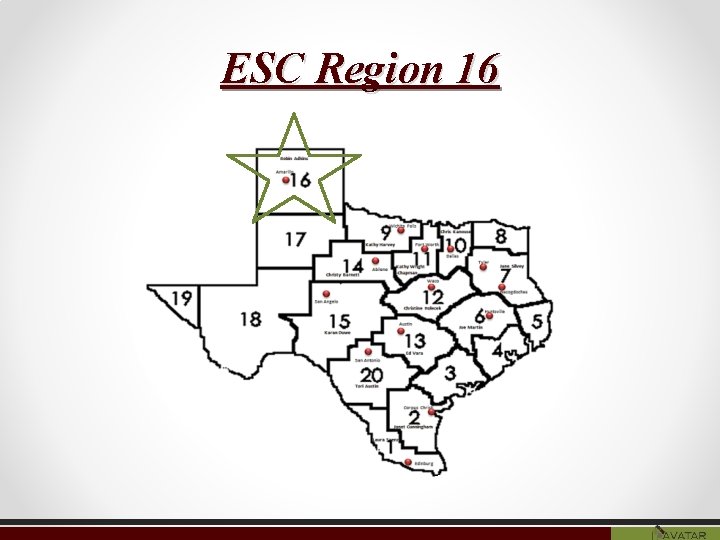
ESC Region 16
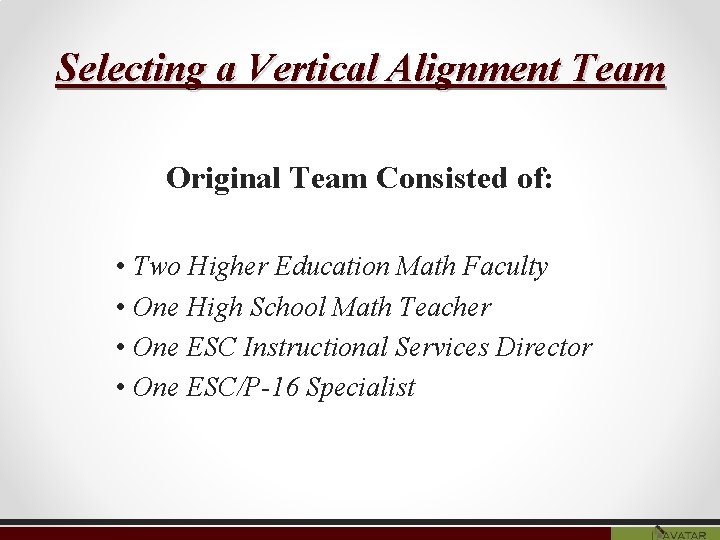
Selecting a Vertical Alignment Team Original Team Consisted of: • Two Higher Education Math Faculty • One High School Math Teacher • One ESC Instructional Services Director • One ESC/P-16 Specialist
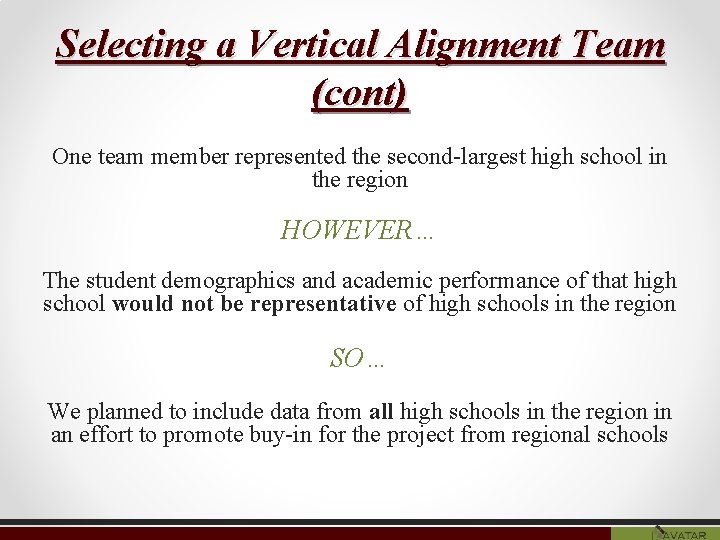
Selecting a Vertical Alignment Team (cont) One team member represented the second-largest high school in the region HOWEVER… The student demographics and academic performance of that high school would not be representative of high schools in the region SO… We planned to include data from all high schools in the region in an effort to promote buy-in for the project from regional schools
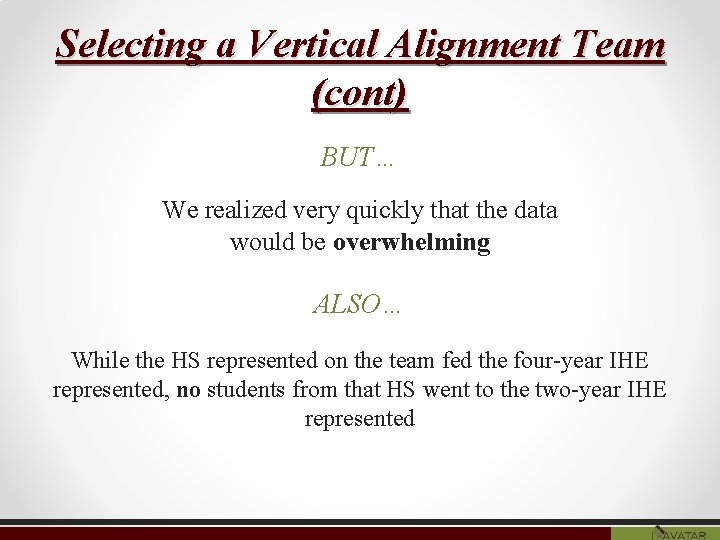
Selecting a Vertical Alignment Team (cont) BUT… We realized very quickly that the data would be overwhelming ALSO… While the HS represented on the team fed the four-year IHE represented, no students from that HS went to the two-year IHE represented
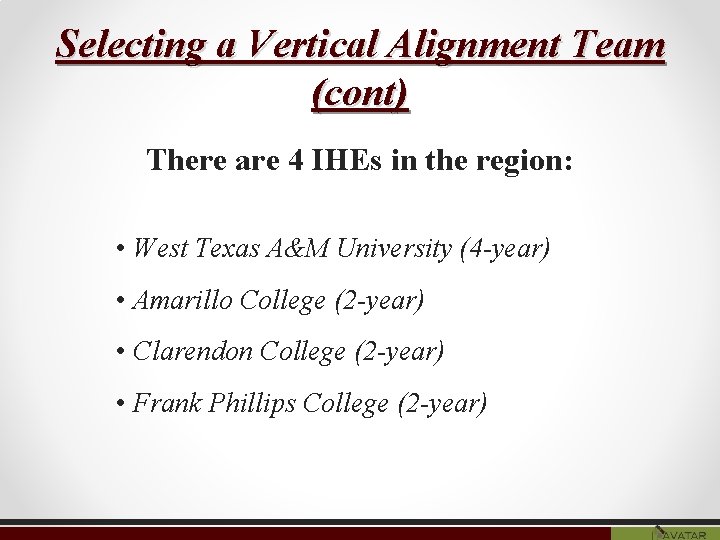
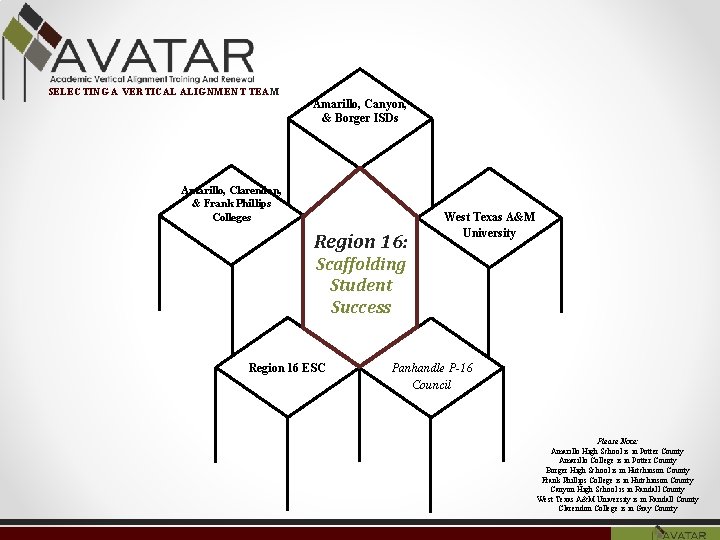
Selecting a Vertical Alignment Team (cont) There are 4 IHEs in the region: • West Texas A&M University (4 -year) • Amarillo College (2 -year) • Clarendon College (2 -year) • Frank Phillips College (2 -year)
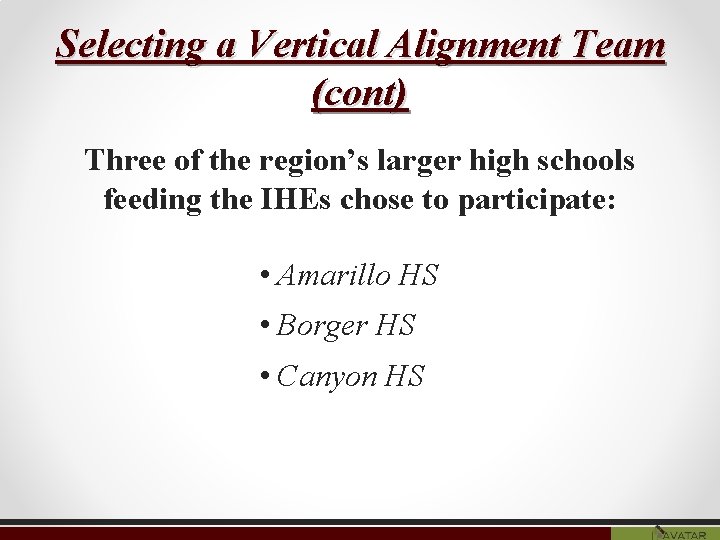
Selecting a Vertical Alignment Team (cont) Three of the region’s larger high schools feeding the IHEs chose to participate: • Amarillo HS • Borger HS • Canyon HS
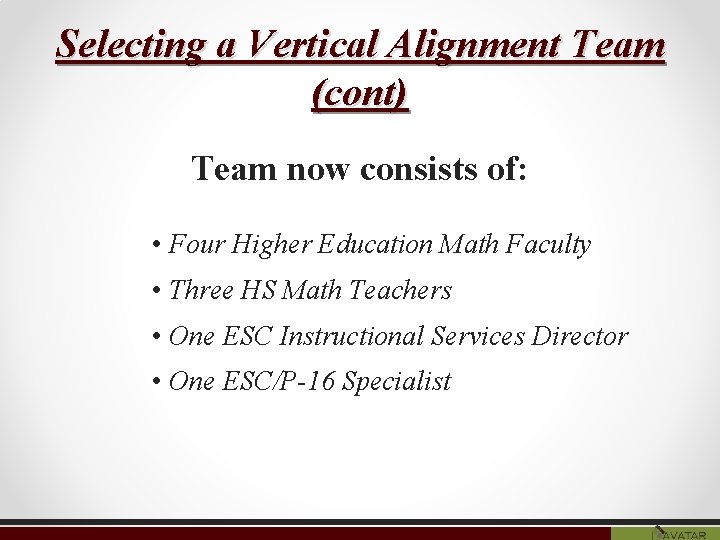
Selecting a Vertical Alignment Team (cont) Team now consists of: • Four Higher Education Math Faculty • Three HS Math Teachers • One ESC Instructional Services Director • One ESC/P-16 Specialist
Resources --Regional Academic Performance --AVATAR Training Modules --Data was “Eye-opening”
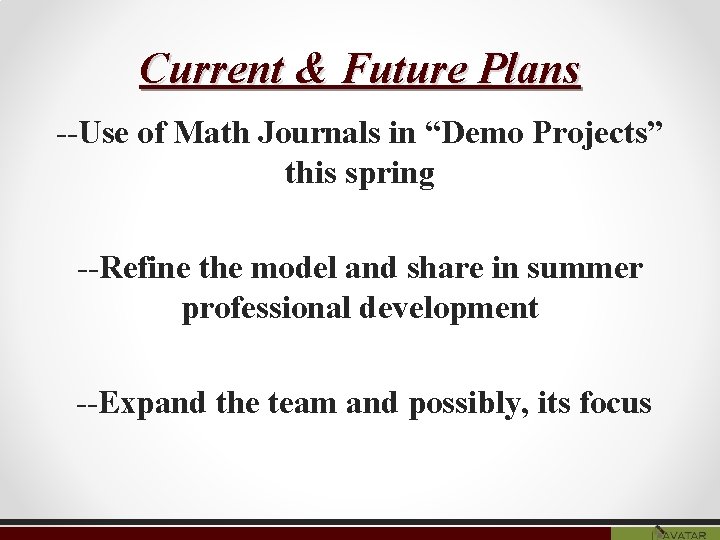
Current & Future Plans --Use of Math Journals in “Demo Projects” this spring --Refine the model and share in summer professional development --Expand the team and possibly, its focus
SELECTING A VERTICAL ALIGNMENT TEAM Amarillo, Canyon, & Borger ISDs Amarillo, Clarendon, & Frank Phillips Colleges Region 16: West Texas A&M University Scaffolding Student Success Region 16 ESC Panhandle P-16 Council Please Note: Amarillo High School is in Potter County Amarillo College is in Potter County Borger High School is in Hutchinson County Frank Phillips College is in Hutchinson County Canyon High School is in Randall County West Texas A&M University is in Randall County Clarendon College is in Gray County
Mathematical Practices from AVATAR Partners Paul Johnson, Del Mar College
Mathematical Practices from AVATAR Partners Gregg Lawler, West Texas A&M University
Mathematics Practices from Region 16 • Mathematics Journal for Algebra II Students • Faculty Exchanges
Math Journals for Algebra II • • • Evolution of the Math Journal Topics for Journal Design Initial Trials Future Plans
Evolution of Math Journal • Team narrowed focus of high school mathematics courses to Algebra II and Pre. Calculus • Focused on College Algebra and Pre-Calculus for higher-education • Reviewed textbooks and syllabi of college algebra courses offered at the regional colleges and university
Evolution of Math Journal • Also reviewed exams from College Algebra and Pre-Calculus courses • Wanted something that Algebra II teachers could use at the end of the semester
Topics for Math Journals Journal • Region 16 AVATAR team created list of topics from Algebra II that students need to know to be successful in College Algebra • Also incorporating a set of “soft” skills needed to succeed in college courses
Journal Design • Customizable cover • Modular design • Page layout – Example problems with room to work – Space for notes
First Trials • Tammy Nash – Amarillo High School – Algebra II/Pre-calculus classroom • Beth Summers – Frank Phillips College – Intermediate algebra section
Future Plans for Math Journals • Continued revision of journal • Possible panel sessions with Algebra II/College Algebra teachers during summer • Rollout of full draft during fall semester – Algebra II courses – Developmental math courses at IHE
Future Plans for Math Journals Journ • Tracking student use of journals – During year – Longitudinal study • Sharing final product with other regions/school districts
Faculty Exchanges • Goal: implement exchanges during Fall 2013 semester • Exchanges with Algebra II and College Algebra faculty and with Pre-calculus faculty
Mathematical Practices from AVATAR Partners Ravae Shaeffer, ESC Region 20
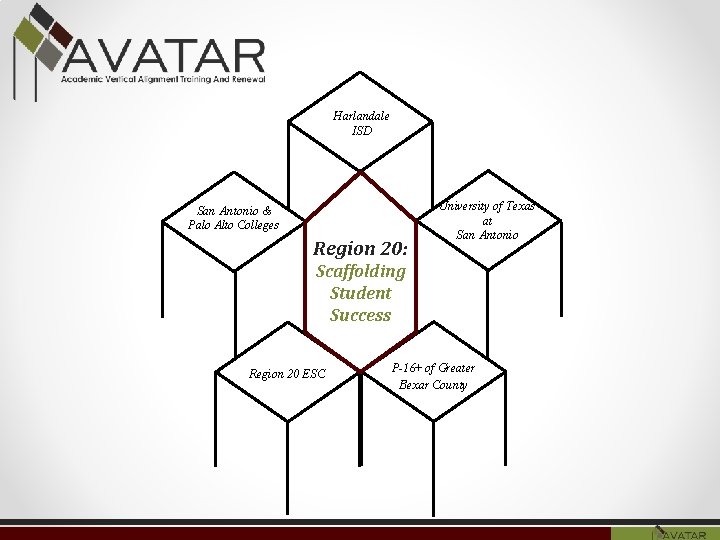
Harlandale ISD San Antonio & Palo Alto Colleges Region 20: University of Texas at San Antonio Scaffolding Student Success Region 20 ESC P-16+ of Greater Bexar County
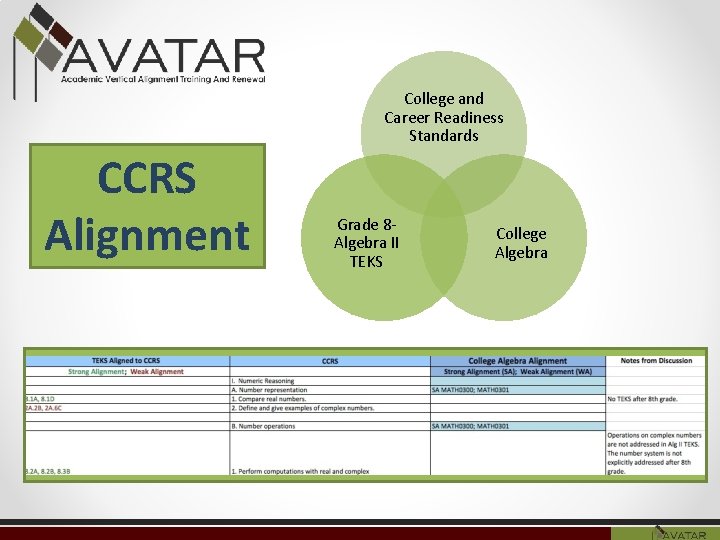
College and Career Readiness Standards CCRS Alignment Grade 8 Algebra II TEKS College Algebra
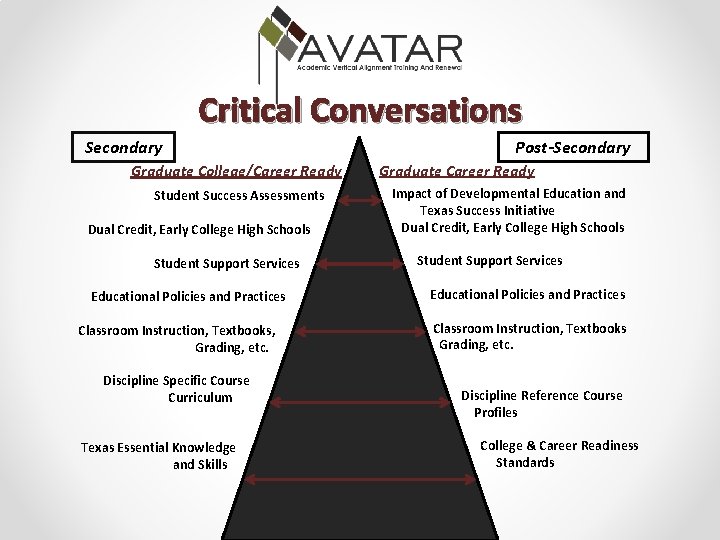
Critical Conversations Secondary Graduate College/Career Ready Student Success Assessments Dual Credit, Early College High Schools Student Support Services Educational Policies and Practices Classroom Instruction, Textbooks, Grading, etc. Discipline Specific Course Curriculum Texas Essential Knowledge and Skills Post-Secondary Graduate Career Ready Impact of Developmental Education and Texas Success Initiative Dual Credit, Early College High Schools Student Support Services Educational Policies and Practices Classroom Instruction, Textbooks Grading, etc. Discipline Reference Course Profiles College & Career Readiness Standards
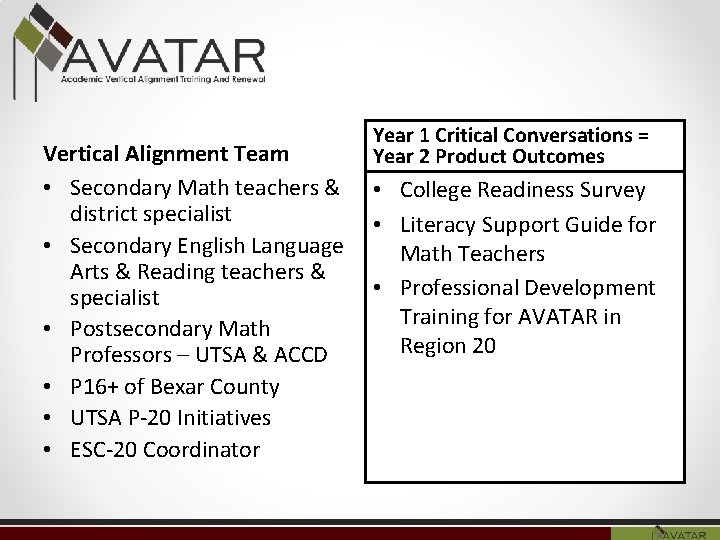
Vertical Alignment Team • Secondary Math teachers & district specialist • Secondary English Language Arts & Reading teachers & specialist • Postsecondary Math Professors – UTSA & ACCD • P 16+ of Bexar County • UTSA P-20 Initiatives • ESC-20 Coordinator Year 1 Critical Conversations = Year 2 Product Outcomes • College Readiness Survey • Literacy Support Guide for Math Teachers • Professional Development Training for AVATAR in Region 20
Discussion & Questions http: //www. ntp 16. notlb. com/avatar