
RETENTION OF FETAL MEMBRANES Dr Bhavna Asstt Prof

RETENTION OF FETAL MEMBRANES Dr. Bhavna Asstt. Prof. Deptt. Of VGO
Introduction The fetal membranes are normally expelled during the third stage of labor. The membranes are said to be retained whenever the third stage of labor is prolonged beyond its normal duration.
Occurs in all species, particularly common in the dairy cow but its consequences may be most serious in the mare. In polytocous species (sow, bitch & queen), may be associated with retention of one or more fetuses.
Causes Three main factors: 1. Insufficient expulsive efforts by the myometrium. 2. Failure of placenta to separate from the endometrium (may be due to inflammatory changes, placental immaturity, hormonal imbalance, immune deficiencies). 3. Mechanical obstruction (including partial closure of the cervix).
Cattle Mostly cattle shed placenta within 6 hours after parturition. Said to be retained if not shed even at 12 -24 hours. RFM is a recurrent theme in considerations of the metritisendometritis-pyometra complex of diseases. An important contributor to bovine infertility due to its role in predisposition to uterine infections.
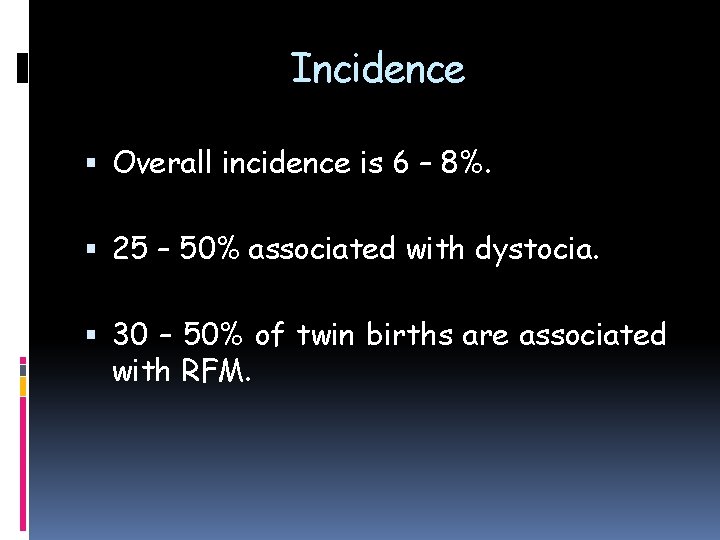
Incidence Overall incidence is 6 – 8%. 25 – 50% associated with dystocia. 30 – 50% of twin births are associated with RFM.
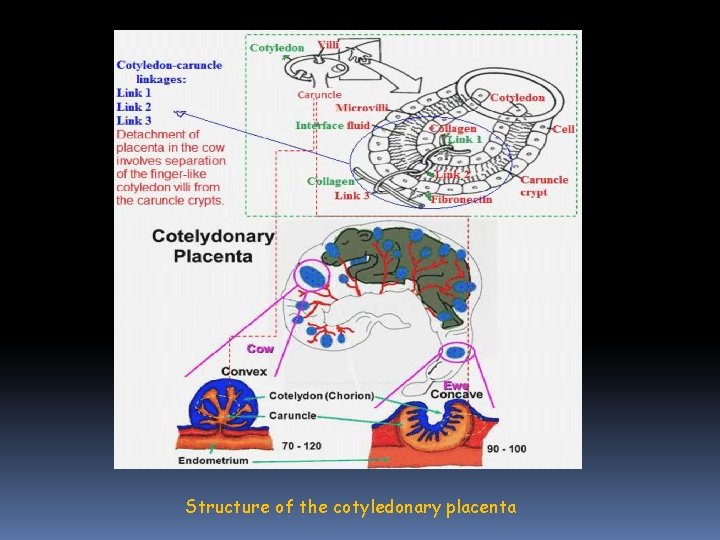
Structure of the cotyledonary placenta
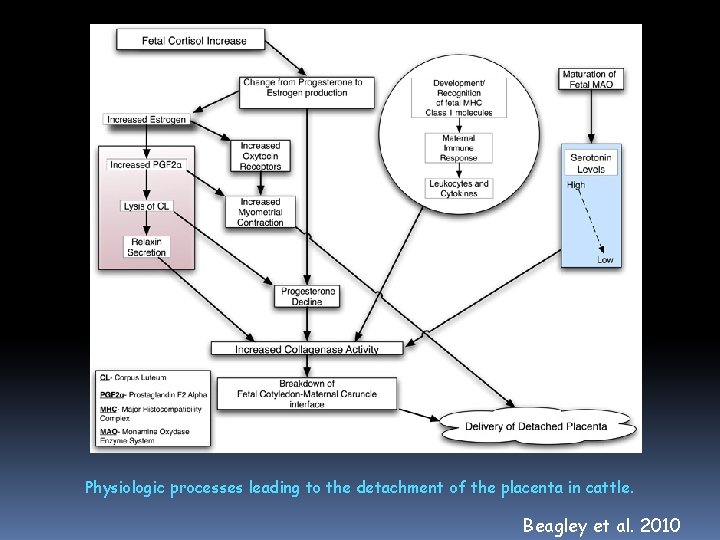
Physiologic processes leading to the detachment of the placenta in cattle. Beagley et al. 2010
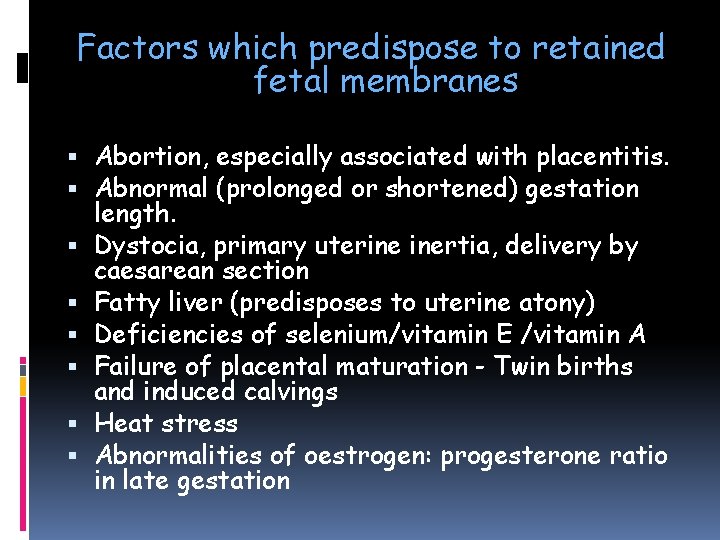
Factors which predispose to retained fetal membranes Abortion, especially associated with placentitis. Abnormal (prolonged or shortened) gestation length. Dystocia, primary uterine inertia, delivery by caesarean section Fatty liver (predisposes to uterine atony) Deficiencies of selenium/vitamin E /vitamin A Failure of placental maturation - Twin births and induced calvings Heat stress Abnormalities of oestrogen: progesterone ratio in late gestation
Clinical Features Membranes (normally visible hanging from vulva) become progressively more decomposed, have fetid odour, contaminated with faeces and soil. Reduced appetite and milk yield. Retention followed by extensive obstetric interference may be supervened by severe metritis and toxaemia within 2 -3 days which can be fatal, if not treated timely.
Effects on subsequent fertility Increased incidence of endometritis. Once metritis is developed, leads to economic losses due to increase in days open, services per conception, calving to first estrus interval and days from calving to first service and reduced conception rates to first service.
Treatment Manual removal, though commonly practised but is contraindicated as it is detrimental to the cow. Can result in damage of endometrium, leading to haemorrhage and infection. If the animal has fever, uterine damage increases the risk of septicaemia and perimetritis.
Ecbolic agents Oxytocin @ 40 -60 IU intramuscularly, if used immediately after calving. PGFα and its analogues have direct effect on the placentomes.

Antibiotics Rationale behind using antibiotics is to prevent or treat metritis. Systemic antibiotics can be used. Ceftiofur @2. 2 mg/kg intramuscularly for 5 days.
Local/intrauterine antibiotics reduce odour but reduce the rate of putrifaction of membranes and level of intrauterine phagocytosis thus, prolonging retention. Tetracyclines cause irritation and p. H damage to endometrium. Intrauterine pessaries are inactivated in the presence of debris present in the uterus.
Collagenase Infusion of collagenase into the stumps of the umbilical arteries for correcting the lack of cotyledon proteolysis. Bacterial collagenase (200, 000 IU) from Clostridium histolyticum dissolved in 1 L of saline is infused.

Prevention Providing cow comfort. Reducing stress around parturition. Careful nutritional management including supplementation of cows with Vitamin E and selenium during transition period in the deficient areas.
Mare One of the most common peripartum problems in mare. Average time taken 1 hour Should not exceed ˃ 2 hours Should be treated as an emergency.
Incidence Usually 2 - 10. 6% 28% after fetotomy 50% after caesarean section
Clinical signs Presence of a variable portion of tissue protruding from the vulva. • • Complications include acute metritis, septicaemia, laminitis and even death.
Treatment Oxytocin @ 20 – 40 IU intramuscularly, can be repeated after 1 hour if membranes are not expelled. Alternatively, slow intravenous infusion of 50 IU oxytocin in 1 L of physiological saline over 1 hour.
Manual removal Can be tried but very carefully. The hanging part is grasped and twisted into a rope. The gloved hand anointed with lubricant is gently introduced along the 'rope' to the area of circumferential attachment in the uterus. As the 'rope' is gently pulled and twisted, the tips of the fingers are pressed between the endometrium and the chorion.
Unwanted side-effects of this manual removal may be serious haemorrhage, invagination of one of the horns and a higher chance of retention of microvilli in the endometrium. The consequences of difficult removal are increased puerperal exudate, containing much tissue debris; endometritis and laminitis; uterine spasm and delayed involution of the uterus.
Another treatment is placement of 10 L of warm saline inside chorioallantoic membrane. Stretching of uterine wall stimulates uterine contraction leading to separation of placenta. Should be used in combination with exogenous oxytocin administration. Collagenase @ 200, 000 IU in 1 L saline can be infused into umbilical arteries.
After care Flushing and siphoning the uterus once or twice daily for a few days using warm, sterile physiological saline should be used in 2 -4 litre flushes (until the recovered fluid is clear). NSAIDS for treating laminitis, if any. Systemic antibiotics in case of toxic metritis. COX inhibitors like flunixin meglumine can be given to treat endotoxaemia.
- Slides: 25