
Retail Rate Options for Small Customers The California

- Slides: 20
Retail Rate Options for Small Customers The California Statewide Pricing Pilot Why? … What? … The Future? Levy Associates
Two Objectives 1 Summarize the most significant results from the California Statewide Pricing Pilot. 2 Identify how California is interpreting these results and what they mean for regulatory policy and demand response. Levy Associates
Why ? q “ Why was there virtually no reduction in electricity peak demand from the customer side of the market when wholesale prices increased by a factor of five in less than a week in the summer of 2000? “ * q How do we solve outage management practices that exempt 50% of the utility customers? q How do you provide customers with the capability to better manage their electric bills and tailor reliability to their individual needs? q What can we do to turn demand response into a viable resource? * CEC Action Plan, October 11, 2002 Levy Associates
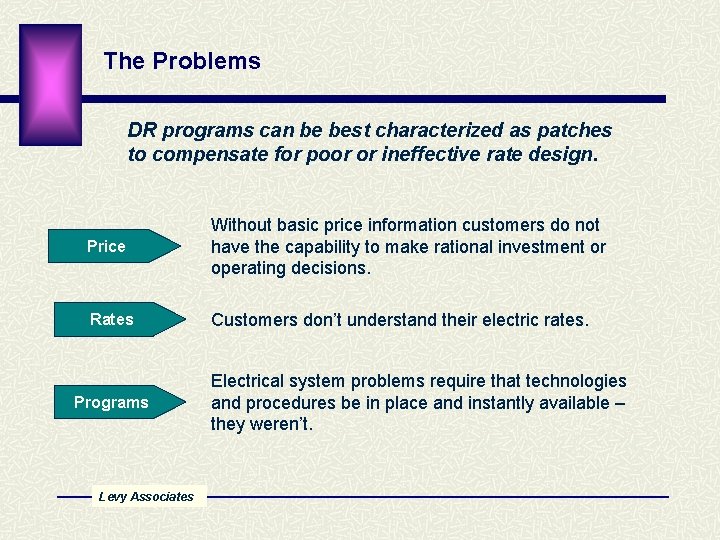
The Problems DR programs can be best characterized as patches to compensate for poor or ineffective rate design. Price Without basic price information customers do not have the capability to make rational investment or operating decisions. Rates Customers don’t understand their electric rates. Programs Levy Associates Electrical system problems require that technologies and procedures be in place and instantly available – they weren’t.
Statewide Pricing Pilot Results Levy Associates
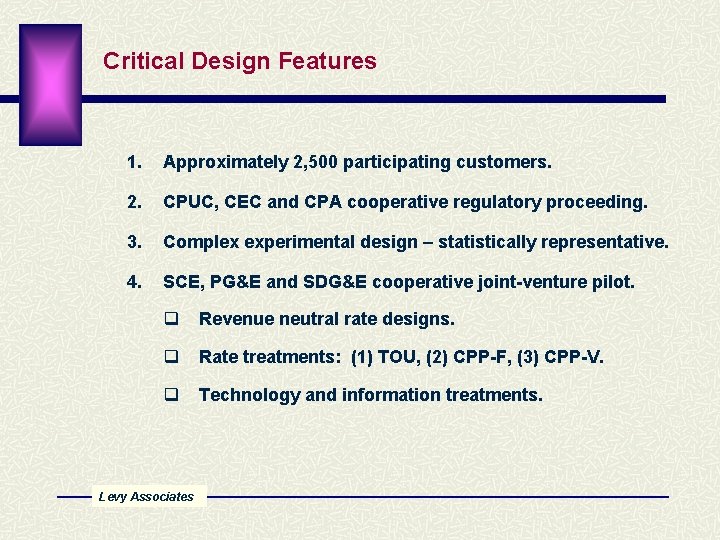
Critical Design Features 1. Approximately 2, 500 participating customers. 2. CPUC, CEC and CPA cooperative regulatory proceeding. 3. Complex experimental design – statistically representative. 4. SCE, PG&E and SDG&E cooperative joint-venture pilot. q Revenue neutral rate designs. q Rate treatments: (1) TOU, (2) CPP-F, (3) CPP-V. q Technology and information treatments. Levy Associates
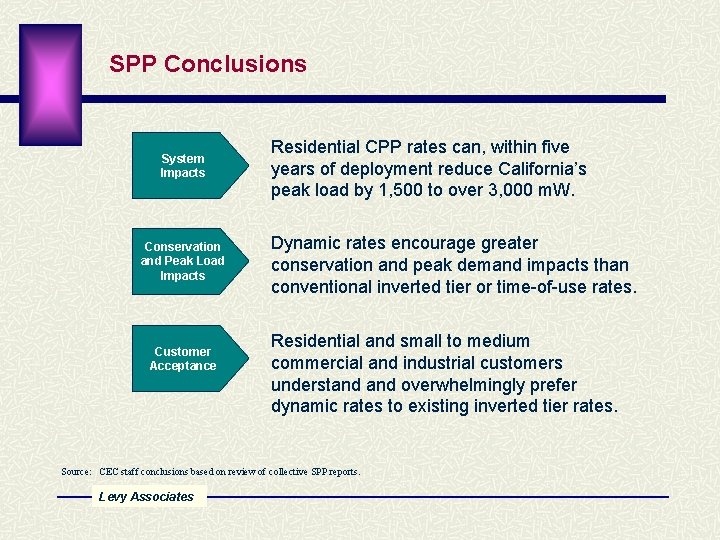
SPP Conclusions System Impacts Conservation and Peak Load Impacts Customer Acceptance Residential CPP rates can, within five years of deployment reduce California’s peak load by 1, 500 to over 3, 000 m. W. Dynamic rates encourage greater conservation and peak demand impacts than conventional inverted tier or time-of-use rates. Residential and small to medium commercial and industrial customers understand overwhelmingly prefer dynamic rates to existing inverted tier rates. Source: CEC staff conclusions based on review of collective SPP reports. Levy Associates
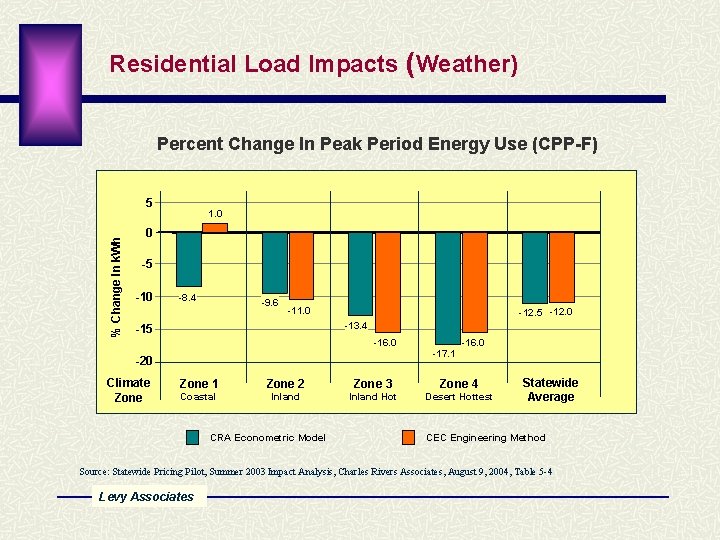
Residential Load Impacts (Weather) Percent Change In Peak Period Energy Use (CPP-F) % Change In k. Wh 5 1. 0 0 -5 -10 -8. 4 -9. 6 -11. 0 -12. 5 -12. 0 -13. 4 -15 -16. 0 -17. 1 -20 Climate Zone -16. 0 Zone 1 Zone 2 Zone 3 Zone 4 Coastal Inland Hot Desert Hottest CRA Econometric Model Statewide Average CEC Engineering Method Source: Statewide Pricing Pilot, Summer 2003 Impact Analysis, Charles Rivers Associates, August 9, 2004, Table 5 -4 Levy Associates
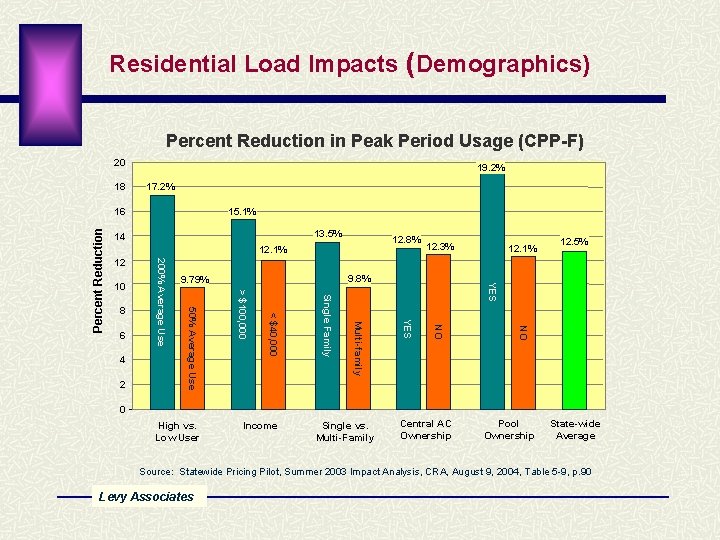
Residential Load Impacts (Demographics) Percent Reduction in Peak Period Usage (CPP-F) 20 18 19. 2% 17. 2% 15. 1% 13. 5% 14 12. 8% 12. 1% 12. 5% YES NO NO YES Multi-family 2 Single Family 4 < $40, 000 6 50% Average Use 8 12. 3% 9. 8% 9. 79% > $100, 000 10 200% Average Use Percent Reduction 16 0 High vs. Low User Income Single vs. Multi-Family Central AC Ownership Pool Ownership State-wide Average Source: Statewide Pricing Pilot, Summer 2003 Impact Analysis, CRA, August 9, 2004, Table 5 -9, p. 90 Levy Associates
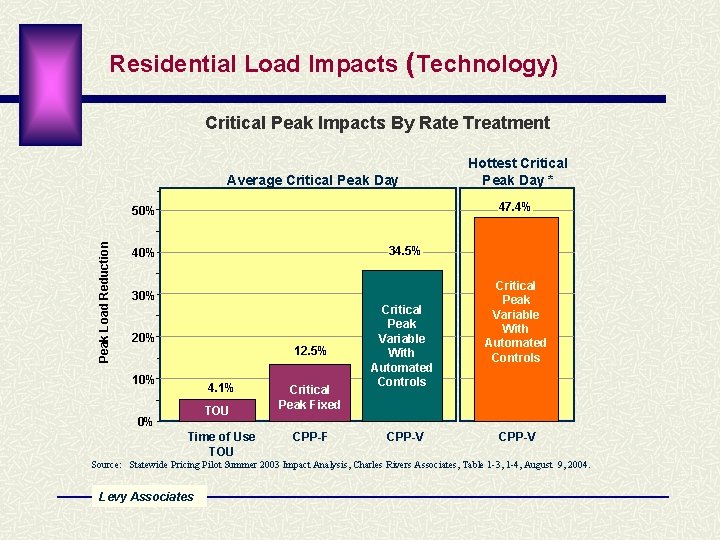
Residential Load Impacts (Technology) Critical Peak Impacts By Rate Treatment Average Critical Peak Day 47. 4% 50% Peak Load Reduction Hottest Critical Peak Day * 34. 5% 40% 30% 20% 12. 5% 10% 4. 1% TOU 0% Time of Use TOU Critical Peak Fixed CPP-F Critical Peak Variable With Automated Controls CPP-V Source: Statewide Pricing Pilot Summer 2003 Impact Analysis, Charles Rivers Associates, Table 1 -3, 1 -4, August 9, 2004. Levy Associates
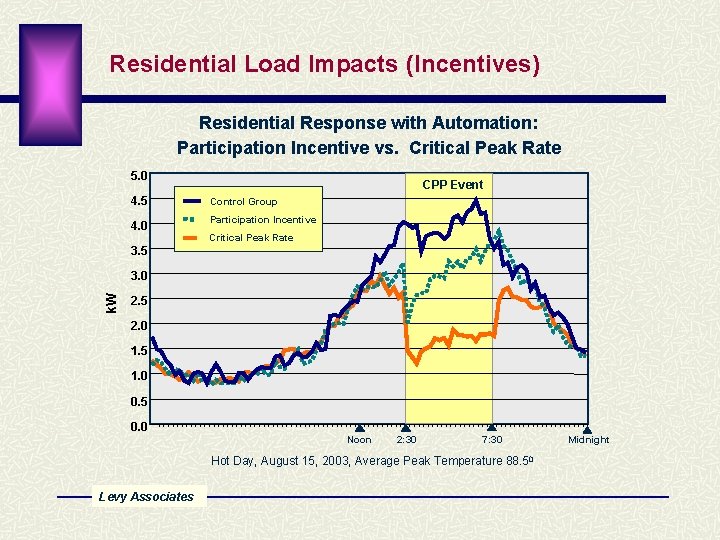
Residential Load Impacts (Incentives) Residential Response with Automation: Participation Incentive vs. Critical Peak Rate 5. 0 4. 5 4. 0 CPP Event Control Group Participation Incentive Critical Peak Rate 3. 5 k. W 3. 0 2. 5 2. 0 1. 5 1. 0 0. 5 0. 0 Noon 2: 30 7: 30 Hot Day, August 15, 2003, Average Peak Temperature 88. 50 Levy Associates Midnight
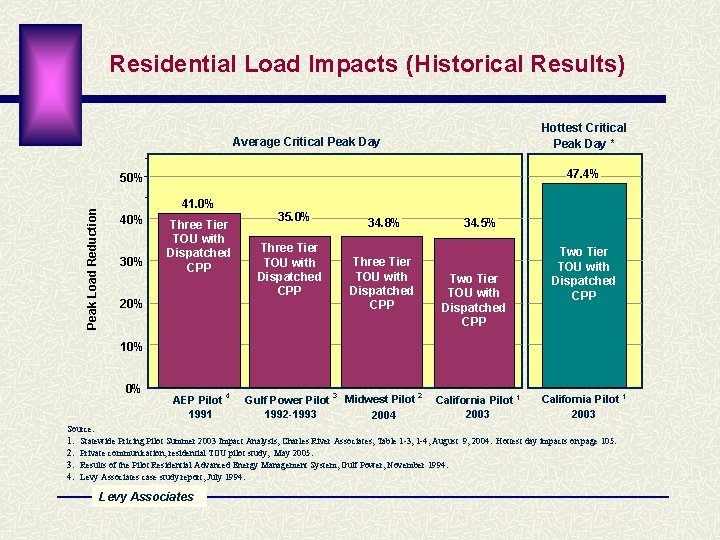
Residential Load Impacts (Historical Results) Hottest Critical Peak Day * Average Critical Peak Day 47. 4% Peak Load Reduction 50% 41. 0% 40% 30% Three Tier TOU with Dispatched CPP 20% 35. 0% Three Tier TOU with Dispatched CPP 34. 8% Three Tier TOU with Dispatched CPP 34. 5% Two Tier TOU with Dispatched CPP 10% 0% AEP Pilot 4 1991 2 Gulf Power Pilot 3 Midwest Pilot 1992 -1993 2004 California Pilot 1 2003 Source: 1. Statewide Pricing Pilot Summer 2003 Impact Analysis, Charles River Associates, Table 1 -3, 1 -4, August 9, 2004. Hottest day impacts on page 105. 2. Private communication, residential TOU pilot study, May 2005. 3. Results of the Pilot Residential Advanced Energy Management System, Gulf Power, November 1994. 4. Levy Associates case study report, July 1994. Levy Associates
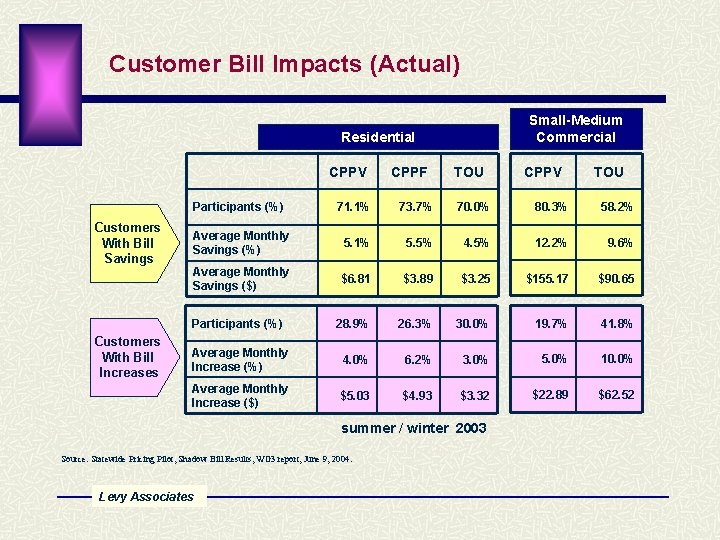
Customer Bill Impacts (Actual) Small-Medium Commercial Residential CPPV Customers With Bill Savings Customers With Bill Increases CPPF TOU CPPV TOU Participants (%) 71. 1% 73. 7% 70. 0% 80. 3% 58. 2% Average Monthly Savings (%) 5. 1% 5. 5% 4. 5% 12. 2% 9. 6% Average Monthly Savings ($) $6. 81 $3. 89 $3. 25 $155. 17 $90. 65 Participants (%) 28. 9% 26. 3% 30. 0% 19. 7% 41. 8% Average Monthly Increase (%) 4. 0% 6. 2% 3. 0% 5. 0% 10. 0% Average Monthly Increase ($) $5. 03 $4. 93 $3. 32 $22. 89 $62. 52 summer / winter 2003 Source: Statewide Pricing Pilot, Shadow Bill Results, WG 3 report, June 9, 2004. Levy Associates
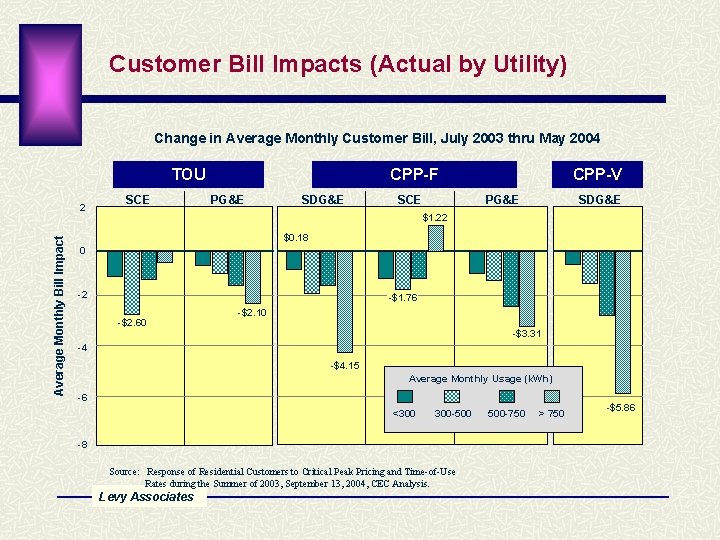
Customer Bill Impacts (Actual by Utility) Change in Average Monthly Customer Bill, July 2003 thru May 2004 TOU Average Monthly Bill Impact 2 SCE CPP-F PG&E SDG&E SCE CPP-V PG&E SDG&E $1. 22 $0. 18 0 -2 -$1. 76 -$2. 60 -$2. 10 -$3. 31 -4 -$4. 15 Average Monthly Usage (k. Wh) -6 <300 300 -500 -8 Source: Response of Residential Customers to Critical Peak Pricing and Time-of-Use Rates during the Summer of 2003, September 13, 2004, CEC Analysis. Levy Associates 500 -750 > 750 -$5. 86
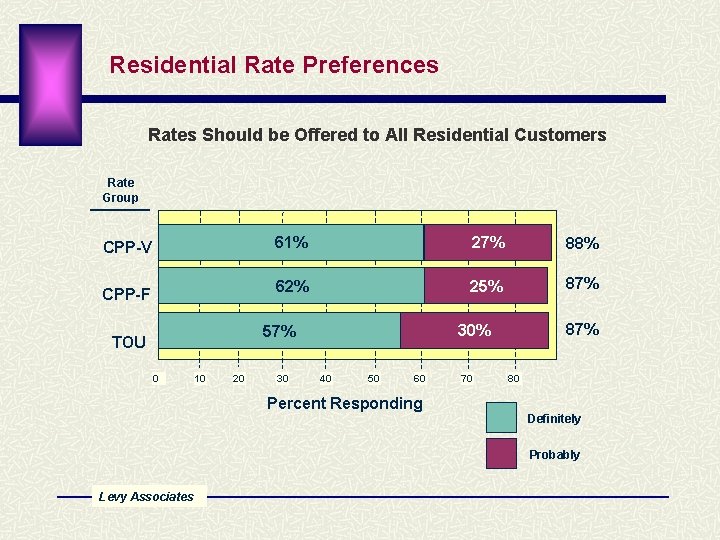
Residential Rate Preferences Rates Should be Offered to All Residential Customers Rate Group CPP-V 61% 27% 88% CPP-F 62% 25% 87% 0 10 20 30 87% 30% 57% TOU 40 50 60 Percent Responding 70 80 Definitely Probably Levy Associates
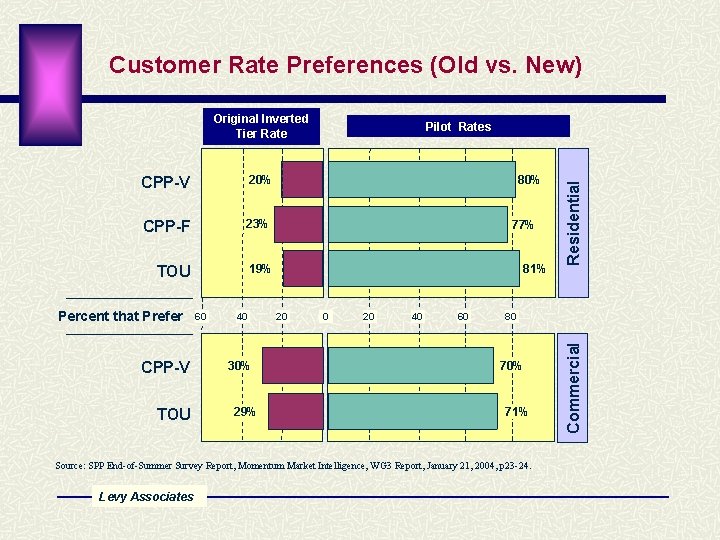
Customer Rate Preferences (Old vs. New) Original Inverted Tier Rate CPP-F 23% TOU 19% Percent that Prefer CPP-V TOU 60 40 30% 29% 80% 77% 81% 20 0 20 40 60 80 70% 71% Source: SPP End-of-Summer Survey Report, Momentum Market Intelligence, WG 3 Report, January 21, 2004, p 23 -24. Levy Associates Residential 20% Commercial CPP-V Pilot Rates
Translating the Results Regulatory Policy and Improved Operating Practices Levy Associates
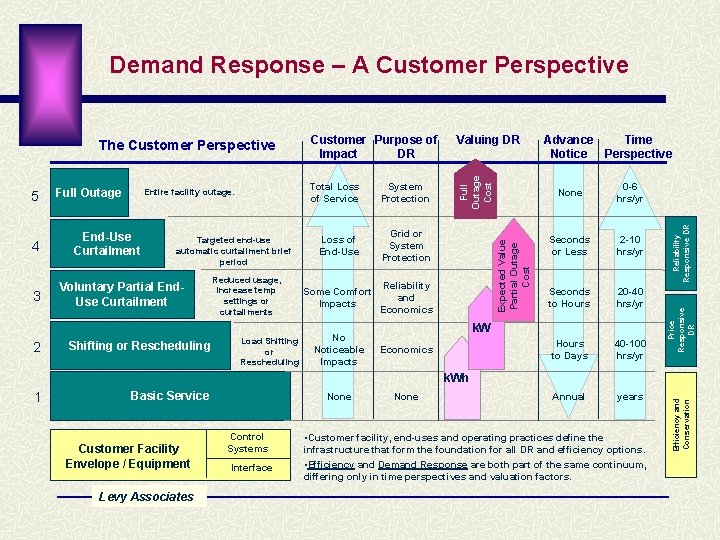
Demand Response – A Customer Perspective 3 2 End-Use Curtailment Targeted end-use automatic curtailment brief period Voluntary Partial End. Use Curtailment Shifting or Rescheduling Reduced usage, increase temp settings or curtailments Load Shifting or Rescheduling Total Loss of Service System Protection Loss of End-Use Grid or System Protection Some Comfort Impacts Reliability and Economics No Noticeable Impacts None 0 -6 hrs/yr Seconds or Less 2 -10 hrs/yr Seconds to Hours 20 -40 hrs/yr Hours to Days 40 -100 hrs/yr Annual years k. W Economics Reliability Responsive DR Entire facility outage. Advance Time Notice Perspective Price Responsive DR 4 Full Outage Valuing DR Expected Value Partial Outage Cost 5 Customer Purpose of Impact DR Full Outage Cost The Customer Perspective 1 Basic Service Customer Facility Envelope / Equipment Levy Associates None Control Systems Interface None • Customer facility, end-uses and operating practices define the infrastructure that form the foundation for all DR and efficiency options. • Efficiency and Demand Response are both part of the same continuum, differing only in time perspectives and valuation factors. Efficiency and Conservation k. Wh
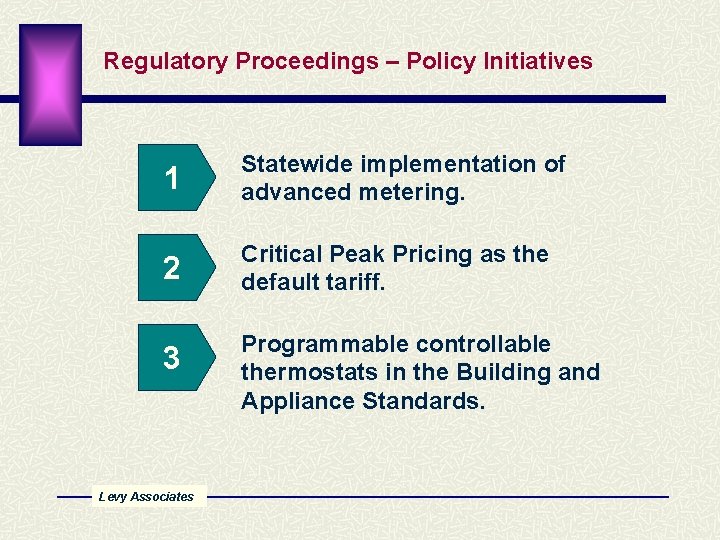
Regulatory Proceedings – Policy Initiatives 1 Statewide implementation of advanced metering. 2 Critical Peak Pricing as the default tariff. 3 Programmable controllable thermostats in the Building and Appliance Standards. Levy Associates
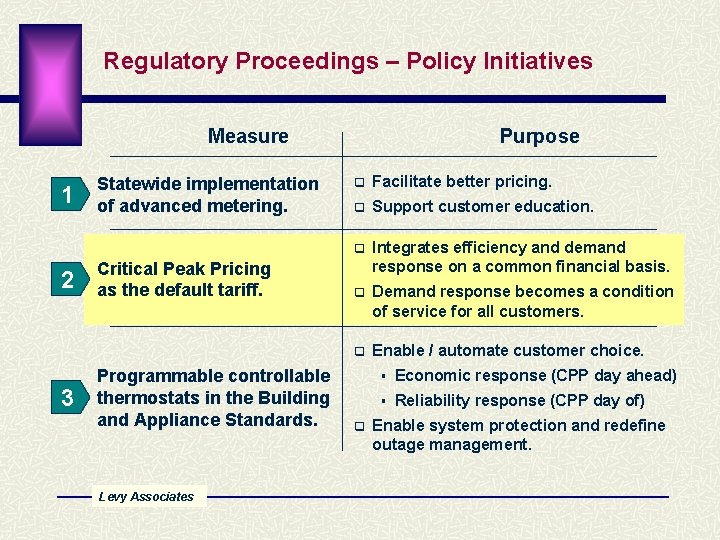
Regulatory Proceedings – Policy Initiatives Measure 1 2 3 Statewide implementation of advanced metering. Critical Peak Pricing as the default tariff. Programmable controllable thermostats in the Building and Appliance Standards. Levy Associates Purpose q Facilitate better pricing. q Support customer education. q Integrates efficiency and demand response on a common financial basis. q Demand response becomes a condition of service for all customers. q Enable / automate customer choice. q § Economic response (CPP day ahead) § Reliability response (CPP day of) Enable system protection and redefine outage management.