
Retail Management Module 4 Identifying and Understanding Customer


- Slides: 31
Retail Management Module 4: Identifying and Understanding Customer Behavior
The Customer Decision-Making Process
Learning Outcomes: The Customer Decision-Making Process 4. 1 Explain the consumer decision-making process 4. 1. 1 Outline the steps of the buying process 4. 1. 2 Identify a situation in which a customer has conflicting needs 4. 1. 3 Describe how a customer finds information to make a buying decision 4. 1. 4 Using the multiattribute model, explain how customers evaluate retailers • •
Activity 1 Marketers study the buying process and consumer motivations in an attempt to understand how purchase decisions are made. Why is it useful to work through how shoppers sort through and make sense of information, the explicit needs, implicit needs, and the models for how they make the decisions they do?
Steps of the Buying Process There are three models of the buying process 1. 2. 3. AIDA Path to Purchase Consumer Buying Process
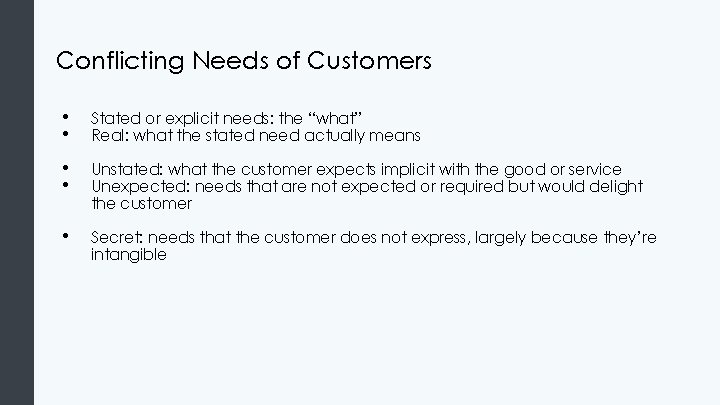
Conflicting Needs of Customers • • Stated or explicit needs: the “what” Real: what the stated need actually means • • Unstated: what the customer expects implicit with the good or service Unexpected: needs that are not expected or required but would delight the customer • Secret: needs that the customer does not express, largely because they’re intangible
Practice Question How can customers needs be in conflict?
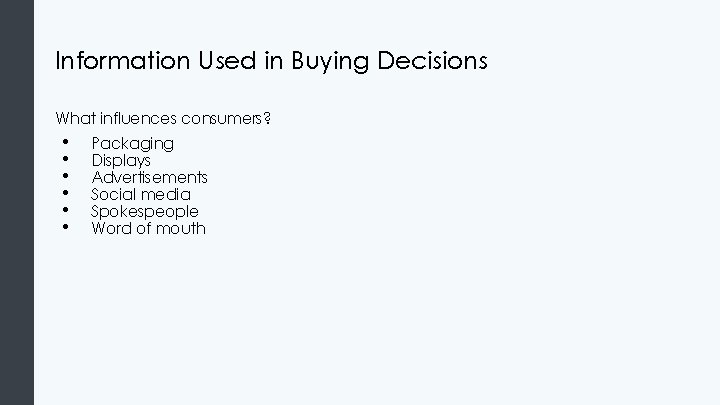
Information Used in Buying Decisions What influences consumers? • • • Packaging Displays Advertisements Social media Spokespeople Word of mouth
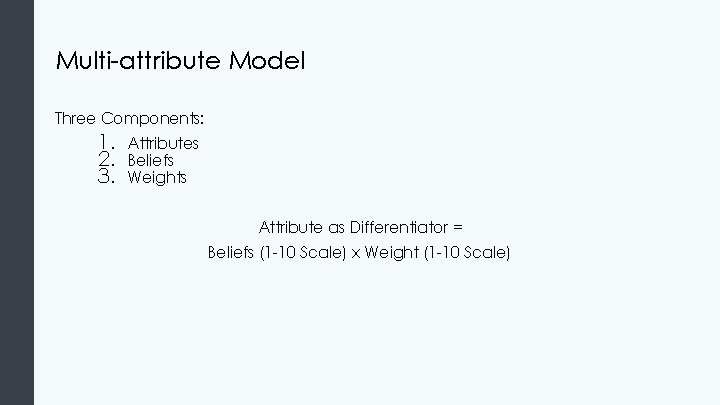
Multi-attribute Model Three Components: 1. 2. 3. Attributes Beliefs Weights Attribute as Differentiator = Beliefs (1 -10 Scale) x Weight (1 -10 Scale)
Katz’s Functional Theories of Attitudes • Utilitarian Function: how well does this meet needs or solve a problem? • Value-expressive Function: how well does this reflect my values or how I ant to reflect myself to others? • Ego-defensive Function: would this negatively affect my image or standing? • Knowledge-based Function: what criteria were used to arrive at this conclusion?
Models of the Buying Process
Learning Outcomes: Models of the Buying Process 4. 2 Identify the various models of buying processes 4. 2. 1 Describe how a retailer can increase sales from customers engaged in extended problem solving 4. 2. 2 Describe how a retailer can increase sales from customers engaged in limited problem solving 4. 2. 3 Describe how a retailer can satisfy the needs of habitual decision making customers by choosing to act in ways that increase loyalty • • •
Increasing Sales with Extended Problem Solving • • • Engaging the customer is crucial. Why is the customer buying that item? What benefits will it provide? • Sales people will need to be able to explain specifically how the product will meet the needs and benefits desired by the consumer
Increasing Sales with Limited Problem Solving • Consumers with a limited problem mindset don’t need a high-level of engagement • They need to be cued to make a purchase • Advertising, promotion, and in-store merchandising can be especially helpful in influencing the decision
Habitual Decision-Making • • • Consumers that make purchasing decisions based on habit don’t think about their purchase They don’t need to dedicate more thought or consideration because their needs are already being met (or exceeded) This results in customer loyalty!
Introduction to Understanding Customers
Learning Outcomes: Introduction to Understanding Customers 4. 3 Describe why it is important for retailers to research and understand their customers • 4. 3. 1 Define a target market • 4. 3. 2 Explain why a retailer would want to meet the needs of a specific group of people
Target Markets Segmentation: The process of identifying homogeneous groups within a population- groups that share a common trait or characteristic • By identifying segments marketers can decide which segment is most attractive to target and position their product or service to develop them as customers
Meeting the Needs of Specific Groups • Segmentation, targeting, and positioning are critical activities because they help focus marketing and sales resources more efficiently • The firm can optimize its marketing mix to position its offerings to meet these consumers’ needs • This ensures that consumers’ needs are satisfied and creates a cycle where the firm can continue to innovate, developing products that suits core customers
Activity 2 Target, Wal-Mart, and Kohl’s all compete in the retail industry to some extent, yet they each have a different unique business model. Why? Discuss your response using the terms “segmentation, targeting, and positioning” in order to compare and contrast these businesses.
Introduction to Describing Customers
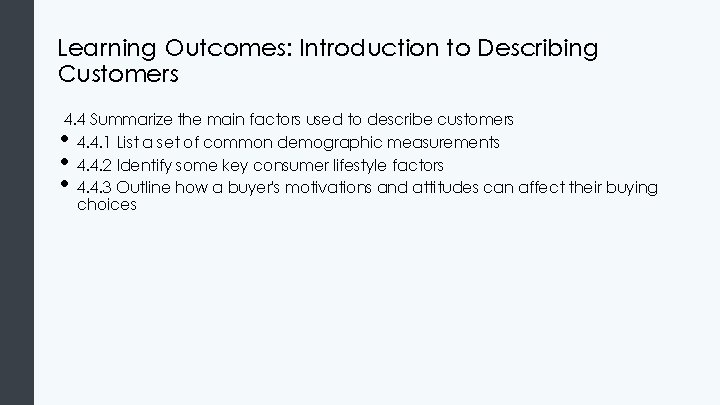
Learning Outcomes: Introduction to Describing Customers 4. 4 Summarize the main factors used to describe customers 4. 4. 1 List a set of common demographic measurements 4. 4. 2 Identify some key consumer lifestyle factors 4. 4. 3 Outline how a buyer's motivations and attitudes can affect their buying choices • • •
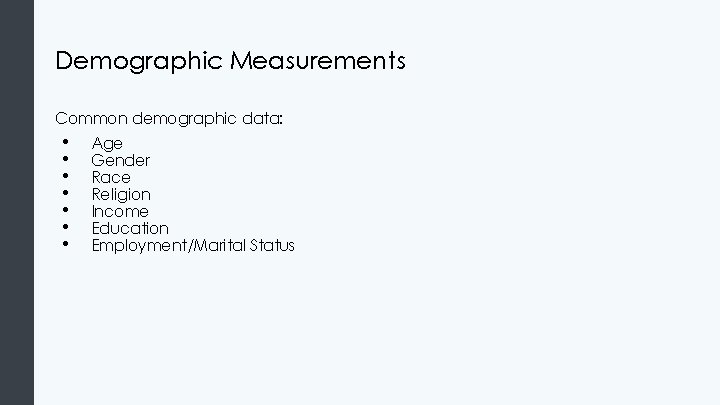
Demographic Measurements Common demographic data: • • Age Gender Race Religion Income Education Employment/Marital Status
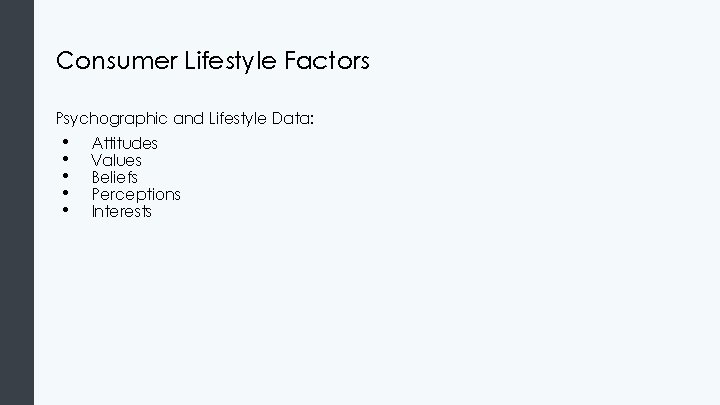
Consumer Lifestyle Factors Psychographic and Lifestyle Data: • • • Attitudes Values Beliefs Perceptions Interests
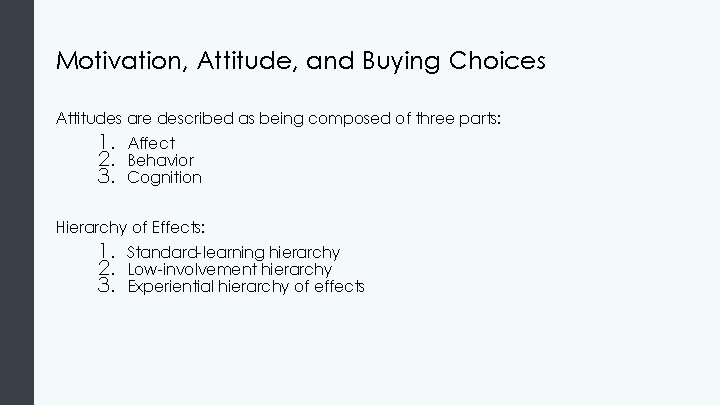
Motivation, Attitude, and Buying Choices Attitudes are described as being composed of three parts: 1. 2. 3. Affect Behavior Cognition Hierarchy of Effects: 1. 2. 3. Standard-learning hierarchy Low-involvement hierarchy Experiential hierarchy of effects
Target Market Planning
Learning Outcomes: Target Market Planning 4. 5 Examine retailer decisions based on target market planning 4. 5. 1 Define a brand community 4. 5. 2 Explain why a retailer would select a differentiated marketing strategy over a mass or concentrated one 4. 5. 3 Predict a retail strategy mix based on the characteristics, needs, and attitudes of their customers • •
Brand Community • A brand community is a community formed on the basis of attachment to a product or brand, stressing the connection between brand, individual identity, and culture “The people out in the marketplace who embrace the values of the brand, as customers and/or purchase influencers, are the brand’s true ‘owners. ’” - Blade Creative Branding
Differentiated, Mass, and Concentrated Marketing Strategies • A firm’s strategy begins with decisions around how it will compete in the marketplace • Which strategy will help to best manage the marketing mix? • How is each aspect of the marketing mix affected depending on what strategy is chosen? • • Differentiated vs. low cost Mass vs. niche
Predicting a Retail Strategy Mix Use the 6 Ps! Product, Place, Price, Promotion, People, Presence • • People: People are the face of an organization. High service environments have lots of helpful people Presence: A retailers participation across multiple channels. This is helpful in managing multi and omni level challenges to meet consumer expectations around accessibility, consistency, and service.
Quick Review • How would you describe the steps of the Buying Process? • How do the needs of customers influences how do they make their buying decisions? • What is the best way to identify and select a target market? • What are the P’s in the Marketing Mix?