
Retail Management Module 12 Retail Pricing and Sales
- Slides: 34
Retail Management Module 12: Retail Pricing and Sales Strategy
Pricing in Retail
Learning Outcomes: Pricing in Retail 12. 1 Identify how pricing fits into the goals of a retail establishment • 12. 1. 1 Define value • 12. 1. 2 Differentiate between basic retail pricing strategies • 12. 1. 3 Explain how pricing is integrated with the rest of the retail mix strategy
Defining Value For customers: • value is the perceived monetary worth of the combination of product, service, and utility. “Value proposition” is a term used to describe an innovation, service, or feature intended to make a company or product attractive to customers. For retailers, value can take on even more meaning
Activity Let’s imagine that you are considering jumping into the retail industry by opening a candy store. You would have a myriad of things to address in your business plan. Make a list of your responses to each question with a partner. Who are your competitors? How much consumer revenue is currently being devoted to candy sales in the existing market? What are the demographics of the customer base? How much is the average purchase by the customer base? Where are the potential locations for your shop?
Retail Pricing Strategies • • Markup Keystone pricing Premium Discount Psychological pricing Bundle Tiered pricing
Pricing and the Retail Mix • • • Product Promotion Presentation Personnel Place Pricing
Pricing Objectives
Learning Outcomes: Pricing Objectives 12. 2 Explain how retailers determine pricing objectives • 12. 2. 1 List some external factors that impact retail pricing • 12. 2. 2 Match various pricing strategies with the business objective it represents • 12. 2. 3 Define price elasticity • 12. 2. 4 Calculate the price elasticity of a product based on the given situation
External Factors and Retail Pricing What are three external factors of retail pricing? • • • Competition Channel Geography
Pricing Strategies Growing revenue is a common business objective • • Create comprehensive strategy across all dimensions of the company Expect that retailer would become more aggressive in pricing • Increasing profit: raising margins through premium pricing and less aggressive promotion • Penetration into a new market area: distribute existing product assortment, adding temporary ”loss leaders”
Price Elasticity • Classic economic principle that helps us understand how much a change in price will affect market behaviors • Important to pricing decisions as it helps understand whether raising or lowering prices will be better • Denotes large impact on demand due to changes in price
Practice Question 1 What is the purpose of studying price elasticity in a retail context?
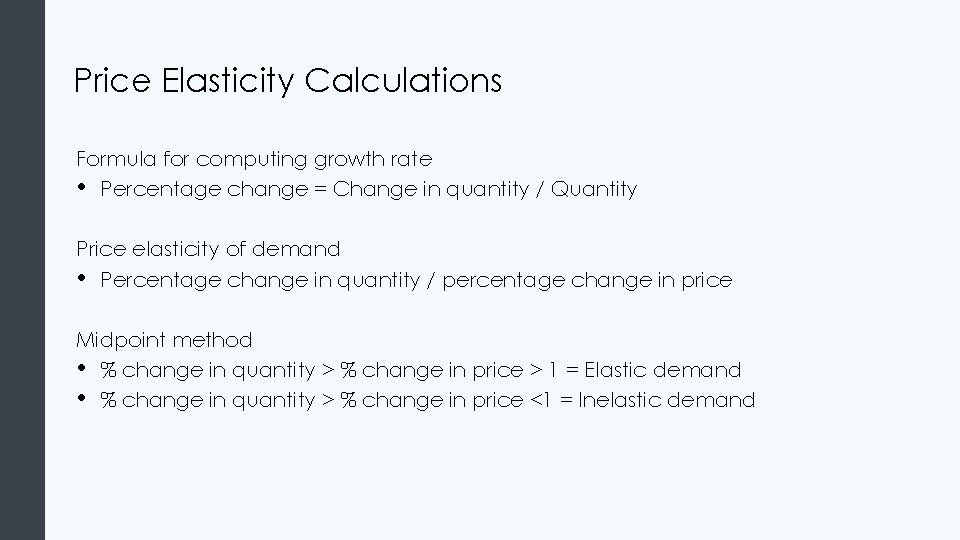
Price Elasticity Calculations Formula for computing growth rate • Percentage change = Change in quantity / Quantity Price elasticity of demand • Percentage change in quantity / percentage change in price Midpoint method • % change in quantity > % change in price > 1 = Elastic demand • % change in quantity > % change in price <1 = Inelastic demand
Product Pricing Methods
Learning Outcomes: Product Pricing Methods 12. 3 Use various pricing methods to determine product pricing • 12. 3. 1 Using cost-oriented pricing equations, calculate the retail price, the cost, and the markup percentage of a product • 12. 3. 2 Calculate the break-even point for retail product sales • 12. 3. 3 Explain how a retailer can use competition-oriented pricing to determine the price of a product • 12. 3. 4 Describe how retailers use demand-oriented pricing
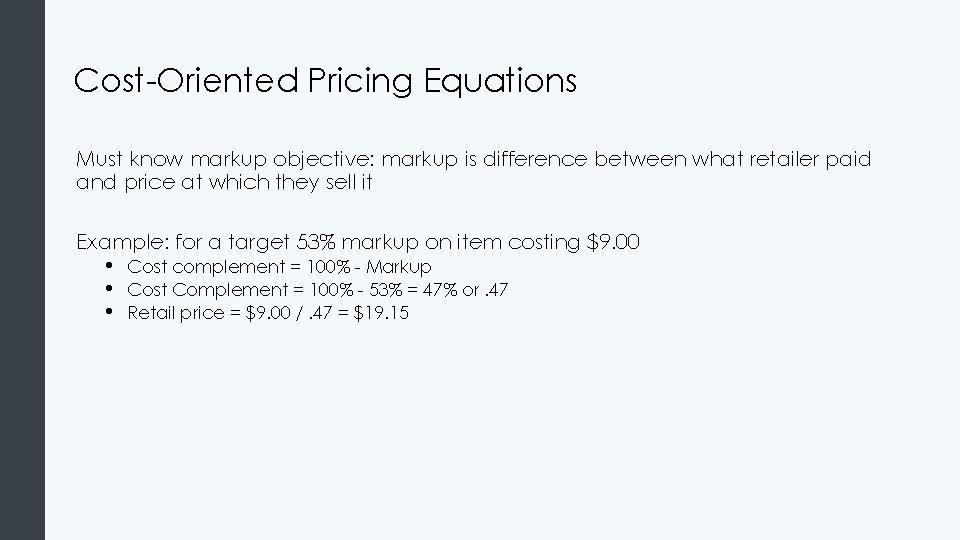
Cost-Oriented Pricing Equations Must know markup objective: markup is difference between what retailer paid and price at which they sell it Example: for a target 53% markup on item costing $9. 00 • • • Cost complement = 100% - Markup Cost Complement = 100% - 53% = 47% or. 47 Retail price = $9. 00 /. 47 = $19. 15
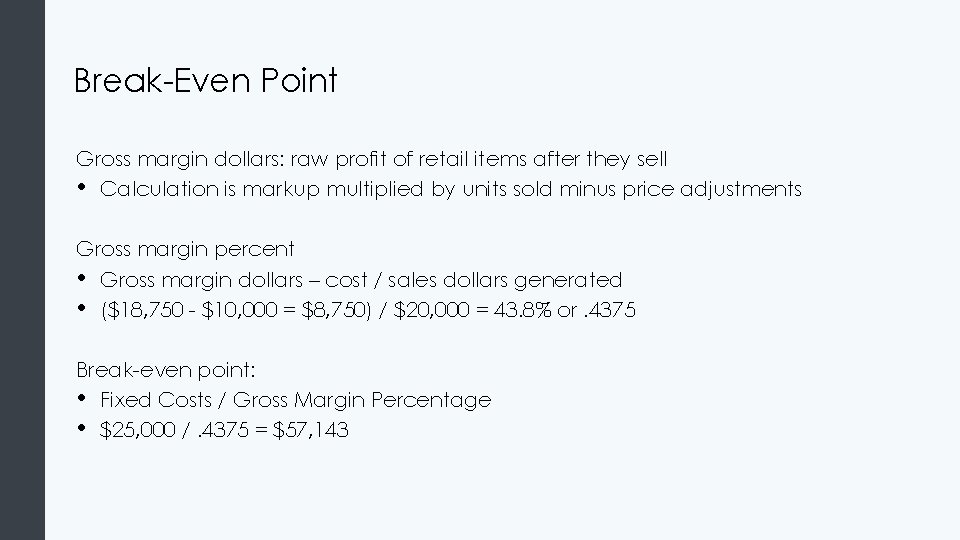
Break-Even Point Gross margin dollars: raw profit of retail items after they sell • Calculation is markup multiplied by units sold minus price adjustments Gross margin percent • Gross margin dollars – cost / sales dollars generated • ($18, 750 - $10, 000 = $8, 750) / $20, 000 = 43. 8% or. 4375 Break-even point: • Fixed Costs / Gross Margin Percentage • $25, 000 /. 4375 = $57, 143
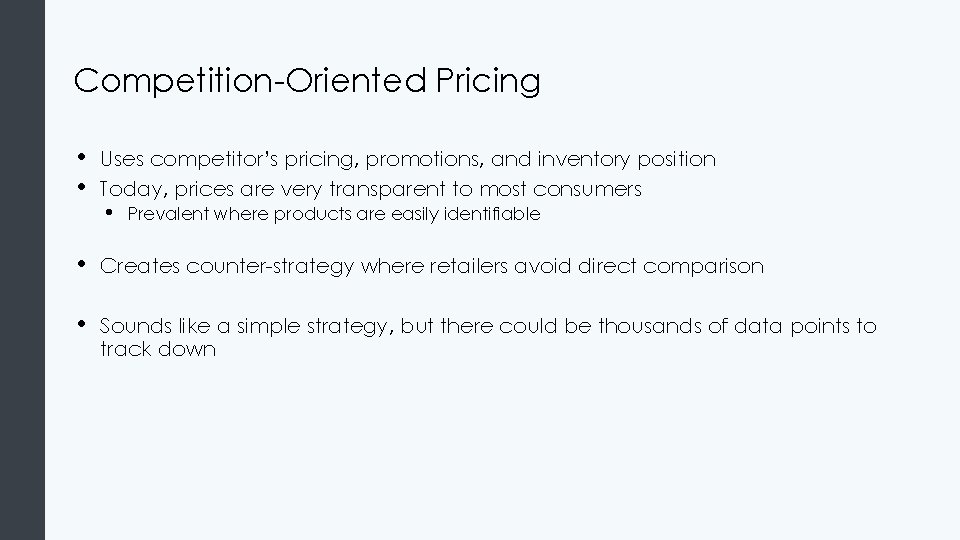
Competition-Oriented Pricing • • Uses competitor’s pricing, promotions, and inventory position Today, prices are very transparent to most consumers • Prevalent where products are easily identifiable • Creates counter-strategy where retailers avoid direct comparison • Sounds like a simple strategy, but there could be thousands of data points to track down
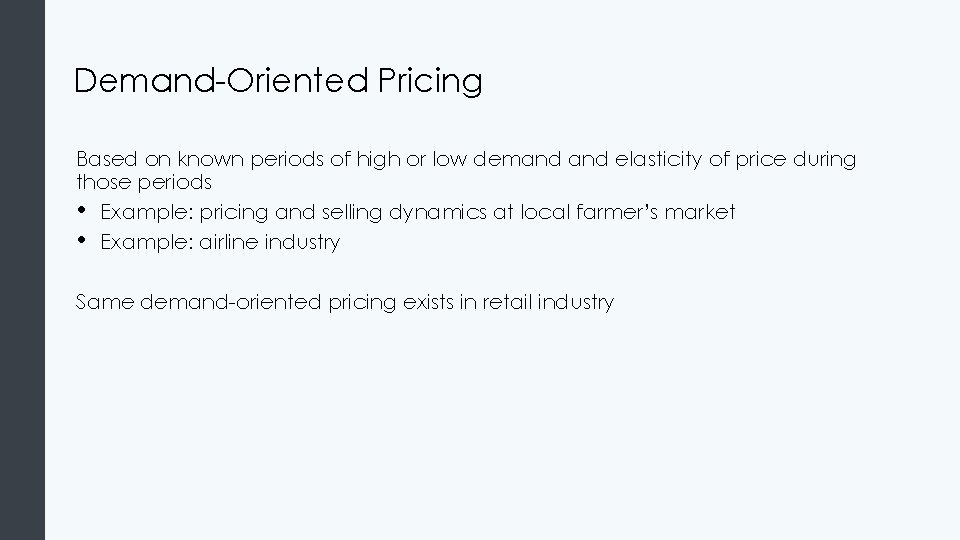
Demand-Oriented Pricing Based on known periods of high or low demand elasticity of price during those periods • Example: pricing and selling dynamics at local farmer’s market • Example: airline industry Same demand-oriented pricing exists in retail industry
Practice Question 2 What is an example of demand-oriented pricing in a retail operation?
Price Adjustment Techniques
Learning Outcomes: Price Adjustment Techniques 12. 4 Examine common price adjustment techniques • 12. 4. 1 Understand the three types of price adjustments used by retailers • 12. 4. 2 Explain how retailers can reduce the amount of product that ends up in markdowns • 12. 4. 3 Summarize the options for liquidating markdown merchandise
Markdown Optimization Software Promotion Price protection Markdown Retailers may have set schedule of when markdowns are taken to ensure inventory will be eliminated by target date
Reducing Product Markdowns Remember that planning and purchasing of retail assortments is art and science • Having a strong supply chain can help reduce lead time • Keep timely receipts of a product • Note the distribution of goods • Quick reaction by merchants to show sellers • Common denominator = execution
Liquidating Markdown Merchandise • • Once retailer decides to markdown product, it remains in inventory until it is sold out First method: set process, including markdown percent thresholds, that will be used to sell through markdown merchandise Sell markdown goods in large chunks to third-party liquidation companies Retailers have designated channels within company to dispose of markdown products
Pricing Techniques
Learning Outcomes: Pricing Techniques 12. 5 Examine pricing techniques used by retailers to increase sales and profits • 12. 5. 1 Differentiate between first, second, and third-degree price discrimination • 12. 5. 2 Define loss leader • 12. 5. 3 Illustrate the technique of price lining • 12. 5. 4 Explain the concepts of KVC and KVI and their impact on retail pricing
Loss Leader • • • Pricing strategy where product is sold at price at or below market cost Describes concept that item is offered for sale at reduced price Tries to maintain current analysis of margins • Examples: sale of diapers at toy store chains, large home improvement stores offer larger tools, telecommunication company stores sell smartphones at discounted prices
Price-Discrimination Exists within a market when sales of identical goods or services are sold at different prices by same provider • • Goal is for seller to make most profit possible Three “degrees” of price discrimination: • • • First: seller of good or service must know maximum price Second: price of good or service varies Third: price varies according to age, sex, location, status
Price Lining • Technique used to group common items at set price-points • Fits well with traditional retail assortment structure • Keep number of retail price points to minimum despite disparate costs from vendors • Does not require set number of price points
History of Odd Pricing In the 1970 s and 1980 s, mass merchants developed the concept of “Key Items” • Identified as way to ensure that products perceived to be most important to customer base are given extra attention Key item strategy involved: management inspection, product development, store presentation guidelines, promotion plans, pricing against competition • Example: pocket t-shirt from 190 s at Gap Stores • High quality, many different colors KVC (Key Value Categories) and KVI (Key Value Items) expanded due to advances in data analytics
Practice Question 3 • What do the acronyms KVC and KVI mean?
Quick Review • • • What is the set of tactical pricing techniques? What are the Six P’s of Retail? Why study the basic economic principles in retail? What does competition-oriented pricing show retailers? Why do price adjustments support business objectives?