
Retail Competition Open Access Power Markets and DISCOMs
- Slides: 16
Retail Competition, Open Access, Power Markets and DISCOMs A medium-term outlook Ann Josey Prayas (Energy Group) Distribution Utility Meet (DUM 2017) 29 th November 2017, Bangalore
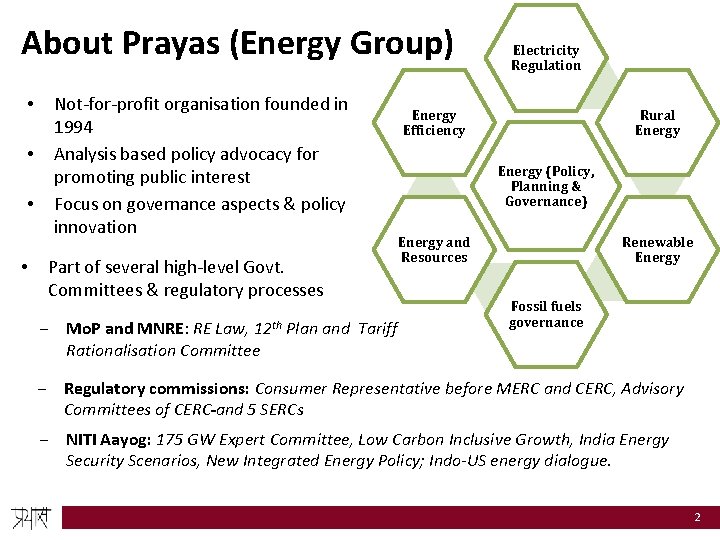
About Prayas (Energy Group) • • Not-for-profit organisation founded in 1994 Analysis based policy advocacy for promoting public interest Focus on governance aspects & policy innovation Part of several high-level Govt. Committees & regulatory processes − Mo. P and MNRE: RE Law, 12 th Plan and Tariff Rationalisation Committee Electricity Regulation Energy Efficiency Rural Energy (Policy, Planning & Governance) Renewable Energy and Resources Fossil fuels governance − Regulatory commissions: Consumer Representative before MERC and CERC, Advisory Committees of CERC and 5 SERCs − NITI Aayog: 175 GW Expert Committee, Low Carbon Inclusive Growth, India Energy Security Scenarios, New Integrated Energy Policy; Indo-US energy dialogue. 2
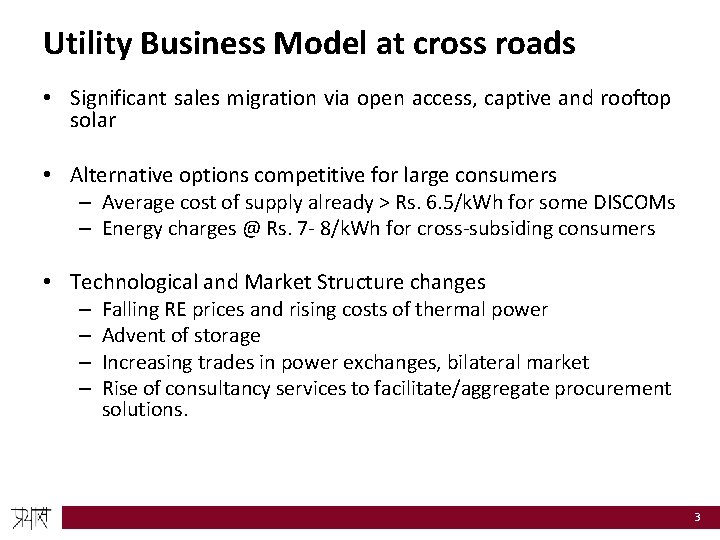
Utility Business Model at cross roads • Significant sales migration via open access, captive and rooftop solar • Alternative options competitive for large consumers – Average cost of supply already > Rs. 6. 5/k. Wh for some DISCOMs – Energy charges @ Rs. 7 - 8/k. Wh for cross-subsiding consumers • Technological and Market Structure changes – Falling RE prices and rising costs of thermal power – Advent of storage – Increasing trades in power exchanges, bilateral market – Rise of consultancy services to facilitate/aggregate procurement solutions. 3
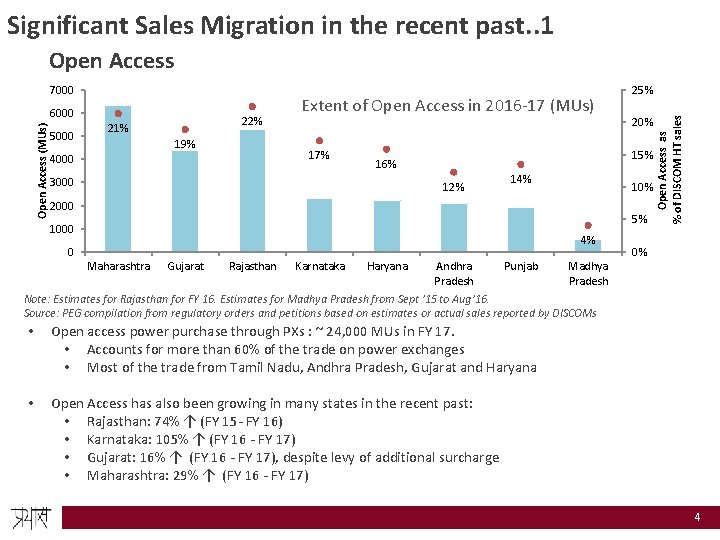
Significant Sales Migration in the recent past. . 1 Open Access (MUs) 6000 5000 22% 21% 19% Extent of Open Access in 2016 -17 (MUs) 17% 4000 20% 15% 16% 3000 25% 12% 14% 10% 2000 5% 1000 4% 0 Maharashtra Gujarat Rajasthan Karnataka Open Access as % of DISCOM HT sales 7000 0% Haryana Andhra Punjab Madhya Pradesh Note: Estimates for Rajasthan for FY 16. Estimates for Madhya Pradesh from Sept ’ 15 to Aug’ 16. Source: PEG compilation from regulatory orders and petitions based on estimates or actual sales reported by DISCOMs • Open access power purchase through PXs : ~ 24, 000 MUs in FY 17. • Accounts for more than 60% of the trade on power exchanges • Most of the trade from Tamil Nadu, Andhra Pradesh, Gujarat and Haryana • Open Access has also been growing in many states in the recent past: • Rajasthan: 74% ↑ (FY 15 - FY 16) • Karnataka: 105% ↑ (FY 16 - FY 17) • Gujarat: 16% ↑ (FY 16 - FY 17), despite levy of additional surcharge • Maharashtra: 29% ↑ (FY 16 - FY 17) 4
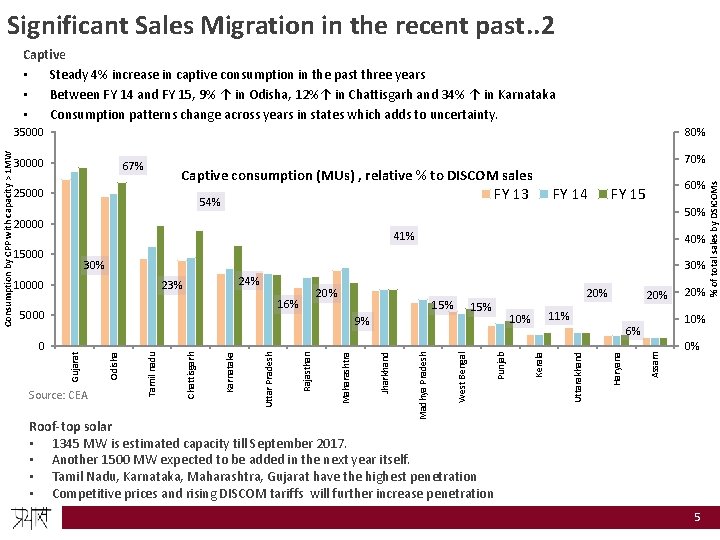
Significant Sales Migration in the recent past. . 2 Captive • Steady 4% increase in captive consumption in the past three years • Between FY 14 and FY 15, 9% ↑ in Odisha, 12%↑ in Chattisgarh and 34% ↑ in Karnataka • Consumption patterns change across years in states which adds to uncertainty. 80% 67% Captive consumption (MUs) , relative % to DISCOM sales 25000 FY 13 54% FY 14 60% FY 15 50% 20000 41% 15000 40% 30% 20% 11% 10% 20% 10% 6% Assam West Bengal Madhya Pradesh Jharkhand Maharashtra Rajasthan Uttar Pradesh Karnataka Chattisgarh Tamil nadu Odisha 9% Source: CEA 20% 15% Haryana 5000 15% Uttarakhand 20% 16% Kerala 24% 23% Punjab 10000 0 70% 0% Roof-top solar • 1345 MW is estimated capacity till September 2017. • Another 1500 MW expected to be added in the next year itself. • Tamil Nadu, Karnataka, Maharashtra, Gujarat have the highest penetration • Competitive prices and rising DISCOM tariffs will further increase penetration 5 % of total sales by DSICOMs 30000 Gujarat Consumption by CPP with capacity > 1 MW 35000
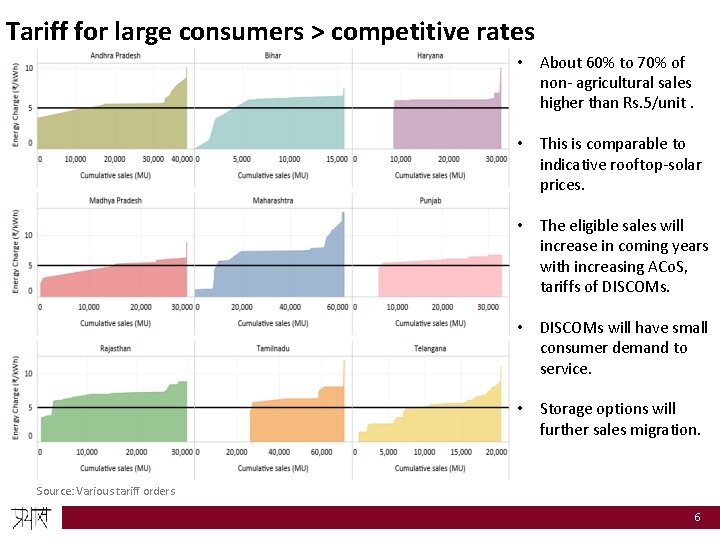
Tariff for large consumers > competitive rates • About 60% to 70% of non- agricultural sales higher than Rs. 5/unit. • This is comparable to indicative rooftop-solar prices. • The eligible sales will increase in coming years with increasing ACo. S, tariffs of DISCOMs. • DISCOMs will have small consumer demand to service. • Storage options will further sales migration. Source: Various tariff orders 6
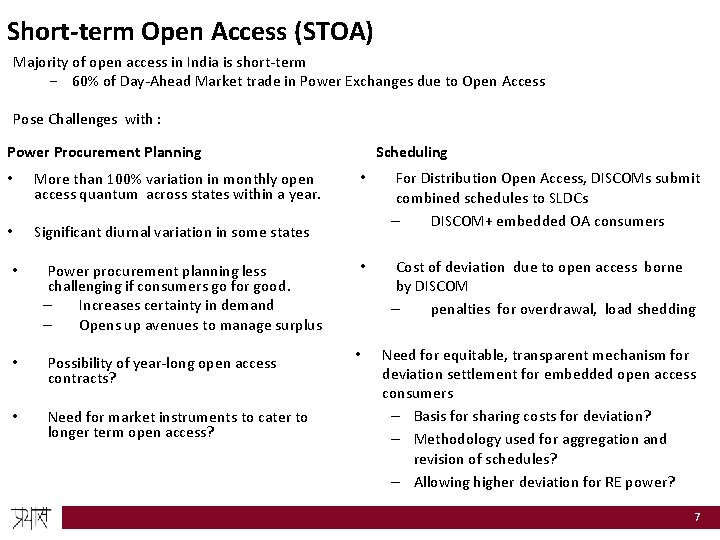
Short-term Open Access (STOA) Majority of open access in India is short-term − 60% of Day-Ahead Market trade in Power Exchanges due to Open Access Pose Challenges with : Power Procurement Planning • More than 100% variation in monthly open access quantum across states within a year. • Significant diurnal variation in some states Scheduling • For Distribution Open Access, DISCOMs submit combined schedules to SLDCs – DISCOM+ embedded OA consumers • Power procurement planning less challenging if consumers go for good. – Increases certainty in demand – Opens up avenues to manage surplus • Cost of deviation due to open access borne by DISCOM – penalties for overdrawal, load shedding • Possibility of year-long open access contracts? • • Need for market instruments to cater to longer term open access? Need for equitable, transparent mechanism for deviation settlement for embedded open access consumers – Basis for sharing costs for deviation? – Methodology used for aggregation and revision of schedules? – Allowing higher deviation for RE power? 7
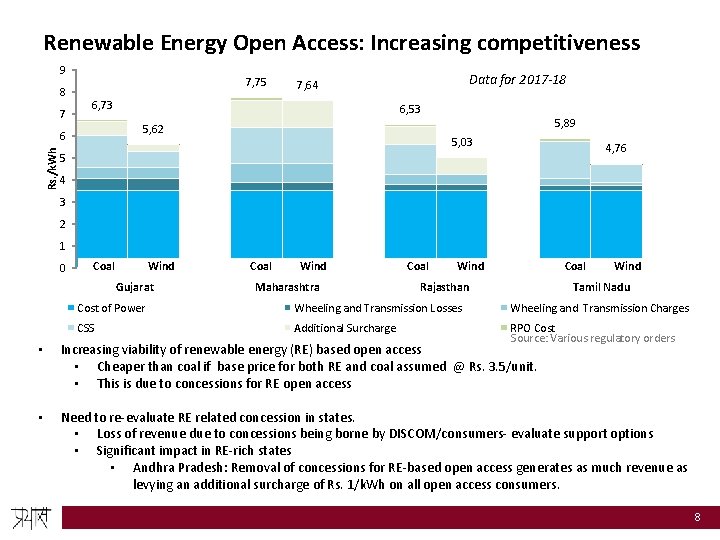
Renewable Energy Open Access: Increasing competitiveness 9 8 7 7, 75 6, 73 6, 53 5, 62 6 Rs. /k. Wh Data for 2017 -18 7, 64 5, 89 5, 03 4, 76 5 4 3 2 1 0 Coal Wind Gujarat Coal Maharashtra Wind Maharashtra Coal Wind Coal Rajasthan Wind Tamil Nadu Rajasthan Tamil Nadu Cost of Power Wheeling and Transmission Losses Wheeling and Transmission Charges CSS Additional Surcharge RPO Cost Source: Various regulatory orders • Increasing viability of renewable energy (RE) based open access • Cheaper than coal if base price for both RE and coal assumed @ Rs. 3. 5/unit. • This is due to concessions for RE open access • Need to re-evaluate RE related concession in states. • Loss of revenue due to concessions being borne by DISCOM/consumers- evaluate support options • Significant impact in RE-rich states • Andhra Pradesh: Removal of concessions for RE-based open access generates as much revenue as levying an additional surcharge of Rs. 1/k. Wh on all open access consumers. 8
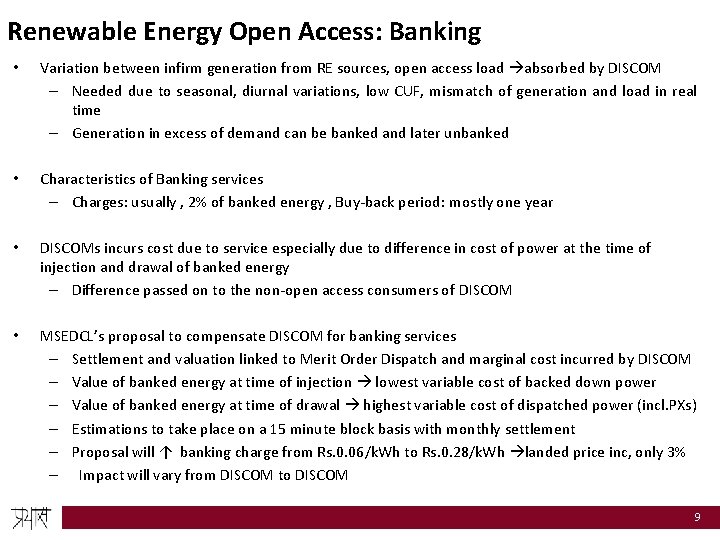
Renewable Energy Open Access: Banking • Variation between infirm generation from RE sources, open access load absorbed by DISCOM – Needed due to seasonal, diurnal variations, low CUF, mismatch of generation and load in real time – Generation in excess of demand can be banked and later unbanked • Characteristics of Banking services – Charges: usually , 2% of banked energy , Buy-back period: mostly one year • DISCOMs incurs cost due to service especially due to difference in cost of power at the time of injection and drawal of banked energy – Difference passed on to the non-open access consumers of DISCOM • MSEDCL’s proposal to compensate DISCOM for banking services – Settlement and valuation linked to Merit Order Dispatch and marginal cost incurred by DISCOM – Value of banked energy at time of injection lowest variable cost of backed down power – Value of banked energy at time of drawal highest variable cost of dispatched power (incl. PXs) – Estimations to take place on a 15 minute block basis with monthly settlement – Proposal will ↑ banking charge from Rs. 0. 06/k. Wh to Rs. 0. 28/k. Wh landed price inc, only 3% – Impact will vary from DISCOM to DISCOM 9
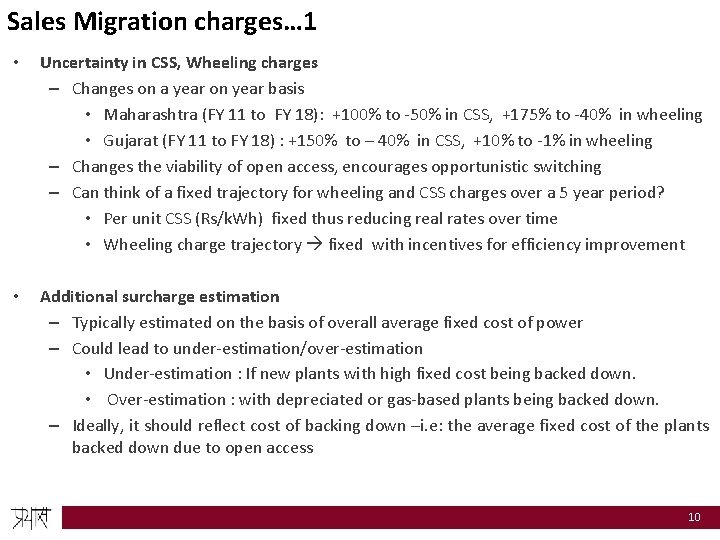
Sales Migration charges… 1 • Uncertainty in CSS, Wheeling charges – Changes on a year on year basis • Maharashtra (FY 11 to FY 18): +100% to -50% in CSS, +175% to -40% in wheeling • Gujarat (FY 11 to FY 18) : +150% to – 40% in CSS, +10% to -1% in wheeling – Changes the viability of open access, encourages opportunistic switching – Can think of a fixed trajectory for wheeling and CSS charges over a 5 year period? • Per unit CSS (Rs/k. Wh) fixed thus reducing real rates over time • Wheeling charge trajectory fixed with incentives for efficiency improvement • Additional surcharge estimation – Typically estimated on the basis of overall average fixed cost of power – Could lead to under-estimation/over-estimation • Under-estimation : If new plants with high fixed cost being backed down. • Over-estimation : with depreciated or gas-based plants being backed down. – Ideally, it should reflect cost of backing down –i. e: the average fixed cost of the plants backed down due to open access 10
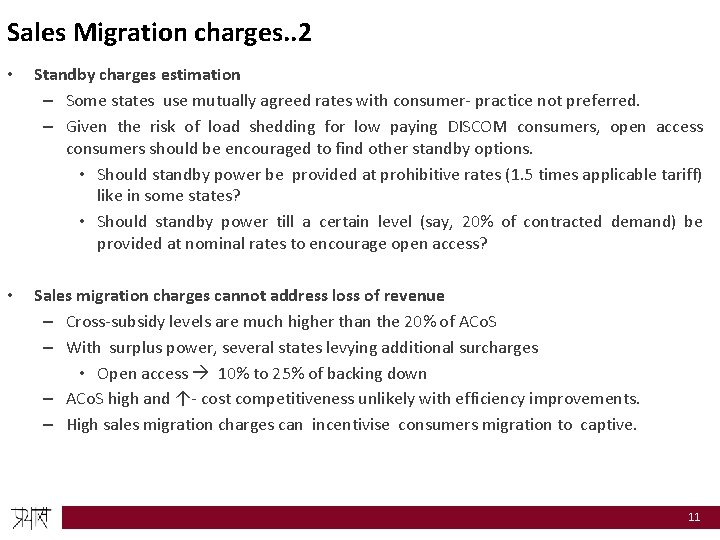
Sales Migration charges. . 2 • Standby charges estimation – Some states use mutually agreed rates with consumer- practice not preferred. – Given the risk of load shedding for low paying DISCOM consumers, open access consumers should be encouraged to find other standby options. • Should standby power be provided at prohibitive rates (1. 5 times applicable tariff) like in some states? • Should standby power till a certain level (say, 20% of contracted demand) be provided at nominal rates to encourage open access? • Sales migration charges cannot address loss of revenue – Cross-subsidy levels are much higher than the 20% of ACo. S – With surplus power, several states levying additional surcharges • Open access 10% to 25% of backing down – ACo. S high and ↑- cost competitiveness unlikely with efficiency improvements. – High sales migration charges can incentivise consumers migration to captive. 11
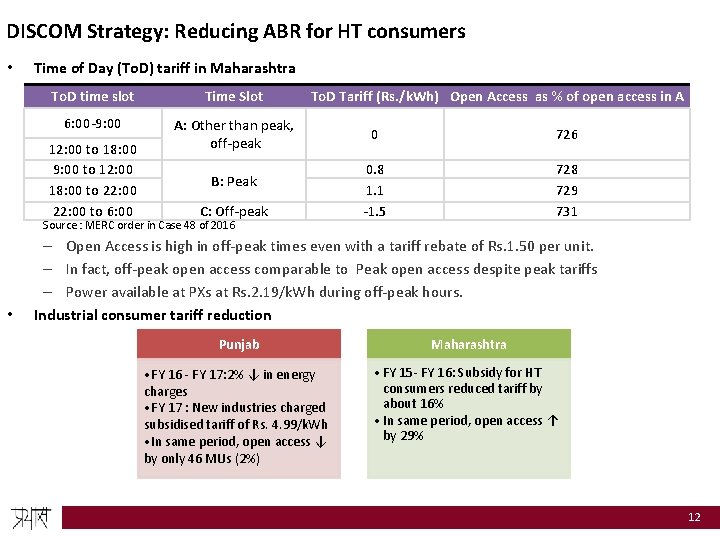
DISCOM Strategy: Reducing ABR for HT consumers • Time of Day (To. D) tariff in Maharashtra To. D time slot Time Slot 6: 00 -9: 00 A: Other than peak, off-peak 12: 00 to 18: 00 9: 00 to 12: 00 18: 00 to 22: 00 to 6: 00 To. D Tariff (Rs. /k. Wh) Open Access as % of open access in A B: Peak C: Off-peak Source : MERC order in Case 48 of 2016 • 0 726 0. 8 1. 1 -1. 5 728 729 731 – Open Access is high in off-peak times even with a tariff rebate of Rs. 1. 50 per unit. – In fact, off-peak open access comparable to Peak open access despite peak tariffs – Power available at PXs at Rs. 2. 19/k. Wh during off-peak hours. Industrial consumer tariff reduction Punjab Maharashtra • FY 16 - FY 17: 2% ↓ in energy charges • FY 17 : New industries charged subsidised tariff of Rs. 4. 99/k. Wh • In same period, open access ↓ by only 46 MUs (2%) • FY 15 - FY 16: Subsidy for HT consumers reduced tariff by about 16% • In same period, open access ↑ by 29% 12
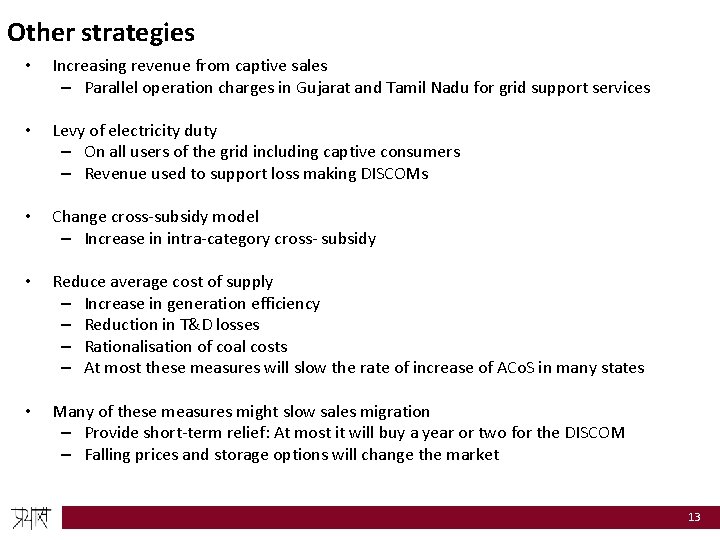
Other strategies • Increasing revenue from captive sales – Parallel operation charges in Gujarat and Tamil Nadu for grid support services • Levy of electricity duty – On all users of the grid including captive consumers – Revenue used to support loss making DISCOMs • Change cross-subsidy model – Increase in intra-category cross- subsidy • Reduce average cost of supply – Increase in generation efficiency – Reduction in T&D losses – Rationalisation of coal costs – At most these measures will slow the rate of increase of ACo. S in many states • Many of these measures might slow sales migration – Provide short-term relief: At most it will buy a year or two for the DISCOM – Falling prices and storage options will change the market 13
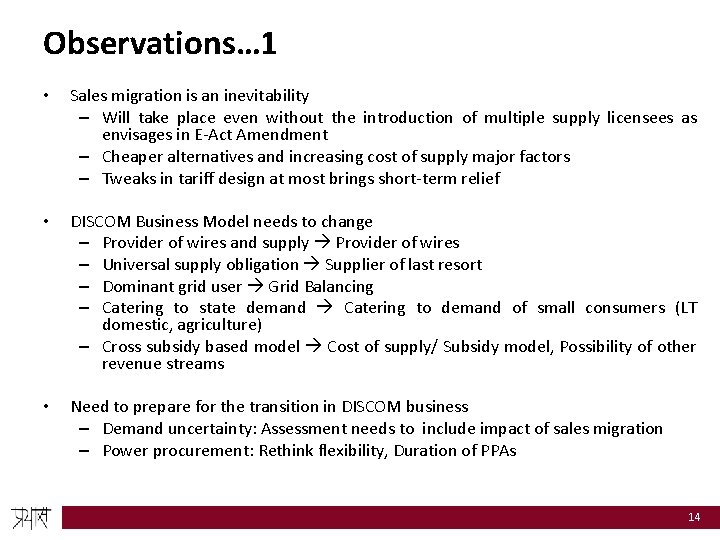
Observations… 1 • Sales migration is an inevitability – Will take place even without the introduction of multiple supply licensees as envisages in E-Act Amendment – Cheaper alternatives and increasing cost of supply major factors – Tweaks in tariff design at most brings short-term relief • DISCOM Business Model needs to change – Provider of wires and supply Provider of wires – Universal supply obligation Supplier of last resort – Dominant grid user Grid Balancing – Catering to state demand Catering to demand of small consumers (LT domestic, agriculture) – Cross subsidy based model Cost of supply/ Subsidy model, Possibility of other revenue streams • Need to prepare for the transition in DISCOM business – Demand uncertainty: Assessment needs to include impact of sales migration – Power procurement: Rethink flexibility, Duration of PPAs 14
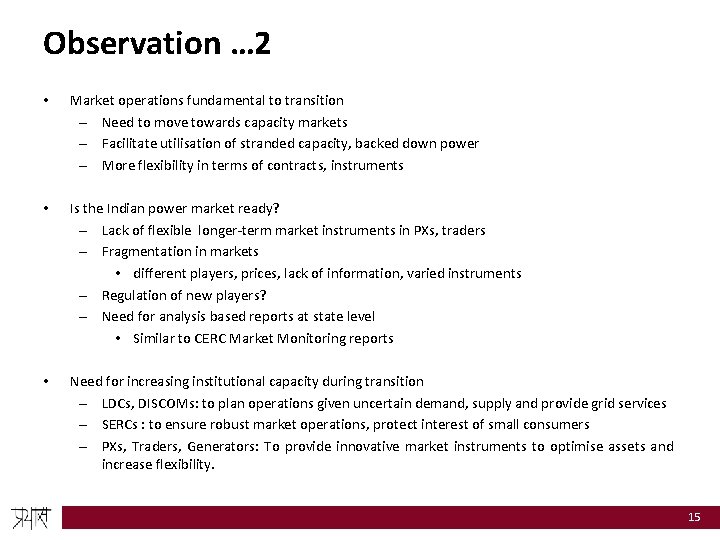
Observation … 2 • Market operations fundamental to transition – Need to move towards capacity markets – Facilitate utilisation of stranded capacity, backed down power – More flexibility in terms of contracts, instruments • Is the Indian power market ready? – Lack of flexible longer-term market instruments in PXs, traders – Fragmentation in markets • different players, prices, lack of information, varied instruments – Regulation of new players? – Need for analysis based reports at state level • Similar to CERC Market Monitoring reports • Need for increasing institutional capacity during transition – LDCs, DISCOMs: to plan operations given uncertain demand, supply and provide grid services – SERCs : to ensure robust market operations, protect interest of small consumers – PXs, Traders, Generators: To provide innovative market instruments to optimise assets and increase flexibility. 15
Thank you ann@prayaspune. org shantanu@prayaspune. org 16