
RET Rules One of the following rules applies

- Slides: 15
RET Rules • One of the following rules applies when counting RETs: – Count a RET for each optional or mandatory subgroup of the ILF or EIF Or – If there are no subgroups, count the ILF or EIF as one RET.
Recap
Software Engineering II Lecture 11 Fakhar Lodhi
Transactional Functions • External Inputs – An external input (EI) is an elementary process that processes data or control information that comes from outside the application boundary. The primary intent of an EI is to maintain one or more ILFs and/or to alter the behavior of the system.
Transactional Functions • External Outputs – An external output (EO) is an elementary process that sends data or control information outside the application boundary. The primary intent of an external output is to present information to a user through processing logic other than, or in addition to, the retrieval of data or control information. The processing logic must contain at least one mathematical formula or calculation, or create derived data. An external output may also maintain one or more ILFs and/or alter the behavior of the system.
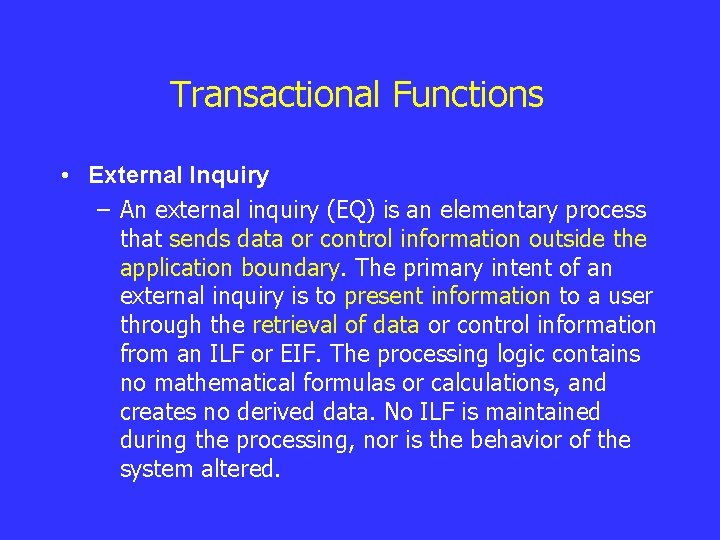
Transactional Functions • External Inquiry – An external inquiry (EQ) is an elementary process that sends data or control information outside the application boundary. The primary intent of an external inquiry is to present information to a user through the retrieval of data or control information from an ILF or EIF. The processing logic contains no mathematical formulas or calculations, and creates no derived data. No ILF is maintained during the processing, nor is the behavior of the system altered.
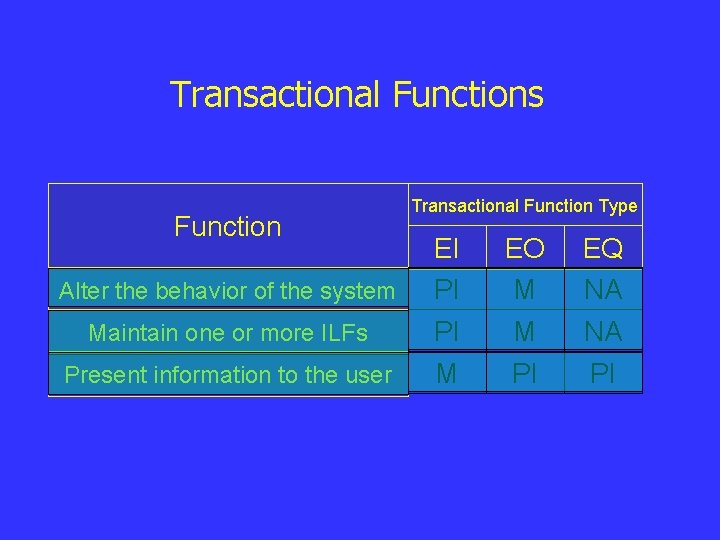
Transactional Functions Function Alter the behavior of the system Maintain one or more ILFs Present information to the user Transactional Function Type EI PI PI M EO M M PI EQ NA NA PI
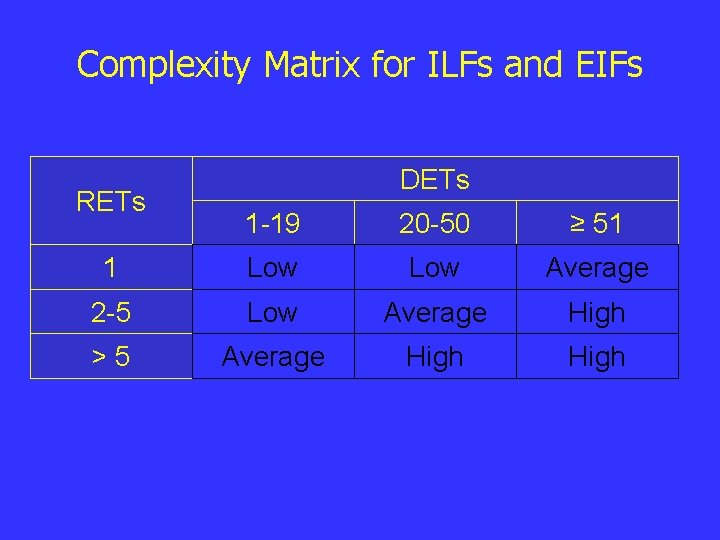
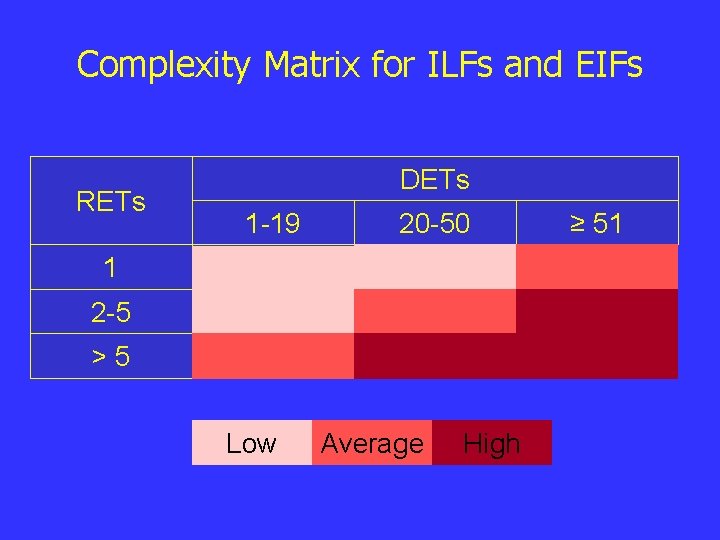
Complexity Matrix for ILFs and EIFs RETs DETs 1 -19 20 -50 ≥ 51 1 Low Average 2 -5 Low Average High >5 Average High
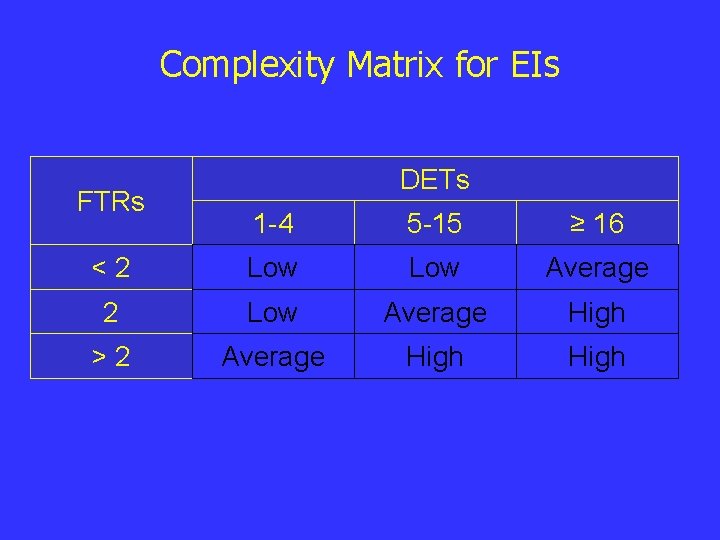
Complexity Matrix for EIs FTRs DETs 1 -4 5 -15 ≥ 16 <2 Low Average High >2 Average High
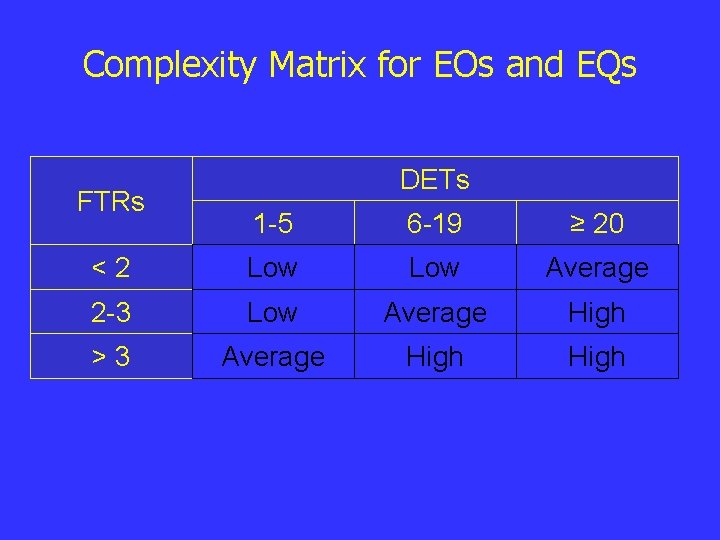
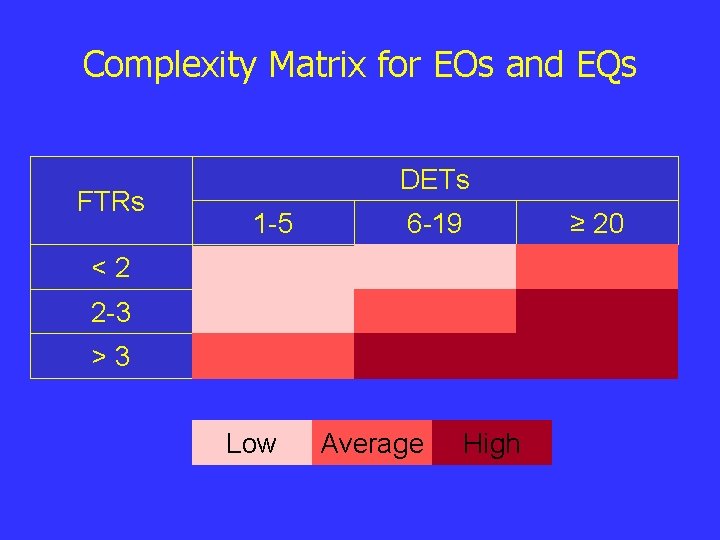
Complexity Matrix for EOs and EQs FTRs DETs 1 -5 6 -19 ≥ 20 <2 Low Average 2 -3 Low Average High >3 Average High
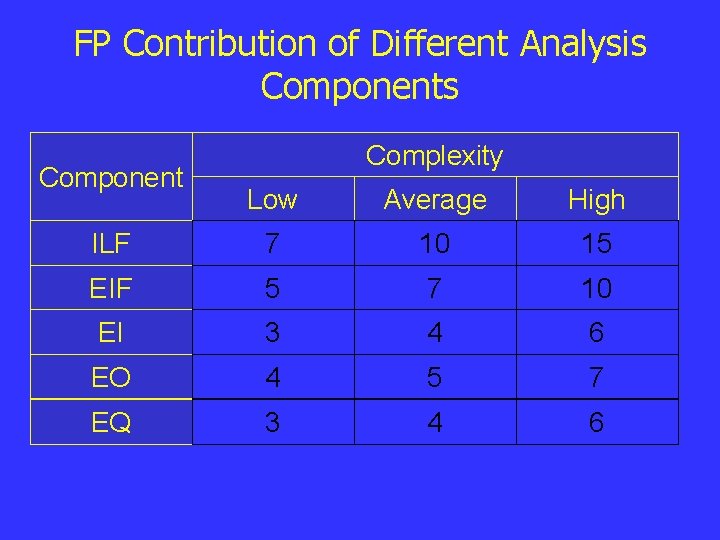
FP Contribution of Different Analysis Component Complexity Low Average High ILF 7 10 15 EIF 5 7 10 EI 3 4 6 EO 4 5 7 EQ 3 4 6
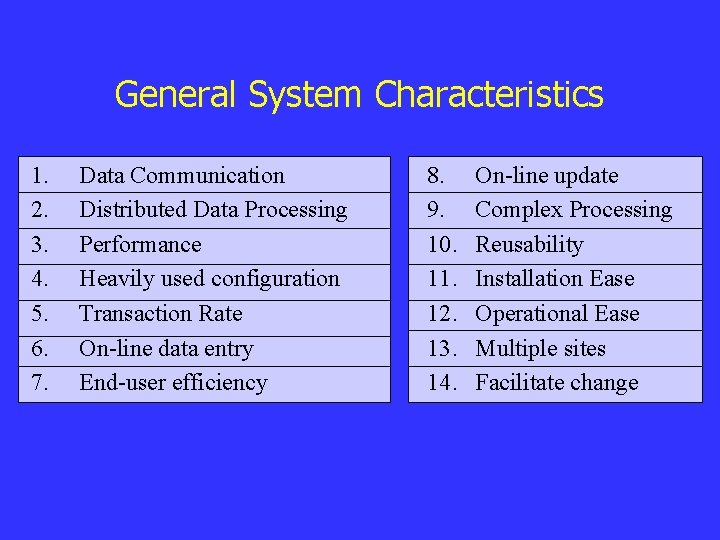
General System Characteristics 1. 2. 3. 4. 5. 6. 7. Data Communication Distributed Data Processing Performance Heavily used configuration Transaction Rate On-line data entry End-user efficiency 8. 9. 10. 11. 12. 13. 14. On-line update Complex Processing Reusability Installation Ease Operational Ease Multiple sites Facilitate change
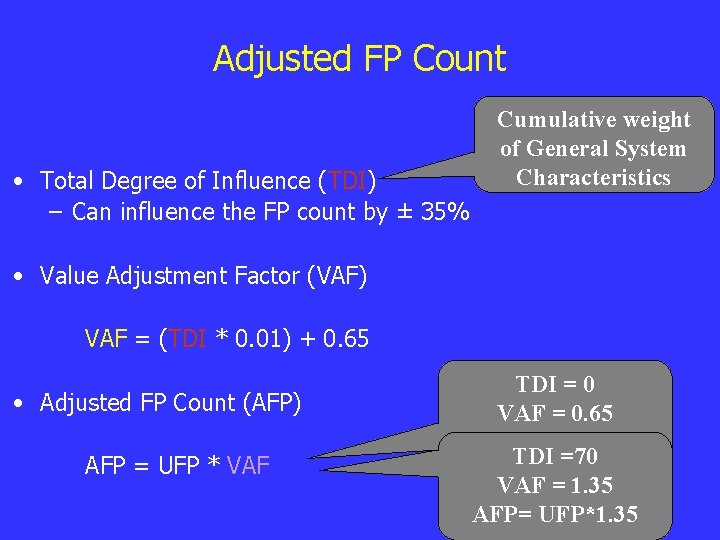
Adjusted FP Count • Total Degree of Influence (TDI) – Can influence the FP count by ± 35% Cumulative weight of General System Characteristics • Value Adjustment Factor (VAF) VAF = (TDI * 0. 01) + 0. 65 • Adjusted FP Count (AFP) AFP = UFP * VAF TDI = 0 VAF = 0. 65 AFP= UFP*0. 65 TDI =70 VAF = 1. 35 AFP= UFP*1. 35
Complexity Matrix for ILFs and EIFs RETs DETs 1 -19 20 -50 1 2 -5 >5 Low Average High ≥ 51
Complexity Matrix for EOs and EQs FTRs DETs 1 -5 6 -19 ≥ 20 <2 2 -3 >3 Low Average High