
Resuscitation 200607 Prepared by Dr Natalie Hood National
Resuscitation 2006/07 Prepared by Dr Natalie Hood National Lifesaving Medical Advisor and Surf Life Saving Australia Revived by Darth. Saver © Surf Life Saving Australia – Version 1 Resuscitation Changes 2006/07 5. 1
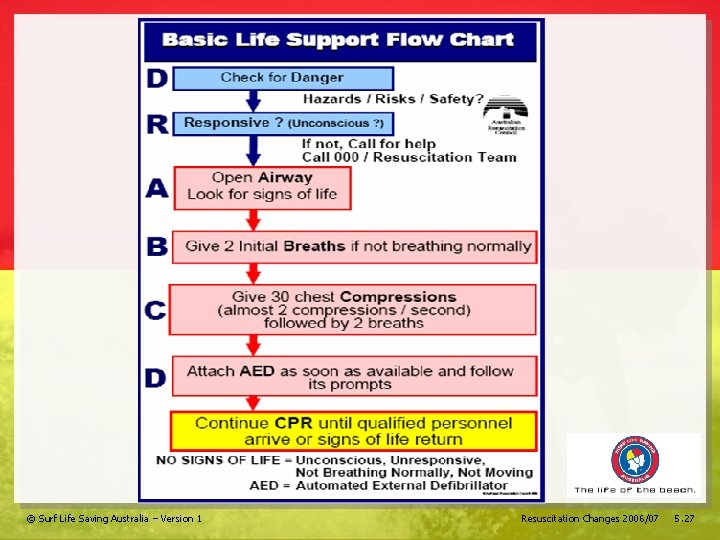
SUMMARY • No E. A. R. • No Pulse Checks • 30 Compressions : 2 Breaths • Rate 100 per minute • Same for 1 and 2 person • Early DEFIB © Surf Life Saving Australia – Version 1 Resuscitation Changes 2006/07 5. 2
History of Resuscitation The first apparent attempt 800 BC. The first resuscitation was Elijah's mouth to mouth (Bible, 2 Kings, iv, 34. ). ". . . And he went up, and lay upon the child, and put his mouth upon his mouth, and his hands upon his hands; and he stretched himself upon the child; and the flesh of the child waxed warm. " © Surf Life Saving Australia – Version 1 Resuscitation Changes 2006/07 5. 3
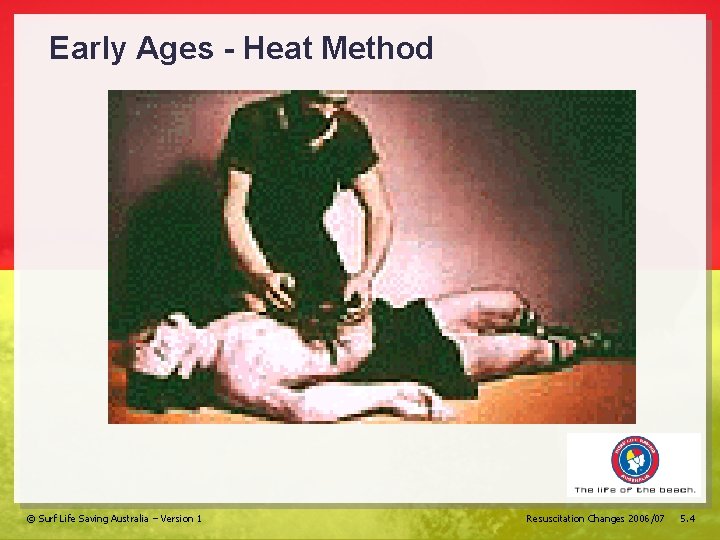
Early Ages - Heat Method © Surf Life Saving Australia – Version 1 Resuscitation Changes 2006/07 5. 4
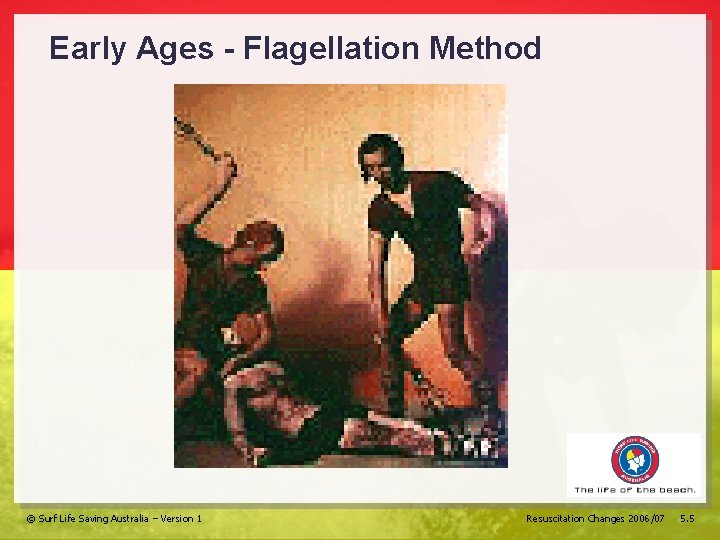
Early Ages - Flagellation Method © Surf Life Saving Australia – Version 1 Resuscitation Changes 2006/07 5. 5

1530 - Bellows Method © Surf Life Saving Australia – Version 1 Resuscitation Changes 2006/07 5. 6
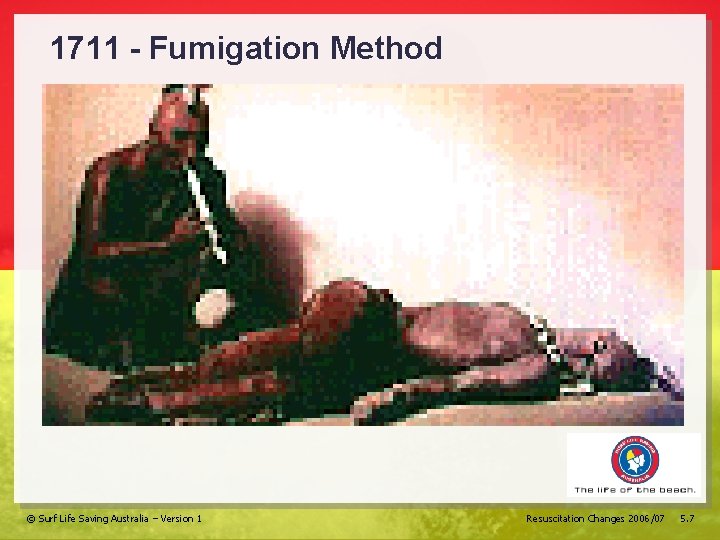
1711 - Fumigation Method © Surf Life Saving Australia – Version 1 Resuscitation Changes 2006/07 5. 7
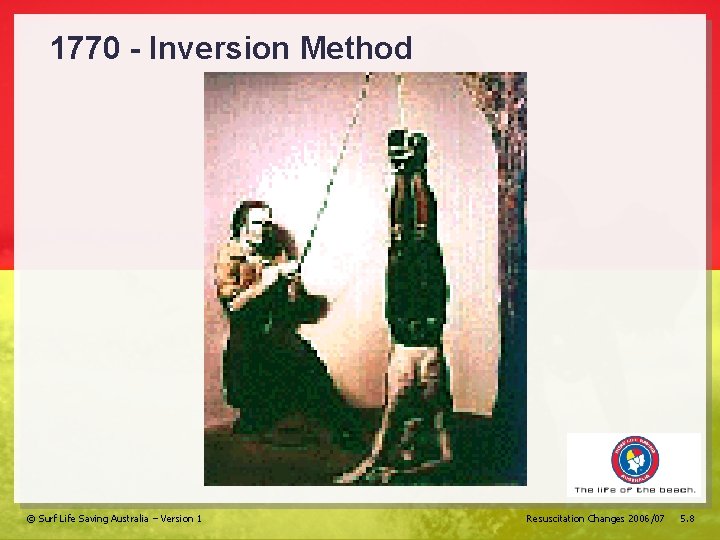
1770 - Inversion Method © Surf Life Saving Australia – Version 1 Resuscitation Changes 2006/07 5. 8
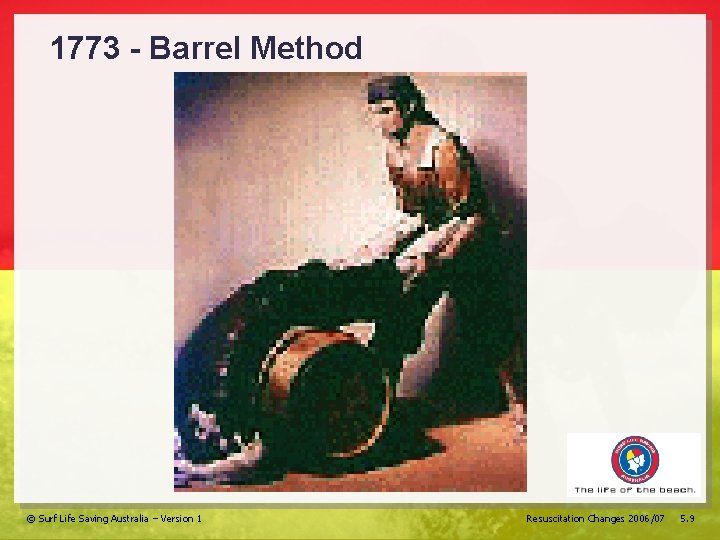
1773 - Barrel Method © Surf Life Saving Australia – Version 1 Resuscitation Changes 2006/07 5. 9
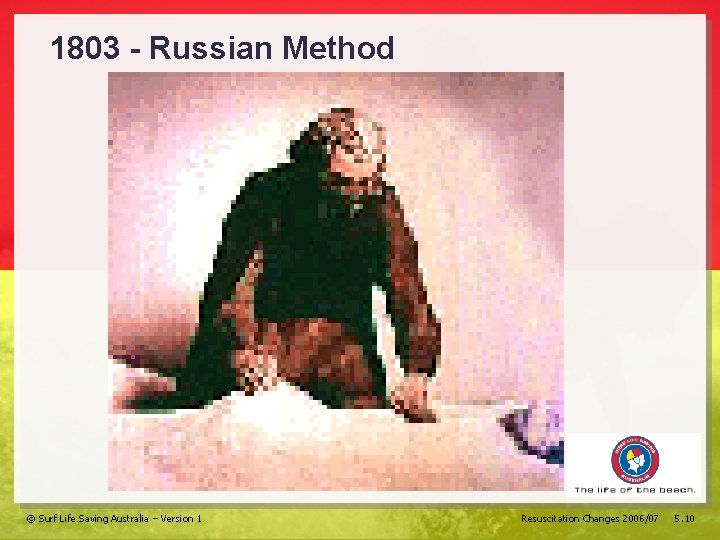
1803 - Russian Method © Surf Life Saving Australia – Version 1 Resuscitation Changes 2006/07 5. 10
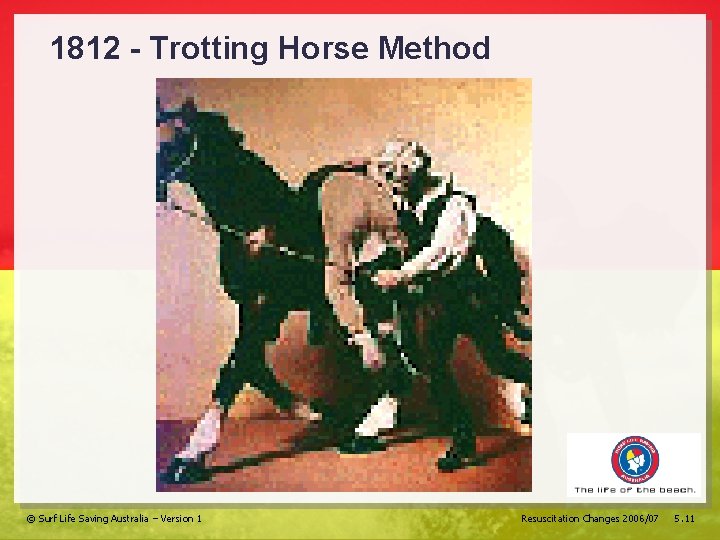
1812 - Trotting Horse Method © Surf Life Saving Australia – Version 1 Resuscitation Changes 2006/07 5. 11
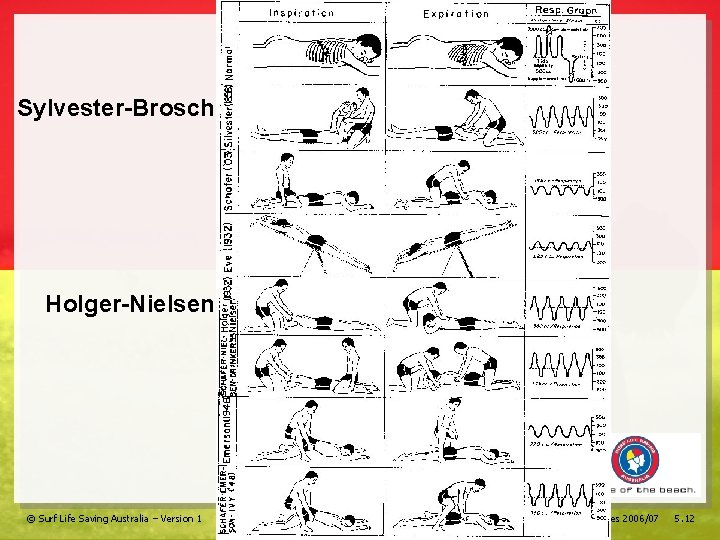
Sylvester-Brosch Holger-Nielsen © Surf Life Saving Australia – Version 1 Resuscitation Changes 2006/07 5. 12
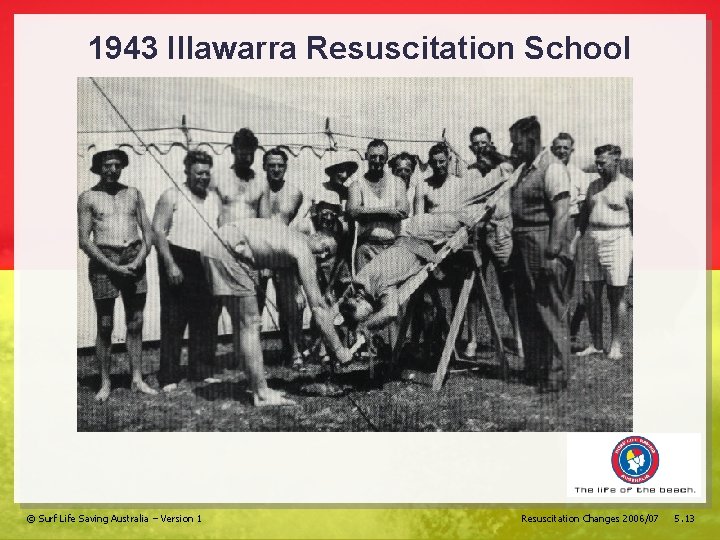
1943 Illawarra Resuscitation School © Surf Life Saving Australia – Version 1 Resuscitation Changes 2006/07 5. 13
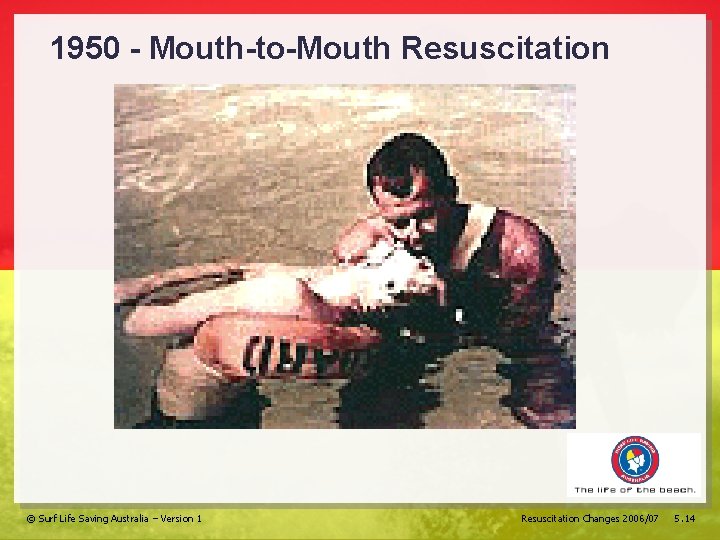
1950 - Mouth-to-Mouth Resuscitation © Surf Life Saving Australia – Version 1 Resuscitation Changes 2006/07 5. 14
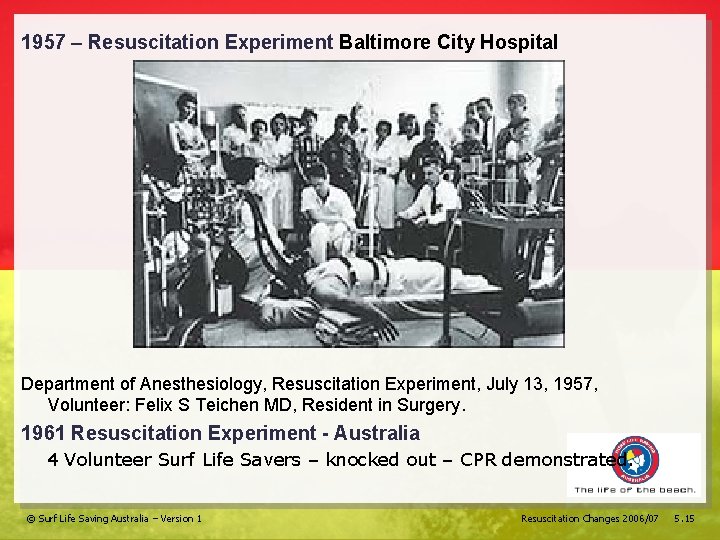
1957 – Resuscitation Experiment Baltimore City Hospital Department of Anesthesiology, Resuscitation Experiment, July 13, 1957, Volunteer: Felix S Teichen MD, Resident in Surgery. 1961 Resuscitation Experiment - Australia 4 Volunteer Surf Life Savers – knocked out – CPR demonstrated. © Surf Life Saving Australia – Version 1 Resuscitation Changes 2006/07 5. 15
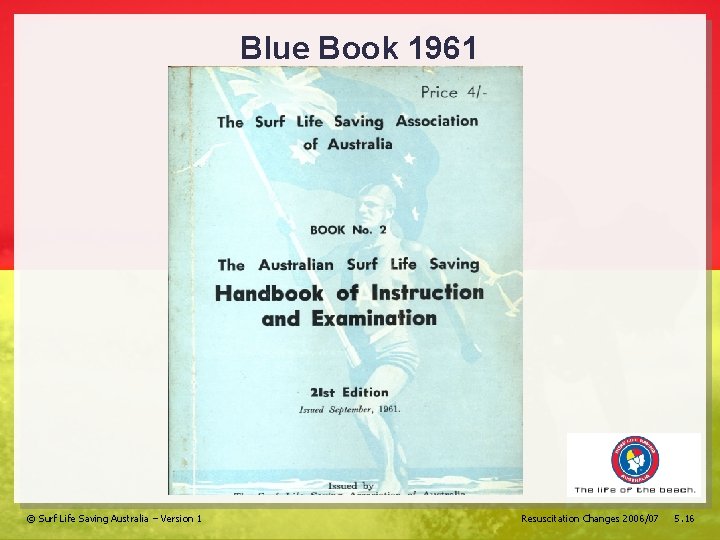
Blue Book 1961 © Surf Life Saving Australia – Version 1 Resuscitation Changes 2006/07 5. 16
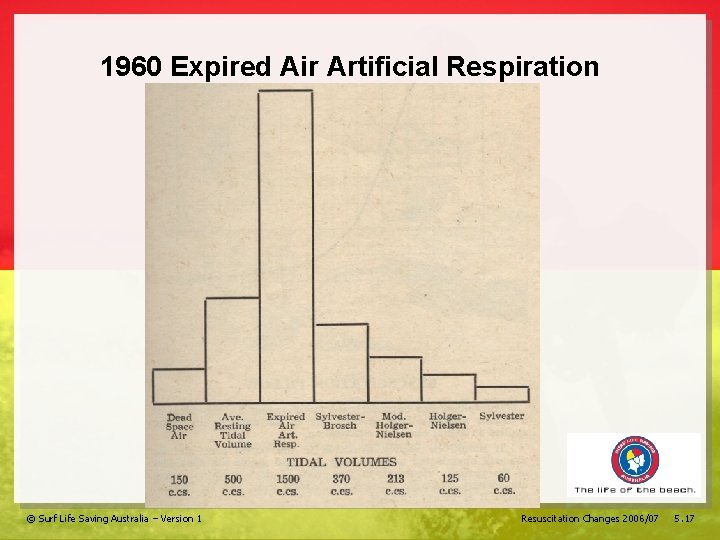
1960 Expired Air Artificial Respiration © Surf Life Saving Australia – Version 1 Resuscitation Changes 2006/07 5. 17
International Consensus • International Liaison Committee on Resuscitation releasing guidelines every five years • Release of new resuscitation guidelines November 2005. Not due for any further review until 2010 © Surf Life Saving Australia – Version 1 Resuscitation Changes 2006/07 5. 18
Australian Resuscitation Council • National body of representatives from medical, first responder and major training organizations • Surf Life Saving Australia and Royal Life Saving Australia each individually represented on the ARC © Surf Life Saving Australia – Version 1 Resuscitation Changes 2006/07 5. 19
Goals of Guideline Development • <10% victims of sudden cardiac arrest victims receive CPR • Simplify guidelines to aid teaching • Reduce confusion to improve retention of knowledge • Aim to increase the number of cardiac or respiratory arrest victims receiving bystander CPR © Surf Life Saving Australia – Version 1 Resuscitation Changes 2006/07 5. 20
SLSA in the Picture • SLSA the peak body in aquatic rescue • SLSA in the forefront of education and training • Need to balance maintenance of niche role in the aquatic environment versus issues of Australia wide, cross organisational consistency © Surf Life Saving Australia – Version 1 Resuscitation Changes 2006/07 5. 21
SLSA in the Picture • Adoption of new guidelines necessary to align with other national and international first responder and training organisations • Credibility of SLSA open to criticism if not seen to be adopting and promoting the ARC guidelines • Current guidelines are evidence based and form the best thinking based on research © Surf Life Saving Australia – Version 1 Resuscitation Changes 2006/07 5. 22
Rational to New Algorithms Current practices • Evidence shows patients receive oversupply of ventilation, more so with the increase of rate of delivery of each cycle • Have differing rates and ratios for 1 and 2 person for adults and children © Surf Life Saving Australia – Version 1 Resuscitation Changes 2006/07 5. 23
Rational to New Algorithms New guidelines for CPR • Emphasize importance of chest compressions with minimal “hands off” time. • 2 initial rescue breaths provide adequate oxygenation and allow rescuers to quickly move to chest compression • Emphasis on hand placement “in centre of chest” • Less importance in precise measurements, walking up ribs or xiphoid finding etc © Surf Life Saving Australia – Version 1 Resuscitation Changes 2006/07 5. 24
Rational to New Algorithms Deletion of pulse checks and recovery checks: • Lay rescuers, first responders and even health care providers only dealing infrequently with arrested patients are unreliable in detecting presence or absence of pulse • Frequent recovery checks are associated with a worse outcome for the patient • CPR now continues until professional help arrives or patient has obvious signs of life © Surf Life Saving Australia – Version 1 Resuscitation Changes 2006/07 5. 25
Two Person Assessment • Airway responder checks airway and breathing with patient on side • Roll back and give 2 rescue breaths if not breathing • ECC responder checks for “signs of life” • If “signs of life” (normal breathing, coughing, moving, conscious) put in recovery position • If no “signs of life” start CPR until “signs of life” noted or ambulance arrives. © Surf Life Saving Australia – Version 1 Resuscitation Changes 2006/07 5. 26
© Surf Life Saving Australia – Version 1 Resuscitation Changes 2006/07 5. 27
Defibrillation in combination with early CPR • Defibrillation taught in most first aid courses • Proficiency in defibrillation included in the Australian definition of First Responder • Further future emphasis likely on teaching and availability of defibrillation • Club SAED’s will need reprogramming in line with new guidelines. SLSA liaising with manufactures © Surf Life Saving Australia – Version 1 Resuscitation Changes 2006/07 5. 28
Training Issues • Chest compressions will need to be interrupted for a short period to deliver rescue breaths • Emphasize the importance of quickly starting CPR if needed and minimizing the time with “hands off” the chest • Technique deteriorates after 1 min yet awareness of fatigue delayed so rotate frequently, at least every 2 minutes (~5 cycles) • Emphasize early placement of defibrillator on patient when available © Surf Life Saving Australia – Version 1 Resuscitation Changes 2006/07 5. 29
THANK YOU © Surf Life Saving Australia – Version 1 Resuscitation Changes 2006/07 5. 30
- Slides: 30