
Results Introduction Figure 3 Mercury analysis involved using
- Slides: 1
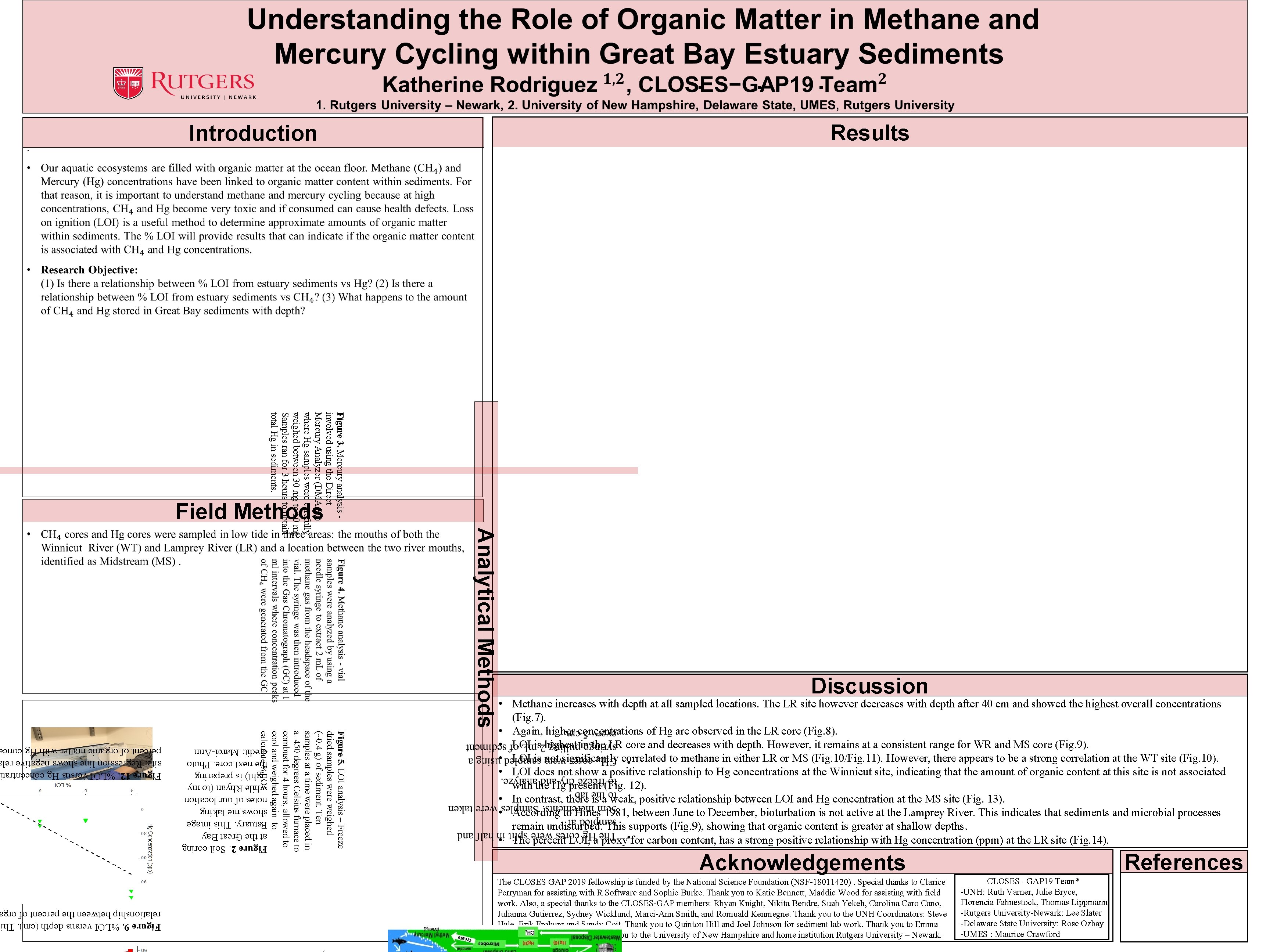
Results Introduction Figure 3. Mercury analysis involved using the Direct Mercury Analyzer (DMA 80) where Hg samples were carefully weighed between 30 mg to 50 mg. Samples ran for 3 hours to obtain total Hg in sediments. Field Methods Analytical Methods Discussion Figure 5. LOI analysis – Freeze dried samples were weighed (~0. 4 g) of sediment. Ten samples at a time were placed in a 450 degrees Celsius furnace to combust for 4 hours, allowed to cool and weighed again to calculate %LOI. • Methane increases with depth at all sampled locations. The LR site however decreases with depth after 40 cm and showed the highest overall concentrations (Fig. 7). • Again, higher concentrations of Hg are observed in the LR core (Fig. 8). • LOI is highest in the LR core and decreases with depth. However, it remains at a consistent range for WR and MS core (Fig. 9). • LOI is not significantly correlated to methane in either LR or MS (Fig. 10/Fig. 11). However, there appears to be a strong correlation at the WT site (Fig. 10). • LOI does not show a positive relationship to Hg concentrations at the Winnicut site, indicating that the amount of organic content at this site is not associated with the Hg present (Fig. 12). • In contrast, there is a weak, positive relationship between LOI and Hg concentration at the MS site (Fig. 13). • According to Hines 1981, between June to December, bioturbation is not active at the Lamprey River. This indicates that sediments and microbial processes remain undisturbed. This supports (Fig. 9), showing that organic content is greater at shallow depths. • The percent LOI, a proxy for carbon content, has a strong positive relationship with Hg concentration (ppm) at the LR site (Fig. 14). References Acknowledgements The CLOSES GAP 2019 fellowship is funded by the National Science Foundation (NSF-18011420). Special thanks to Clarice Perryman for assisting with R Software and Sophie Burke. Thank you to Katie Bennett, Maddie Wood for assisting with field work. Also, a special thanks to the CLOSES-GAP members: Rhyan Knight, Nikita Bendre, Suah Yekeh, Carolina Caro Cano, Julianna Gutierrez, Sydney Wicklund, Marci-Ann Smith, and Romuald Kenmegne. Thank you to the UNH Coordinators: Steve Hale, Erik Froburg and Sandy Coit. Thank you to Quinton Hill and Joel Johnson for sediment lab work. Thank you to Emma Burkett for QGIS images. Thank you to the University of New Hampshire and home institution Rutgers University – Newark. CLOSES –GAP 19 Team* -UNH: Ruth Varner, Julie Bryce, Florencia Fahnestock, Thomas Lippmann -Rutgers University-Newark: Lee Slater -Delaware State University: Rose Ozbay -UMES : Maurice Crawford Figure 2. Soil coring at the Great Bay Estuary. This image shows me taking notes of our location while Rhyan (to my right) is preparing the next core. Photo credit: Marci-Ann Figure 12. %LOI versus Hg concentrat site. Regression line shows negative rel percent of organic matter with Hg conc Figure 9. %LOI versus depth (cm). Thi relationship between the percent of org