
Results from TOBAs Cross correlation analysis to search
Results from TOBAs Cross correlation analysis to search for a Stochastic Gravitational Wave Background University of Tokyo Ayaka Shoda M. Ando, K. Okada, K. Ishidoshiro, W. Kokuyama, Y. Aso, K. Tsubono
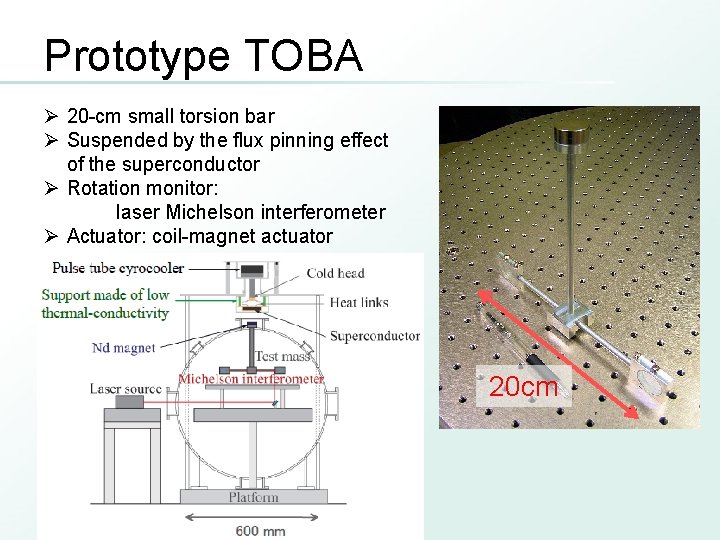
Prototype TOBA Ø 20 -cm small torsion bar Ø Suspended by the flux pinning effect of the superconductor Ø Rotation monitor: laser Michelson interferometer Ø Actuator: coil-magnet actuator 20 cm
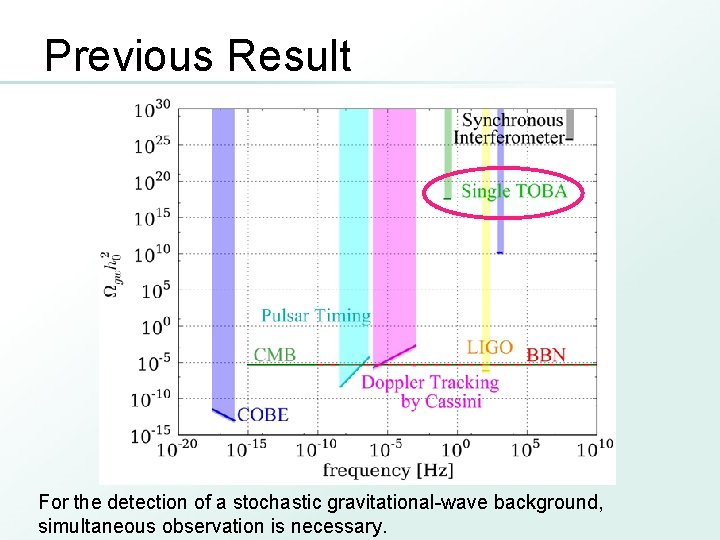
Previous Result For the detection of a stochastic gravitational-wave background, simultaneous observation is necessary.
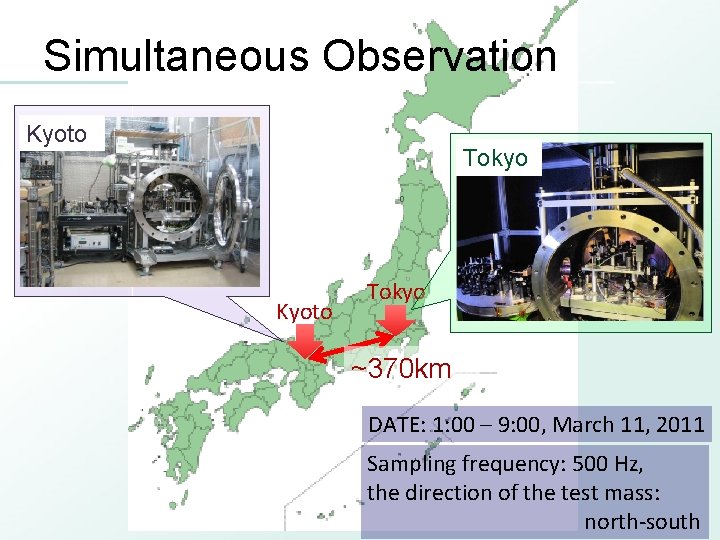
Simultaneous Observation Kyoto Tokyo ~370 km DATE: 1: 00 – 9: 00, March 11, 2011 Sampling frequency: 500 Hz, the direction of the test mass: north-south
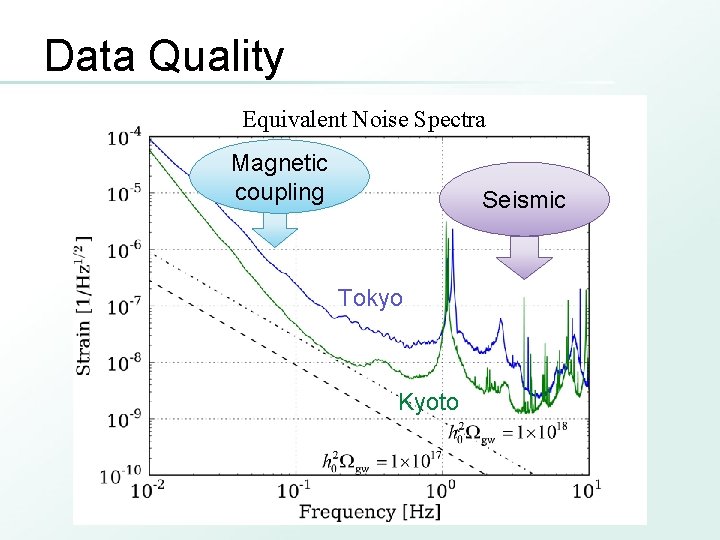
Data Quality Equivalent Noise Spectra Magnetic coupling Seismic Tokyo Kyoto
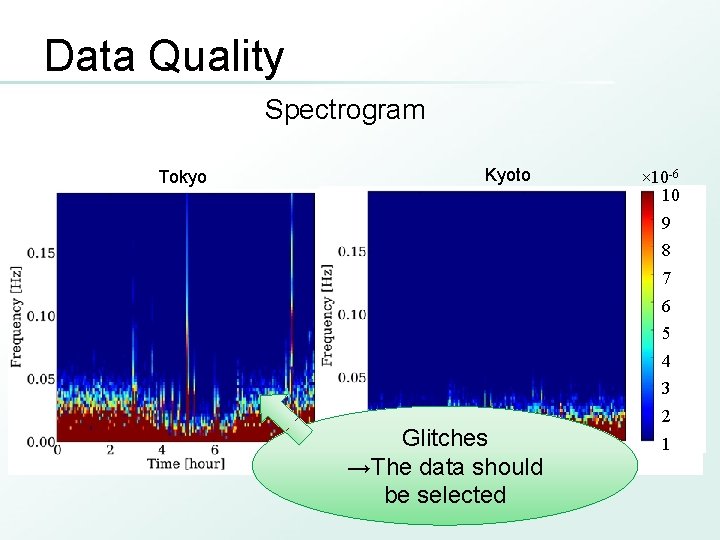
Data Quality Spectrogram Tokyo Kyoto × 10 -6 10 9 8 7 6 5 4 3 Glitches →The data should be selected 2 1
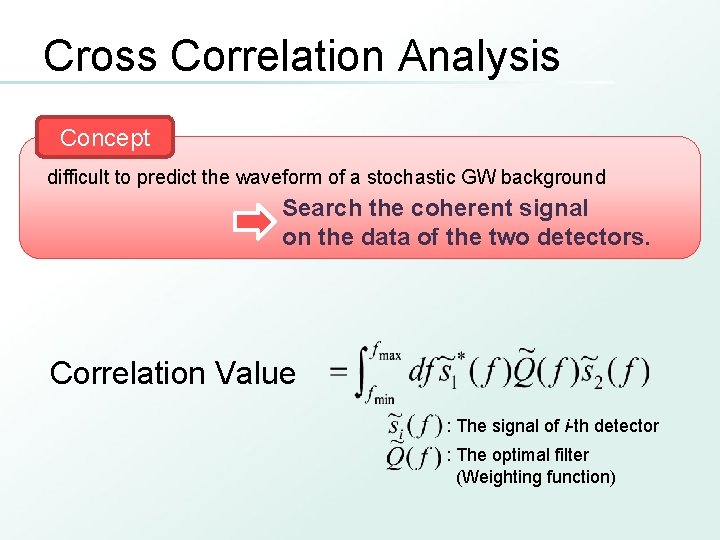
Cross Correlation Analysis Concept difficult to predict the waveform of a stochastic GW background Search the coherent signal on the data of the two detectors. Correlation Value : The signal of i-th detector : The optimal filter (Weighting function)
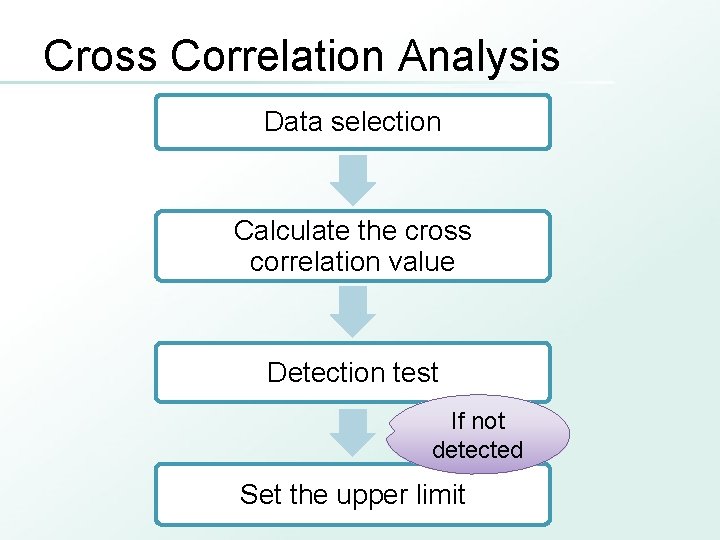
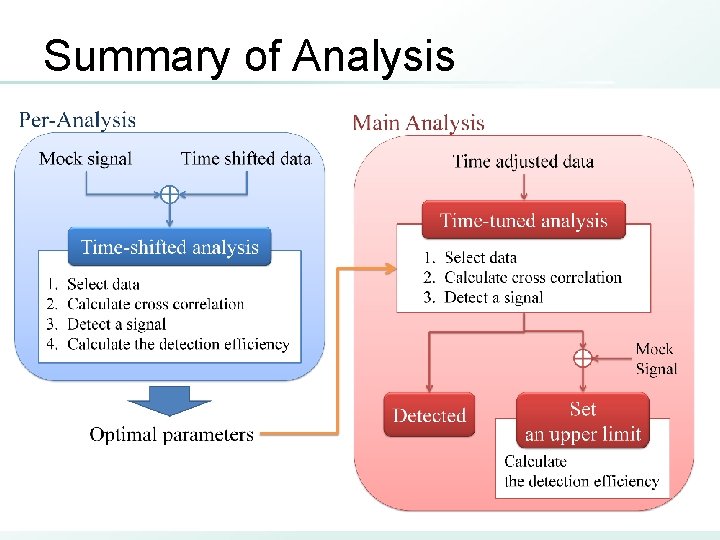
Cross Correlation Analysis Data selection Calculate the cross correlation value Detection test If not detected Set the upper limit
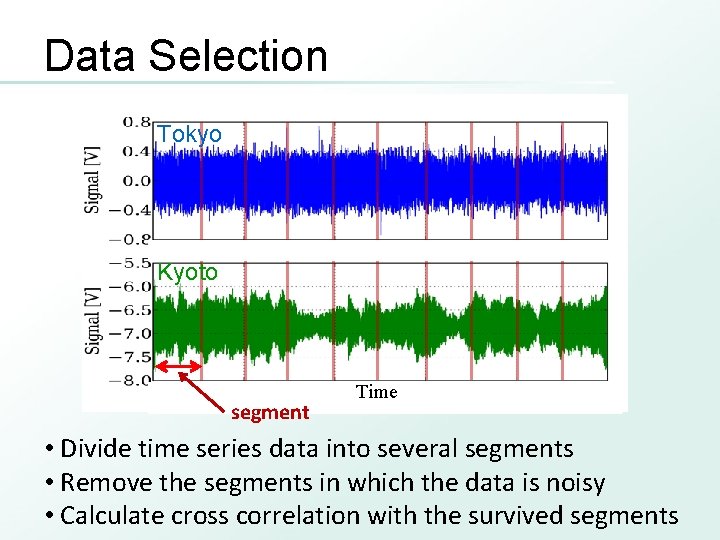
Data Selection Tokyo Kyoto segment Time • Divide time series data into several segments • Remove the segments in which the data is noisy • Calculate cross correlation with the survived segments
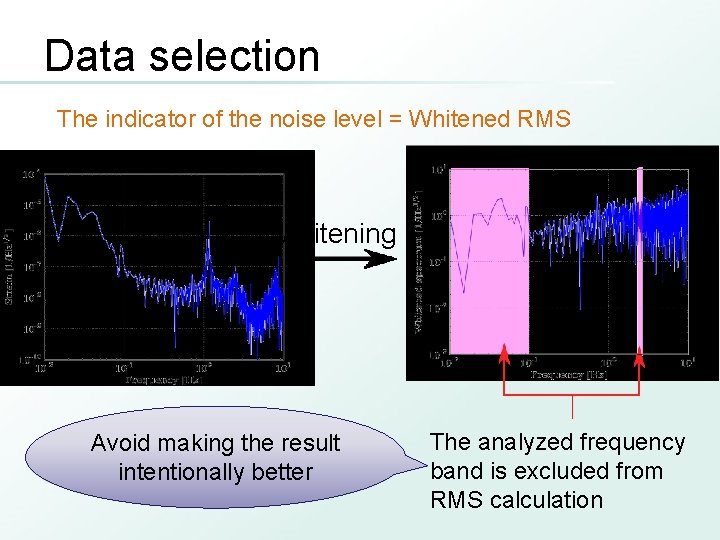
Data selection The indicator of the noise level = Whitened RMS whitening Avoid making the result intentionally better The analyzed frequency band is excluded from RMS calculation
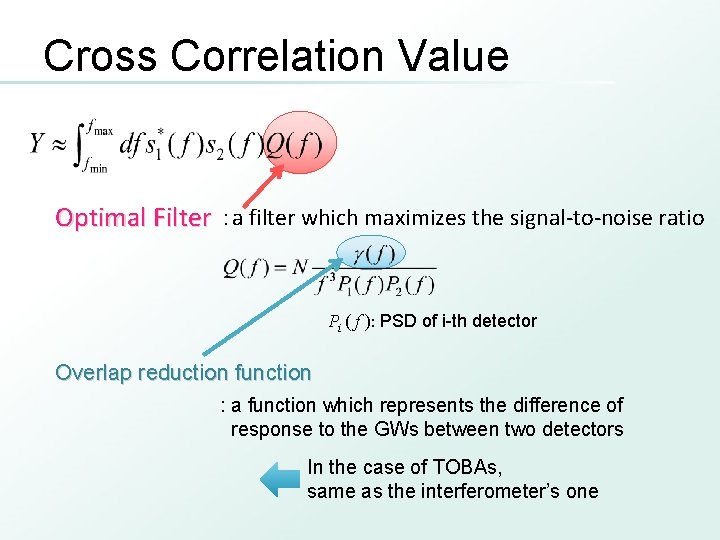
Cross Correlation Value Optimal Filter :a filter which maximizes the signal-to-noise ratio Pi ( f ): PSD of i-th detector Overlap reduction function : a function which represents the difference of response to the GWs between two detectors In the case of TOBAs, same as the interferometer’s one
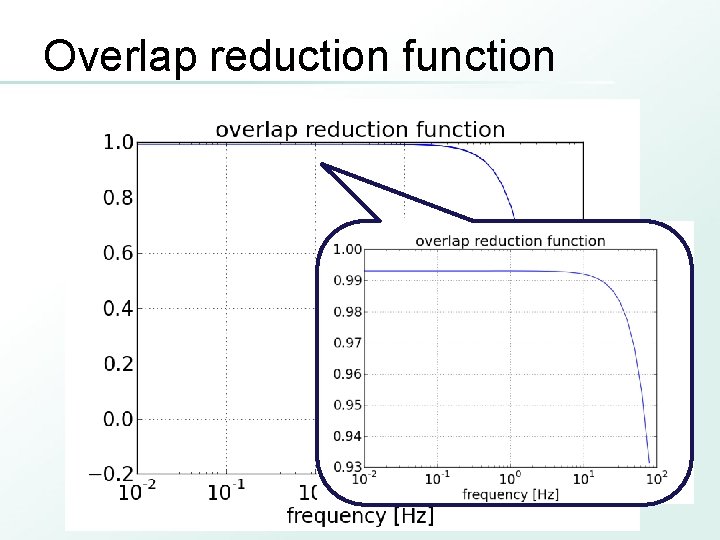
Overlap reduction function
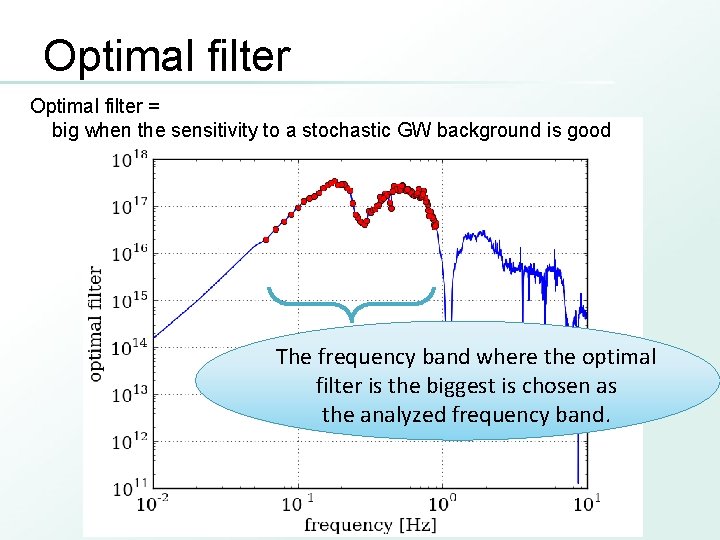
Optimal filter = big when the sensitivity to a stochastic GW background is good The frequency band where the optimal filter is the biggest is chosen as the analyzed frequency band.
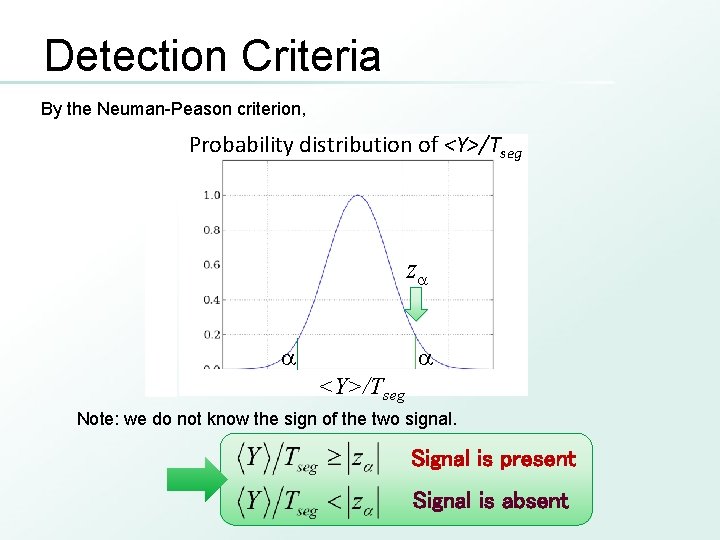
Detection Criteria By the Neuman-Peason criterion, Probability distribution of <Y>/Tseg za a a <Y>/Tseg Note: we do not know the sign of the two signal. Signal is present Signal is absent
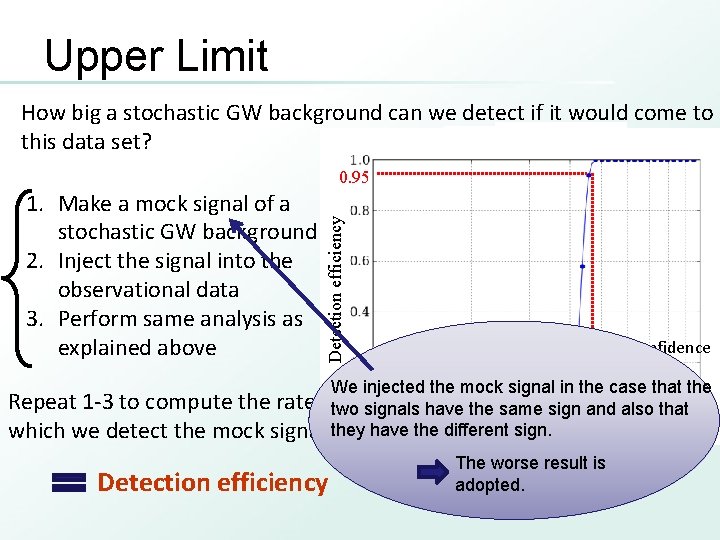
Upper Limit How big a stochastic GW background can we detect if it would come to Mock signal this data set? Receiver operating characteristic 1. Make a mock signal of a stochastic GW background 2. Inject the signal into the observational data 3. Perform same analysis as explained above Detection efficiency 0. 95 95% confidence upper limit We injected the mock signal in the case that the Repeat 1 -3 to compute the rate attwo signals have the same sign and also that different signals which we detect the mock signal. they have The the amplitude of injected Detection efficiency The worse result is adopted.
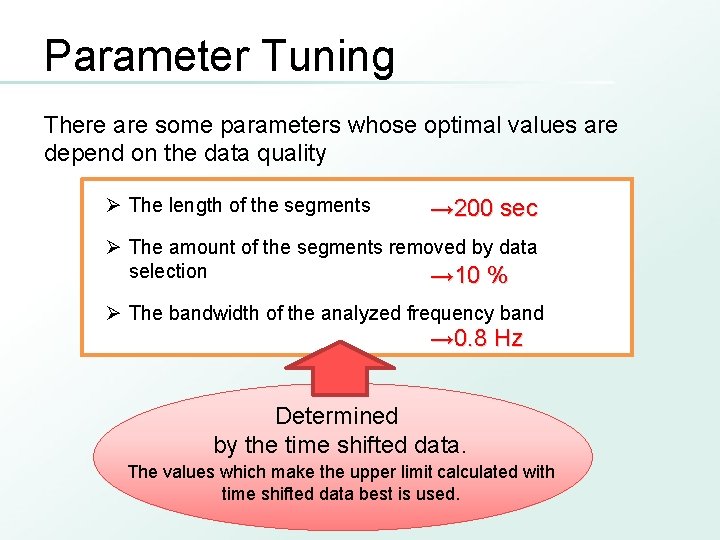
Parameter Tuning There are some parameters whose optimal values are depend on the data quality Ø The length of the segments → 200 sec Ø The amount of the segments removed by data selection → 10 % Ø The bandwidth of the analyzed frequency band → 0. 8 Hz Determined by the time shifted data. The values which make the upper limit calculated with time shifted data best is used.
Summary of Analysis
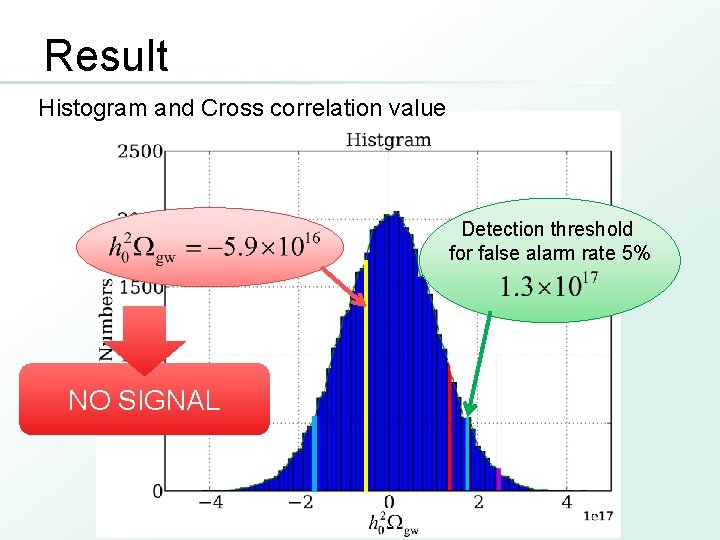
Result Histogram and Cross correlation value Detection threshold for false alarm rate 5% NO SIGNAL
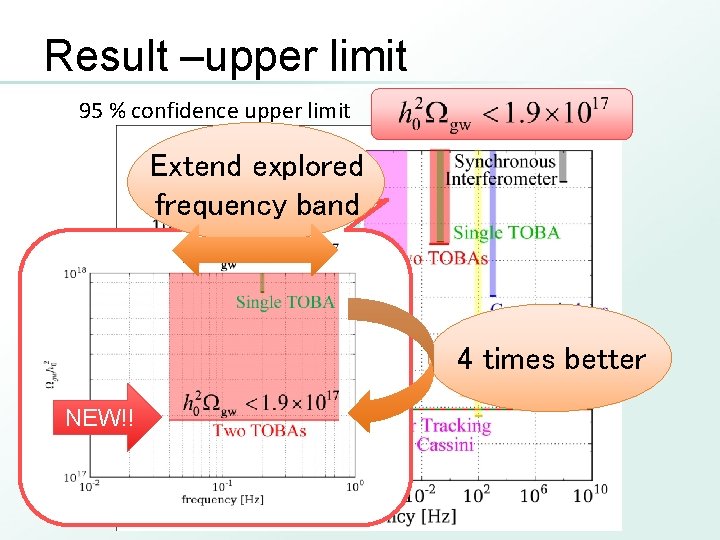
Result –upper limit 95 % confidence upper limit Extend explored frequency band 4 times better NEW!!
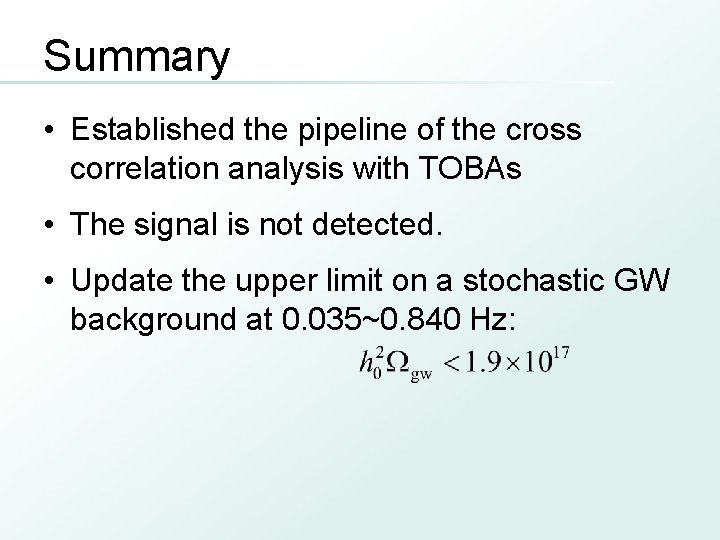
Summary • Established the pipeline of the cross correlation analysis with TOBAs • The signal is not detected. • Update the upper limit on a stochastic GW background at 0. 035~0. 840 Hz:
- Slides: 20