
Results from LIGO Observations Stephen Fairhurst University of
Results from LIGO Observations Stephen Fairhurst University of Wisconsin - Milwaukee on behalf of the LIGO Scientific Collaboration LIGO-G 060363 -00 -
Introduction ● Overview of LIGO searches for gravitational wave transients, – ● Signals lasting from a few ms to a few minutes. Broadly split into two categories: – Well modelled sources ● – Unmodelled sources ● ● Binary inspiral, black hole ringdown, cosmic string cusps BH merger, core-collapse supernovae, GRB engines, . . . No GW identified so far, but upper limits are becoming astrophysically interesting. LIGO-G 060363 -00 -
Outline ● ● Gravitational wave bursts – Unmodelled bursts – Astronomically triggered searches Coalescing binaries – Binary neutron stars – Binary black holes LIGO-G 060363 -00 -
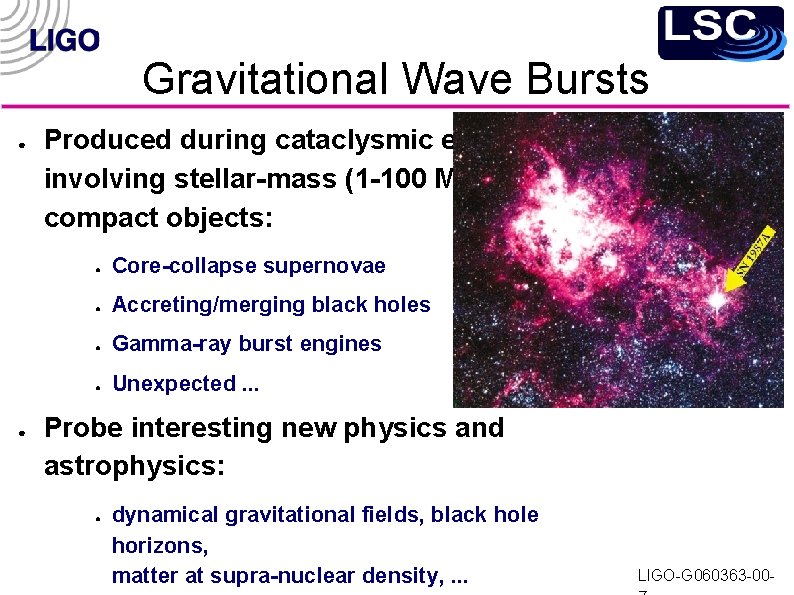
Gravitational Wave Bursts ● ● Produced during cataclysmic events involving stellar-mass (1 -100 M⊙) compact objects: ● Core-collapse supernovae ● Accreting/merging black holes ● Gamma-ray burst engines ● Unexpected. . . Probe interesting new physics and astrophysics: ● dynamical gravitational fields, black hole horizons, matter at supra-nuclear density, . . . LIGO-G 060363 -00 -
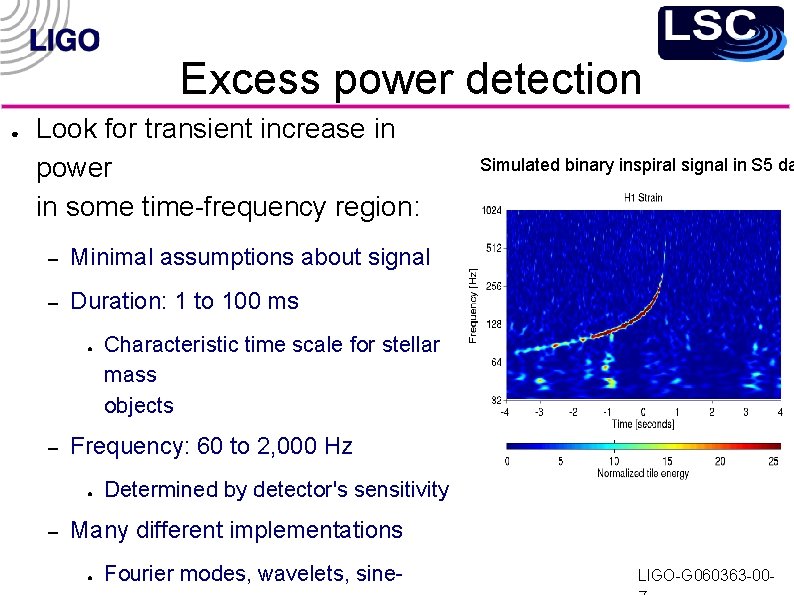
Excess power detection ● Look for transient increase in power in some time-frequency region: – Minimal assumptions about signal – Duration: 1 to 100 ms ● – Characteristic time scale for stellar mass objects Frequency: 60 to 2, 000 Hz ● – Simulated binary inspiral signal in S 5 da Determined by detector's sensitivity Many different implementations ● Fourier modes, wavelets, sine- LIGO-G 060363 -00 -
Consistency Checks ● ● Require time and frequency coincidence in three LIGO detectors. Follow up coincidences with: – Amplitude consistency between co-located H 1 -H 2 detectors – Cross correlation of data from pairs of detectors – Check environmental and auxiliary channels for: ● ● Earthquakes, airplanes, trains, instrumental misbehaviour, . . . – Remove times of poor data quality – Veto events associated to known noise sources Compare remaining events with background estimated by LIGO-G 060363 -00 repeating analysis with large time shifts of detector data.
Burst Search Results ● Analysis of data from first three science runs (S 1 -S 3) complete: 1. B. Abbott et al. (LSC), First upper limits from LIGO on gravitational wave bursts. Phys. Rev. D 69, 102001 (2004). 2. B. Abbott et al. (LSC), A Search for Gravitational Waves Associated with the Gamma Ray Burst GRB 030329 Using the LIGO Detectors. Phys. Rev. D 72, 042002 (2005). 3. B. Abbott et al. (LSC), Upper Limits on Gravitational Wave Bursts in LIGO's Second Science Run. Phys. Rev. D 72, 062001 (2005) 4. B. Abbott et al. (LSC), T. Akutsu et al. (TAMA), Upper Limits from the LIGO and TAMA Detectors on the Rate of Gravitational-Wave Bursts. Phys. Rev. D 72, 122004 (2005) 5. B. Abbott et al. (LSC), Search for gravitational wave bursts in LIGO's third science run. Class. Quant. Grav. 23, S 29 -S 39 (2006) ● Results from S 4 being finalised. LIGO-G 060363 -00 -
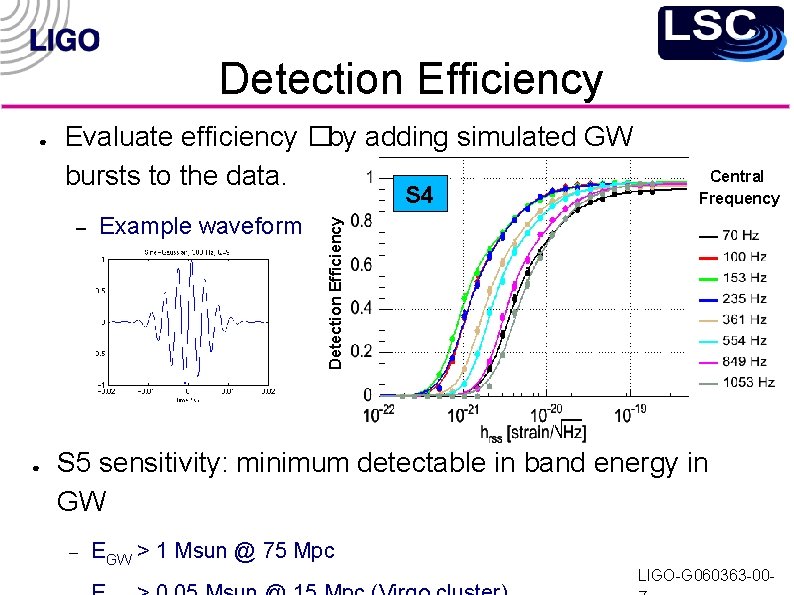
Detection Efficiency ● Evaluate efficiency �by adding simulated GW bursts to the data. – ● Example waveform Detection Efficiency S 4 Central Frequency S 5 sensitivity: minimum detectable in band energy in GW – EGW > 1 Msun @ 75 Mpc LIGO-G 060363 -00 -
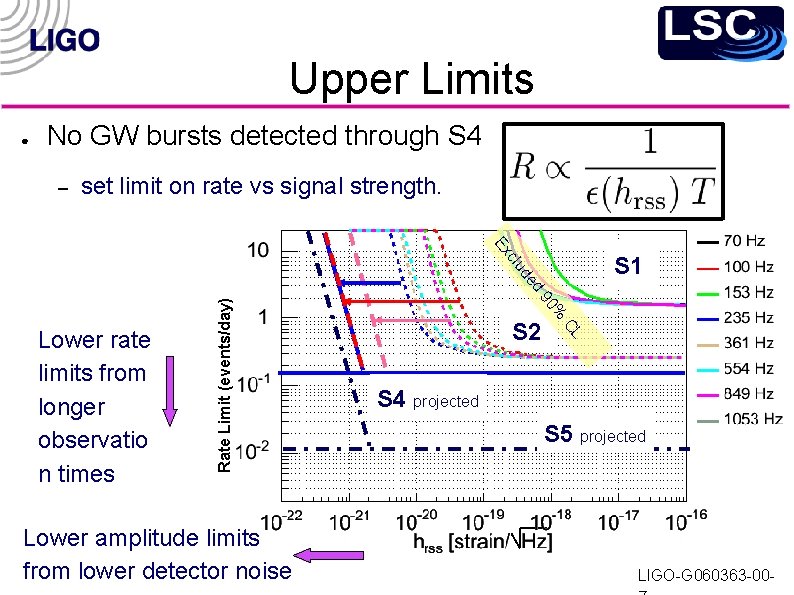
Upper Limits ● No GW bursts detected through S 4 – set limit on rate vs signal strength. Ex clu S 1 CL S 2 % Lower amplitude limits from lower detector noise 90 Rate Limit (events/day) d de Lower rate limits from longer observatio n times S 4 projected S 5 projected LIGO-G 060363 -00 -
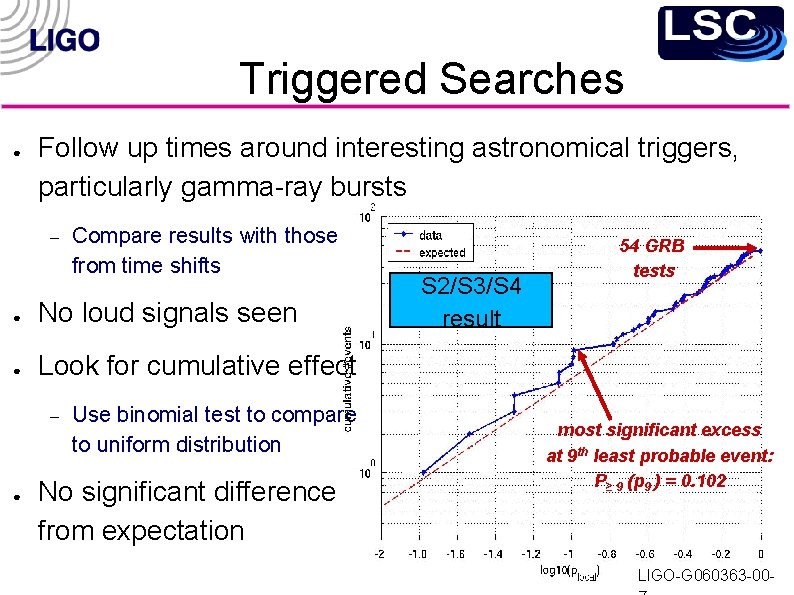
Triggered Searches ● Follow up times around interesting astronomical triggers, particularly gamma-ray bursts – Compare results with those from time shifts ● No loud signals seen ● Look for cumulative effect – ● Use binomial test to compare to uniform distribution No significant difference from expectation S 2/S 3/S 4 result 54 GRB tests most significant excess at 9 th least probable event: P≥ 9 (p 9 ) = 0. 102 LIGO-G 060363 -00 -
Outline ● ● Gravitational wave bursts – Unmodelled bursts – Astronomically triggered searches Coalescing binaries – Binary neutron stars – Binary black holes LIGO-G 060363 -00 -
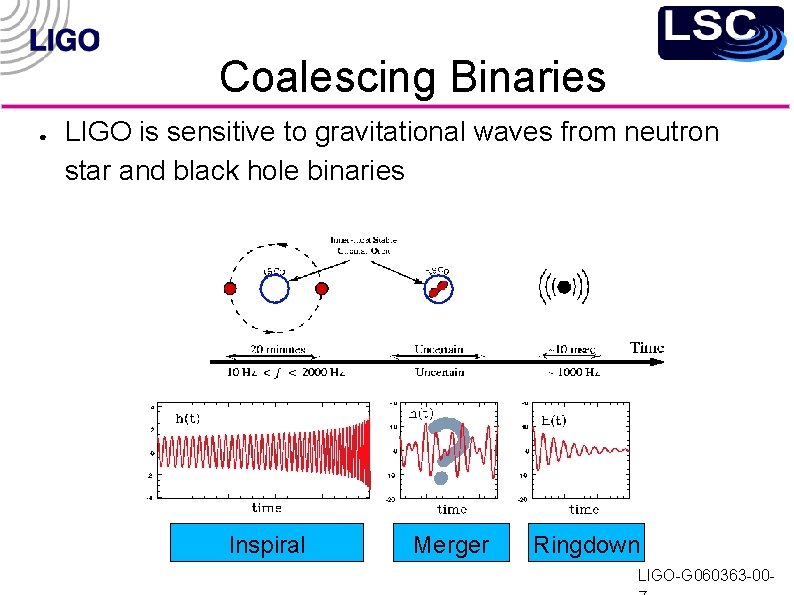
Coalescing Binaries ● LIGO is sensitive to gravitational waves from neutron star and black hole binaries Inspiral Merger Ringdown LIGO-G 060363 -00 -
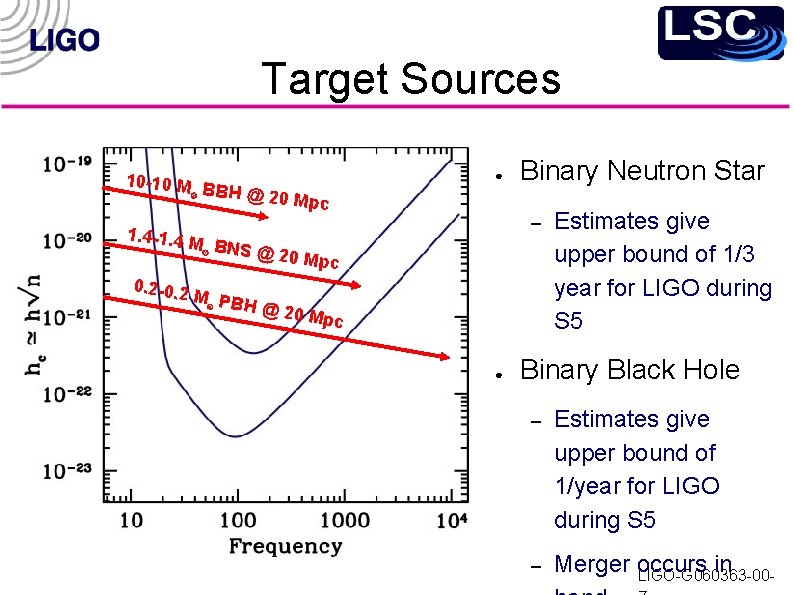
Target Sources 10 -10 M ⊙ 0 Mpc 1. 4 -1. 4 M ⊙ 0. 2 -0. 2 ● BBH @ 2 BNS @ 20 Binary Neutron Star – Mpc M⊙ PBH @ 20 M pc ● Estimates give upper bound of 1/3 year for LIGO during S 5 Binary Black Hole – Estimates give upper bound of 1/year for LIGO during S 5 – Merger occurs in LIGO-G 060363 -00 -
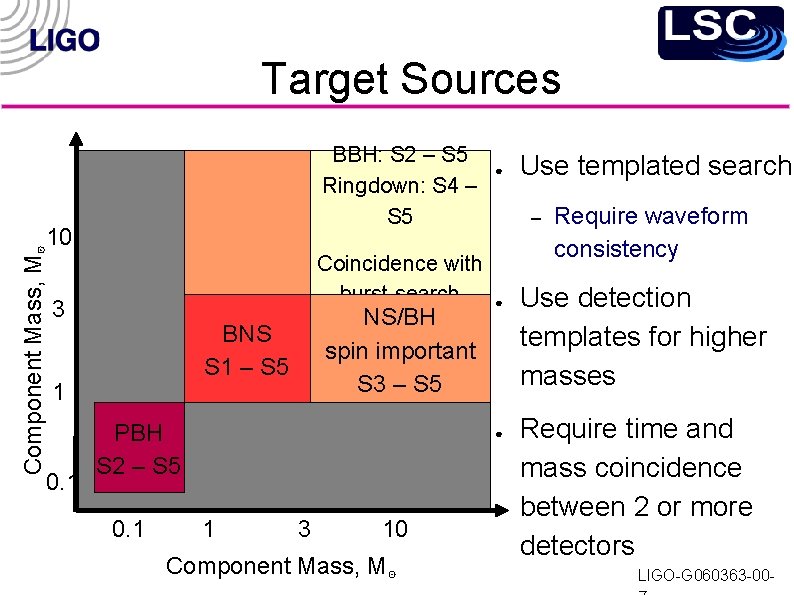
Target Sources BBH: S 2 – S 5 Ringdown: S 4 – S 5 Component Mass, M⊙ 10 Coincidence with burst search 3 BNS S 1 – S 5 1 0. 1 NS/BH spin important S 3 – S 5 PBH S 2 – S 5 0. 1 ● – ● ● 1 3 10 Component Mass, M⊙ Use templated search Require waveform consistency Use detection templates for higher masses Require time and mass coincidence between 2 or more detectors LIGO-G 060363 -00 -
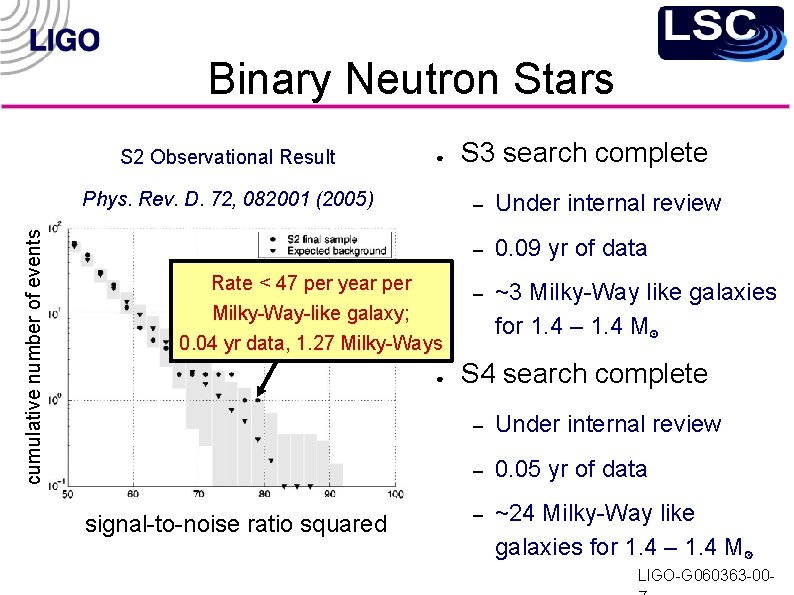
Binary Neutron Stars S 2 Observational Result ● cumulative number of events Phys. Rev. D. 72, 082001 (2005) Rate < 47 per year per Milky-Way-like galaxy; 0. 04 yr data, 1. 27 Milky-Ways ● signal-to-noise ratio squared S 3 search complete – Under internal review – 0. 09 yr of data – ~3 Milky-Way like galaxies for 1. 4 – 1. 4 M⊙ S 4 search complete – Under internal review – 0. 05 yr of data – ~24 Milky-Way like galaxies for 1. 4 – 1. 4 M⊙ LIGO-G 060363 -00 -
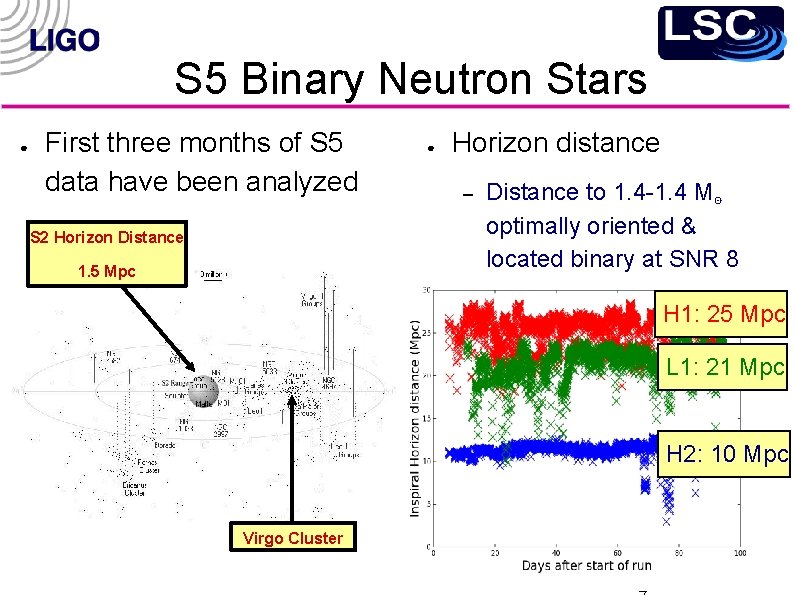
S 5 Binary Neutron Stars ● First three months of S 5 data have been analyzed S 2 Horizon Distance 1. 5 Mpc ● Horizon distance – Distance to 1. 4 -1. 4 M⊙ optimally oriented & located binary at SNR 8 H 1: 25 Mpc L 1: 21 Mpc H 2: 10 Mpc Virgo Cluster LIGO-G 060363 -00 -
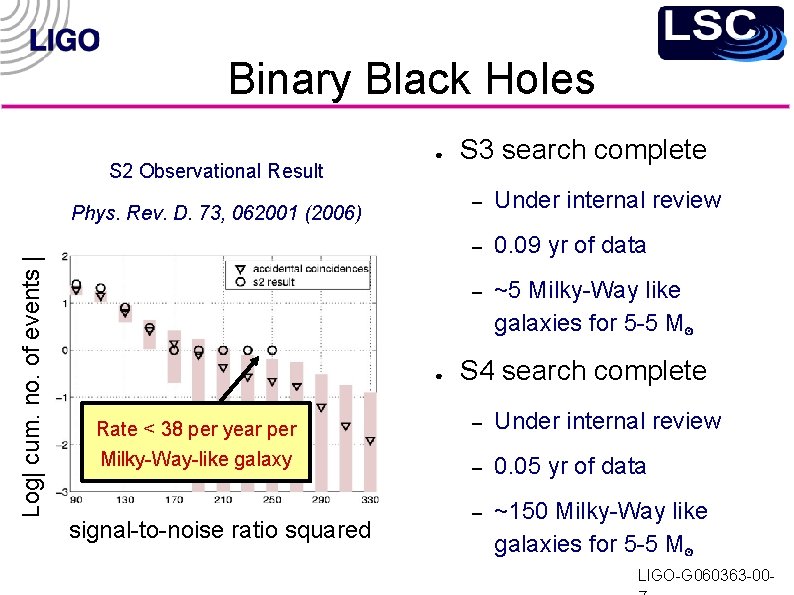
Binary Black Holes S 2 Observational Result ● Log| cum. no. of events | Phys. Rev. D. 73, 062001 (2006) ● Rate < 38 per year per Milky-Way-like galaxy signal-to-noise ratio squared S 3 search complete – Under internal review – 0. 09 yr of data – ~5 Milky-Way like galaxies for 5 -5 M⊙ S 4 search complete – Under internal review – 0. 05 yr of data – ~150 Milky-Way like galaxies for 5 -5 M⊙ LIGO-G 060363 -00 -
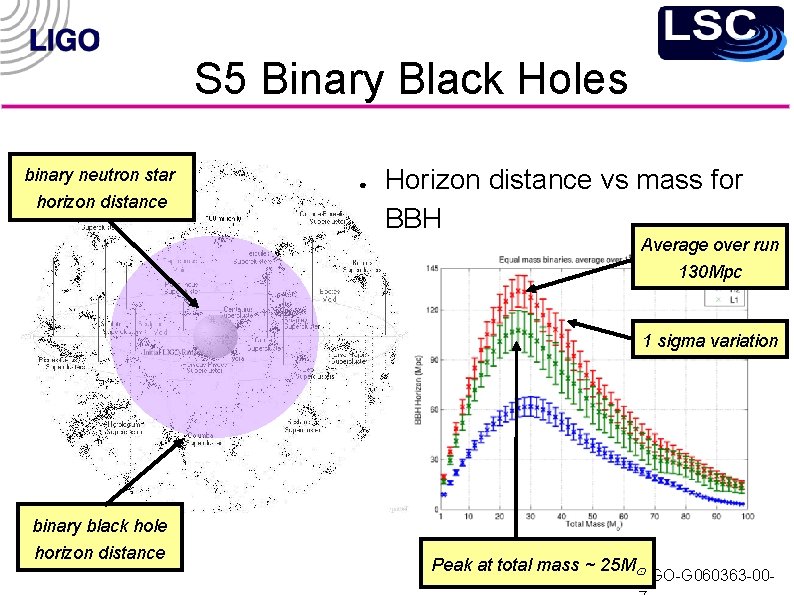
S 5 Binary Black Holes binary neutron star horizon distance ● Horizon distance vs mass for BBH Average over run 130 Mpc 1 sigma variation binary black hole horizon distance Image: R. Powell Peak at total mass ~ 25 M⊙ LIGO-G 060363 -00 -
Conclusions ● Analysis of LIGO data is in full swing – In the process of acquiring one year of coincident data at design sensitivity. – “Online” analysis & follow-up provide rapid feedback to experimentalists. Results from fourth and fifth LIGO science runs are appearing. – ● Burst searches – Rate and amplitude sensitivites continue to improve ● ● Minimum detectable in-band energy: EGW ~ 1 M⊙ at r ~100 Mpc. Inspiral searches – S 5 sensitivity makes this an exciting time for gravitational wave astronomy and astrophysics. LIGO-G 060363 -00 -
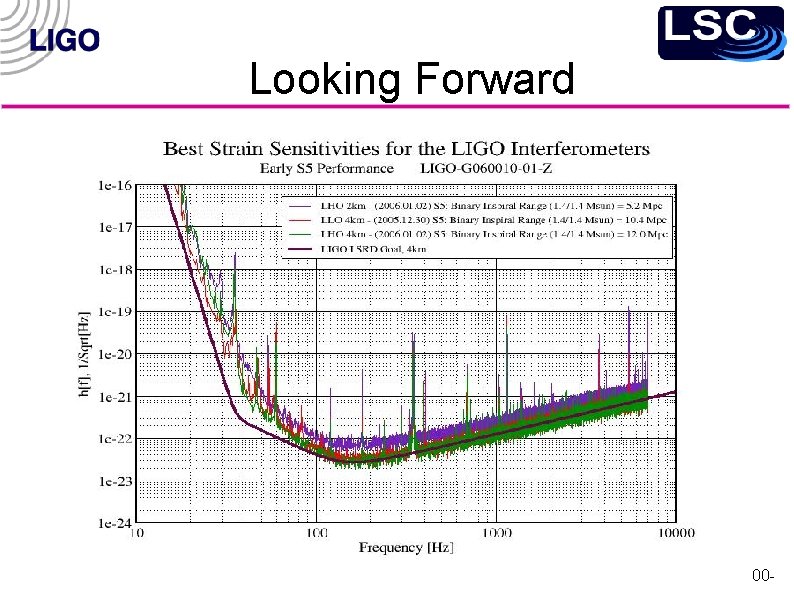
Looking Forward LIGO-G 060363 -00 -
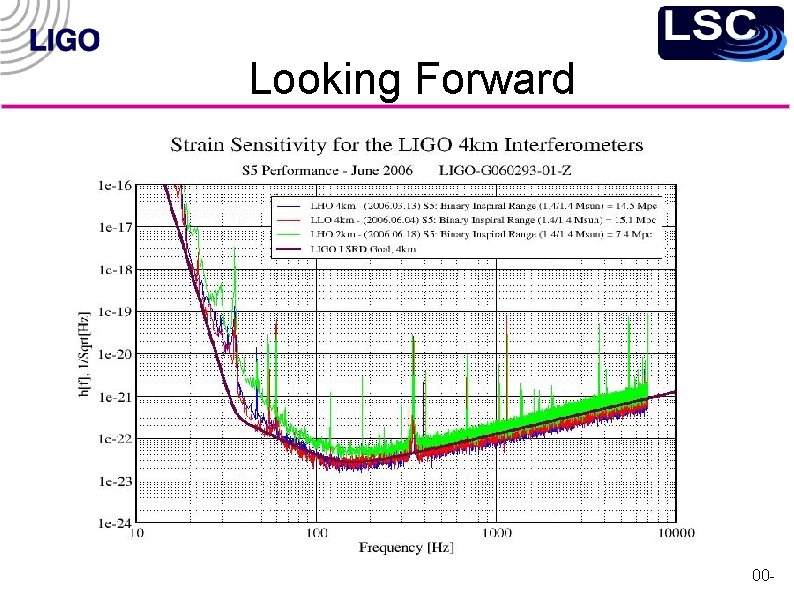
Looking Forward LIGO-G 060363 -00 -
- Slides: 21