
Results from ALMA Band 10 the Cats Paw
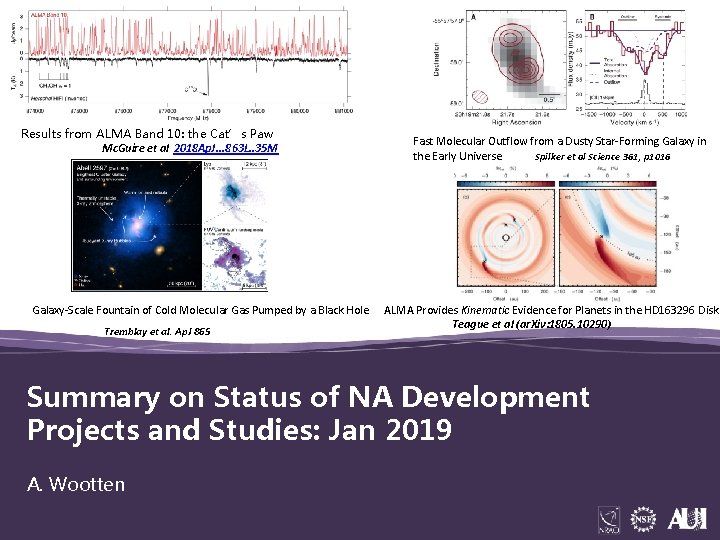
Results from ALMA Band 10: the Cat’s Paw Mc. Guire et al 2018 Ap. J. . . 863 L. . 35 M Galaxy-Scale Fountain of Cold Molecular Gas Pumped by a Black Hole Tremblay et al. Ap. J 865 Fast Molecular Outflow from a Dusty Star-Forming Galaxy in the Early Universe Spilker et al Science 361, p 1016 ALMA Provides Kinematic Evidence for Planets in the HD 163296 Disk Teague et al (ar. Xiv: 1805. 10290) Summary on Status of NA Development Projects and Studies: Jan 2019 A. Wootten 1 Informational Meeting – Jan 2019
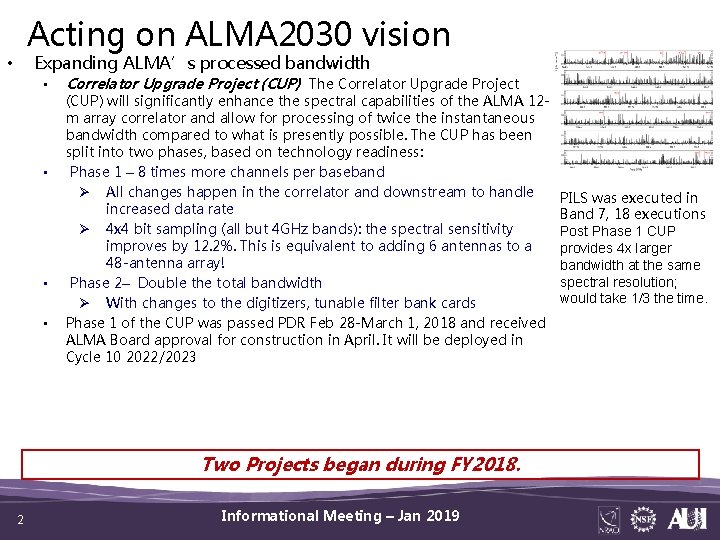
Acting on ALMA 2030 vision Expanding ALMA’s processed bandwidth • • • Correlator Upgrade Project (CUP) The Correlator Upgrade Project (CUP) will significantly enhance the spectral capabilities of the ALMA 12 m array correlator and allow for processing of twice the instantaneous bandwidth compared to what is presently possible. The CUP has been split into two phases, based on technology readiness: Phase 1 – 8 times more channels per baseband Ø All changes happen in the correlator and downstream to handle increased data rate Ø 4 x 4 bit sampling (all but 4 GHz bands): the spectral sensitivity improves by 12. 2%. This is equivalent to adding 6 antennas to a 48 -antenna array! Phase 2– Double the total bandwidth Ø With changes to the digitizers, tunable filter bank cards Phase 1 of the CUP was passed PDR Feb 28 -March 1, 2018 and received ALMA Board approval for construction in April. It will be deployed in Cycle 10 2022/2023 Two Projects began during FY 2018. 2 Informational Meeting – Jan 2019 PILS was executed in Band 7, 18 executions Post Phase 1 CUP provides 4 x larger bandwidth at the same spectral resolution; would take 1/3 the time.
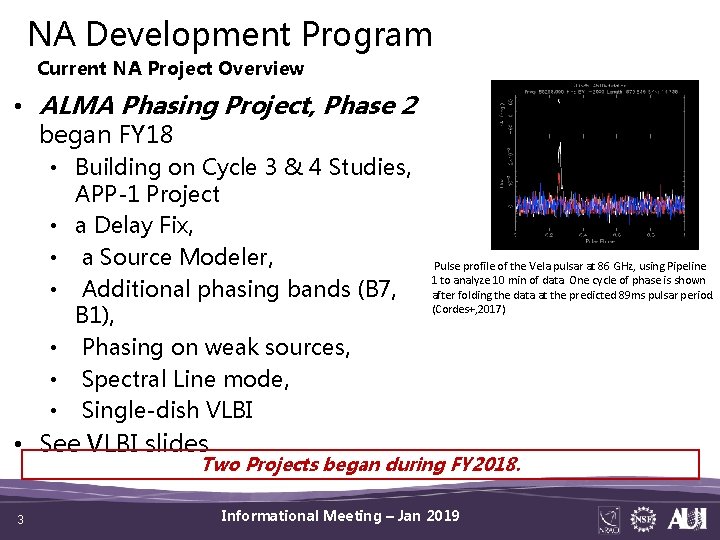
NA Development Program Current NA Project Overview • ALMA Phasing Project, Phase 2 began FY 18 • Building on Cycle 3 & 4 Studies, APP-1 Project • a Delay Fix, • a Source Modeler, • Additional phasing bands (B 7, B 1), • Phasing on weak sources, • Spectral Line mode, • Single-dish VLBI Pulse profile of the Vela pulsar at 86 GHz, using Pipeline 1 to analyze 10 min of data. One cycle of phase is shown after folding the data at the predicted 89 ms pulsar period. (Cordes+, 2017) • See VLBI slides Two Projects began during FY 2018. 3 Informational Meeting – Jan 2019
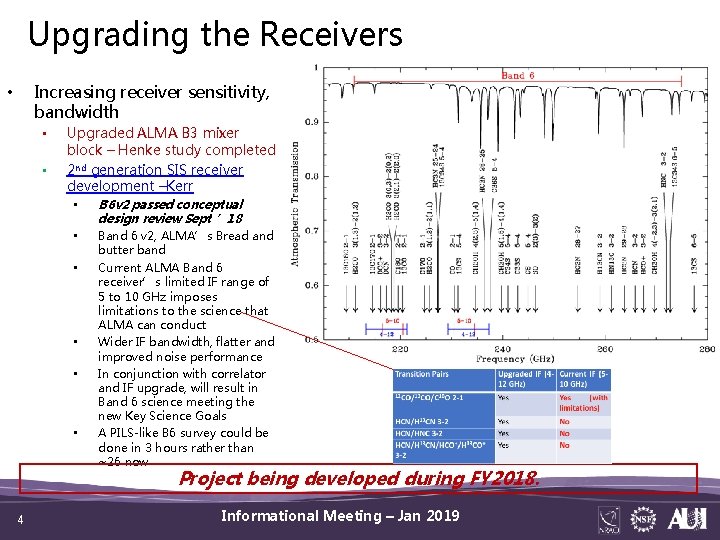
Upgrading the Receivers Increasing receiver sensitivity, bandwidth • • • Upgraded ALMA B 3 mixer block – Henke study completed 2 nd generation SIS receiver development –Kerr • B 6 v 2 passed conceptual design review Sept ’ 18 • Band 6 v 2, ALMA’s Bread and butter band Current ALMA Band 6 receiver’s limited IF range of 5 to 10 GHz imposes limitations to the science that ALMA can conduct Wider IF bandwidth, flatter and improved noise performance In conjunction with correlator and IF upgrade, will result in Band 6 science meeting the new Key Science Goals A PILS-like B 6 survey could be done in 3 hours rather than ~26 now • • Project being developed during FY 2018. 4 Informational Meeting – Jan 2019
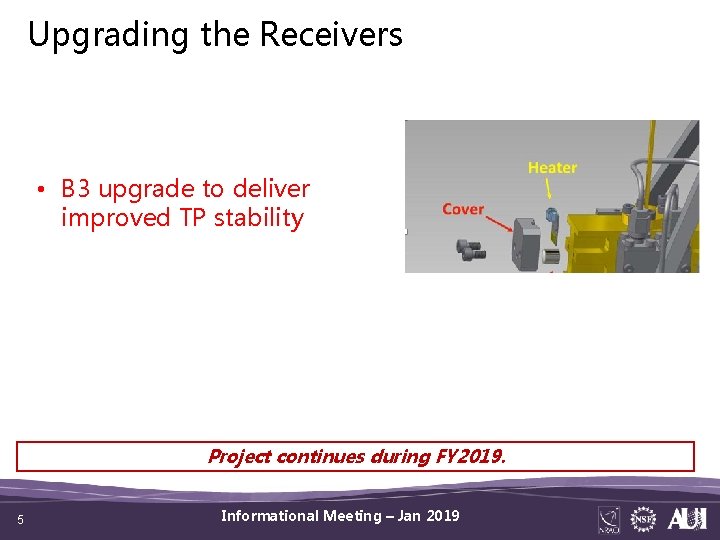
Upgrading the Receivers • B 3 upgrade to deliver improved TP stability Project continues during FY 2019. 5 Informational Meeting – Jan 2019
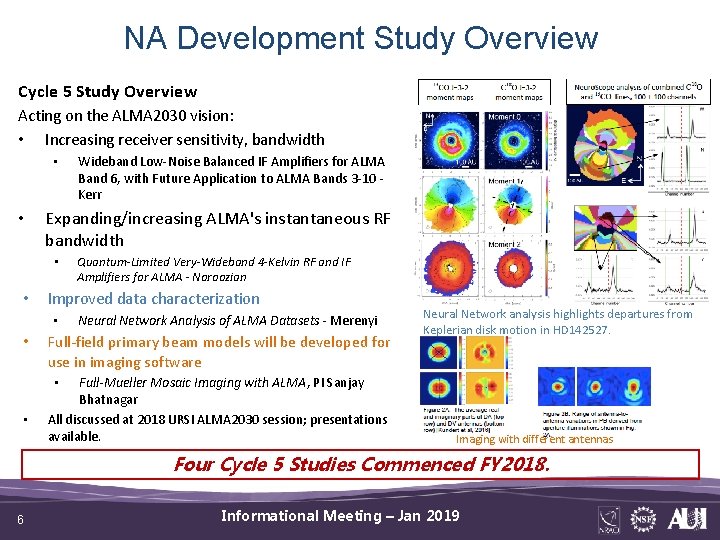
NA Development Study Overview Cycle 5 Study Overview Acting on the ALMA 2030 vision: • Increasing receiver sensitivity, bandwidth • • Expanding/increasing ALMA's instantaneous RF bandwidth • • Quantum-Limited Very-Wideband 4 -Kelvin RF and IF Amplifiers for ALMA - Noroozian Improved data characterization • • Wideband Low-Noise Balanced IF Amplifiers for ALMA Band 6, with Future Application to ALMA Bands 3 -10 Kerr Neural Network Analysis of ALMA Datasets - Merenyi Full-field primary beam models will be developed for use in imaging software Full-Mueller Mosaic Imaging with ALMA, PI Sanjay Bhatnagar All discussed at 2018 URSI ALMA 2030 session; presentations available. Neural Network analysis highlights departures from Keplerian disk motion in HD 142527. • • Imaging with different antennas Four Cycle 5 Studies Commenced FY 2018. 6 Informational Meeting – Jan 2019
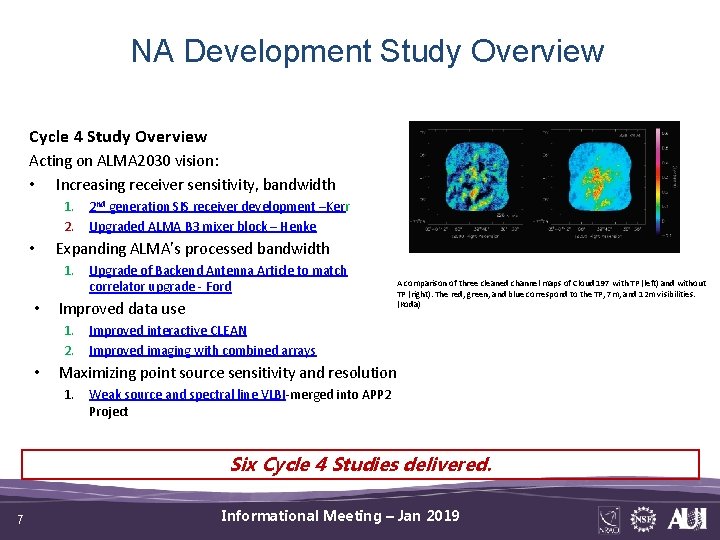
NA Development Study Overview Cycle 4 Study Overview Acting on ALMA 2030 vision: • Increasing receiver sensitivity, bandwidth 1. 2 nd generation SIS receiver development –Kerr 2. Upgraded ALMA B 3 mixer block – Henke • Expanding ALMA’s processed bandwidth 1. Upgrade of Backend Antenna Article to match correlator upgrade - Ford • Improved data use A comparison of three cleaned channel maps of Cloud 197 with TP (left) and without TP (right). The red, green, and blue correspond to the TP, 7 m, and 12 m visibilities. (Koda) 1. Improved interactive CLEAN 2. Improved imaging with combined arrays • Maximizing point source sensitivity and resolution 1. Weak source and spectral line VLBI-merged into APP 2 Project Six Cycle 4 Studies delivered. 7 Informational Meeting – Jan 2019
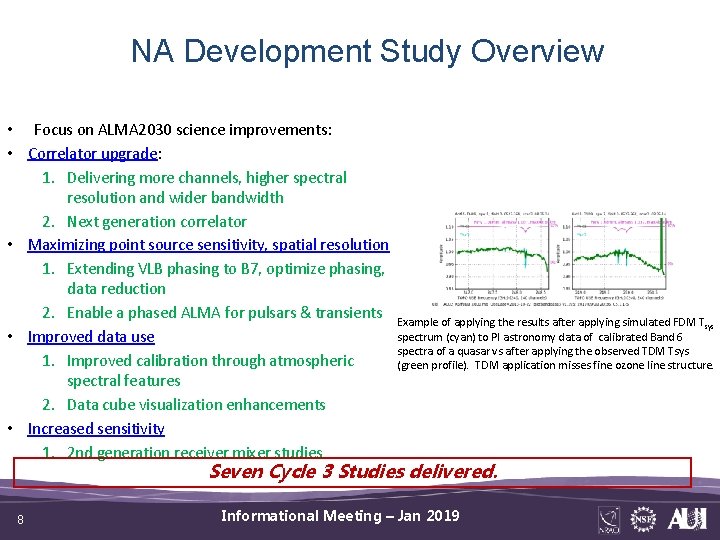
NA Development Study Overview • Focus on ALMA 2030 science improvements: • Correlator upgrade: 1. Delivering more channels, higher spectral resolution and wider bandwidth 2. Next generation correlator • Maximizing point source sensitivity, spatial resolution 1. Extending VLB phasing to B 7, optimize phasing, data reduction 2. Enable a phased ALMA for pulsars & transients • Improved data use 1. Improved calibration through atmospheric spectral features 2. Data cube visualization enhancements • Increased sensitivity 1. 2 nd generation receiver mixer studies Example of applying the results after applying simulated FDM Tsys spectrum (cyan) to PI astronomy data of calibrated Band 6 spectra of a quasar vs after applying the observed TDM Tsys (green profile). TDM application misses fine ozone line structure. Seven Cycle 3 Studies delivered. 8 Informational Meeting – Jan 2019
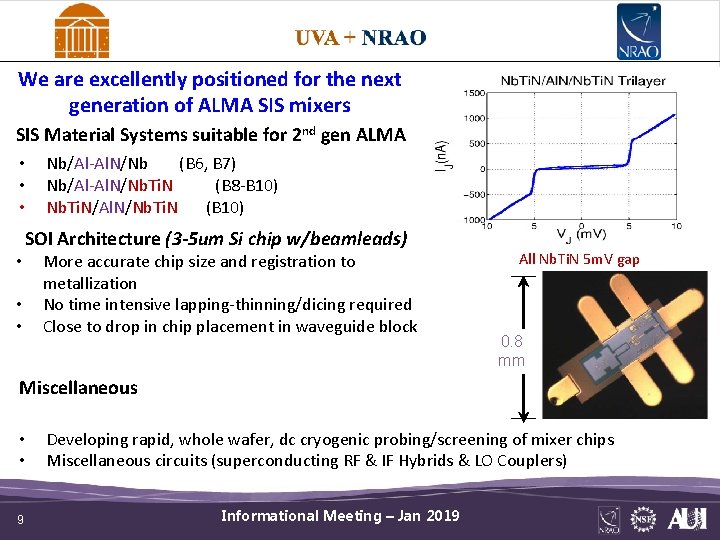
We are excellently positioned for the next generation of ALMA SIS mixers SIS Material Systems suitable for 2 nd gen ALMA • • • Nb/Al-Al. N/Nb (B 6, B 7) Nb/Al-Al. N/Nb. Ti. N (B 8 -B 10) Nb. Ti. N/Al. N/Nb. Ti. N (B 10) SOI Architecture (3 -5 um Si chip w/beamleads) • • • More accurate chip size and registration to metallization No time intensive lapping-thinning/dicing required Close to drop in chip placement in waveguide block All Nb. Ti. N 5 m. V gap 0. 8 mm Miscellaneous • • 9 Developing rapid, whole wafer, dc cryogenic probing/screening of mixer chips Miscellaneous circuits (superconducting RF & IF Hybrids & LO Couplers) Informational Meeting – Jan 2019
• Projects Immediate Future – NA has two new projects, Correlator Upgrade 2 and B 6 v 2 ready – New Call for Projects forseen Cycle 8 = FY 2021 • • Anticipated dates (TBC): Project Cf. Ps: 1 Dec 2019 Deadline for submission: 15 Mar 2020 Funding start: 1 Oct 2020 • Studies – NA: Call closed 1 May 2017; four new Studies selected. – Current Call planned for Cycle 7 = FY 2020 – Anticipated dates (TBC): • Study Cf. Ps: 1 Dec 2018 • Deadline for submission: 15 Mar 2019 • Funding start: 1 Oct 2019 10 Informational Meeting – Jan 2019
science. nrao. edu public. nrao. edu ngvla. nrao. edu The National Radio Astronomy Observatory is a facility of the National Science Foundation operated under cooperative agreement by Associated Universities, Inc. 11 Informational Meeting – Jan 2019
- Slides: 11