
Result Based Planning Rabi S Sainju National Planning
Result Based Planning Rabi S Sainju National Planning Commission Secretariat Rabi S Sainju NASC: Result Based Planning 12 th August 2015
Presentation Outline 1. Background : Demand for Better Result 2. Concept and focus of RBP 3. Elements and Basic Tools of RBP 4. Result based Planning Process 5. Result based Management 6. Result Chain 7. Operationalization of RBP in Nepal 8. Conclusions Rabi S Sainju NASC: Result Based Planning 2 12 th August 2015
Background: Demand for Better Results • GDP-centered economic growth led to steady increase in income inequality • Realization to introduce participation, transparency and accountability into government work. • Increasing demand for the delivery of sustainable and more equitable development. • Positive changes of NPM movement on some countries in 1980 s through greater accountability in the public sector • Greater realization for optimum use of limited resources for achieving greater value for money and international goals • Realization among the donors for development 3 effectiveness Rabi S Sainju NASC: Result Based Planning 12 th August 2015
RB Approach in Public Sector Mgmt Ø Began in UK, New Zealand, Australia in the 1980 s Ø Expanded to USA in early 1990 s Ø Encouraged by OECD among developed countries during the 1990 s Ø Pushed by USA (Bush Adm. ) as a policy for devt aid starting early 2001 Ø Being increasingly adopted by developing countries and agencies in various forms 4 Rabi S Sainju NASC: Result Based Planning 12 th August 2015
What is result based planning ? • Result-based planning uses public’s needs and desired results as the foundation for planning l Result based planning focuses on the key questions: q “How has the planning made a difference? ” q “How are the lives of the general public better as a result of planning? ” 5 Rabi S Sainju NASC: Result Based Planning 12 th August 2015
Result Based Planning Why and How ? • Results-based planning focuses more on the results in terms of outcome and impact of the plan. • It tries to ensures whether the outcome and impact of the plan is as per the set medium term goals and long term vision. • It gives importance to strategy as to how it could be realized by looking at different options it have and develop policies and programs to realize the goals and targets. • It is thus more a strategic planning as against the normal medium term planning that started from the Communist Regime in Russia focusing more the material balance. 6 Rabi S Sainju NASC: Result Based Planning 12 th August 2015
Result Based Planning Why and How ? (Contd. . ) • It focus on a medium term goal derived from a clear vision of the future, • It propose a combination of objectives that have been prioritized by rigorous analysis of the political, social and economic environment. • The long-term vision however should be based on a well documented assessment of the country’s socioeconomic status and include goals to be achieved in each of the strategic areas. • It also need to respond to the question “How do we want to get there? ” 7 Rabi S Sainju NASC: Result Based Planning 12 th August 2015
RBP: Why do we care? • • Changes focus from HOW to get it done to WHY we do it To drive the planning process from people’s need Makes us accountable to our client and stakeholders Help to demonstrate results: 1. Better implementation 2. Better communication 3. Stronger capacity development 4. More realistic project schedules 5. Useful evaluation results 6. Reducing opportunities and pressures for corruption 8 Rabi S Sainju NASC: Result Based Planning 12 th August 2015 8
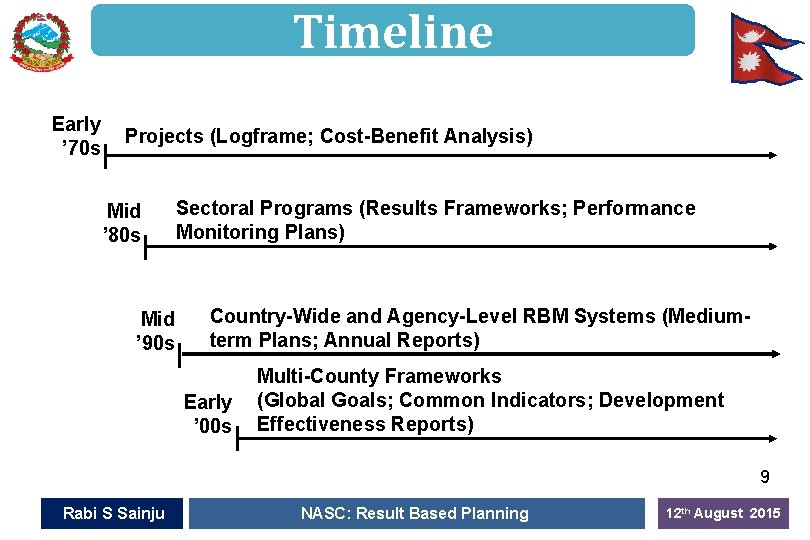
Timeline Early ’ 70 s Projects (Logframe; Cost-Benefit Analysis) Mid ’ 80 s Mid ’ 90 s Sectoral Programs (Results Frameworks; Performance Monitoring Plans) Country-Wide and Agency-Level RBM Systems (Mediumterm Plans; Annual Reports) Early ’ 00 s Multi-County Frameworks (Global Goals; Common Indicators; Development Effectiveness Reports) 9 Rabi S Sainju NASC: Result Based Planning 12 th August 2015
Elements of a Result Based Planning • Understand where we are ? – Analysis of the socio-economic status , poverty and inequality and the strength and weaknesses of the economy and the country’s development effort. Finding gaps and strength. • Clear vision as to what we want to achieve or where we want to reach over a medium to long term? – Setting up of long term vision and objectives and targets for the medium term. • Clear understanding of the path as to how we achieve vision and objectives ? - Choosing options for better strategy to attain the objective/goals and designing policies and programs to ensure its outcome/output and impact relating to medium term objectives and long term vision. • Clear understanding of the resources - both human and capital and institutional setup to achieve set targets? Analysis of resource potential and availability, both domestic and foreign, in financing policies and programs and assessing institutional set ups to carry out plan implementation. • Ensure whether we have accomplished the set targets. Designing monitoring and evaluation system to check implementation process , output and the quality 10 of work done as envisaged. Rabi S Sainju NASC: Result Based Planning 12 th August 2015
Basic Tools Used in Result Based Planning • Planning consistency is given top most priority in RBP. Most often a macro planning model is used for checking the consistency and analysis. • Expenditure framework that make consistency in resource potential and availability in the likely future situation is also used for the purpose. • Result Framework is widely used to check the consistency in the outcome/impact, output and inputs. • Result based monitoring framework is used for monitoring and evaluation of the plan and provide feed back. 11 Rabi S Sainju NASC: Result Based Planning 12 th August 2015

Results-based planning process Plan for results • Results Plan defined • Indicators, targets Evaluate results Budget for results • Budget aligned Budgetwith • How & who Evaluate • Dissemination, feedback activities Goals Monitor results • Linked to planning Monitor • How & who • Data, reporting Rabi S Sainju Implement for results Implement 12 NASC: Result Based Planning 12 th August 12 2015
Result Based Management (RBM) A result is a desirable change resulting from a causeeffect relationship (output, outcome and impact) RBM includes § Defining realistic expected results with proper analysis § Identifying beneficiaries & design programmes meet their needs § Monitoring progress for results using result indicators § Reporting on results achieved and resources involved § Identifying and managing risks § Lessons learning and informed decision making 13 Rabi S Sainju NASC: Result Based Planning 12 th August 2015
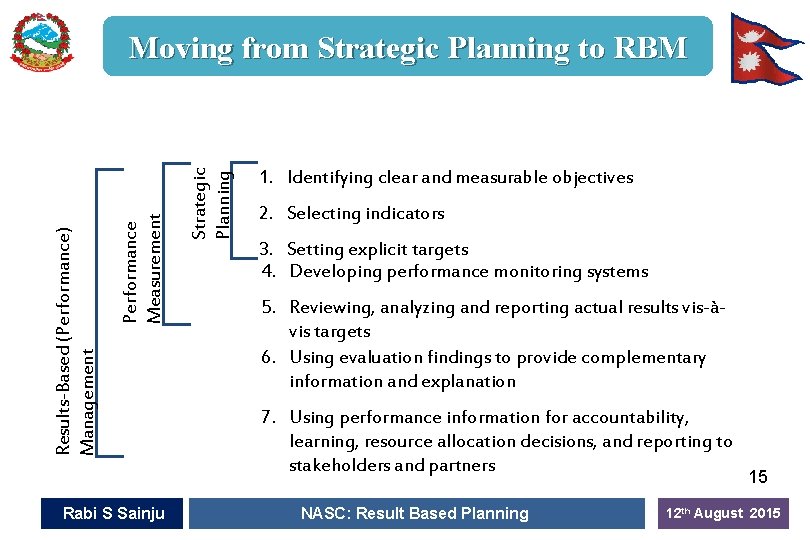
Rabi S Sainju Strategic Planning Performance Measurement Results-Based (Performance) Management Moving from Strategic Planning to RBM 1. Identifying clear and measurable objectives 2. Selecting indicators 3. Setting explicit targets 4. Developing performance monitoring systems 5. Reviewing, analyzing and reporting actual results vis-àvis targets 6. Using evaluation findings to provide complementary information and explanation 7. Using performance information for accountability, learning, resource allocation decisions, and reporting to stakeholders and partners NASC: Result Based Planning 15 12 th August 2015
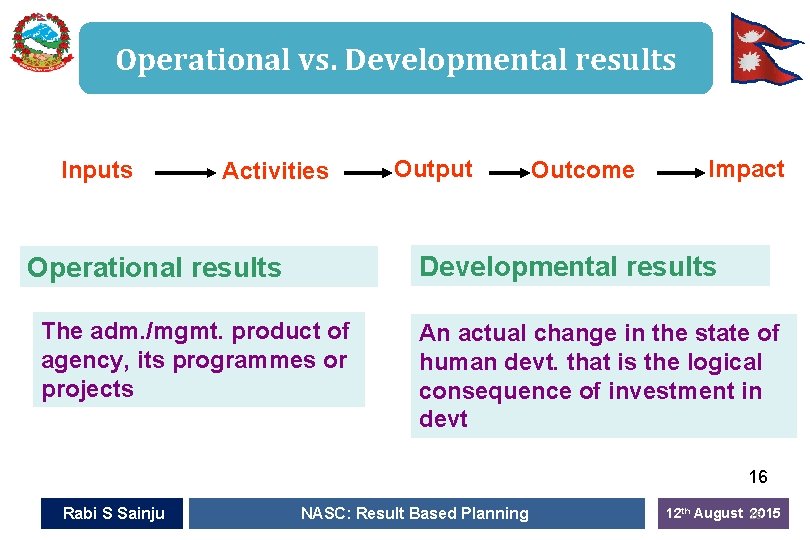
Operational vs. Developmental results Inputs Activities Output Outcome Impact Developmental results Operational results The adm. /mgmt. product of agency, its programmes or projects An actual change in the state of human devt. that is the logical consequence of investment in devt 16 Rabi S Sainju NASC: Result Based Planning 12 th August 16 2015
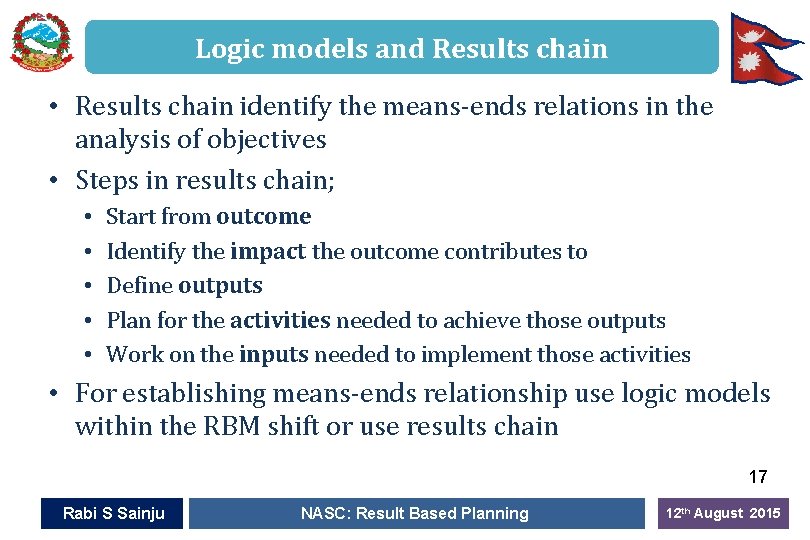
Logic models and Results chain • Results chain identify the means-ends relations in the analysis of objectives • Steps in results chain; • • • Start from outcome Identify the impact the outcome contributes to Define outputs Plan for the activities needed to achieve those outputs Work on the inputs needed to implement those activities • For establishing means-ends relationship use logic models within the RBM shift or use results chain 17 Rabi S Sainju NASC: Result Based Planning 12 th August 2015
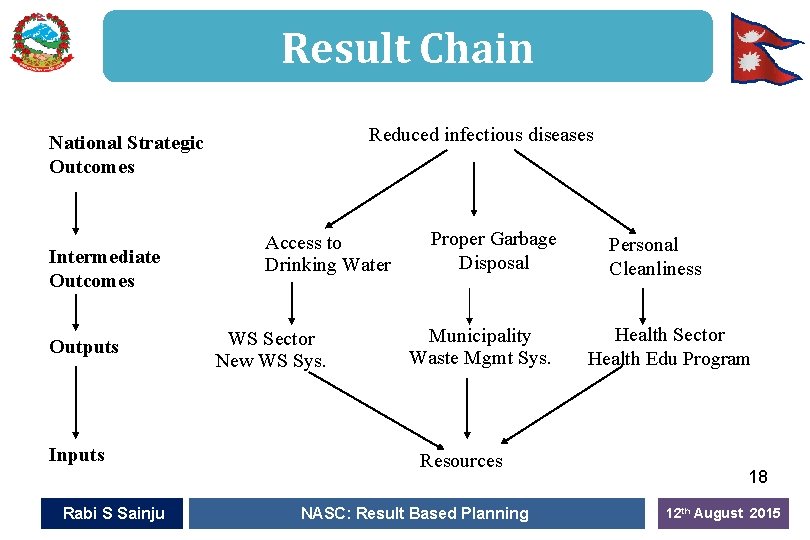
Result Chain Reduced infectious diseases National Strategic Outcomes Intermediate Outcomes Outputs Inputs Rabi S Sainju Access to Drinking Water WS Sector New WS Sys. Proper Garbage Disposal Municipality Waste Mgmt Sys. Resources NASC: Result Based Planning Personal Cleanliness Health Sector Health Edu Program 18 12 th August 2015
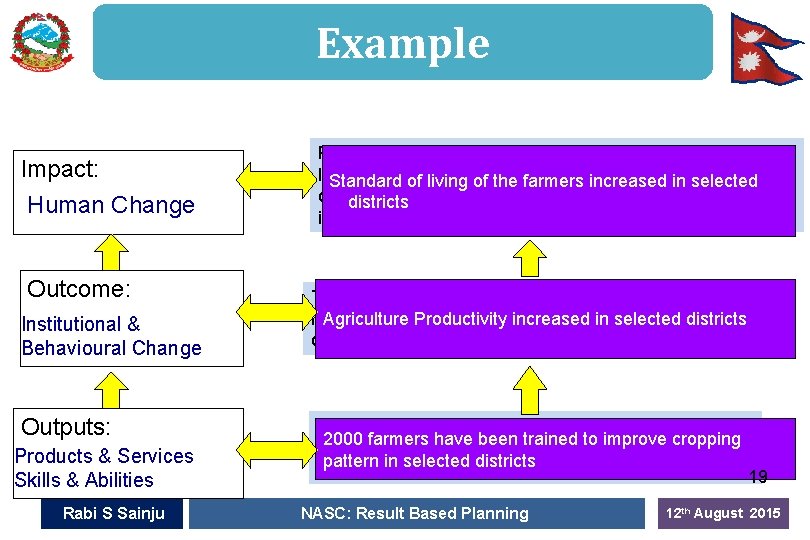
Example Impact: Human Change Outcome: Institutional & Behavioural Change Outputs: Products & Services Skills & Abilities Rabi S Sainju Positive and negative, primary and secondary long-term produced by a increased in selected Standardeffects of living of the farmers development districts intervention, directly or indirectly, intended or unintended. The likely or achieved short-term and medium-term effects of anincreased intervention’s Agriculture Productivity in selected districts outputs. The products and services which result from the 2000 farmers have been trained to improve cropping completion of activities within a development pattern in selected districts intervention. 19 NASC: Result Based Planning 12 th August 2015
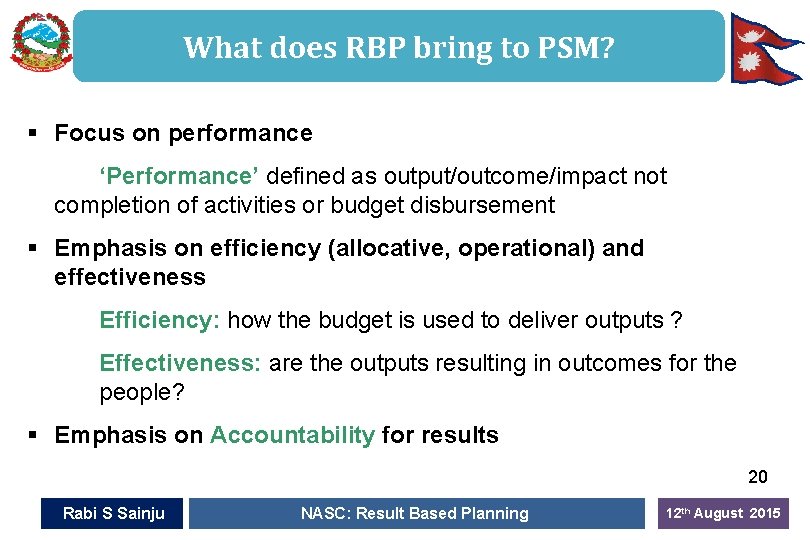
What does RBP bring to PSM? § Focus on performance ‘Performance’ defined as output/outcome/impact not completion of activities or budget disbursement § Emphasis on efficiency (allocative, operational) and effectiveness Efficiency: how the budget is used to deliver outputs ? Effectiveness: are the outputs resulting in outcomes for the people? § Emphasis on Accountability for results 20 Rabi S Sainju NASC: Result Based Planning 12 th August 2015
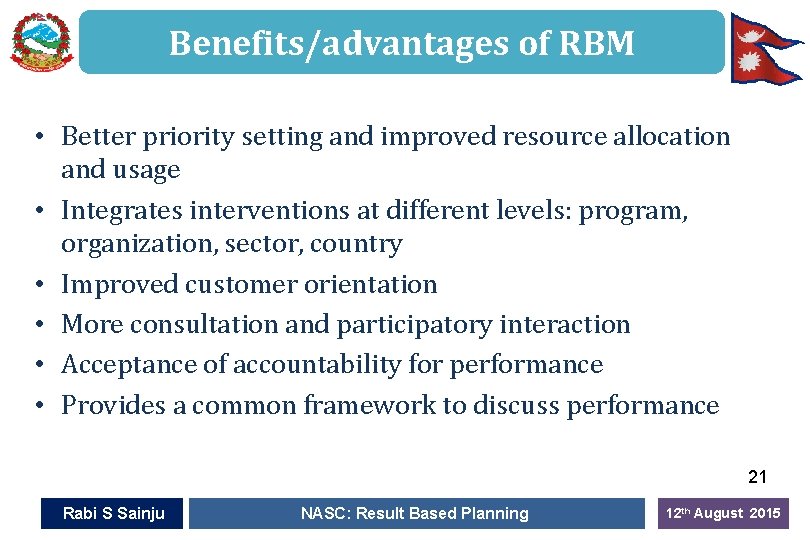
Benefits/advantages of RBM • Better priority setting and improved resource allocation and usage • Integrates interventions at different levels: program, organization, sector, country • Improved customer orientation • More consultation and participatory interaction • Acceptance of accountability for performance • Provides a common framework to discuss performance 21 Rabi S Sainju NASC: Result Based Planning 12 th August 2015
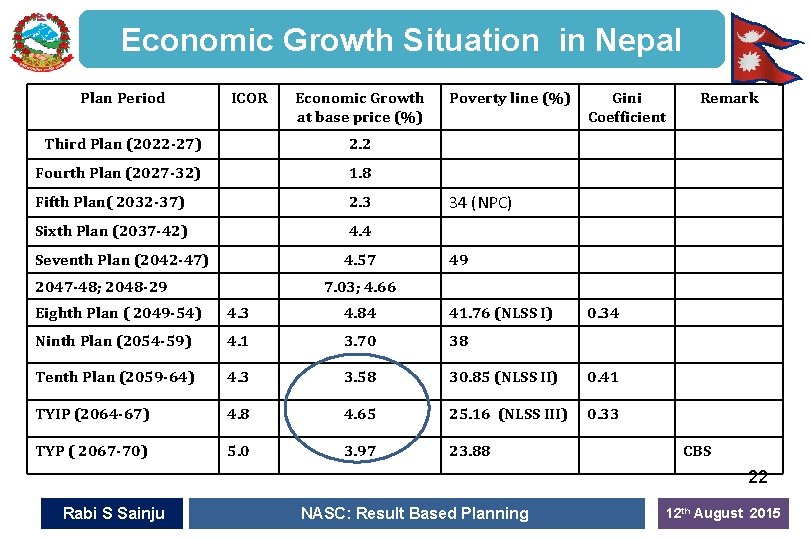
Economic Growth Situation in Nepal Plan Period ICOR Economic Growth at base price (%) Third Plan (2022 -27) 2. 2 Fourth Plan (2027 -32) 1. 8 Fifth Plan( 2032 -37) 2. 3 Sixth Plan (2037 -42) 4. 4 Seventh Plan (2042 -47) 4. 57 2047 -48; 2048 -29 Poverty line (%) Gini Coefficient Remark 34 (NPC) 49 7. 03; 4. 66 Eighth Plan ( 2049 -54) 4. 3 4. 84 41. 76 (NLSS I) 0. 34 Ninth Plan (2054 -59) 4. 1 3. 70 38 Tenth Plan (2059 -64) 4. 3 3. 58 30. 85 (NLSS II) 0. 41 TYIP (2064 -67) 4. 8 4. 65 25. 16 (NLSS III) 0. 33 TYP ( 2067 -70) 5. 0 3. 97 23. 88 CBS 22 Rabi S Sainju NASC: Result Based Planning 12 th August 2015
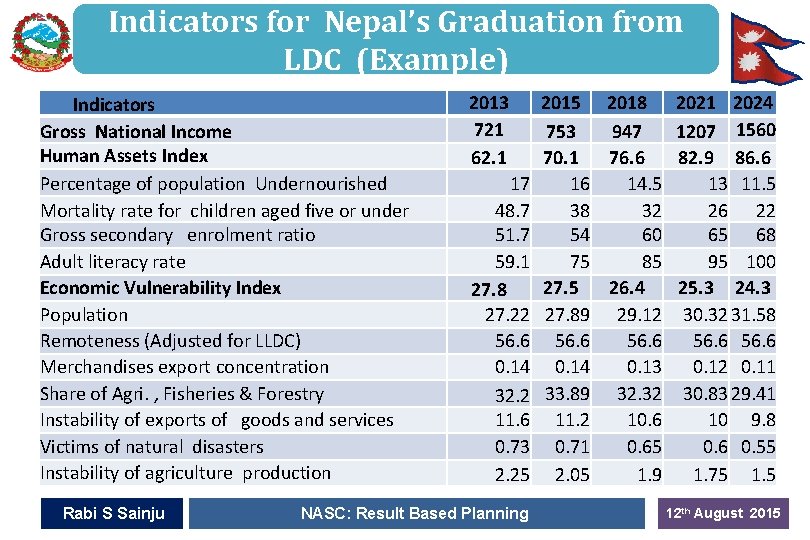
Indicators for Nepal’s Graduation from LDC (Example) Indicators Gross National Income Human Assets Index Percentage of population Undernourished Mortality rate for children aged five or under Gross secondary enrolment ratio Adult literacy rate Economic Vulnerability Index Population Remoteness (Adjusted for LLDC) Merchandises export concentration Share of Agri. , Fisheries & Forestry Instability of exports of goods and services Victims of natural disasters Instability of agriculture production Rabi S Sainju 2013 721 62. 1 17 48. 7 51. 7 59. 1 27. 8 27. 22 56. 6 0. 14 32. 2 11. 6 0. 73 2. 25 NASC: Result Based Planning 2015 2018 753 947 70. 1 76. 6 16 14. 5 38 32 54 60 75 85 27. 5 26. 4 27. 89 29. 12 56. 6 0. 14 0. 13 33. 89 32. 32 11. 2 10. 6 0. 71 0. 65 2. 05 1. 9 2021 2024 1207 1560 82. 9 86. 6 13 11. 5 26 22 65 68 95 100 25. 3 24. 3 30. 32 31. 58 56. 6 0. 12 0. 11 30. 83 29. 41 10 9. 8 0. 6 0. 55 1. 75 1. 5 12 th August 2015
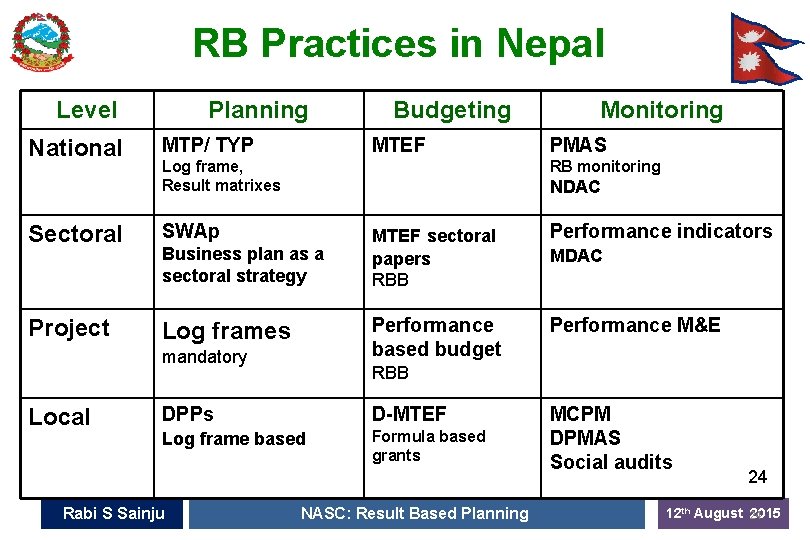
RB Practices in Nepal Level National Planning MTP/ TYP MTEF Log frame, Result matrixes Sectoral SWAp Project Local Budgeting Monitoring PMAS RB monitoring NDAC Performance indicators Business plan as a sectoral strategy MTEF sectoral papers RBB Log frames Performance M&E mandatory Performance based budget DPPs D-MTEF Log frame based Formula based grants Rabi S Sainju MDAC RBB NASC: Result Based Planning MCPM DPMAS Social audits 24 12 th August 24 2015
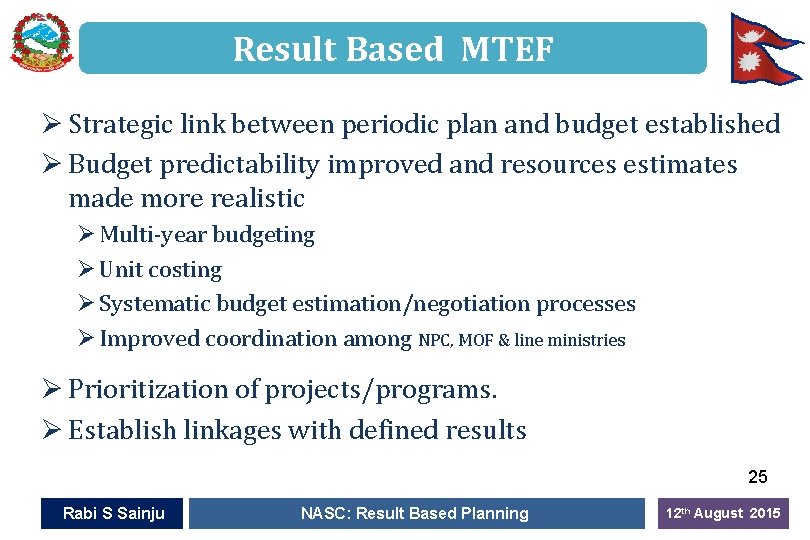
Result Based MTEF Ø Strategic link between periodic plan and budget established Ø Budget predictability improved and resources estimates made more realistic Ø Multi-year budgeting Ø Unit costing Ø Systematic budget estimation/negotiation processes Ø Improved coordination among NPC, MOF & line ministries Ø Prioritization of projects/programs. Ø Establish linkages with defined results 25 Rabi S Sainju NASC: Result Based Planning 12 th August 2015
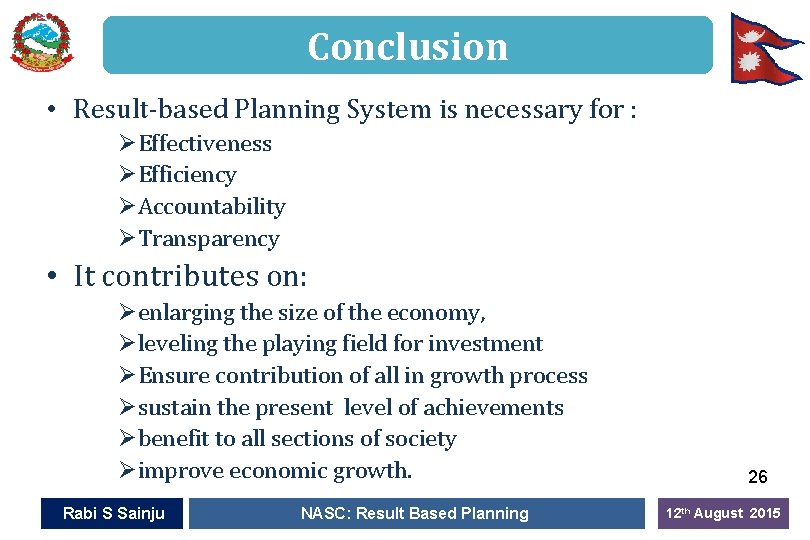
Conclusion • Result-based Planning System is necessary for : ØEffectiveness ØEfficiency ØAccountability ØTransparency • It contributes on: Øenlarging the size of the economy, Øleveling the playing field for investment ØEnsure contribution of all in growth process Øsustain the present level of achievements Øbenefit to all sections of society Øimprove economic growth. Rabi S Sainju NASC: Result Based Planning 26 12 th August 2015
Take home message • Frameworks/tools help in design but are not panacea • Form commitment of leadership needed to proceed results -based reforms • Adopt sequential approaches linking broad-based and pilots • Institutionalization and mainstreaming is necessary • Capacities need to be enhanced • Linking incentive structure with results is vital for the success 27 Rabi S Sainju NASC: Result Based Planning 12 th August 2015
28 Rabi S Sainju NASC: Result Based Planning 12 th August 2015
- Slides: 27