
Restructuring the Math Pipeline for Success Cuyamaca College
- Slides: 23
Restructuring the Math Pipeline for Success Cuyamaca College Math Pathways
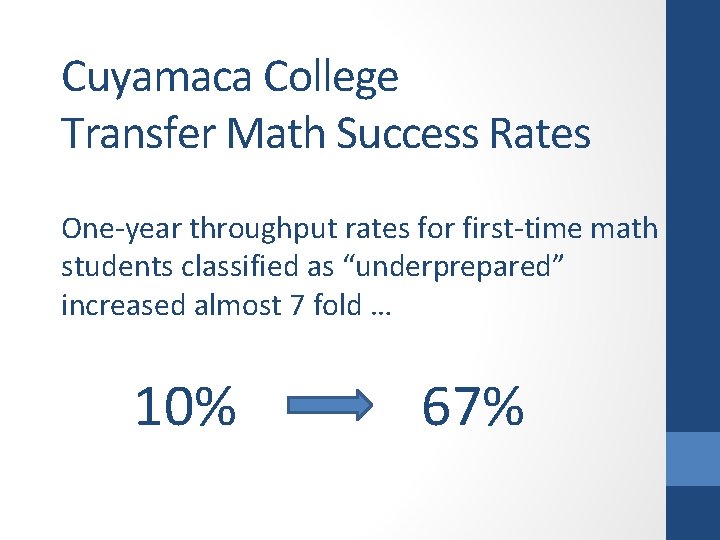
Cuyamaca College Transfer Math Success Rates One-year throughput rates for first-time math students classified as “underprepared” increased almost 7 fold … 10% 67%
Math Pathways Goals • Annihilate the achievement gap • Increase the proportion of incoming students who complete a degree- or transfer-level math course in much less time • Increase the proportion of students who transfer and/or earn a degree or certificate
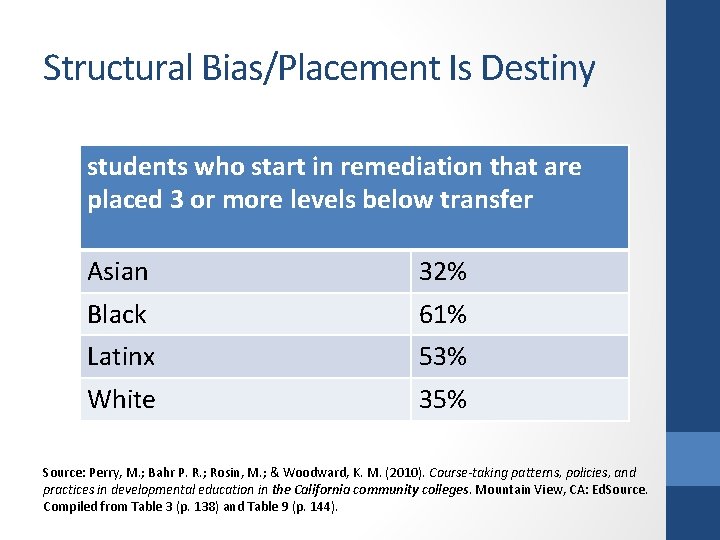
Structural Bias/Placement Is Destiny students who start in remediation that are placed 3 or more levels below transfer Asian 32% Black 61% Latinx 53% White 35% Source: Perry, M. ; Bahr P. R. ; Rosin, M. ; & Woodward, K. M. (2010). Course-taking patterns, policies, and practices in developmental education in the California community colleges. Mountain View, CA: Ed. Source. Compiled from Table 3 (p. 138) and Table 9 (p. 144).
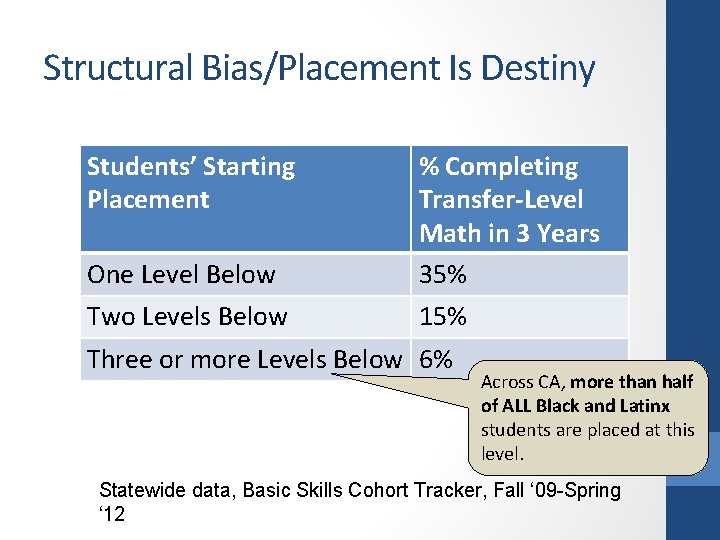
Structural Bias/Placement Is Destiny Students’ Starting Placement One Level Below % Completing Transfer-Level Math in 3 Years 35% Two Levels Below 15% Three or more Levels Below 6% Across CA, more than half of ALL Black and Latinx students are placed at this level. Statewide data, Basic Skills Cohort Tracker, Fall ‘ 09 -Spring ‘ 12
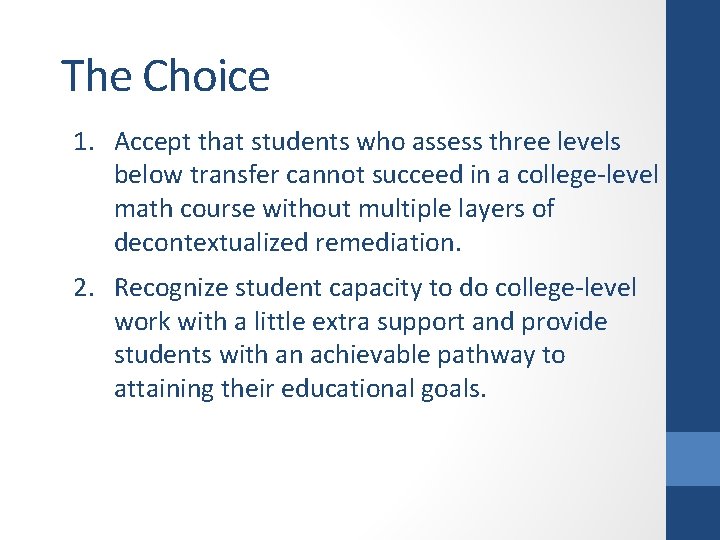
The Choice 1. Accept that students who assess three levels below transfer cannot succeed in a college-level math course without multiple layers of decontextualized remediation. 2. Recognize student capacity to do college-level work with a little extra support and provide students with an achievable pathway to attaining their educational goals.
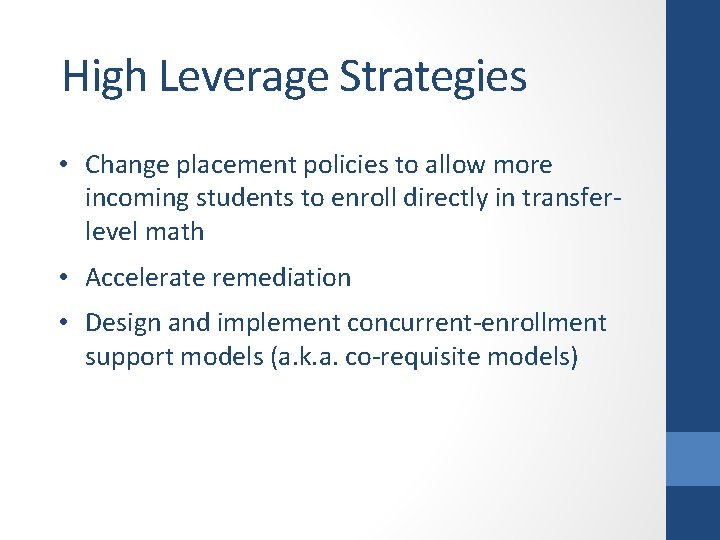
High Leverage Strategies • Change placement policies to allow more incoming students to enroll directly in transferlevel math • Accelerate remediation • Design and implement concurrent-enrollment support models (a. k. a. co-requisite models)
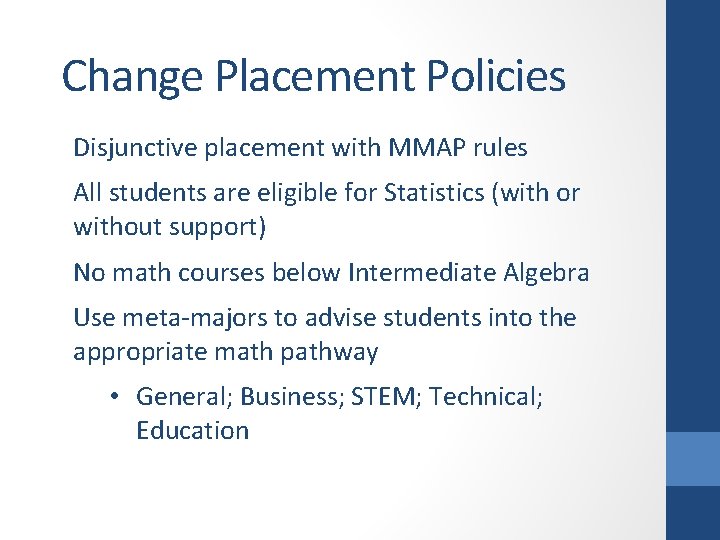
Change Placement Policies Disjunctive placement with MMAP rules All students are eligible for Statistics (with or without support) No math courses below Intermediate Algebra Use meta-majors to advise students into the appropriate math pathway • General; Business; STEM; Technical; Education
Paradigm Shifts in Teaching & Learning • The activity-based math classroom • Intentional support for the affective domain • Change expectations: students, teachers, staff, and administrators
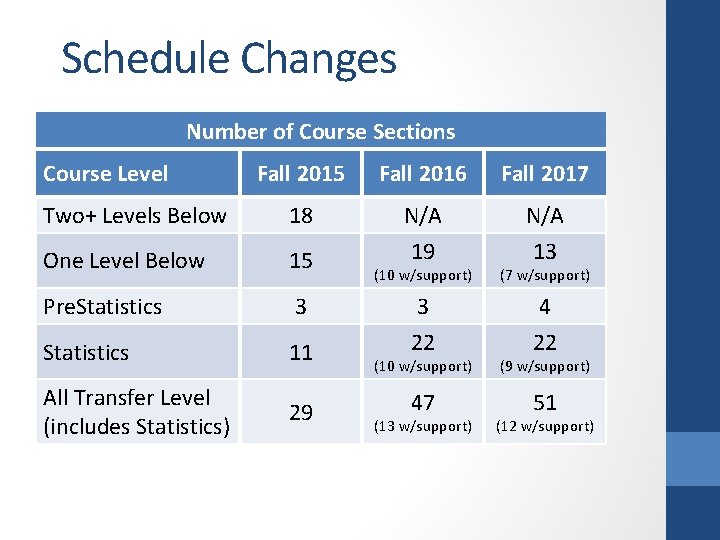
Schedule Changes Number of Course Sections Course Level Fall 2015 Fall 2016 Fall 2017 Two+ Levels Below 18 One Level Below 15 N/A 19 N/A 13 Pre. Statistics 3 Statistics 11 All Transfer Level (includes Statistics) 29 (10 w/support) (7 w/support) 3 22 4 22 (10 w/support) (9 w/support) 47 51 (13 w/support) (12 w/support)
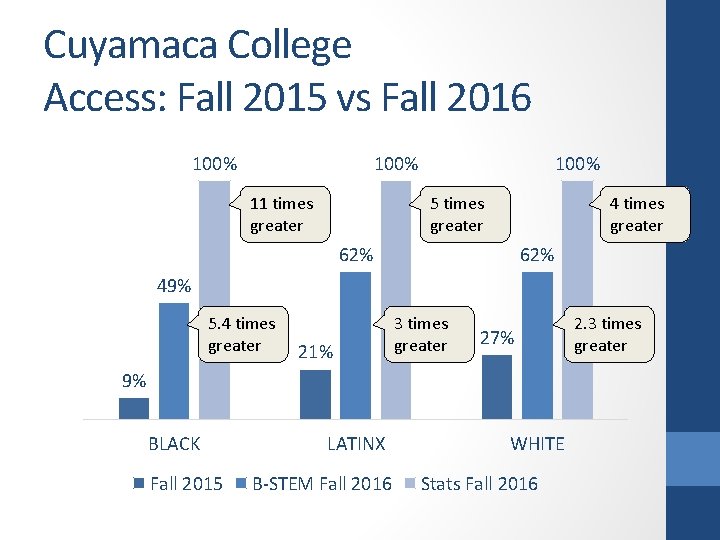
Cuyamaca College Access: Fall 2015 vs Fall 2016 100% 11 times greater 100% 5 times greater 4 times greater 62% 49% 5. 4 times greater 21% 3 times greater 27% 9% BLACK Fall 2015 LATINX B-STEM Fall 2016 WHITE Stats Fall 2016 2. 3 times greater
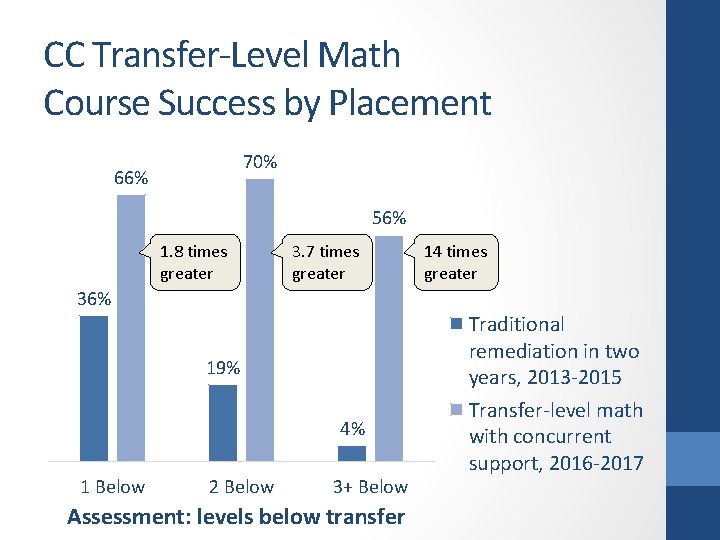
CC Transfer-Level Math Course Success by Placement 70% 66% 56% 1. 8 times greater 3. 7 times greater 36% 19% 4% 1 Below 2 Below 3+ Below Assessment: levels below transfer 14 times greater Traditional remediation in two years, 2013 -2015 Transfer-level math with concurrent support, 2016 -2017
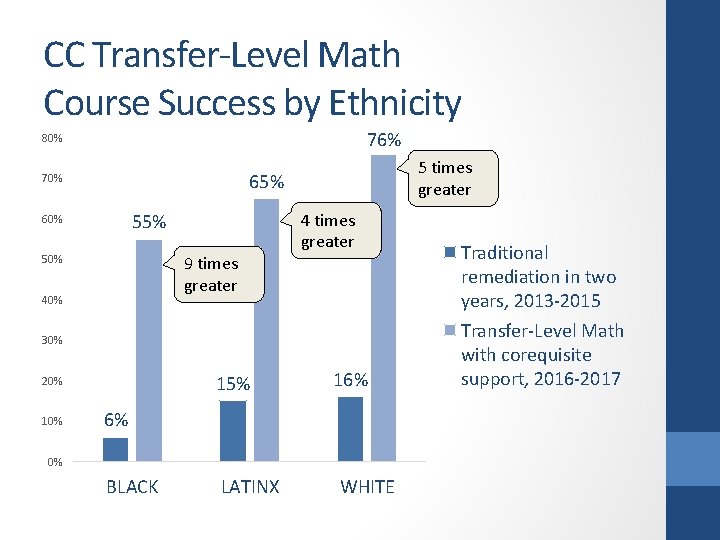
CC Transfer-Level Math Course Success by Ethnicity 76% 80% 5 times greater 65% 70% 4 times greater 55% 60% 50% 9 times greater 40% 30% 15% 20% 16% 6% 0% BLACK LATINX WHITE Traditional remediation in two years, 2013 -2015 Transfer-Level Math with corequisite support, 2016 -2017
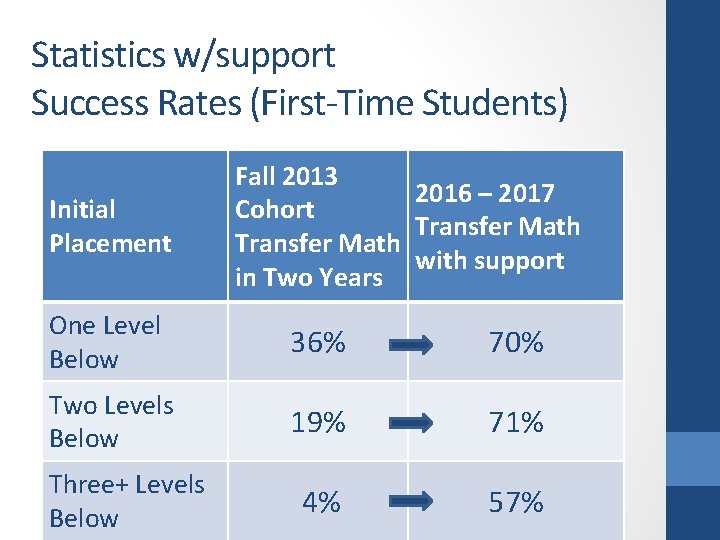
Statistics w/support Success Rates (First-Time Students) Initial Placement Fall 2013 2016 – 2017 Cohort Transfer Math with support in Two Years One Level Below 36% 70% Two Levels Below 19% 71% 4% 57% Three+ Levels Below
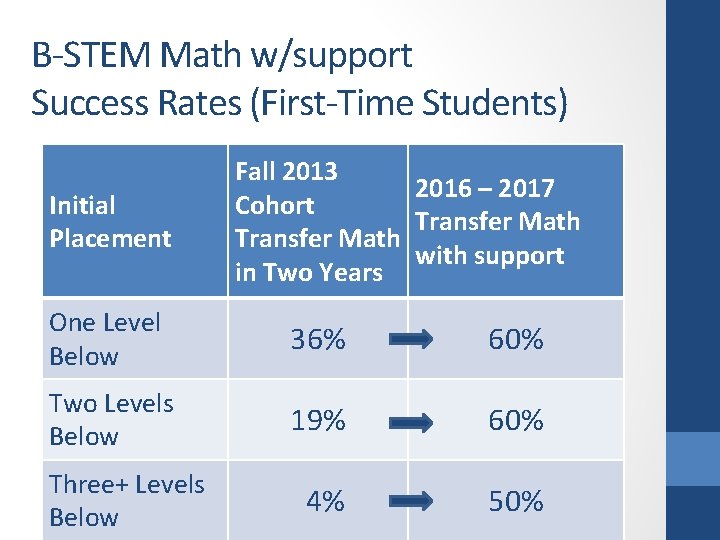
B-STEM Math w/support Success Rates (First-Time Students) Initial Placement Fall 2013 2016 – 2017 Cohort Transfer Math with support in Two Years One Level Below 36% 60% Two Levels Below 19% 60% 4% 50% Three+ Levels Below
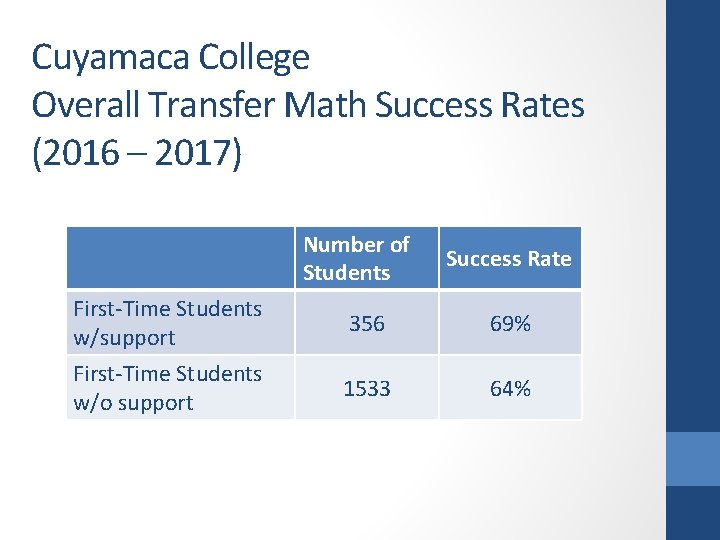
Cuyamaca College Overall Transfer Math Success Rates (2016 – 2017) Number of Students Success Rate First-Time Students w/support 356 69% First-Time Students w/o support 1533 64%
The Latest Question So they get access and they’re more successful in your math classes, but how are they doing in classes with a math prereq?
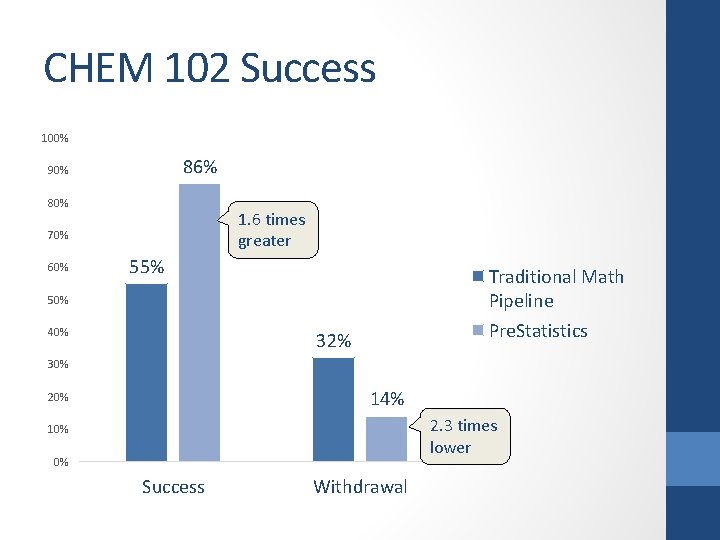
CHEM 102 Success 100% 86% 90% 80% 1. 6 times greater 70% 60% 55% Traditional Math Pipeline Pre. Statistics 50% 40% 32% 30% 14% 20% 2. 3 times lower 10% 0% Success Withdrawal
VOICES OF STUDENTS, FACULTY & COUNSELORS
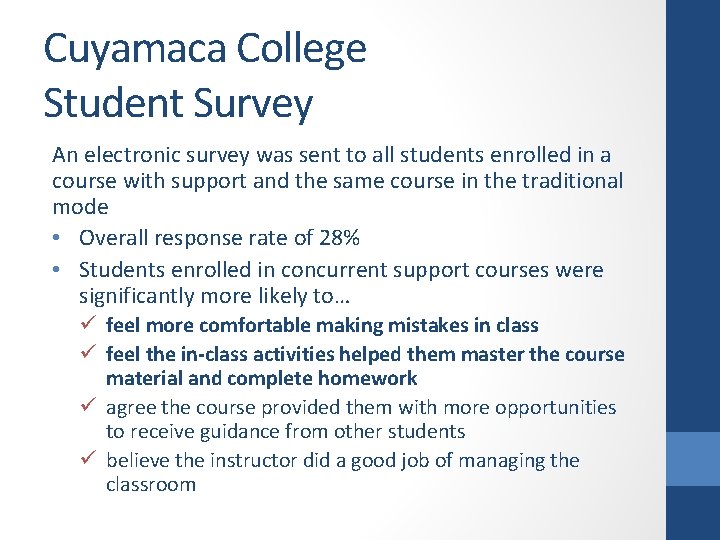
Cuyamaca College Student Survey An electronic survey was sent to all students enrolled in a course with support and the same course in the traditional mode • Overall response rate of 28% • Students enrolled in concurrent support courses were significantly more likely to… ü feel more comfortable making mistakes in class ü feel the in-class activities helped them master the course material and complete homework ü agree the course provided them with more opportunities to receive guidance from other students ü believe the instructor did a good job of managing the classroom
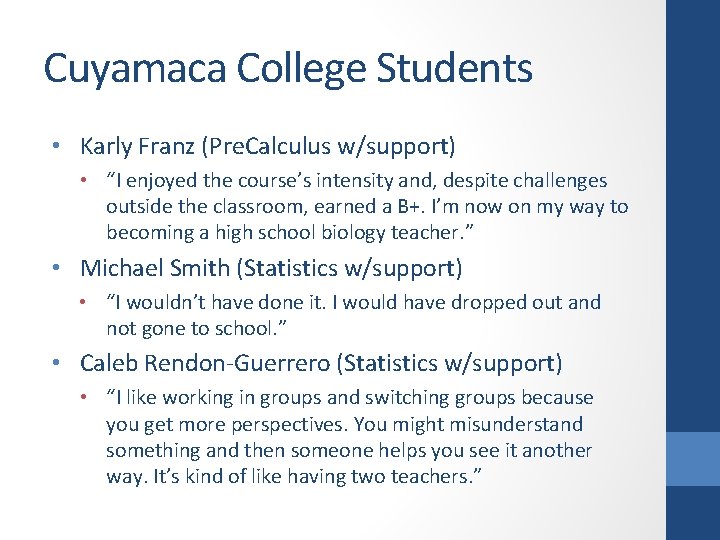
Cuyamaca College Students • Karly Franz (Pre. Calculus w/support) • “I enjoyed the course’s intensity and, despite challenges outside the classroom, earned a B+. I’m now on my way to becoming a high school biology teacher. ” • Michael Smith (Statistics w/support) • “I wouldn’t have done it. I would have dropped out and not gone to school. ” • Caleb Rendon-Guerrero (Statistics w/support) • “I like working in groups and switching groups because you get more perspectives. You might misunderstand something and then someone helps you see it another way. It’s kind of like having two teachers. ”
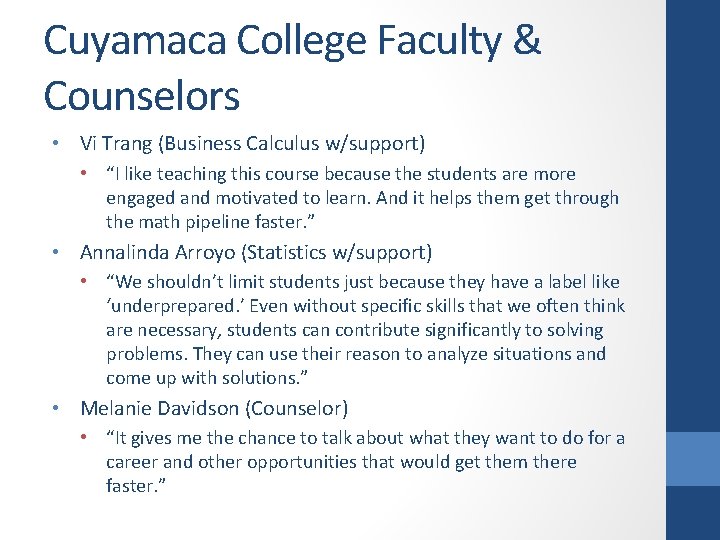
Cuyamaca College Faculty & Counselors • Vi Trang (Business Calculus w/support) • “I like teaching this course because the students are more engaged and motivated to learn. And it helps them get through the math pipeline faster. ” • Annalinda Arroyo (Statistics w/support) • “We shouldn’t limit students just because they have a label like ‘underprepared. ’ Even without specific skills that we often think are necessary, students can contribute significantly to solving problems. They can use their reason to analyze situations and come up with solutions. ” • Melanie Davidson (Counselor) • “It gives me the chance to talk about what they want to do for a career and other opportunities that would get them there faster. ”
Resources & Contacts Tammi Marshall Math Department Chair Cuyamaca College Tammi. Marshall@gcccd. edu Cuyamaca Math Pathways materials https: //app. box. com/s/vkpu 5 ku tm 8 lz 5 ozm 65 flpjcbvug 8 vpfs