
RESTRAINTS AND TIME OUT ROOMS REQUIREMENTS AND ALTERNATIVES


- Slides: 50
RESTRAINTS AND TIME OUT ROOMS: REQUIREMENTS AND ALTERNATIVES: PART 1 Jennifer Zalucky, Behavior Specialist & Educational Consultant Shenendehowa Central School District Julie M. Keegan Esq. , Disability Rights New York: Parent/Student Attorney © NYS Special Education Task Force – March 2015
Session Plan • Overview of legal requirements regarding the use of emergency interventions (restraints) and time out rooms • Concerns related to use of restraint and time out room • Alternatives & best practices • Questions & answers
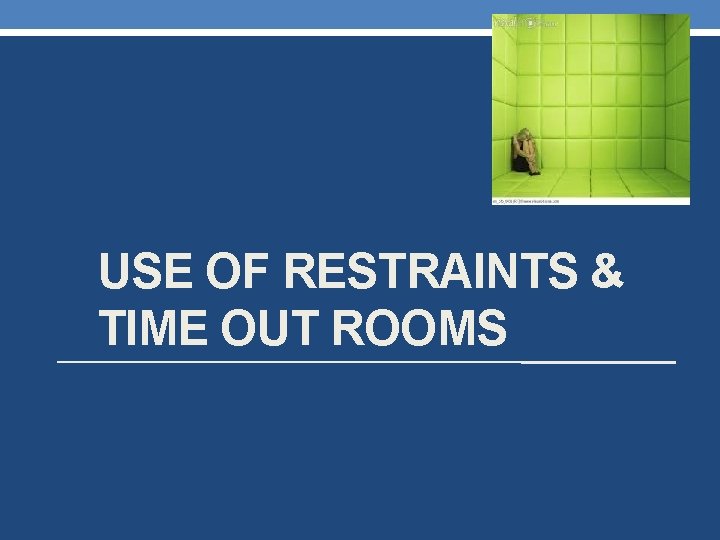
USE OF RESTRAINTS & TIME OUT ROOMS
The Costs of Restraint and Use of Time Out Rooms • Student injuries • Staff injuries • Emotional injuries – trauma, PTSD, anxiety, depression • Impact on other students
Sources & Resources • Dangerous Use of Seclusion and Restraints in Schools Remains Widespread and Difficult to Remedy: A Review of Ten Cases, United States Senate Health, Education, Labor, and Pensions Committee (Feb. 12, 2014) http: //www. help. senate. gov/imo/media/doc/Seclusion%20 a nd%20 Restraints%20 Final%20 Report. pdf • Data Snapshot: School Discipline, U. S. Department of Education Office for Civil Rights, Data Collection Issue Brief No. 1 (March 2014) http: //www 2. ed. gov/about/offices/list/ocr/docs/crdcdiscipline-snapshot. pdf
DRNY Investigative Study • Survey • English: https: //www. surveymonkey. com/s/restraint_seclusion_schools • Spanish: https: //es. surveymonkey. com/s/Restriccion_y_aislamiento_schools • Interviews with survey participants • Review of reports and complaints filed with the NYS Education Department • Review of laws in other states • Review of federal initiatives • Review of research on impact of restraint and seclusion on students
Restraints (“Emergency Interventions”) 8 NYCRR 200. 22 (d) • “Emergency” - a situation in which immediate intervention involving the use of reasonable physical force is necessary; i. e. situations in which non-physical procedures cannot reasonably be employed: 1. to protect oneself from physical injury; 2. to protect another person from physical injury; 3. to protect school property 4. to restrain or remove a pupil whose behavior is interfering with the orderly exercise and performance of school functions, powers and duties, if that pupil has refused to comply with a request to refrain from further disruptive acts.
Use of Restraints: Requirements • Limited Purpose - restraint cannot be used as: 1. Punishment 2. A substitute for systematic behavioral interventions that are designed to change, replace, modify or eliminate a targeted behavior (i. e. a Behavior Intervention Plan)
Definitional Issues/Concerns 1. Physical “Escort” v. Physical Restraint 2. Broad scope of situations in which restraints are permissible • • Situations in which non-physical procedures cannot reasonably be employed. . . to restrain or remove a pupil whose behavior is interfering with the orderly exercise and performance of school functions, powers and duties, if that pupil has refused to comply with a request to refrain from further disruptive acts
Use of Restraints: Requirements, cont’d • Training - staff who may be called upon to use restraints must be trained in safe & effective restraint procedures • Strategies for Crisis Intervention & Prevention (SCIP) • Therapeutic Crisis Intervention (TCI) • “Handle with Care” – new program offered by BOCES • Issues/Concerns • What constitutes “safe & effective” • No statewide training or State-endorsed training • Who determines if student can safely tolerate a physical restraint? • No apparent consequences if untrained staff impose a restraint
Restraints: Required Documentation Each use of restraint must be documented as follows: • Name and date of birth of the student; • The setting and the location of the incident; • The name of the staff or other persons involved; • A description of the incident and the emergency intervention used, including duration; • A statement as to whether the student has a current behavioral intervention plan; and • Details of any injuries sustained by the student or others, including staff, as a result of the incident. Must be submitted to/reviewed by school supervisory personnel and, as necessary, the school nurse or other medical personnel.
Documentation Issues/Concerns Required Documentation does not currently include: • Specific description of events/issues leading to restraint • Description of what non-physical, de-escalation procedures were tried before restraint imposed • Type of restraint • Name of witnesses • Actions that will be taken to avoid future use of restraints. For example: • Alternative de-escalation strategies • Functional behavior assessment & behavior intervention plan (initial or updated) • Crisis intervention plan
Notice to Parents & Others “The parent of the student shall be notified. ” 8 NYCRR 200. 22(d) Issues/Concerns • Notified how? When? What information? • What rights does parent have? • Debriefing ? • Complaint procedure? • Avoiding future restraint?
Use of Time Out Rooms 8 NYCRR 200. 22(c) An area for a student to safely deescalate, regain control and prepare to meet expectations to return to his or her education program. • Must be part of Behavior Intervention Plan • must state maximum duration in room as behavioral consequence. • Parent must be notified TOR is part of BIP. • Parent must be allowed to see room • Exception: TOR can be used for unanticipated situations that pose an immediate concern for the physical safety of a student or others
TOR – Room Specific Requirements • Must provide a means for visual and auditory monitoring of the • • student at all times Must be of adequate size to allow the student to move about and recline comfortably. Wall and floor coverings designed to prevent injury Adequate lighting and ventilation. Room temperature within the normal comfort range. Clean and free of objects and fixtures that could be potentially dangerous to a student. Must be unlocked and the door must be able to be opened from the inside. The use of locked rooms or spaces for purposes of time out is prohibited. Staff shall continuously monitor the student in a time out room.
TOR – General Requirements District must have policy & procedures regarding: 1. Prohibiting placing a student in a locked room or space or in a room where the student cannot be continuously observed and supervised; 2. Time limitations for the use of the time out room; 3. Staff training on the policies and procedures related to the use of time out room; 4. Data collection to monitor the effectiveness of the use of time out rooms; and 5. Information to be provided to parents
Time Out Rooms - Issues/Concerns • Notice to Parents - no legal obligation to inform parent of each time out room incident • Are restraints being used to get the student to the time out room • What happens if student wants to get out? • Disciplinary v. therapeutic uses • No process for debriefing/discussion to prevent future use
Additional Considerations for Restraints and Time Out Rooms • Need for periodic review procedure • Need for written school-wide policies and training on such policies • Need for data reporting and data collection at district level and at state level • Statewide database • Statewide complaint procedure
Restraints and Time Out Rooms: Requirements and Alternatives, Part 2 Jen Zalucky
Restraint and Seclusion: What are the behaviors that lead to: Restraint? Seclusion? How do we get there? >> Stress <<
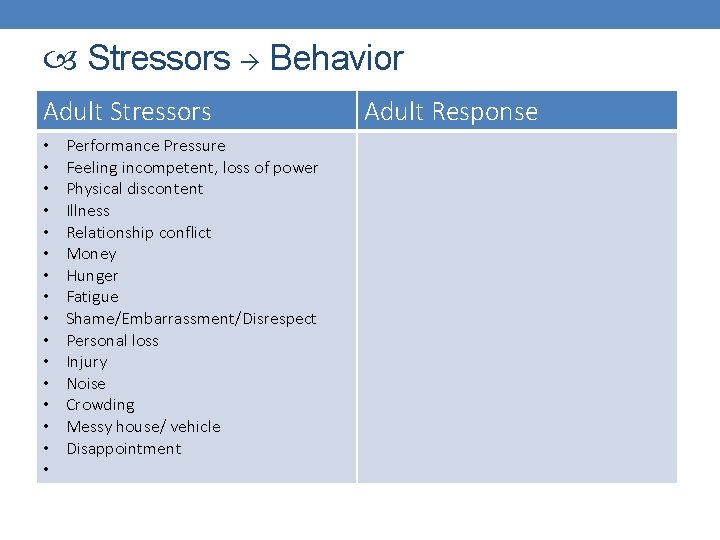
Stressors Behavior Adult Stressors Adult Response
Stressors Behavior Adult Stressors • • • • Performance Pressure Feeling incompetent, loss of power Physical discontent Illness Relationship conflict Money Hunger Fatigue Shame/Embarrassment/Disrespect Personal loss Injury Noise Crowding Messy house/ vehicle Disappointment Adult Response
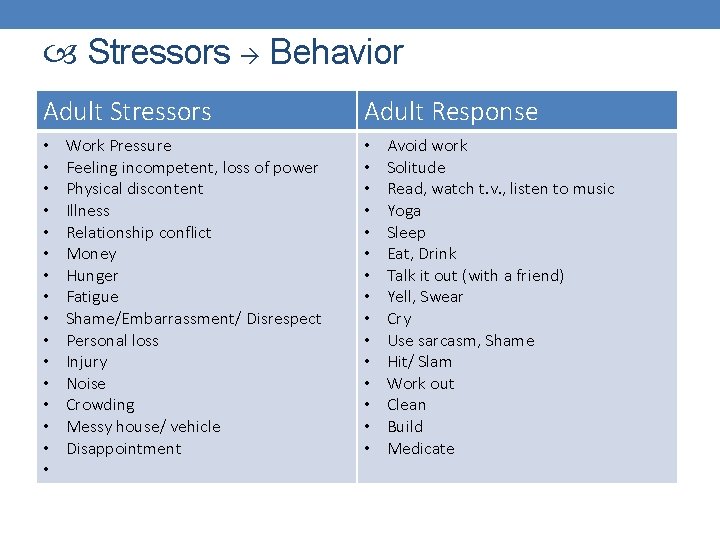
Stressors Behavior Adult Stressors • • • • Work Pressure Feeling incompetent, loss of power Physical discontent Illness Relationship conflict Money Hunger Fatigue Shame/Embarrassment/ Disrespect Personal loss Injury Noise Crowding Messy house/ vehicle Disappointment Adult Response • • • • Avoid work Solitude Read, watch t. v. , listen to music Yoga Sleep Eat, Drink Talk it out (with a friend) Yell, Swear Cry Use sarcasm, Shame Hit/ Slam Work out Clean Build Medicate
Stressors Behavior Student Stressors Student Response
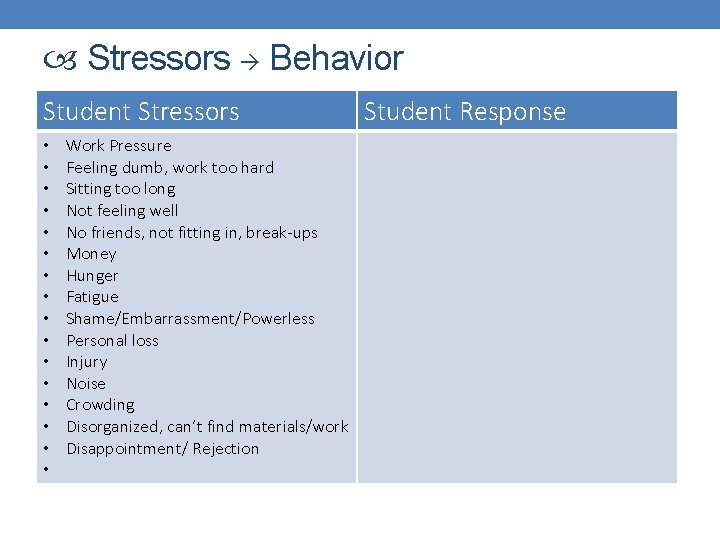
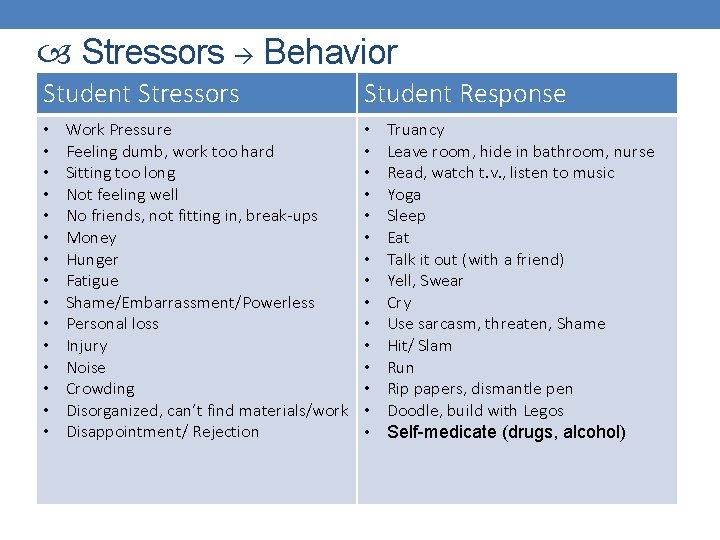
Stressors Behavior Student Stressors • • • • Work Pressure Feeling dumb, work too hard Sitting too long Not feeling well No friends, not fitting in, break-ups Money Hunger Fatigue Shame/Embarrassment/Powerless Personal loss Injury Noise Crowding Disorganized, can’t find materials/work Disappointment/ Rejection Student Response
Stressors Behavior Student Stressors • • • • Work Pressure Feeling dumb, work too hard Sitting too long Not feeling well No friends, not fitting in, break-ups Money Hunger Fatigue Shame/Embarrassment/Powerless Personal loss Injury Noise Crowding Disorganized, can’t find materials/work Disappointment/ Rejection Student Response • • • • Truancy Leave room, hide in bathroom, nurse Read, watch t. v. , listen to music Yoga Sleep Eat Talk it out (with a friend) Yell, Swear Cry Use sarcasm, threaten, Shame Hit/ Slam Run Rip papers, dismantle pen Doodle, build with Legos Self-medicate (drugs, alcohol)
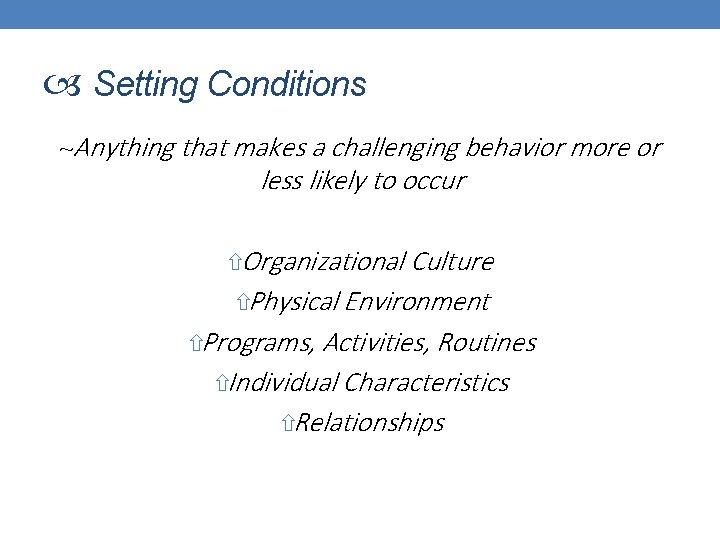
Setting Conditions ~Anything that makes a challenging behavior more or less likely to occur Organizational Culture Physical Environment Programs, Activities, Routines Individual Characteristics Relationships
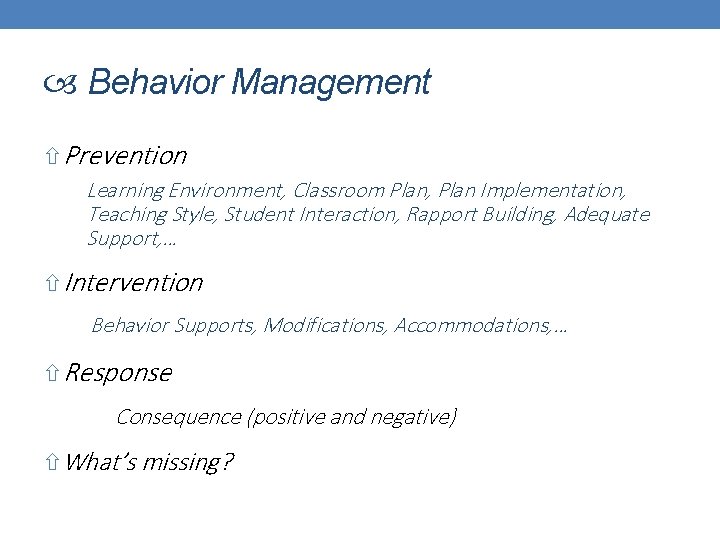
Behavior Management Prevention Learning Environment, Classroom Plan, Plan Implementation, Teaching Style, Student Interaction, Rapport Building, Adequate Support, … Intervention Behavior Supports, Modifications, Accommodations, … Response Consequence (positive and negative) What’s missing?
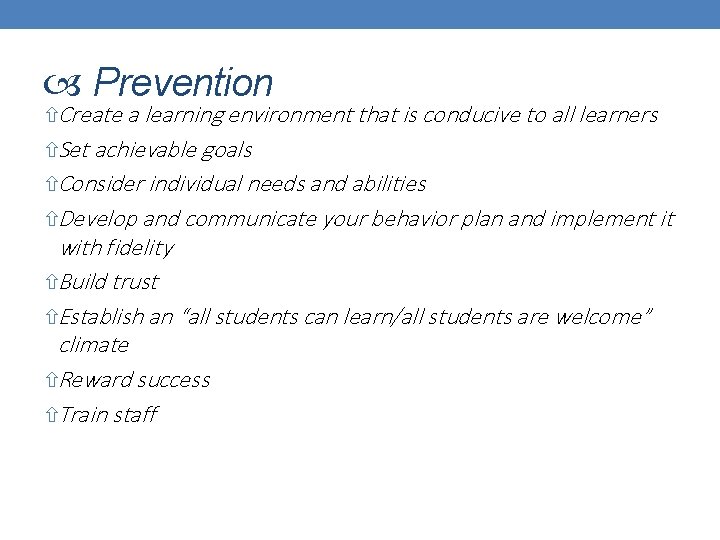
Prevention Create a learning environment that is conducive to all learners Set achievable goals Consider individual needs and abilities Develop and communicate your behavior plan and implement it with fidelity Build trust Establish an “all students can learn/all students are welcome” climate Reward success Train staff
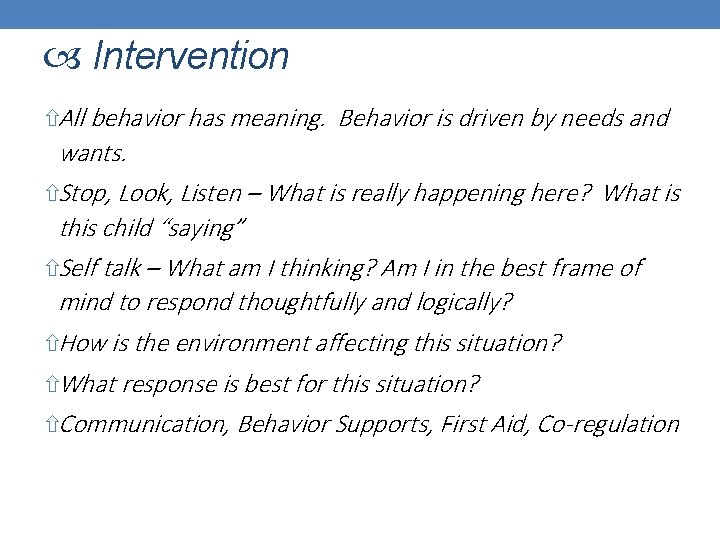
Intervention All behavior has meaning. Behavior is driven by needs and wants. Stop, Look, Listen – What is really happening here? What is this child “saying” Self talk – What am I thinking? Am I in the best frame of mind to respond thoughtfully and logically? How is the environment affecting this situation? What response is best for this situation? Communication, Behavior Supports, First Aid, Co-regulation
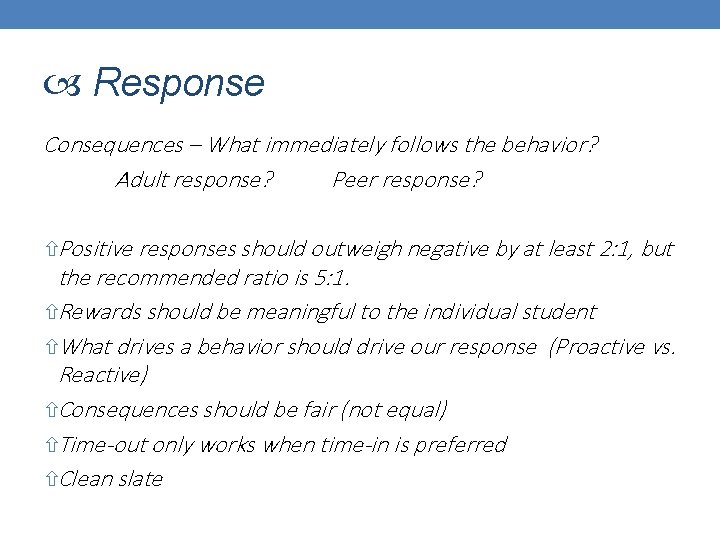
Response Consequences – What immediately follows the behavior? Adult response? Peer response? Positive responses should outweigh negative by at least 2: 1, but the recommended ratio is 5: 1. Rewards should be meaningful to the individual student What drives a behavior should drive our response (Proactive vs. Reactive) Consequences should be fair (not equal) Time-out only works when time-in is preferred Clean slate
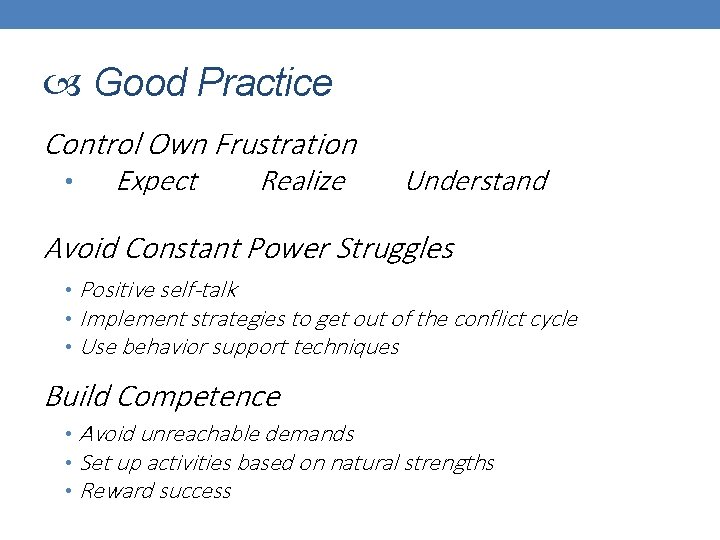
Good Practice Control Own Frustration • Expect Realize Understand Avoid Constant Power Struggles • • • Positive self-talk Implement strategies to get out of the conflict cycle Use behavior support techniques Build Competence • • • Avoid unreachable demands Set up activities based on natural strengths Reward success
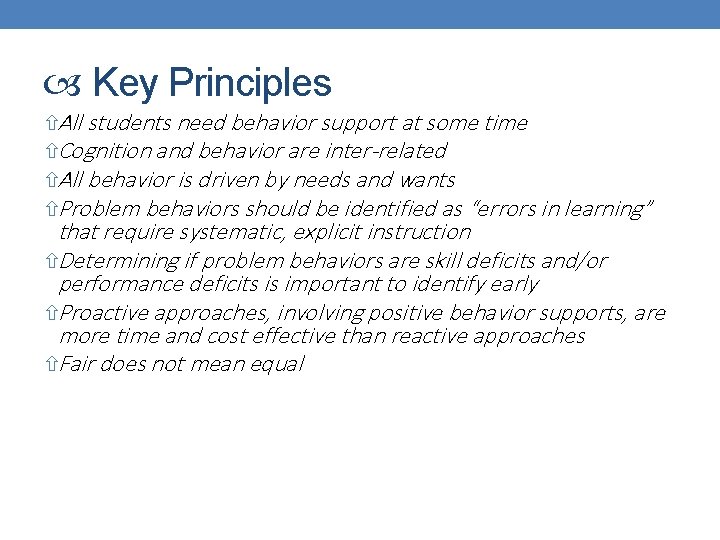
Key Principles All students need behavior support at some time Cognition and behavior are inter-related All behavior is driven by needs and wants Problem behaviors should be identified as “errors in learning” that require systematic, explicit instruction Determining if problem behaviors are skill deficits and/or performance deficits is important to identify early Proactive approaches, involving positive behavior supports, are more time and cost effective than reactive approaches Fair does not mean equal
Crisis ~A crisis occurs when a child’s inability to cope results in a change in behavior ~A crisis is a collision of setting conditions and triggers Sometimes, behavioral display results in a level of physical behavior that poses an imminent threat to the safety of self or other which requires a physical response, but not always.
Crisis Intervention, Goals & Outcome Goal: To Support and Teach To provide support in a way that reduces stress and risk To teach more alternative, prosocial ways of handling stress Outcome: Decrease in Undesired Behavior Increase in Prosocial Behavior Feel Safe Learn
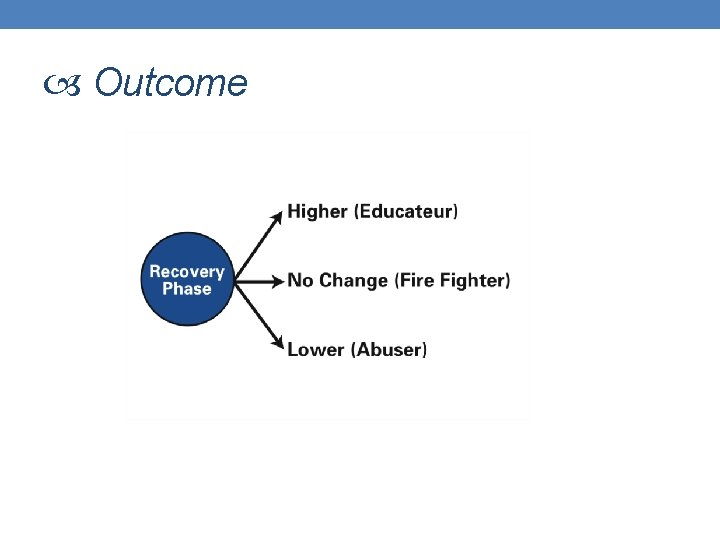
Outcome
Regulations May provide reasonable force…(see Julie’s slides) Incumbent upon all agencies to provide training to all staff who work with students who have higher risk of exhibiting such behaviors
Crisis Intervention Programs Examples… Strategies in Crisis Prevention and Intervention (SCIP) Crisis Prevention Institute (CPI) Therapeutic Crisis Intervention (TCI) TCI is a program developed through Cornell University. The aim of the program was to create a model for various agencies to use in their efforts to prevent crises from occurring, de-escalate potential crises, and manage acute behavior by teaching students positive coping skills and creating positive learning environments. • TCI is research-based guidelines for implementing strategies to reduce high -risk interventions. •
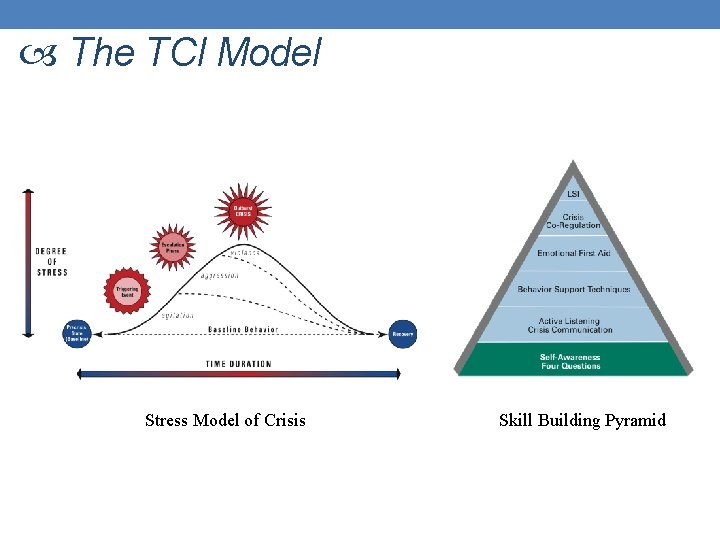
The TCI Model Stress Model of Crisis Skill Building Pyramid
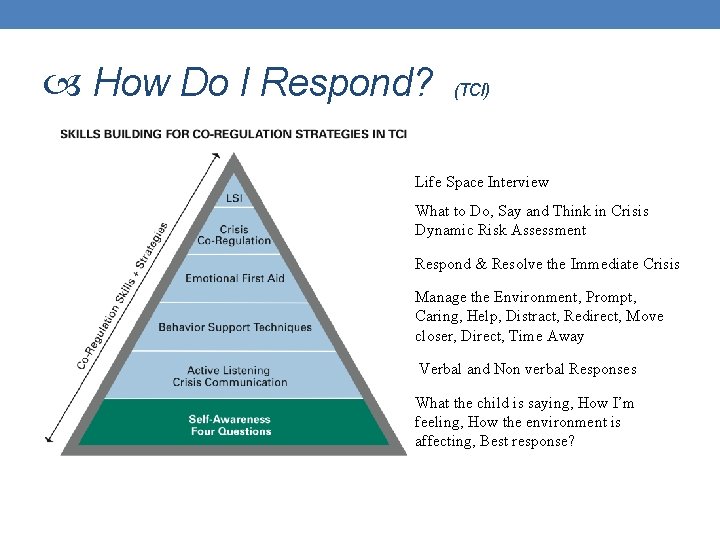
How Do I Respond? (TCI) Life Space Interview What to Do, Say and Think in Crisis Dynamic Risk Assessment Respond & Resolve the Immediate Crisis Manage the Environment, Prompt, Caring, Help, Distract, Redirect, Move closer, Direct, Time Away Verbal and Non verbal Responses What the child is saying, How I’m feeling, How the environment is affecting, Best response?
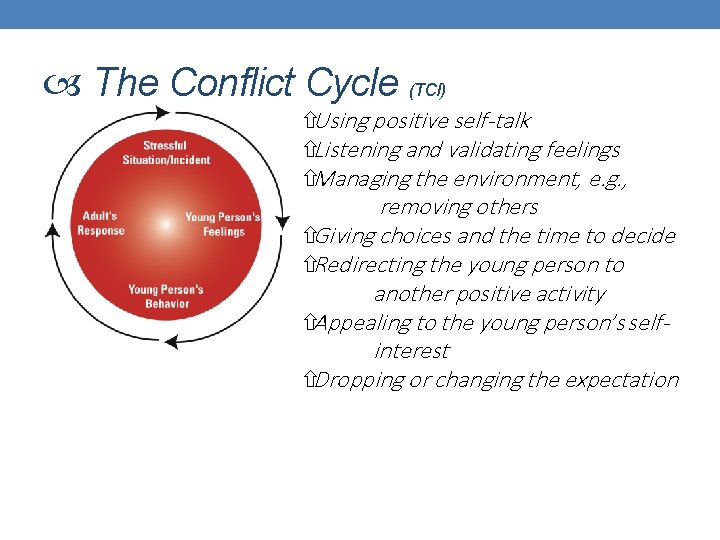
The Conflict Cycle (TCI) Using positive self-talk Listening and validating feelings Managing the environment, e. g. , removing others Giving choices and the time to decide Redirecting the young person to another positive activity Appealing to the young person’s selfinterest Dropping or changing the expectation
Physical Restraint Should Only Be Used When. . (All three must be met) Agency policies and state regulations approve restraint Young person’s Individual Crisis Management Plan indicates it (ICMP) Our professional dynamic risk assessment indicates it
Individual Crisis Management Plan ~Plan to respond to high risk behaviors Safety Concerns/Warning (medical, physical, psychological) Potential Triggers (personal, family, social, etc. ) High Risk Behaviors (what are people likely to see? ) Intervention Strategies for: Pre-Crisis, Triggering, Escalation, Outburst, Recovery Emergency Contacts Review Date for ICMP and by whom?
Physical Restraint Should Never Be Used to. . . (TCI) Demonstrate Authority Enforce Compliance Inflict pain or harm Punish or discipline
Physical Restraint Should Not Be Used If… (TCI) You cannot control the young person safely You are not in control or are too angry Sexual stimulation is the motivation You are in a public place Young person has a weapon Young person’s medical condition prohibits it Young person has emotional problems risking re-traumatization Young person is on medication(s) that affects his/her system
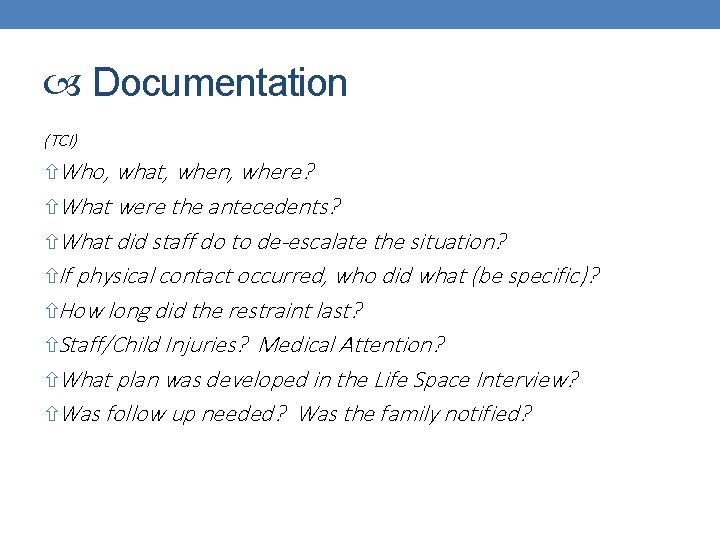
Documentation (TCI) Who, what, when, where? What were the antecedents? What did staff do to de-escalate the situation? If physical contact occurred, who did what (be specific)? How long did the restraint last? Staff/Child Injuries? Medical Attention? What plan was developed in the Life Space Interview? Was follow up needed? Was the family notified?
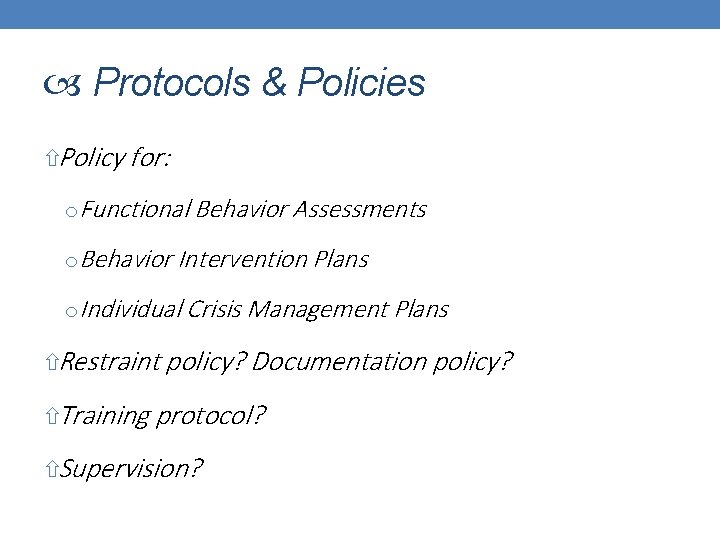
Protocols & Policies Policy for: o Functional Behavior Assessments o Behavior Intervention Plans o Individual Crisis Management Plans Restraint policy? Documentation policy? Training protocol? Supervision?
Final thoughts… “Children do well if they can. If they’re not doing well, something is standing in their way. ” ~Ross Greene, Author of the Explosive Child