
Restraint of Power Philip Selznick The one to
- Slides: 6
Restraint of Power
Philip Selznick • The one to develop a standard to asses the quality of a country’s laws. • He was a professor at the faculty of law at Stanford University. • Was on of the founding directors of The Centre for the Study of Law and Society.
Concept of Restraint of Power • He argued that the essence of a law did not lie in “the exercise of power and control, but in the predictable restraint on those using that power” • By his standard to asses the quality of a country’s laws there must be an independent branch of government or body to be able to review, challenge or limit the laws made by the ruling government.
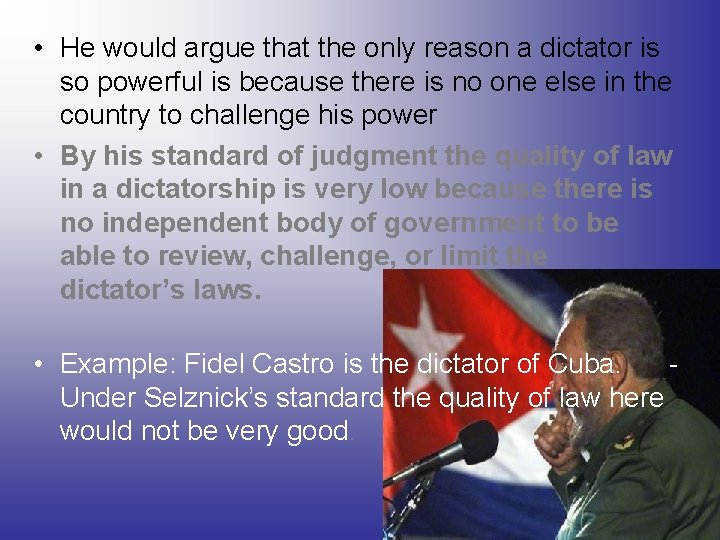
• He would argue that the only reason a dictator is so powerful is because there is no one else in the country to challenge his power • By his standard of judgment the quality of law in a dictatorship is very low because there is no independent body of government to be able to review, challenge, or limit the dictator’s laws. • Example: Fidel Castro is the dictator of Cuba. Under Selznick’s standard the quality of law here would not be very good.
Canada • Canada has had the restraint of government power even before the Canadian Charter of Rights and Freedoms was passed. • Canadian citizens go to court to challenge the government’s laws when they feel their legal rights have been violated
Roncarelli vs. Duplessis • Roncarelli posted bail for 400 Jehovah’s Witnesses before Quebec Premier could order the QLC to cancel the liquor license for Roncarelli’s restaurant. • Roncarelli sued Duplessis for damages and was awarded $25 000 by the Superior Court of Quebec. The Quebec Court of Appeal overturned that judgment, so Roncarelli took the case to the Supreme Court. • The Supreme Court overturned the Court of Appeal’s judgment. The court found the premier’s action to be a “gross abuse of legal power” VS