
Restorative Practices Restorative Loudoun County Public Schools Practices
Restorative Practices Restorative Loudoun County Public Schools Practices Loudoun County Public Schools MSAAC & SEAC Presentation November 20, 2019 • MSAAC & SEAC Presentation • November 20, 2019 Clark Bowers, Ed. D. , Director of Student Services • Clark Bowers, Ed. D. , Director of Student Mr. Darren Madison, Services Student Assistance Specialist/RP Trainer • Department of Pupil Services

What Are Restorative Practices (RP) Restorative practices: LCPS Restorative Practices offer a continuum of services to promote a safe and inclusive environment for all students. Restorative language helps children understand how their behavior affects and impacts others while discouraging harmful behavior. Restorative circles create a culture of belonging and help build community and connection. Restorative conferencing provides an opportunity and process for students and families to resolve conflict and repair harm that has occurred.
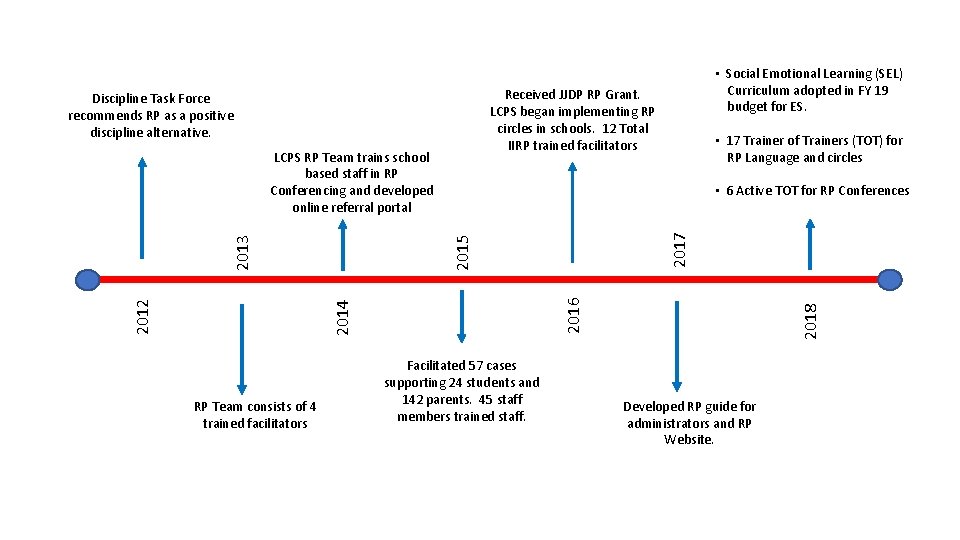
Received JJDP RP Grant. LCPS began implementing RP circles in schools. 12 Total IIRP trained facilitators Discipline Task Force recommends RP as a positive discipline alternative. LCPS RP Team trains school based staff in RP Conferencing and developed online referral portal • 17 Trainer of Trainers (TOT) for RP Language and circles 2017 • 6 Active TOT for RP Conferences Facilitated 57 cases supporting 24 students and 142 parents. 45 staff members trained staff. 2018 2014 2016 2015 2013 2012 RP Team consists of 4 trained facilitators • Social Emotional Learning (SEL) Curriculum adopted in FY 19 budget for ES. Developed RP guide for administrators and RP Website.
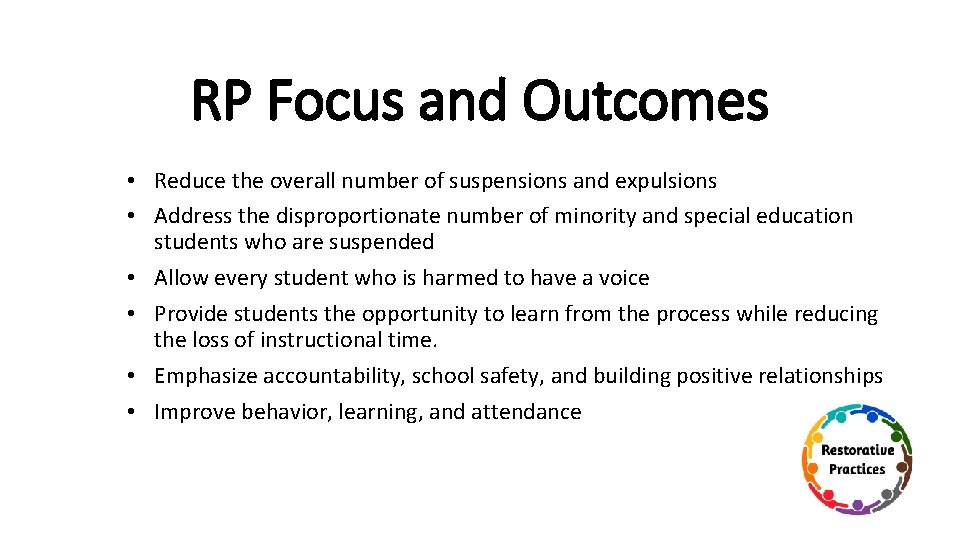
RP Focus and Outcomes • Reduce the overall number of suspensions and expulsions • Address the disproportionate number of minority and special education students who are suspended • Allow every student who is harmed to have a voice • Provide students the opportunity to learn from the process while reducing the loss of instructional time. • Emphasize accountability, school safety, and building positive relationships • Improve behavior, learning, and attendance
Where to begin
Framework of a Restorative School Team PBIS Team RP Facilitator Training RP Language/Circle Training RP Introduction to School Leaders RP Introduction to School Staff Introduction to Circles through Advisory lessons • Unified Mental Health Team • • •
Framework of a Restorative Classroom • • • Restorative Language Restorative Classroom Circles School Administration Support Unified Mental Health Team Support District RP Support & Training
Benefits to Students • Promotes school safety • Defines norms for all students • Develops SEL skills: • • • Empathy, Awareness of the impact of student choices (behavior, words, gestures), Conflict resolution, Kindness and tolerance, Community values, and Communication Skills Allows student voice Provides alternative disciplinary strategy Limits time out-of-school or the classroom Introduces skills that translate into life skills, resiliency, and positive mental health outcomes
Restorative Strategies
Restorative Practices Language Tier 1, 2, and 3 1. RP Language is the building block of the school culture. (Tier 1 and 2) • Includes affective questions and statements that focus on the behavior of the listener and not their character. 2. Conflict Recognition: (Tier 3) • Connects and affirms all participants • Sharing emotions “getting real” makes it possible to restore relationships • Focus is on behavior, not the person. • Encourages students to share their perspectives and feelings in a safe environment. • Does not protect students from the consequences of their behavior.
Restorative Practices – RP Circles Tier 1 & 2 1. Community Building Circles – Builds connections between students within entire school community 2. Classroom Circles o Assists with classroom management o Builds positive relationships and cohesion between students o Used to model expectations and allow student voice 3. Impromptu and Responsive Circles - Proactive and preventative. Focuses on a specific topic of concern. Designed to resolve or prevent conflicts/behavior issues.
Restorative Practices – Restorative Conferencing Tier 3 To be used as a positive discipline alternative in lieu of suspensions or expulsions • Used for incidences when harm has been done and discipline is being considered. • Facilitated by trained conference facilitators • Referred by school administrators
Restorative Practices – Restorative Conferencing Tier 3 REFERRAL • School administrator makes recommendation for RP and receives parent permission • School administrators enter referral in to central office on-line database • RP case is assigned to Regional RP Leader • Case is assigned to school-based staff if they are RP trained or another LCPS trainer. • Conference is held if both parties agree (if not, alternative strategies and/or interventions will be discussed by MTSS team). • RP outcome data is entered into central office database
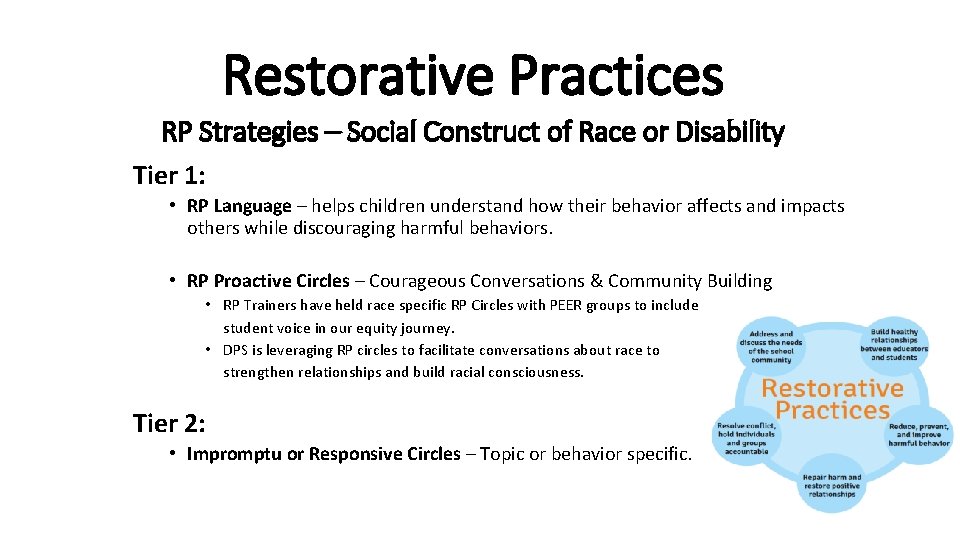
Restorative Practices RP Strategies – Social Construct of Race or Disability Tier 1: • RP Language – helps children understand how their behavior affects and impacts others while discouraging harmful behaviors. • RP Proactive Circles – Courageous Conversations & Community Building • RP Trainers have held race specific RP Circles with PEER groups to include student voice in our equity journey. • DPS is leveraging RP circles to facilitate conversations about race to strengthen relationships and build racial consciousness. Tier 2: • Impromptu or Responsive Circles – Topic or behavior specific.
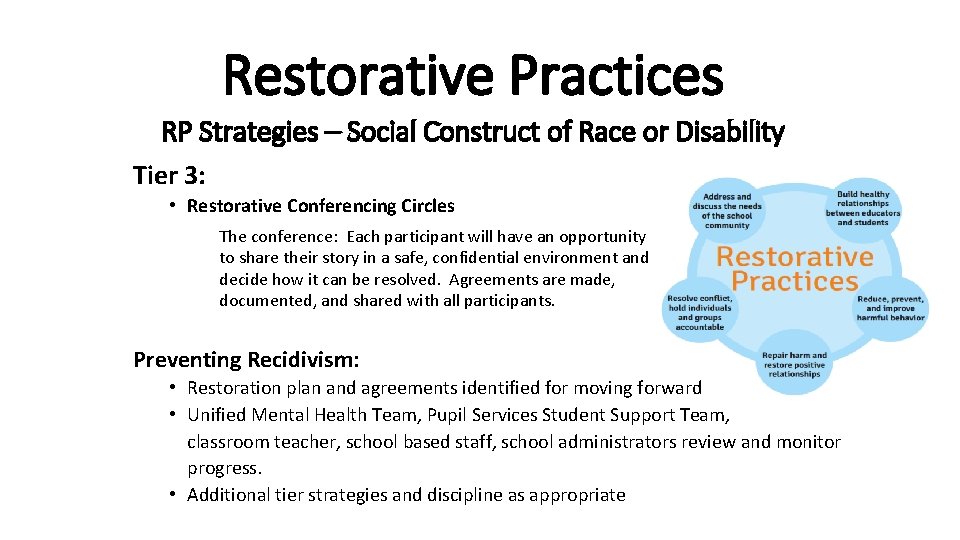
Restorative Practices RP Strategies – Social Construct of Race or Disability Tier 3: • Restorative Conferencing Circles The conference: Each participant will have an opportunity to share their story in a safe, confidential environment and decide how it can be resolved. Agreements are made, documented, and shared with all participants. Preventing Recidivism: • Restoration plan and agreements identified for moving forward • Unified Mental Health Team, Pupil Services Student Support Team, classroom teacher, school based staff, school administrators review and monitor progress. • Additional tier strategies and discipline as appropriate
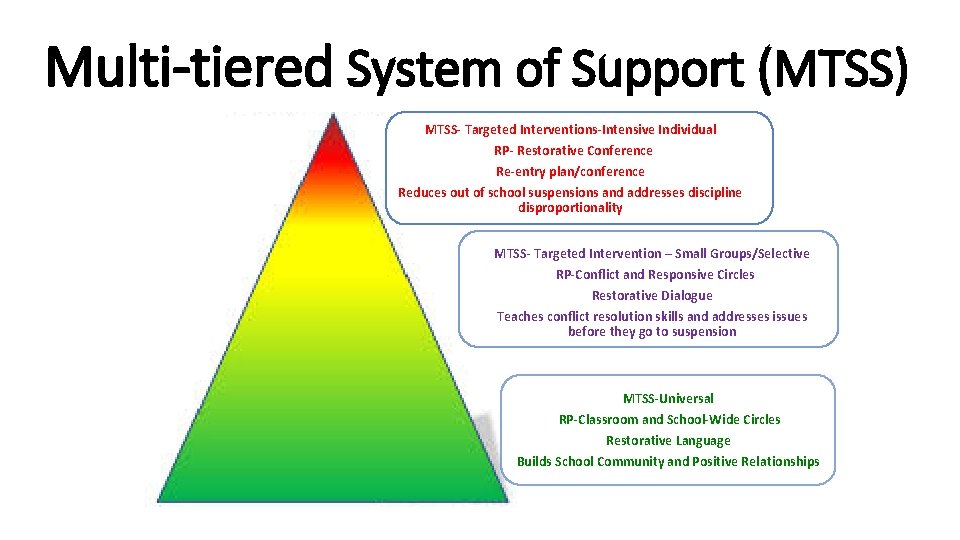
Multi-tiered System of Support (MTSS) MTSS- Targeted Interventions-Intensive Individual RP- Restorative Conference Re-entry plan/conference Reduces out of school suspensions and addresses discipline disproportionality MTSS- Targeted Intervention – Small Groups/Selective RP-Conflict and Responsive Circles Restorative Dialogue Teaches conflict resolution skills and addresses issues before they go to suspension MTSS-Universal RP-Classroom and School-Wide Circles Restorative Language Builds School Community and Positive Relationships
- Slides: 17