
Restorative Practices in the Classroom A practical guide
- Slides: 28
Restorative Practices in the Classroom: A practical guide to facilitating community circles and harm circles Jessica Johnson Junior High Science Teacher jessjohn 1988@gmail. com
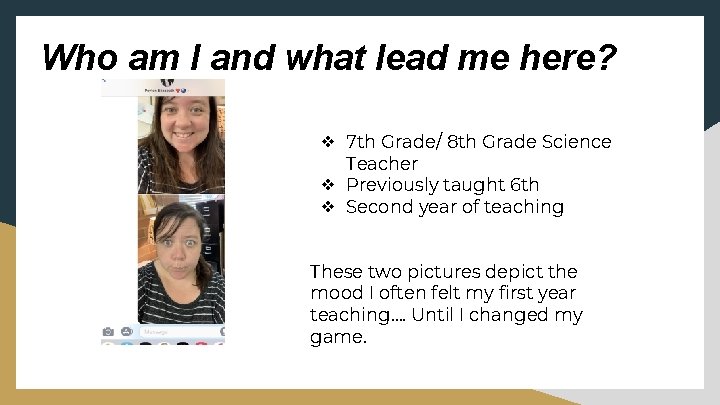
Who am I and what lead me here? ❖ 7 th Grade/ 8 th Grade Science Teacher ❖ Previously taught 6 th ❖ Second year of teaching These two pictures depict the mood I often felt my first year teaching…. Until I changed my game.
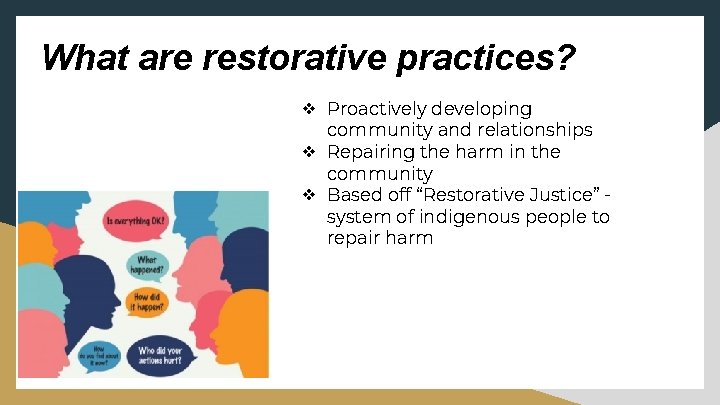
What are restorative practices? ❖ Proactively developing community and relationships ❖ Repairing the harm in the community ❖ Based off “Restorative Justice” system of indigenous people to repair harm
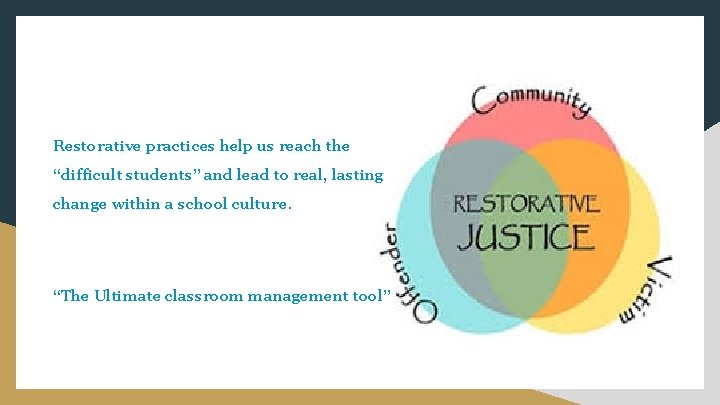
Restorative practices help us reach the “difficult students” and lead to real, lasting change within a school culture. “The Ultimate classroom management tool”
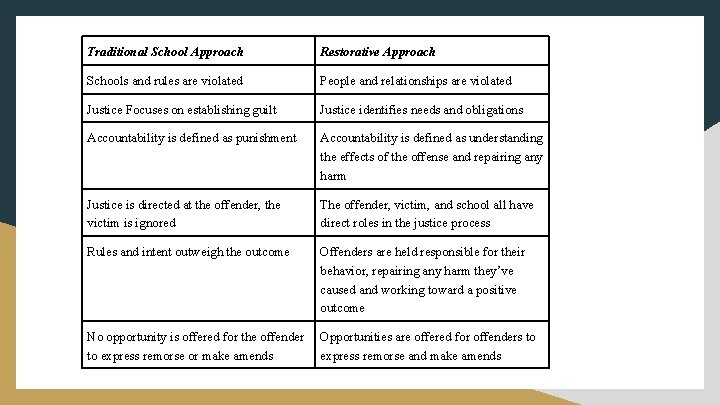
Traditional School Approach Restorative Approach Schools and rules are violated People and relationships are violated Justice Focuses on establishing guilt Justice identifies needs and obligations Accountability is defined as punishment Accountability is defined as understanding the effects of the offense and repairing any harm Justice is directed at the offender, the victim is ignored The offender, victim, and school all have direct roles in the justice process Rules and intent outweigh the outcome Offenders are held responsible for their behavior, repairing any harm they’ve caused and working toward a positive outcome No opportunity is offered for the offender to express remorse or make amends Opportunities are offered for offenders to express remorse and make amends
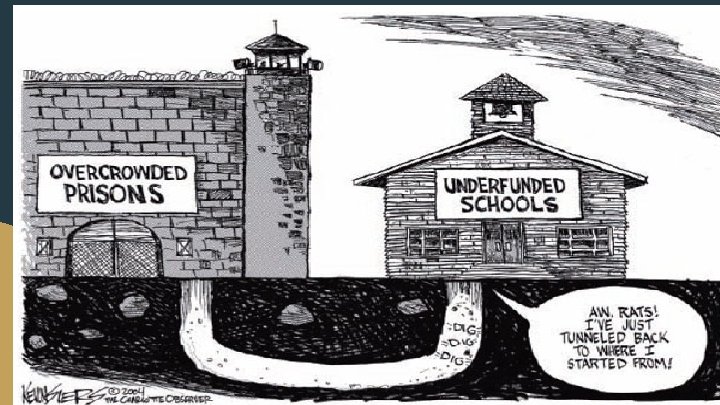
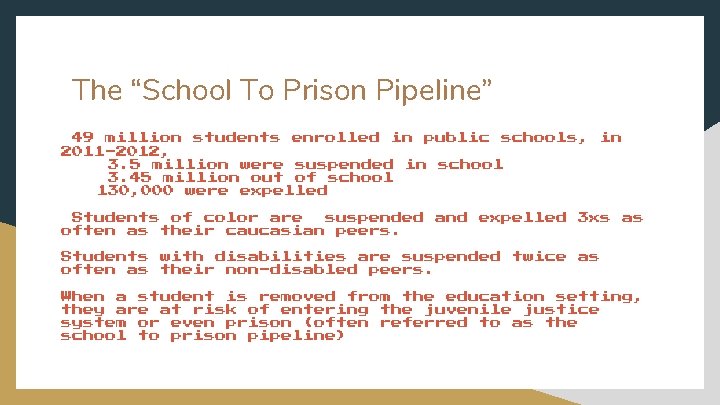
The “School To Prison Pipeline” 49 million students enrolled in public schools, 2011 -2012, 3. 5 million were suspended in school 3. 45 million out of school 130, 000 were expelled Students of color are suspended often as their caucasian peers. Students often as and expelled with disabilities are suspended their non-disabled peers. twice in 3 xs as as When a student is removed from the education setting, they are at risk of entering the juvenile justice system or even prison (often referred to as the school to prison pipeline)
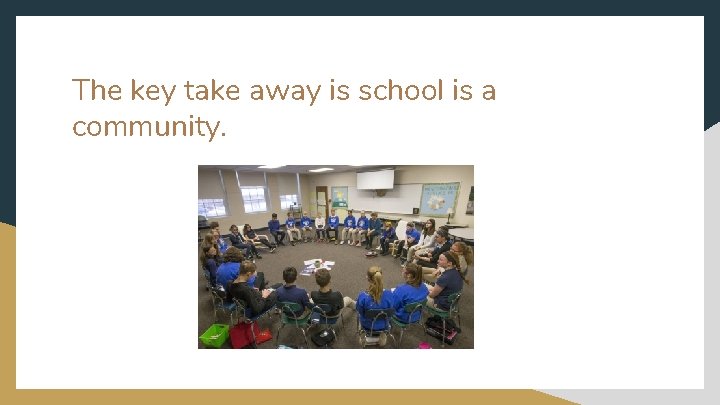
The key take away is school is a community.
Restorative Practices Video
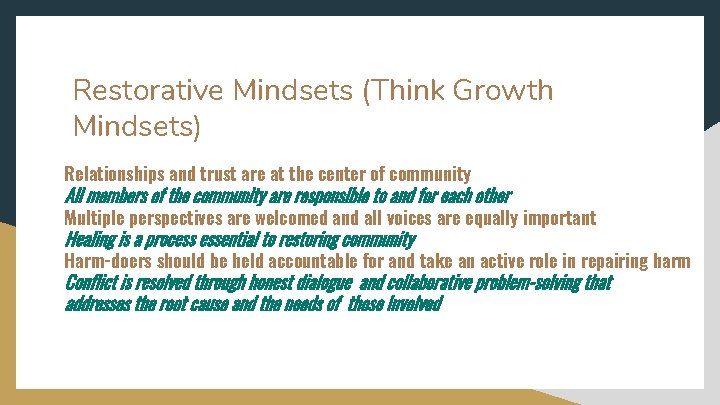
Restorative Mindsets (Think Growth Mindsets) Relationships and trust are at the center of community All members of the community are responsible to and for each other Multiple perspectives are welcomed and all voices are equally important Healing is a process essential to restoring community Harm-doers should be held accountable for and take an active role in repairing harm Conflict is resolved through honest dialogue and collaborative problem-solving that addresses the root cause and the needs of those involved
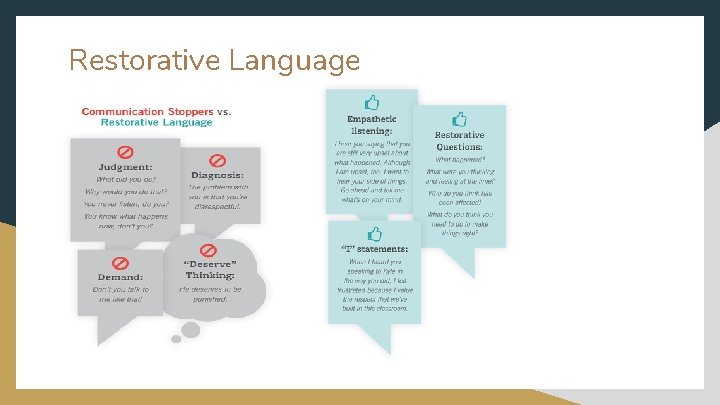
Restorative Language
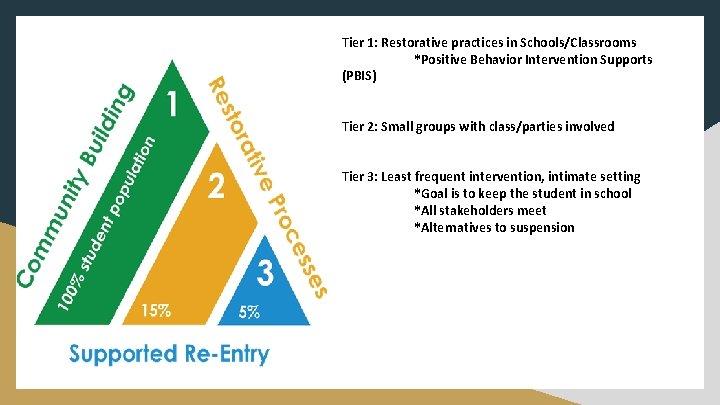
Tier 1: Restorative practices in Schools/Classrooms *Positive Behavior Intervention Supports (PBIS) Tier 2: Small groups with class/parties involved Tier 3: Least frequent intervention, intimate setting *Goal is to keep the student in school *All stakeholders meet *Alternatives to suspension
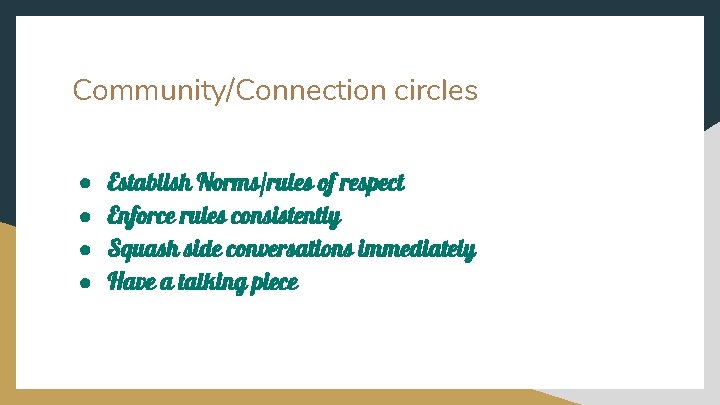
Community/Connection circles ● ● Establish Norms/rules of respect Enforce rules consistently Squash side conversations immediately Have a talking piece
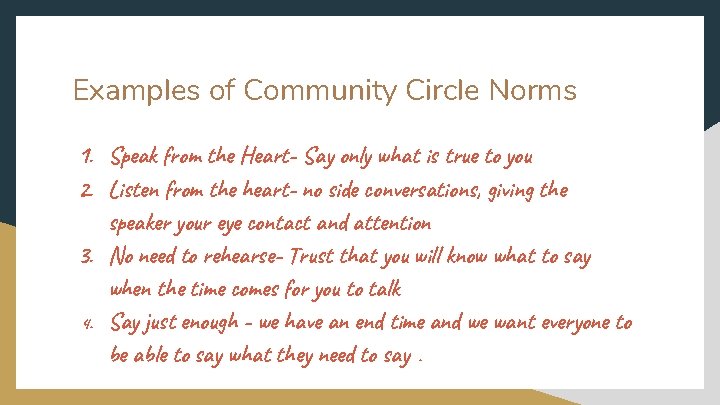
Examples of Community Circle Norms 1. Speak from the Heart- Say only what is true to you 2. Listen from the heart- no side conversations, giving the speaker your eye contact and attention 3. No need to rehearse- Trust that you will know what to say when the time comes for you to talk 4. Say just enough - we have an end time and we want everyone to be able to say what they need to say.
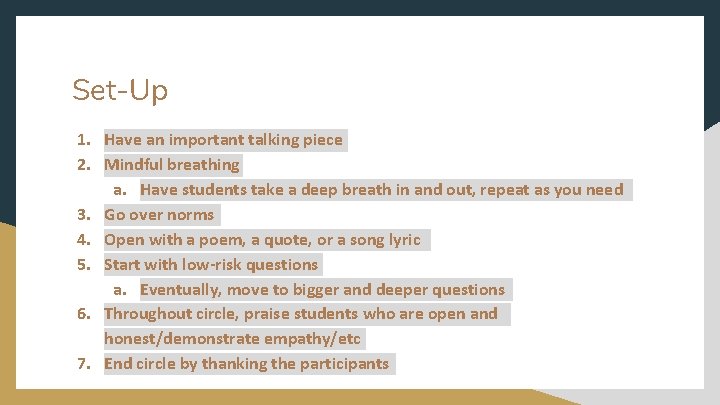
Set-Up 1. Have an important talking piece 2. Mindful breathing a. Have students take a deep breath in and out, repeat as you need 3. Go over norms 4. Open with a poem, a quote, or a song lyric 5. Start with low-risk questions a. Eventually, move to bigger and deeper questions 6. Throughout circle, praise students who are open and honest/demonstrate empathy/etc 7. End circle by thanking the participants
Overcoming Pushback “Circles take away from lesson time” “This takes too long”
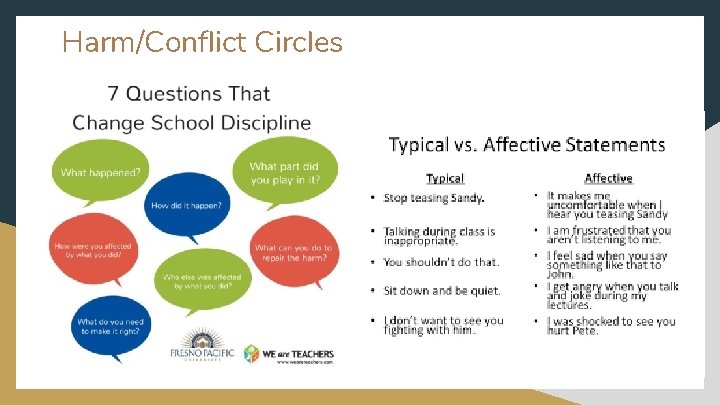
Harm/Conflict Circles
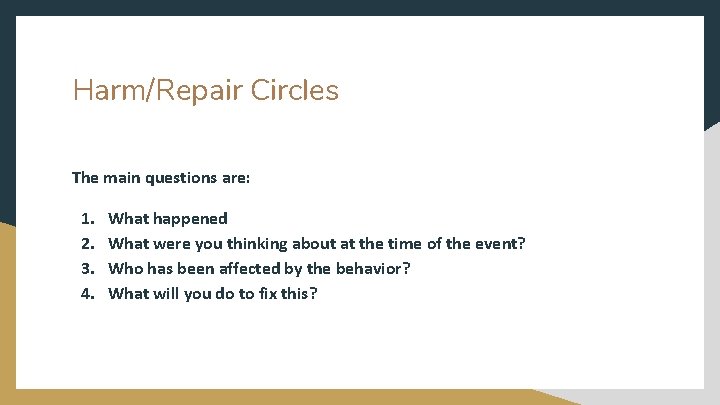
Harm/Repair Circles The main questions are: 1. 2. 3. 4. What happened What were you thinking about at the time of the event? Who has been affected by the behavior? What will you do to fix this?
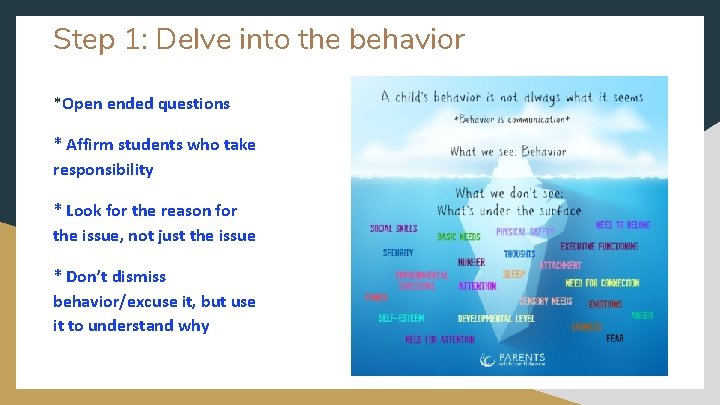
Step 1: Delve into the behavior *Open ended questions * Affirm students who take responsibility * Look for the reason for the issue, not just the issue * Don’t dismiss behavior/excuse it, but use it to understand why
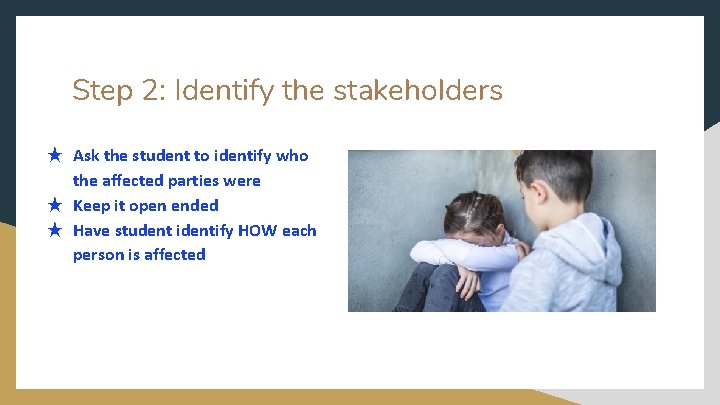
Step 2: Identify the stakeholders ★ Ask the student to identify who the affected parties were ★ Keep it open ended ★ Have student identify HOW each person is affected
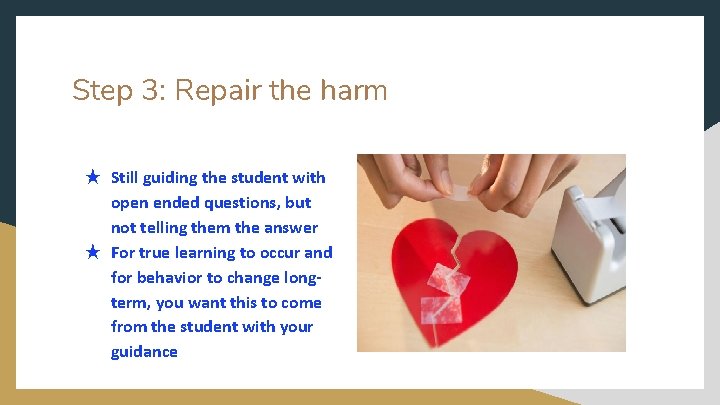
Step 3: Repair the harm ★ Still guiding the student with open ended questions, but not telling them the answer ★ For true learning to occur and for behavior to change longterm, you want this to come from the student with your guidance
Step 4: Reintegrate ★ Once the student has repaired the harm, they need to be reintegrated into a routine ★ For every redirection, there should be three affirmations ideally the same day ★ Remember: RELATIONSHIPS ARE EVERYTHING!
Overcoming Pushback “I can’t find the time” “ This isn’t my job” “ This won’t work” “This won’t work for all students” “It’s too complicated”
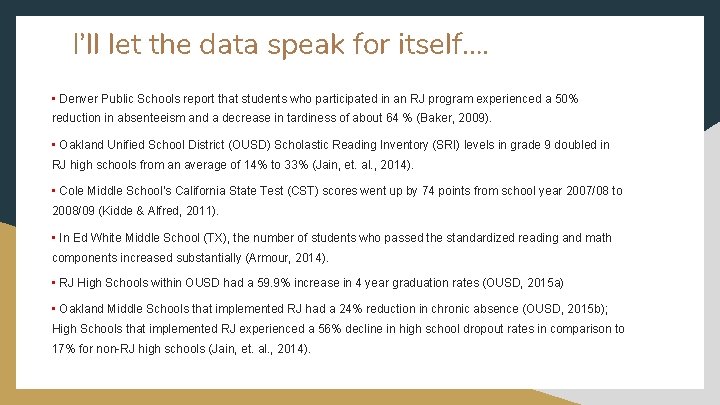
I’ll let the data speak for itself…. • Denver Public Schools report that students who participated in an RJ program experienced a 50% reduction in absenteeism and a decrease in tardiness of about 64 % (Baker, 2009). • Oakland Unified School District (OUSD) Scholastic Reading Inventory (SRI) levels in grade 9 doubled in RJ high schools from an average of 14% to 33% (Jain, et. al. , 2014). • Cole Middle School’s California State Test (CST) scores went up by 74 points from school year 2007/08 to 2008/09 (Kidde & Alfred, 2011). • In Ed White Middle School (TX), the number of students who passed the standardized reading and math components increased substantially (Armour, 2014). • RJ High Schools within OUSD had a 59. 9% increase in 4 year graduation rates (OUSD, 2015 a) • Oakland Middle Schools that implemented RJ had a 24% reduction in chronic absence (OUSD, 2015 b); High Schools that implemented RJ experienced a 56% decline in high school dropout rates in comparison to 17% for non-RJ high schools (Jain, et. al. , 2014).
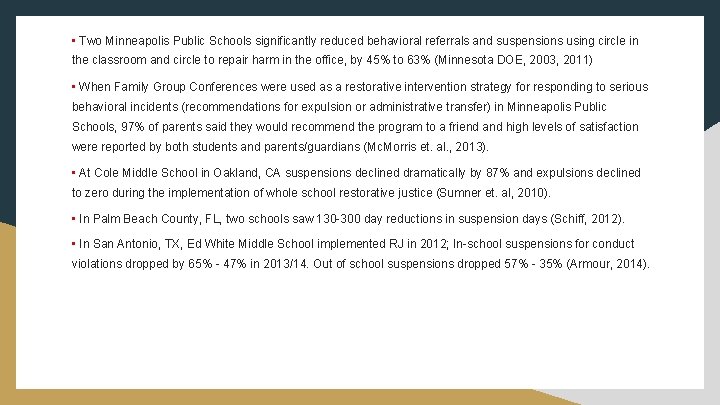
• Two Minneapolis Public Schools significantly reduced behavioral referrals and suspensions using circle in the classroom and circle to repair harm in the office, by 45% to 63% (Minnesota DOE, 2003, 2011) • When Family Group Conferences were used as a restorative intervention strategy for responding to serious behavioral incidents (recommendations for expulsion or administrative transfer) in Minneapolis Public Schools, 97% of parents said they would recommend the program to a friend and high levels of satisfaction were reported by both students and parents/guardians (Mc. Morris et. al. , 2013). • At Cole Middle School in Oakland, CA suspensions declined dramatically by 87% and expulsions declined to zero during the implementation of whole school restorative justice (Sumner et. al, 2010). • In Palm Beach County, FL, two schools saw 130 -300 day reductions in suspension days (Schiff, 2012). • In San Antonio, TX, Ed White Middle School implemented RJ in 2012; In-school suspensions for conduct violations dropped by 65% - 47% in 2013/14. Out of school suspensions dropped 57% - 35% (Armour, 2014).
“Either we spend time meeting a child’s emotional needs by filling their cup with love or we spend time dealing with the behaviors caused by their unmet needs. Either way, we spend the time. ” - Pam Leo, author of Connection Parenting
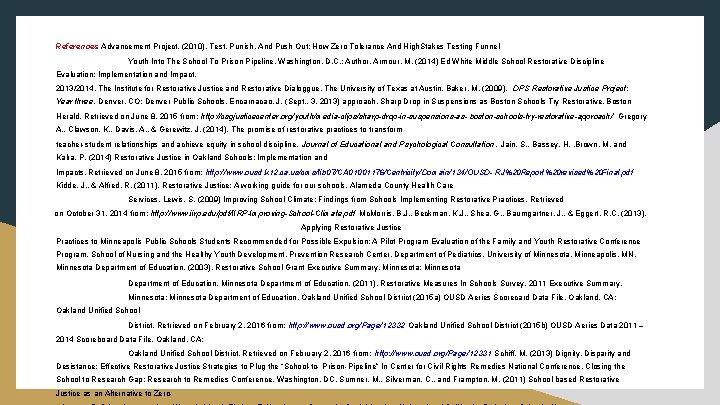
References Advancement Project. (2010). Test, Punish, And Push Out: How Zero Tolerance And High. Stakes Testing Funnel Youth Into The School To Prison Pipeline. Washington, D. C. : Author. Armour, M. (2014) Ed White Middle School Restorative Discipline Evaluation: Implementation and Impact, 2013/2014. The Institute for Restorative Justice and Restorative Dialoggue, The University of Texas at Austin. Baker, M. (2009). DPS Restorative Justice Project: Year three. Denver, CO: Denver Public Schools. Encarnacao, J. (Sept. , 3, 2013) approach. Sharp Drop in Suspensions as Boston Schools Try Restorative. Boston Herald. Retrieved on June 8, 2015 from: http: //csgjusticecenter. org/youth/media-clips/sharp-drop-in-suspensions-as- boston-schools-try-restorative-approach/ Gregory A. , Clawson, K. , Davis, A. , & Gerewitz, J. (2014). The promise of restorative practices to transform teacher-student relationships and achieve equity in school discipline. Journal of Educational and Psychological Consultation. Jain, S. , Bassey, H. , Brown, M. and Kalra, P. (2014) Restorative Justice in Oakland Schools: Implementation and Impacts. Retrieved on June 8, 2015 from: http: //www. ousd. k 12. ca. us/cms/lib 07/CA 01001176/Centricity/Domain/134/OUSD- RJ%20 Report%20 revised%20 Final. pdf Kidde, J. , & Alfred, R. (2011). Restorative Justice: A working guide for our schools. Alameda County Health Care Services. Lewis, S. (2009) Improving School Climate: Findings from Schools Implementing Restorative Practices. Retrieved on October 31, 2014 from: http: //www. iirp. edu/pdf/IIRP-Improving-School-Climate. pdf Mc. Morris, B. J. , Beckman, K. J. , Shea, G. , Baumgartner, J. , & Eggert, R. C. (2013). Applying Restorative Justice Practices to Minneapolis Public Schools Students Recommended for Possible Expulsion: A Pilot Program Evaluation of the Family and Youth Restorative Conference Program. School of Nursing and the Healthy Youth Development. Prevention Research Center, Department of Pediatrics, University of Minnesota, Minneapolis, MN. Minnesota Department of Education. (2003). Restorative School Grant Executive Summary. Minnesota: Minnesota Department of Education. (2011). Restorative Measures In Schools Survey, 2011 Executive Summary. Minnesota: Minnesota Department of Education. Oakland Unified School District (2015 a) OUSD Aeries Scorecard Data File. Oakland, CA: Oakland Unified School District. Retrieved on February 2, 2016 from: http: //www. ousd. org/Page/12332 Oakland Unified School District (2015 b) OUSD Aeries Data 2011 – 2014 Scoreboard Data File. Oakland, CA: Oakland Unified School District. Retrieved on February 2, 2016 from: http: //www. ousd. org/Page/12331 Schiff, M. (2013) Dignity, Disparity and Desistance: Effective Restorative Justice Strategies to Plug the “School-to- Prison-Pipeline” In Center for Civil Rights Remedies National Conference. Closing the School to Research Gap: Research to Remedies Conference. Washington, DC. Sumner, M. , Silverman, C. , and Frampton, M. (2011) School-based Restorative Justice as an Alternative to Zero-