
Restorative Management of Deep over bite introduction overbite
Restorative Management of Deep over bite

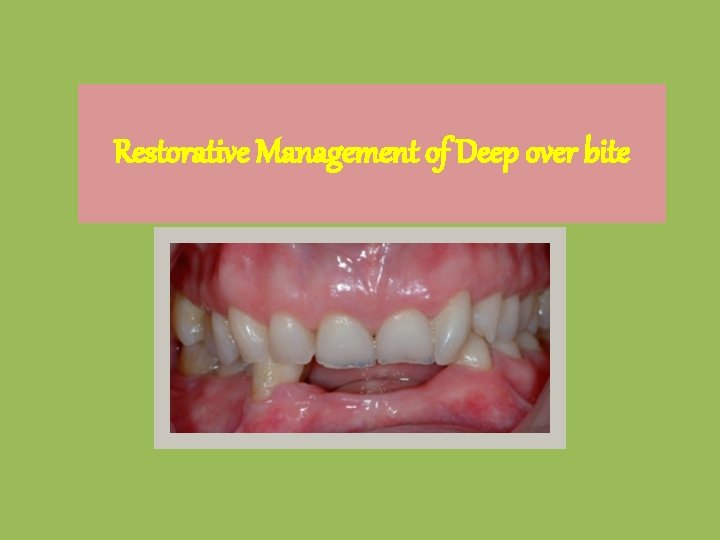
introduction § overbite refers to the degree of vertical overlap of the upper and lower incisor teeth. § Where the overlap is greater than half of the lower incisor tooth height, the overbite is considered to be increased or deep. § This is a common finding in individuals with Class II incisor relationships and a Class II skeletal pattern. § A traumatic overbite is where there is damage to the underlying periodontium or the hard tissues of the teeth involved.

The progression from an asymptomatic deep overbite to symptomatic traumatic overbite in an adult patient may be due to a number of factors: 1) 2) 3) 4) 5) 6) Poor plaque control cause inflammation of the palatal gingivae and swelling. soft tissue trauma from the opposing incisal edges. The resulting discomfort can hinder oral hygiene efforts, increasing the risk of periodontal disease. Food impaction; development of lateral periodontal cysts. incisal edges occlude on to the gingival margins of the opposing teeth, traumatic stripping of the gingivae and gingival recession. Loss of posterior occluding units may lead to anterior posturing of the mandible and over closure. following the loss of posterior support, the presence of a strong lower lip may cause lingual tilting of the lower incisors
Restorative treatment • If there are teeth requiring replacement or significant tooth wear; further restorative intervention may be indicated. This is likely to involve increasing the patient’s OVD. • Any changes to the occlusion are made in a controlled way, otherwise existing problems may be exacerbated. • For example, where there is palatal tooth wear or soft tissue trauma, the clinician may be tempted to: • restore the posterior teeth at an increased OVD, creating inter-incisal space and alleviating symptoms. However, if the lower incisors are left out of occlusion, they are likely to overerupt, resulting in recurrence of the original problem. • Similarly, if the incisal edges of the lower teeth are simply adjusted to create space, it is likely that they will erupt to re-establish the previous position if they remain unopposed.
• Changes in OVD are generally well tolerated by dentate patients and most treatment can be delivered with increases of between 1‑ 3 mm. • To plan treatment, study models should be articulated on a semiadjustable articulator using a facebow registration and an interocclusal record, taken in the retruded arc of closure. • Articulation of models facilitates the assessment of occlusal relationships and can help in determining the increase in OVD needed to permit the desired treatment.
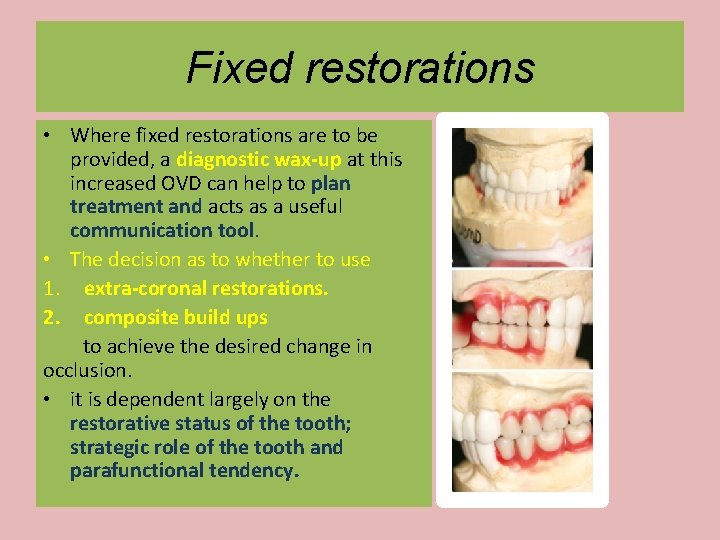
Fixed restorations • Where fixed restorations are to be provided, a diagnostic wax-up at this increased OVD can help to plan treatment and acts as a useful communication tool. • The decision as to whether to use 1. extra-coronal restorations. 2. composite build ups to achieve the desired change in occlusion. • it is dependent largely on the restorative status of the tooth; strategic role of the tooth and parafunctional tendency.
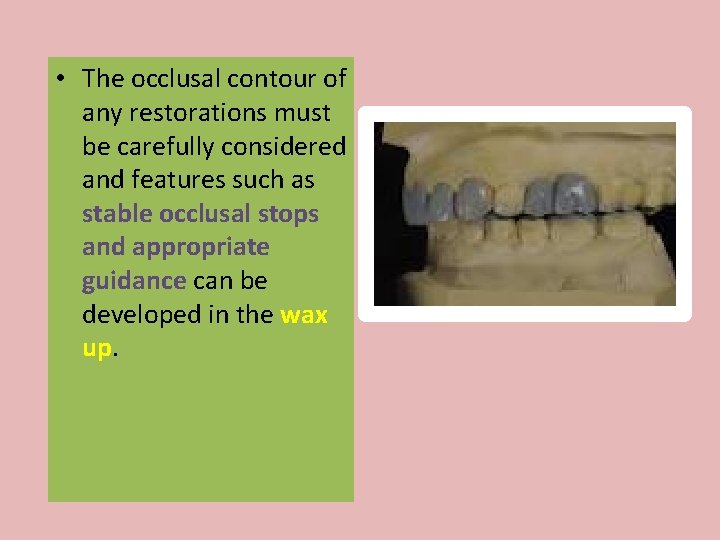
• The occlusal contour of any restorations must be carefully considered and features such as stable occlusal stops and appropriate guidance can be developed in the wax up.
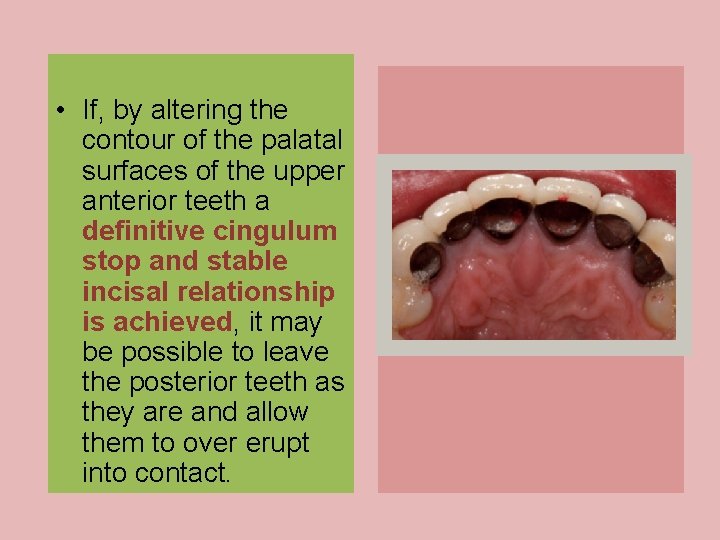
• If, by altering the contour of the palatal surfaces of the upper anterior teeth a definitive cingulum stop and stable incisal relationship is achieved, it may be possible to leave the posterior teeth as they are and allow them to over erupt into contact.

The use of this technique is not appropriate where the 1. buccal segments are heavily restored. 2. posterior units are unopposed. 3. teeth are not in an adequate functional relationship due an arch size discrepancy. • In these situations, restoration of the posterior teeth via direct or indirect onlays or crowns at the new OVD is recommended.
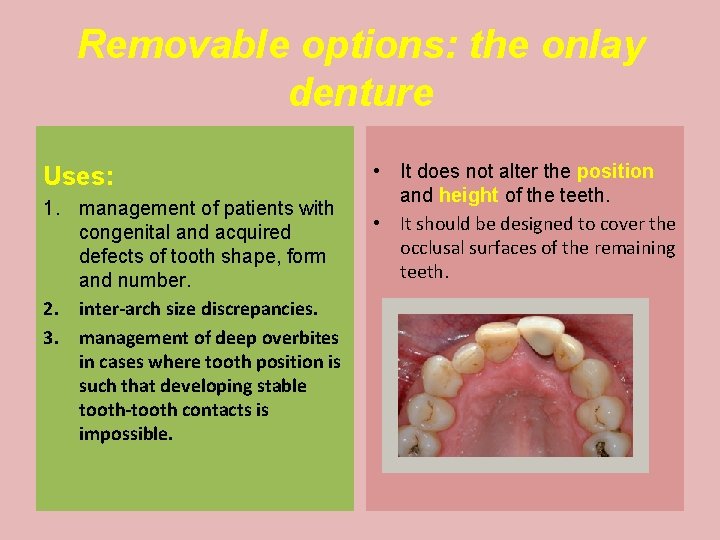
Removable options: the onlay denture Uses: 1. management of patients with congenital and acquired defects of tooth shape, form and number. 2. inter-arch size discrepancies. 3. management of deep overbites in cases where tooth position is such that developing stable tooth-tooth contacts is impossible. • It does not alter the position and height of the teeth. • It should be designed to cover the occlusal surfaces of the remaining teeth.
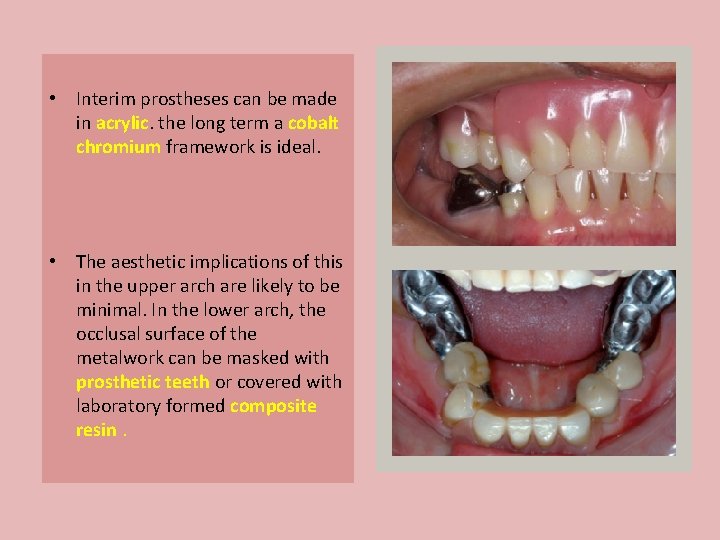
• Interim prostheses can be made in acrylic. the long term a cobalt chromium framework is ideal. • The aesthetic implications of this in the upper arch are likely to be minimal. In the lower arch, the occlusal surface of the metalwork can be masked with prosthetic teeth or covered with laboratory formed composite resin.

• The occlusal surface of an upper denture can be extended palatally to improve the contact with the lower teeth or in the lower arch, an overlay section could be extended buccally to increase the width of the occlusal table. • Upper dentures should be designed with a flat anterior bite place to provide even contact with the lower incisors.

Thank you
- Slides: 13