
RESTORATION ROMANTICISM UNIFICATION AND THE INDUSTRIAL REVOLUTION What
- Slides: 42
RESTORATION, ROMANTICISM, UNIFICATION AND THE INDUSTRIAL REVOLUTION
What do we do now? Using your assigned political perspective (position on the Spectrum) answer the following: a) Conservative, b)Moderate, c) Liberal, d)France 1) 2) 3) 4) How would you deal with France? (would you take over, punish, etc. ? ) What would you do with the Countries that were controlled by Napoleon? What type of Government would you install in France? What type of Government would be promoted throughout Europe?
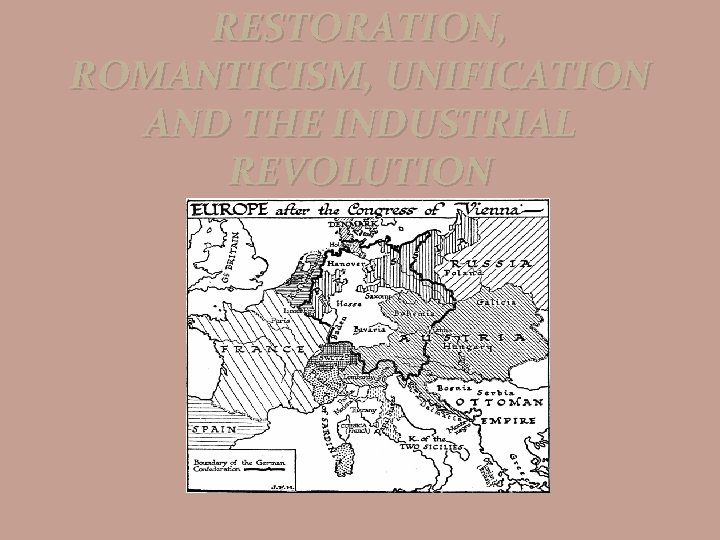
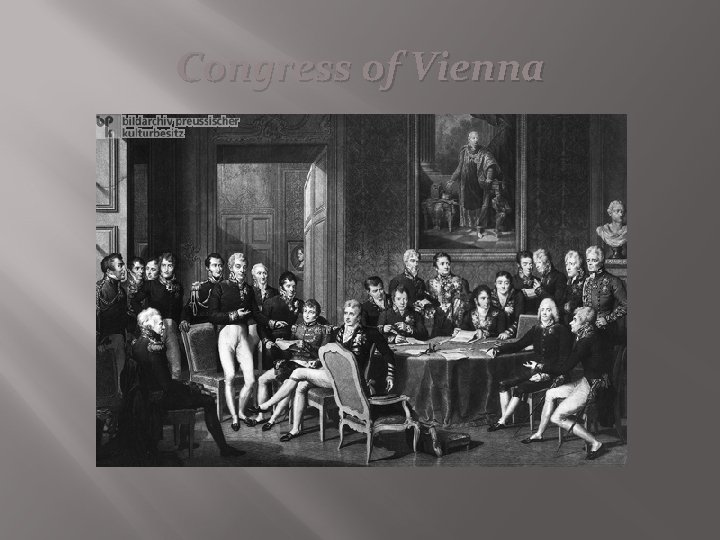
I. The Congress of Vienna ~Called by Great Britain, Prussia, Russia and Austria, following victory over France and Napoleon. ~ Focus of meeting was to restore order to Europe ~ Primary focus of meeting was to redraw the continent’s political and settle many of the other issues arising from the French Revolutionary Wars, The Napoleonic Wars, and The dissolution of the Holy Roman Empire. ~ Congress began before Napoleon’s 100 Days (Wellington, Representing G. B. , had to leave to face Napoleon at Waterloo)
~ The Vienna Congress was the first occasion in European history where on a continental scale people came together in one place to hammer out a treaty. - In the past, treaties had been achieved via messengers and messages between heads of state. ~ The Congress of Vienna had delegates from over 200 States and Princely houses. ~ Most of the work was completed by the 5 “Great Powers”- Austria, Great Britain, Russia, Prussia, and France (? !? !).
Congress of Vienna
A. Leaders Seek Stability - Objective is to create a lasting Peace, ending a period of 25 years of war. ~Many secret meetings, and pageantry- servants came along with delegates, many parties and balls, but seldom did all of the delegates meet at the same time. ~Through Diplomacy agreements are reached to return to old order. ~Congress is Dominated by Klemens Von Metternich - Very smart, fluent in 5 languages - Referred to himself as “European”, not Austrian ~3 Major Goals: * Strengthen Nations around France * Create a Balance of Power * Restore Royal Families
B. Restoring “Old Order” 1. Encircling France with strengthened countries Kingdom of the Netherlands 39 German Confederacy Switzerland is created from independent states 2. Balance of Power France would give back captured lands France stays a world power 3. Legitimacy- Return Rulers to Thrown No major powers, Unhappy
C) New Political Philosophies 1. Conservatism- Protect “traditional governments” 2. Liberalism- More power to Educated parliaments. ~ Like early stages of FR- not the Reign of Terror ~ Middle Class 3. Radicalism- Drastic/ Violent Change ~ Like Terror
� Meanwhile…. . �Back in the New World, the idea of Revolution is catching on…. .
The Spread of Nationalist Revolutions • Inspired by Enlightenment Ideas, the People of Latin America rebelled against Spanish and Portuguese Rule in the early 19 th century. • * Military Force frees most of S. America – guided by Militant Revolutionaries, Simon Bolivar and Jose de San Martin. • * Portugal undergoes a “peaceful” revolution
South American Independence movement from Spain led primarily by Simon Bolivar and Jose de San Martin. Through their efforts, Venezuela, Argentina, Columbia, Peru, Ecuador, and eventually Spanish held Latin America gained their independence. The Spanish held lands of the new world were heavily segregated among class lines.
South American Independence Social Classes were determined by birth, and there was no opportunity for change. Social Class Groups in the new world: * The Peninsulares- Born in Europe, moved to new world. Highest group. . 1%. Only group eligible to hold public office. • The Creoles- born in the new world to European parents. 22. 8% of population. Frustrated with lack of opportunity because of birth status. The Metizos- Mixed European and Indian Ancestry. 7% • The Mulattos- Mixed European and African. 7% * Africans and Indians- though large groups (especially Indians @ 55%) they had very little say and were treated poorly. •
South American Independence This unfairness in the social structure was tolerated for many years. The Creoles were the group most interested in, and most able to carry out change. They wanted to be involved in self government, but could not at as they were not born in Europe. They were however educated in European schools, particularly at the time of the Fr. Rev. • The Creoles tolerated the system until the Spanish King was replaced by Napoleon’s brother. • The Creoles did not feel any Allegiance to a French ruler and thus began the push for independence.
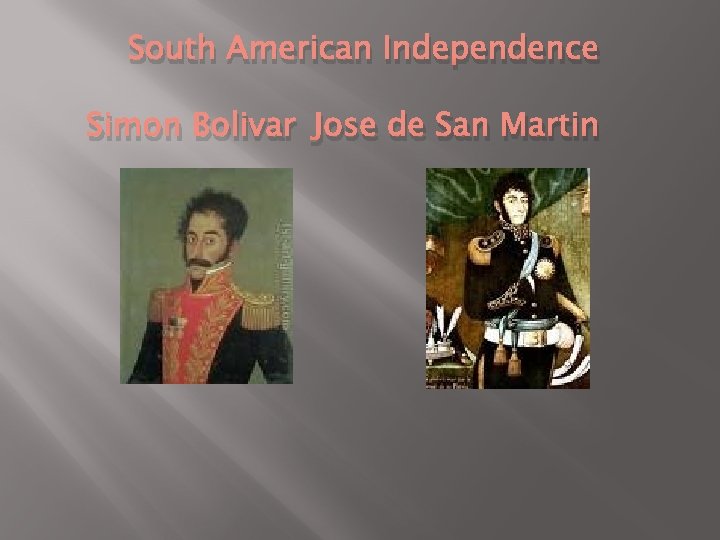
South American Independence The first countries to declare independence were Argentina, led by Jose de San Martin, and Venezuela led by Simon Bolivar.
South American Independence Simon Bolivar Jose de San Martin
South American Independence Time to Think: In pairs, discuss and compile the following: * Two similarities between the Revolutions in France and South America * Two differences between the Revolutions in France and South America.
Central American Independence The Island of Saint Dominique (Haiti) was the first Latin American Territory to gain its independence from European Rule (France). In 1791 a Revolution began when 100, 000 slaves rose up against their captors with a leader by the name of Toussaint L’Ouverture. Toussaint pushed France for the official end of Slavery. Toussaint was imprisioned. Independence was eventually obtained under the guidance of Jean Jacques Dessalines in 1804. The country was renamed Haiti.
Mexico’s fight for Independence was not led by the Creole’s as in other areas of Latin America, but by the Mestizo’s and Indians. In 1810, Padre Miguel Hidalgo called for a rebellion against the Spanish. 60, 000 people rose up and marched on Mexico City. The rebels lost but soon rallied again behind Jose Maria Morelos. He was defeated in 1815 by Iturbide. . Independence was eventually achieved in 1821, due largely to the fact that the factions had united against Spain, under Iturbide, in light of another revolution back in Spain. The rest of Central America broke away from Mexico in 1823 calling themselves the United Provinces of Central America.
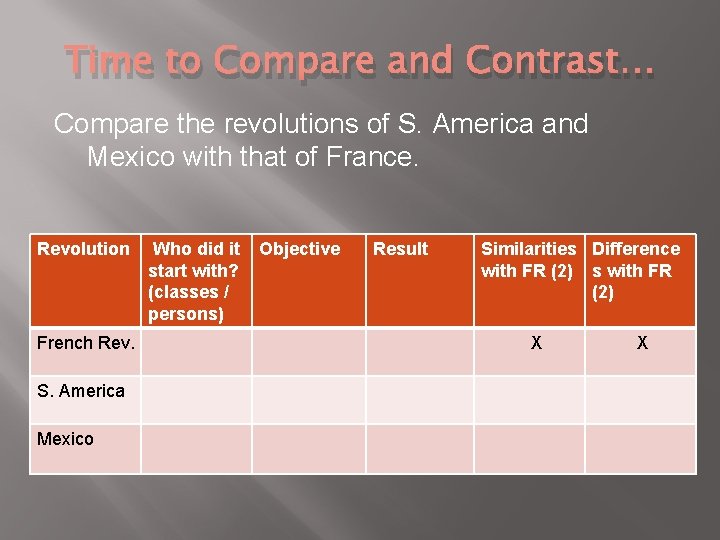
Time to Compare and Contrast… Compare the revolutions of S. America and Mexico with that of France. Revolution French Rev. S. America Mexico Who did it start with? (classes / persons) Objective Result Similarities Difference with FR (2) s with FR (2) X X
� Just when you thought we were done with revolutions, back across the Atlantic ~ Europe 2. 0
Revolutions spread across Europe The congress of Vienna was successful in creating peace for “Europe” but not for within the individual nations. Many of the European countries experienced a backlash against the conservative governments imposed by the Congress of Vienna. Hundreds of Revolutions erupted between 1815 and 1848.
European Revolutions Many of the issues behind the numerous revolutions centered around the form of Government. ~Conservatives v. Moderates v. Liberals. Other forces affecting many European countries revolved around Nationalism and the creation of “Nation States”. Loyalty to one’s country, not a King or an Empire.
European Revolutions This Era of Revolutions began in the Balkans. The Balkans were a Region of Europe that included: Greece, Albania, Bulgaria, Romania, Turkey and the Yugoslavia. ~The first of the major Revolutions occurred in Greece as they sought independence from the Ottoman Turks in 1821. - The Greek Revolution received much support from the West and Russia. Britain, France and Russia provided military and naval support, and the U. S. sent aid and assistance. ~ WHY? -Independence was achieved in 1830.
European Revolutions Holland, Belgium, Germany, Austria, Hungary, Poland, Czechoslovakia, Italy, France, Russia and most other nations experienced some form of revolutionary movement. These movements ranged from single issue causes to calls for an entirely new government and control.
European Revolutions France. Yes, France is still at it…. After Napoleon was defeated at Waterloo and exiled, France’s King Charles X was put in power. King Charles X tried to return France to a state of Absolute Monarchy. He was run out of France into exile in Great Britain.
European Revolutions France (Cont. ): After Charles X, King Louis-Philippe was put in power. He was a liberal reformer who embraced enlightenment ideas and the reforms of the revolution. He was popular and ruled for 18 years. He was eventually ousted in favor of a republic. The republic elected Louis-Napoleon Bonaparte (nephew) as President. He was a strong leader and took the title of Emperor Napoleon III. - He was a successful ruler who helped with economic reform and guided France into the Industrial Revolution.
European Revolutions Russia- Revolutionary movements were growing in Russia. Serfs were tired of centuries of being powerless and believed the time had come for the Serfdom to end. Russia was led by Czar Nicholas I in 1853, who rather than employ internal reforms, decided he could modernize Russia by declaring war on the Ottomans = The Crimean War.
European Revolutions Russia was not yet industrialized and was easily defeated by a coalition army comprised of the Turks, France, the Brits and Sardinia. The Crimean War ended the long lasting peace established by the Congress of Vienna. Subsequent Russian leaders, though they decided to modernize, to reform sufficiently to crush the tide of revolutionary sediment. Alexander the II was assassinated and was followed by Alexander the III.
European Revolutions � Russia’s failure to modernize and to offer betterment to the lives of the serfs (peasants) set the stage for the Revolutions of 1905 and 1917, in which the Czar was forced to abdicate. What other European nation’s monarch lost his job because of his failure to modernize and improve the lives of the peasants?
Spread of the Nationalism and the Rise of the Nation State By the Mid 1850’s people throughout Europe began to identify more with their country and region than a king or emperor. Nationalism is defined as extreme pride and loyalty to one’s country. This movement fueled the creation of many new Nation States carved out of existing empires or through smaller principalities pulling together.
Spread of the Nationalism and the Rise of the Nation State A Nation State is essentially synonymous with “Country”. Nation States must have: 1) Defined territory with a set boundary 2) Set Population 3) Makes and controls their own laws. 4) Sovereign – not answerable to any other power or entity.
Spread of the Nationalism and the Rise of the Nation State Nationalism destroyed the centuries old empires of Russia and Austro Hungary and helped to build and unite the nations of Italy and Germany.
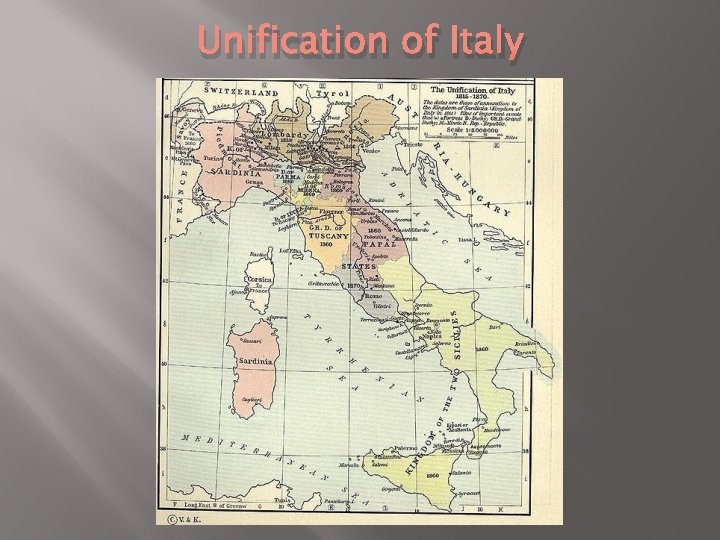
Unification of Italy Prior to 1815, much of Italy was ruled by foreign rulers - Austria controlled the North and Spain controlled the South. In 1832, Giuseppe Mazzini organized a group called “Young Italy”. His group sought to achieve independence for Italy and create a free “Nation State”. Briefly achieved a republic in Rome. Mazzini’s efforts failed (like most of the revolutions of 1848), and he was forced into exile.
Unification of Italy
Unification of Italy The Unification of Italy made considerable steps to becoming a nation state under the leadership of Kingdom of Piedmont-Sardina. The King of Sardinia, Victor Emmanuel II named Camillo di Cavour to the position of Prime Minister. Cavour did expand unite Italy, but not for the creation of a Nation State, but for purposes of creating a dominate Sardinia.
Unification of Italy Cavour enlisted the help of Giuseppe Garibaldi and his troops (the Red Shirts) to help unify Southern Italy and bring them under the control of Sardinia. The last area to fall under the control of Sardinia were the Papal States which included Rome. Eventually Sardinia conquered Rome, but Vatican City remained under control of the Pope. Thus Italy was essentially united by 1877.
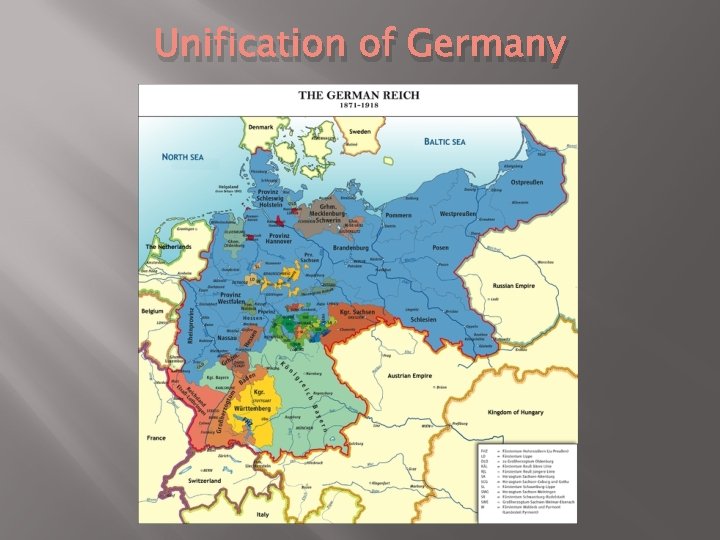
Unification of Germany Since 1815 Germany had existed in the loosely unified German Confederation, consisting of 39 German States. The largest and most dominant of these states were Prussia and the Austro-Hungary Empire. Prussia became the most advanced of the German States.
Unification of Germany
Unification of Germany Prussia had been modernized and organized under the strong rule of Kaiser Wilhelm the First. Wilhelm I appointed Otto Von Bismarck as Prime Minister. Von Bismarck relied on his theory of Real Politik and Blood and Iron in unifying Germany.
Unification of Germany Bismarck relied on two wars to accomplish his goal of a unified Germany. Austria resisted unification, attempting to assert itself as the dominant German State. Austria was defeated by Prussia in the Seven Weeks War.
Unification of Germany Southern German States had resisted Unification with Prussia and the Northern German States. Much of their resistance was based on the fact that Germany was mostly protestant but that the southern states were Catholic. To get the Southern States to rally around Prussia, Von Bismarck provoked France into attacking Prussia prevailed and defeated France in 1870, thus paving the way for unified Germany, aka the “Second Reich”.
Your Turn… In your notes, respond to the following with a well written paragraph. You may use your notes and text book. Explain how nationalism can be both a constructive force and destructive force. Cite specific examples.