
Resting Membrane Potential Voltage TEXTBOOK OF MEDICAL PHYSIOLOGY
Resting Membrane Potential (Voltage) TEXTBOOK OF MEDICAL PHYSIOLOGY GUYTON & HALL 11 TH EDITION UNIT II CHAPTER 5 Dr. Mohammed Alotaibi MRes, Ph. D (Liverpool, England) Department of Physiology College of Medicine King Saud University
RESTING MEMBRANE POTENTIAL OBJECTIVES By the end of this lecture, the student should be able to: • Identify and describe different potentials & types of membrane ionic channels & equal or unequal distribution of ions across the membrane • Identify cell membrane creating concentration and electrical gradients. • Identify and describe diffusion and equilibrium potential • Apply Nernst equation to calculate equilibrium potential. • Identify resting membrane potential (RMP) • describe genesis of resting membrane potential (RMP) and appreciate the effect of changes in ionic composition and/or permeability on genesis of RMP and the role of ions channels, and Na+ - K+ pump • Identify voltmeter to measure very small membrane potential difference between inside & outside as resting membrane potential.
Q : What are Excitable tissues ? ﺳﺮﻳﻊ ﺍﻻﻧﻔﻌﺎﻝ A: They are nerve and muscle Q: What property do excitable tissues have that makes them different from other body tissues ? A: Their membrane acts as an electric capacitor ﻣﻜﺜﻒ storing opposite charges on the opposite sides of the membrane. This will create: v Resting membrane potential(RMP) of high value ( -70 to -90 m. V ) compared to other body cells ( in RBC , for example MP= -5 m. V ). This high RMP makes the nerve or muscle membrane function as a capacitor , that can “discharge” , ﻳﻔﺮﻍ producing large voltage changes ( action potentials ).
Q : What is the membrane potential ( MP ) ? ﺍﻟﺠﻬﺪ ﺍﻟﻐﺸﺎﺋﻲ It is the difference in potential ( voltage ) between the inner side & outer side of the membrane (nerve or muscle membranes) Q : What are the states of MP ? (1) Resting Membrane Potential ( RMP) : value of MP in a “ resting ” state (unstimulated excitable membrane). It ranges between -70 and -90 m. V in different excitable tissue cells, in large myelinated nerves = -90 m. V (2) Graded Potential (Local Response ) : MP in a stimulated cell that is producing a local , non-propagated potential ﻏﻴﺮ ﻣﻨﺘﺸﺮ (an electrical change which is measurable only in the immediate vicinity ﻣﻨﻄﻘﺔ ﻣﺠﺎﻭﺭﻩ of the cell but not far from it). (3) Action potential ( AP) : MP in case of a nerve that is generating a propagated ﻣﻨﺘﺸﺮ electrical potential after stimulation by effective stimulus ( an electrical potential which can be measured even at long distances far from the cell-body of the nerve)
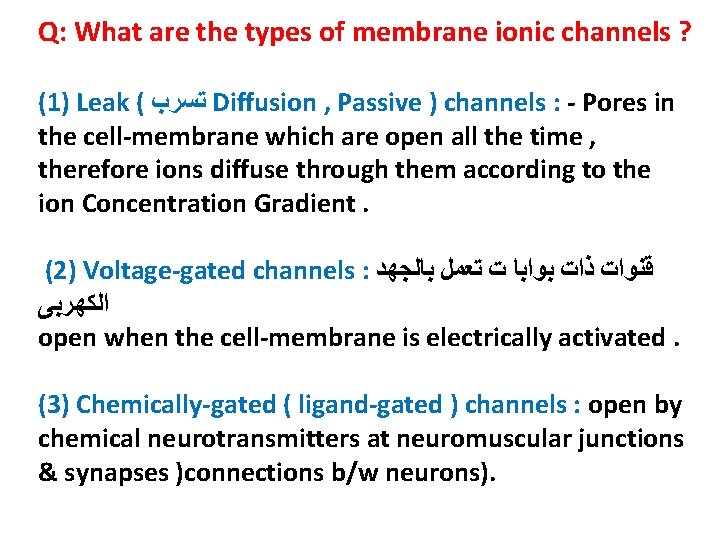
Q: What are the types of membrane ionic channels ? (1) Leak ( ﺗﺴﺮﺏ Diffusion , Passive ) channels : - Pores in the cell-membrane which are open all the time , therefore ions diffuse through them according to the ion Concentration Gradient. (2) Voltage-gated channels : ﻗﻨﻮﺍﺕ ﺫﺍﺕ ﺑﻮﺍﺑﺎ ﺕ ﺗﻌﻤﻞ ﺑﺎﻟﺠﻬﺪ ﺍﻟﻜﻬﺮﺑﻰ open when the cell-membrane is electrically activated. (3) Chemically-gated ( ligand-gated ) channels : open by chemical neurotransmitters at neuromuscular junctions & synapses )connections b/w neurons).
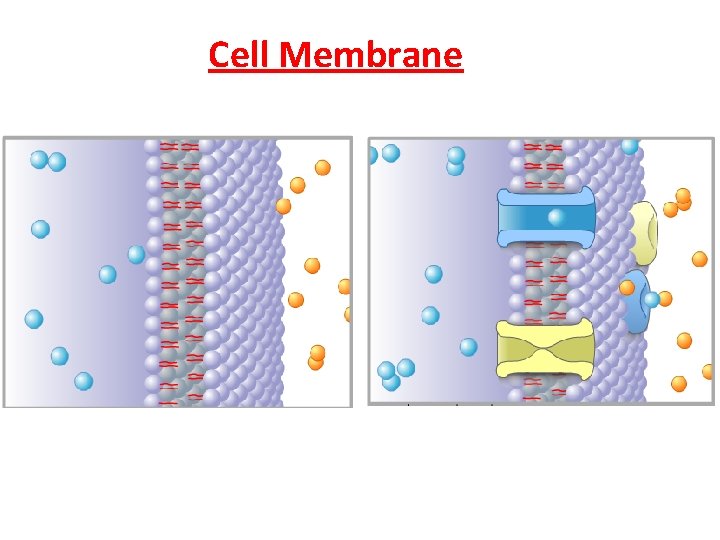
Cell Membrane
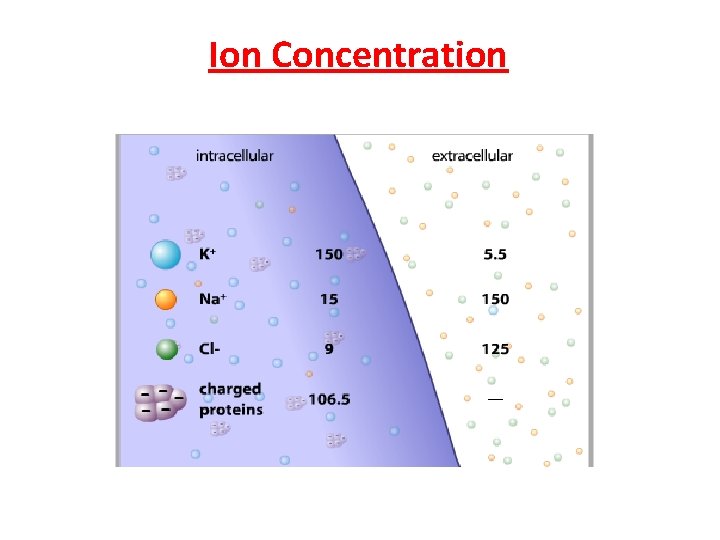
Ion Concentration
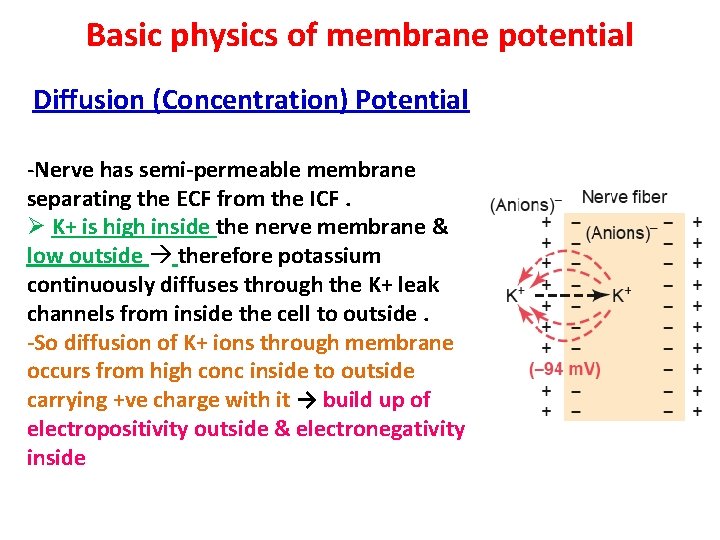
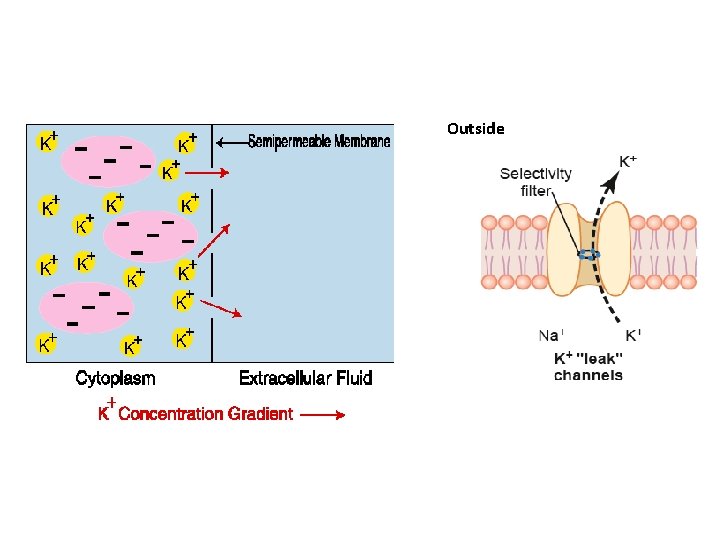
Basic physics of membrane potential Diffusion (Concentration) Potential -Nerve has semi-permeable membrane separating the ECF from the ICF. Ø K+ is high inside the nerve membrane & low outside therefore potassium continuously diffuses through the K+ leak channels from inside the cell to outside. -So diffusion of K+ ions through membrane occurs from high conc inside to outside carrying +ve charge with it → build up of electropositivity outside & electronegativity inside
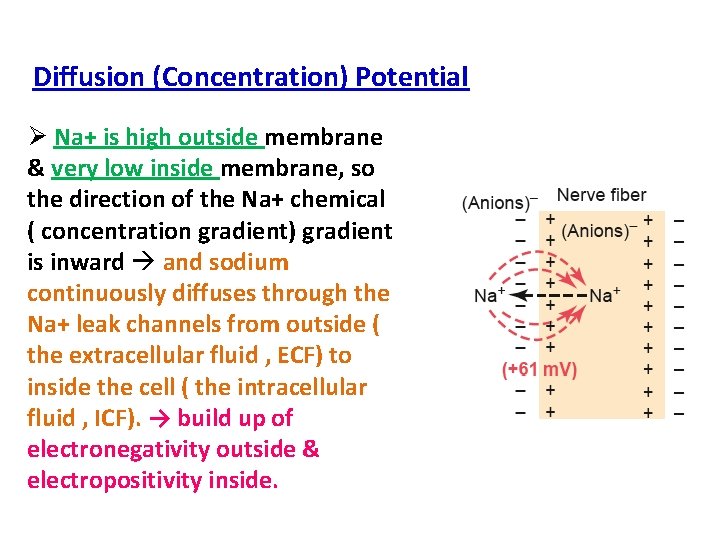
Diffusion (Concentration) Potential Ø Na+ is high outside membrane & very low inside membrane, so the direction of the Na+ chemical ( concentration gradient) gradient is inward and sodium continuously diffuses through the Na+ leak channels from outside ( the extracellular fluid , ECF) to inside the cell ( the intracellular fluid , ICF). → build up of electronegativity outside & electropositivity inside.
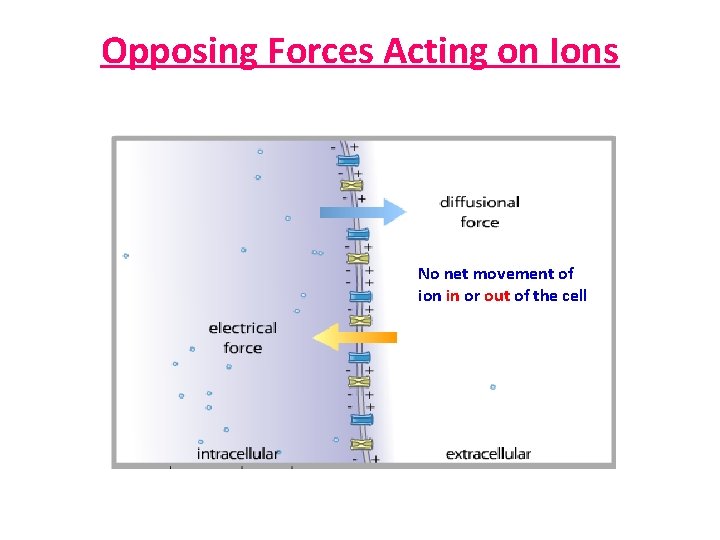
Opposing Forces Acting on Ions No net movement of ion in or out of the cell
NERNST EQUATION -The Potassium Nernst ( Equilibrium ) Potential • - Nernst calculated the level of concentration potential of ions across the membrane that prevent net diffusion of ions to inside or outside Nernst made a hypothesis which said that if we suppose that (1)the ECF and ICF contained ONLY potassium ion , (2)and that the cell-membrane was freely permeable to K+ → then K+ will diffuse down its concentration (chemical) gradient ( via the K+ leak channels ) from inside the cell to outside , carrying with it +ve charges to the outside , -This progressively increasing the negativity on the inner side of the membrane because we are losing +ve charges from inside ). • At this goes on and on , negative charges build inside, an opposing negative electrical potential , tending to prevent the exit of the +ve potassium ions (force tends to keep K+ inside).
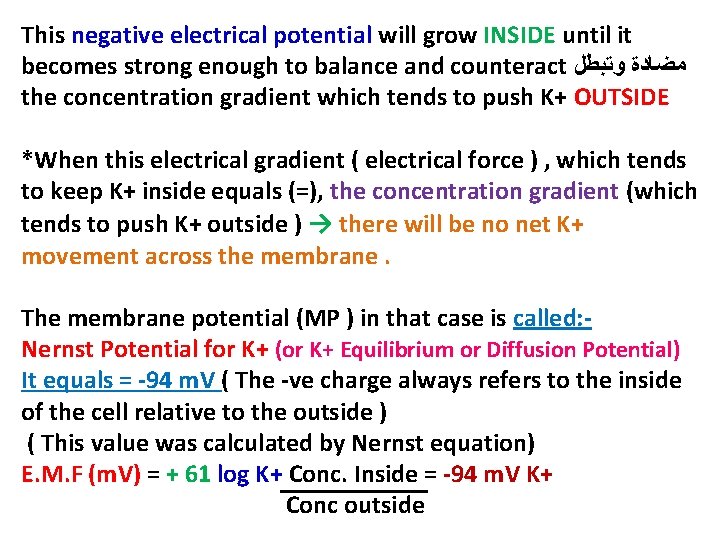
This negative electrical potential will grow INSIDE until it becomes strong enough to balance and counteract ﻣﻀﺎﺩﺓ ﻭﺗﺒﻄﻞ the concentration gradient which tends to push K+ OUTSIDE *When this electrical gradient ( electrical force ) , which tends to keep K+ inside equals (=), the concentration gradient (which tends to push K+ outside ) → there will be no net K+ movement across the membrane. The membrane potential (MP ) in that case is called: Nernst Potential for K+ (or K+ Equilibrium or Diffusion Potential) It equals = -94 m. V ( The -ve charge always refers to the inside of the cell relative to the outside ) ( This value was calculated by Nernst equation) E. M. F (m. V) = + 61 log K+ Conc. Inside = -94 m. V K+ Conc outside
The SODIUM Nernst ( Equilibrium ) Potential Nernst made a hypothesis which said that if we suppose that: (1) the ECF and ICF contained ONLY sodium ions , (2) and that the nerve-membrane was freely permeable to Na+ → then Na+ will diffuse down its concentration gradient to the Inside of the cell, carrying with it +ve charges , and progressively decreasing the negativity on the inner side of the membrane. -As this goes on and on , and as the positive charges build inside , an opposing Electrical Potential begins to develop , tending to prevent the +ve Na+ ions from entering. This electrical potential will grow until it becomes strong enough to balance and counteract ﻳﺒﻄﻞ the concentration gradient which tends to push Na+ inside. When this electrical gradient ( force ) , which tends to drive (PUSH) Na+ outside equals = the concentration gradient ( which tends to push Na+ in ) → there will be no Na+ movement across the membrane. The MP potential in that case is called: Nernst Potential for Na+ ( or Na+ Equilibrium or Diffusion Potential ) = +61 m. V. ( The charge always refers to the inside of the cell )
What determines the magnitude (value) of the Equilibrium (Nernst) Potential ? • The ratio of the ion concentration on the two sides of the membrane ( inside&outside). • The value of this potential & EMF can be determined by : Nernst potential = electromotive force (EMF) EMF (m. V) = ± 61 x log Ion conc. Inside Ion conc. outside -The greater the ratio (it means ion conc. inside is higher than outside) the greater the force for ions to diffuse in one direction (from inside to outside) Ø For K = - 94 mv & for Na = + 61 mv ((it is –ve for K & + ve for Na ( K diffuses out so ↓ the ratio & Na diffuses inside so ↑ the ratio))
THE RESTING MEMBRANE POTENTIAL OF NERVES
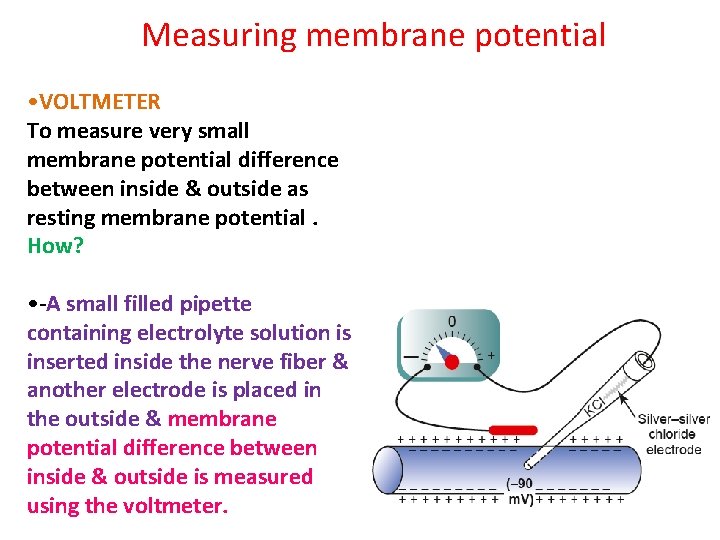
Measuring membrane potential • VOLTMETER To measure very small membrane potential difference between inside & outside as resting membrane potential. How? • -A small filled pipette containing electrolyte solution is inserted inside the nerve fiber & another electrode is placed in the outside & membrane potential difference between inside & outside is measured using the voltmeter.
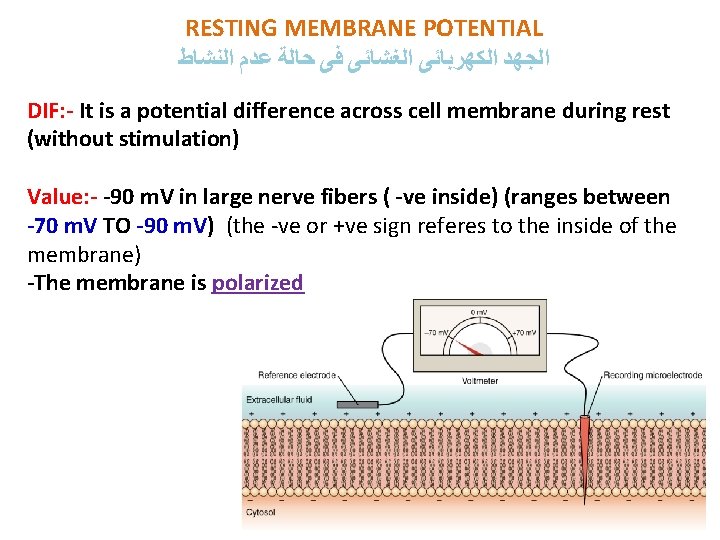
RESTING MEMBRANE POTENTIAL ﺍﻟﺠﻬﺪ ﺍﻟﻜﻬﺮﺑﺎﺋﻰ ﺍﻟﻐﺸﺎﺋﻰ ﻓﻰ ﺣﺎﻟﺔ ﻋﺪﻡ ﺍﻟﻨﺸﺎﻁ DIF: - It is a potential difference across cell membrane during rest (without stimulation) Value: - -90 m. V in large nerve fibers ( -ve inside) (ranges between -70 m. V TO -90 m. V) (the -ve or +ve sign referes to the inside of the membrane) -The membrane is polarized
• Q 1: What are the factors that make the inside of the cell negative ? Depend mainly on transport properties of resting membrane, the factors that make the inside of the cell negative: 1 - Contribution of K & Na diffusion potential through Na & K leak channels of nerve membrane 2 - Active transport of Na & K ions ( Na/K pump) 3 - Negative ions inside membrane as proteins & phosphate sulphate
Origin of RMP: 1 - Contribution of K diffusion potential: N. B/ K diffusion contributes far more to membrane potential than Na diffusion. Ø At rest , K inside is 35 times higher than outside K+ leak channels → more K+ diffuses to outside than Na+ to inside , because K leak channels are far more permeable to K than Na about 50100 time due to small size of K molecules → more potassium lost than sodium gained → net loss of +ve ions from inside the cell → more negative inside (net K OUTFLUX TO OUTSIDE causing –ve inside) Ø Applying Nernst Equation: -K inside is 35 times higher than outside (35/1) - Nernst potential = - 61 x log 35/1 (1. 54) = -94 m. V, (if K is the only ion act on membrane →RMP = -94 mv with negativity inside the nerve)
Outside
2 - Contribution of Na diffusion potential: • Na leak channels: - have Slight permeability to Na ions from outside to inside. • - Nernst potential = + 61 x log ( Na inside/ Na outside = 0. 1) = 61 x log 0. 1= + 61 m. V -Nernst potential for Na inside membrane = + 61 m. V (if Na is the only ion acting on the membrane → RMP = + 61 m. V with positivity inside the nerve +
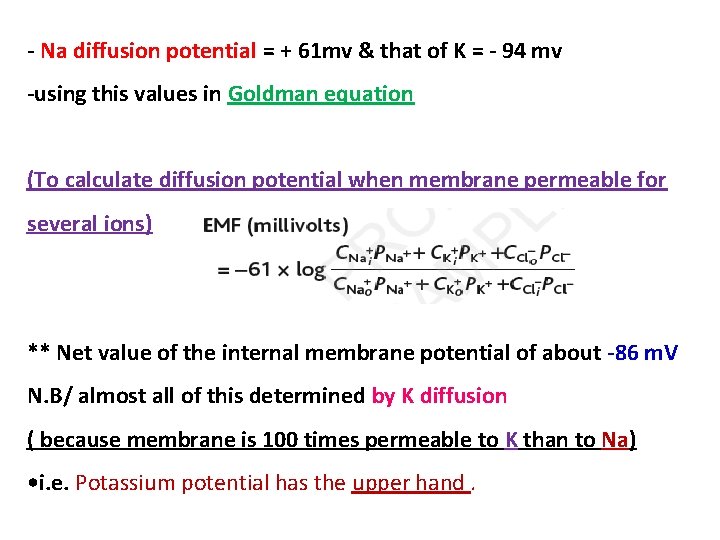
- Na diffusion potential = + 61 mv & that of K = - 94 mv -using this values in Goldman equation (To calculate diffusion potential when membrane permeable for several ions) ** Net value of the internal membrane potential of about -86 m. V N. B/ almost all of this determined by K diffusion ( because membrane is 100 times permeable to K than to Na) • i. e. Potassium potential has the upper hand.
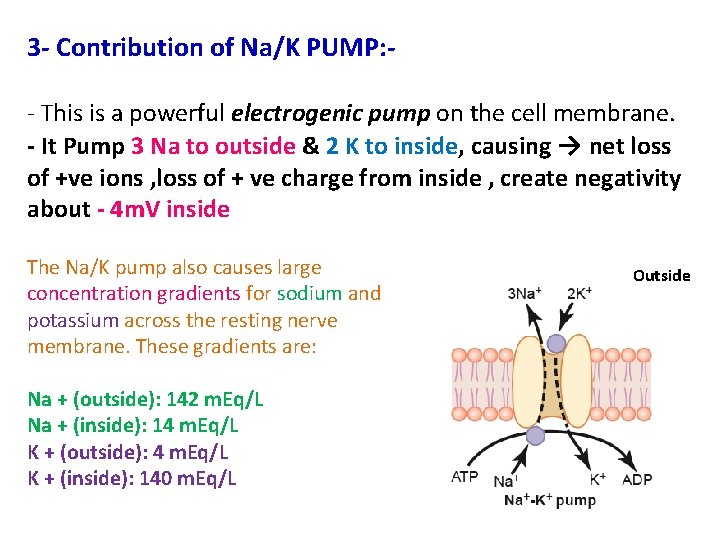
3 - Contribution of Na/K PUMP: - This is a powerful electrogenic pump on the cell membrane. - It Pump 3 Na to outside & 2 K to inside, causing → net loss of +ve ions , loss of + ve charge from inside , create negativity about - 4 m. V inside The Na/K pump also causes large concentration gradients for sodium and potassium across the resting nerve membrane. These gradients are: Na + (outside): 142 m. Eq/L Na + (inside): 14 m. Eq/L K + (outside): 4 m. Eq/L K + (inside): 140 m. Eq/L Outside
-So NET MEMBRANE POTENTIAL will be : Diffusion potential (caused by K & Na diffusion) + Electrogenic Na/K pump (-86 m. V ) + (- 4 m. V) = -90 m. V 4 - Effect of Large intracellular anions(negative ions) (proteins , sulphates & phosphates ), very low effect.
- Slides: 24