
Resting Membrane Potential Action Potential Propagation Neuromuscular JunctionSynapse
• Resting Membrane Potential • Action Potential • Propagation • Neuromuscular Junction/Synapse • Excitation-Contraction Coupling • Cross-Bridge Movements/Cycling 9 -1
• Na+ and K+ • Na+/K+ pumps • Neurotransmitter • Acetylcholinesterase • Receptors • Binding Sites • ATP ADP • Ca+2 9 -2
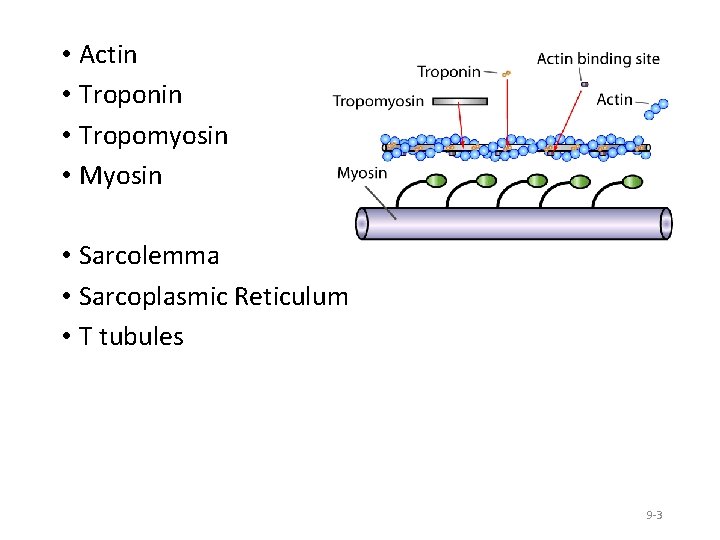
• Actin • Troponin • Tropomyosin • Myosin • Sarcolemma • Sarcoplasmic Reticulum • T tubules 9 -3
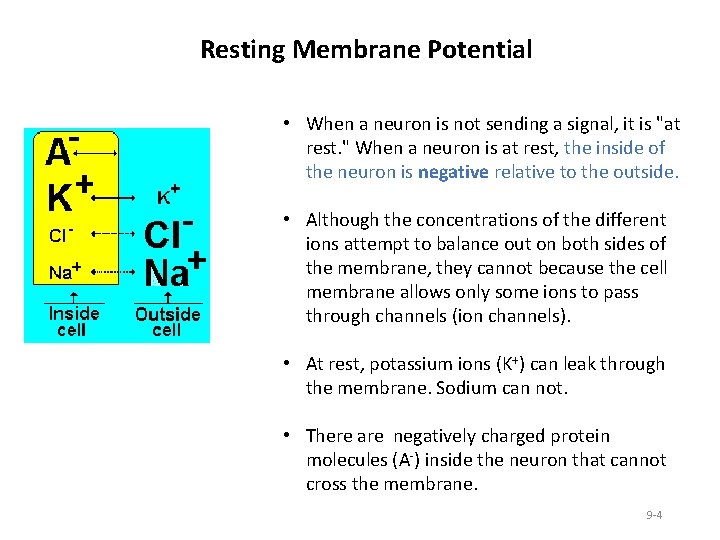
Resting Membrane Potential • When a neuron is not sending a signal, it is "at rest. " When a neuron is at rest, the inside of the neuron is negative relative to the outside. • Although the concentrations of the different ions attempt to balance out on both sides of the membrane, they cannot because the cell membrane allows only some ions to pass through channels (ion channels). • At rest, potassium ions (K+) can leak through the membrane. Sodium can not. • There are negatively charged protein molecules (A-) inside the neuron that cannot cross the membrane. 9 -4
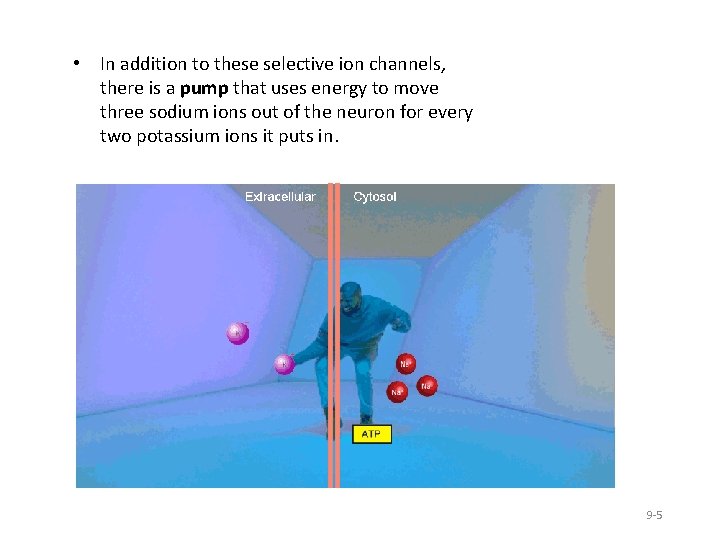
• In addition to these selective ion channels, there is a pump that uses energy to move three sodium ions out of the neuron for every two potassium ions it puts in. 9 -5
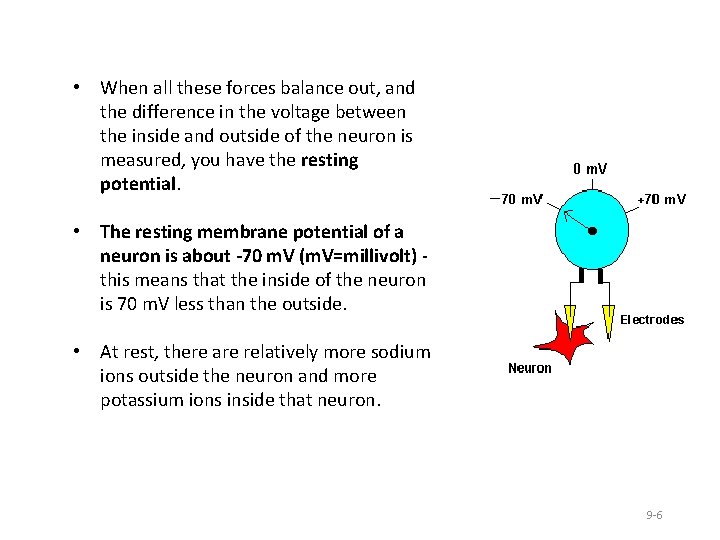
• When all these forces balance out, and the difference in the voltage between the inside and outside of the neuron is measured, you have the resting potential. • The resting membrane potential of a neuron is about -70 m. V (m. V=millivolt) this means that the inside of the neuron is 70 m. V less than the outside. • At rest, there are relatively more sodium ions outside the neuron and more potassium ions inside that neuron. 9 -6
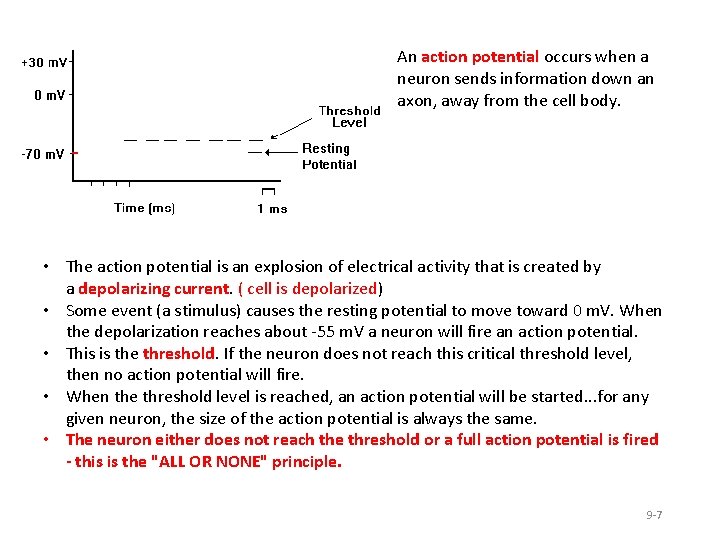
An action potential occurs when a neuron sends information down an axon, away from the cell body. • The action potential is an explosion of electrical activity that is created by a depolarizing current. ( cell is depolarized) • Some event (a stimulus) causes the resting potential to move toward 0 m. V. When the depolarization reaches about -55 m. V a neuron will fire an action potential. • This is the threshold. If the neuron does not reach this critical threshold level, then no action potential will fire. • When the threshold level is reached, an action potential will be started. . . for any given neuron, the size of the action potential is always the same. • The neuron either does not reach the threshold or a full action potential is fired - this is the "ALL OR NONE" principle. 9 -7
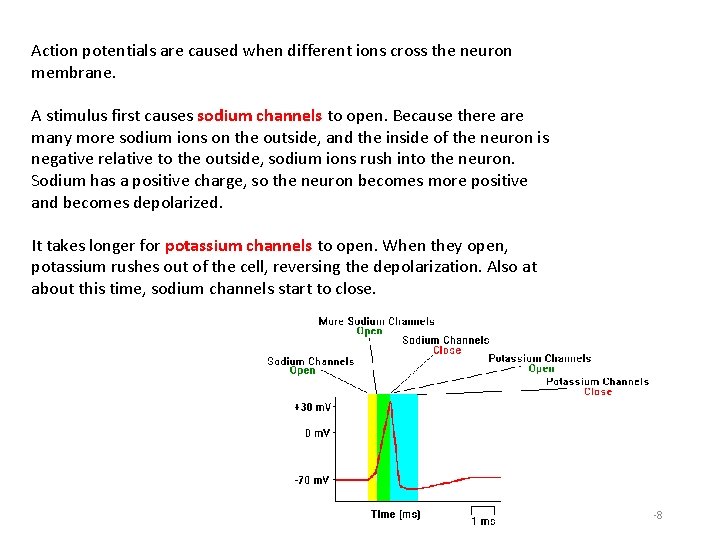
Action potentials are caused when different ions cross the neuron membrane. A stimulus first causes sodium channels to open. Because there are many more sodium ions on the outside, and the inside of the neuron is negative relative to the outside, sodium ions rush into the neuron. Sodium has a positive charge, so the neuron becomes more positive and becomes depolarized. It takes longer for potassium channels to open. When they open, potassium rushes out of the cell, reversing the depolarization. Also at about this time, sodium channels start to close. 9 -8
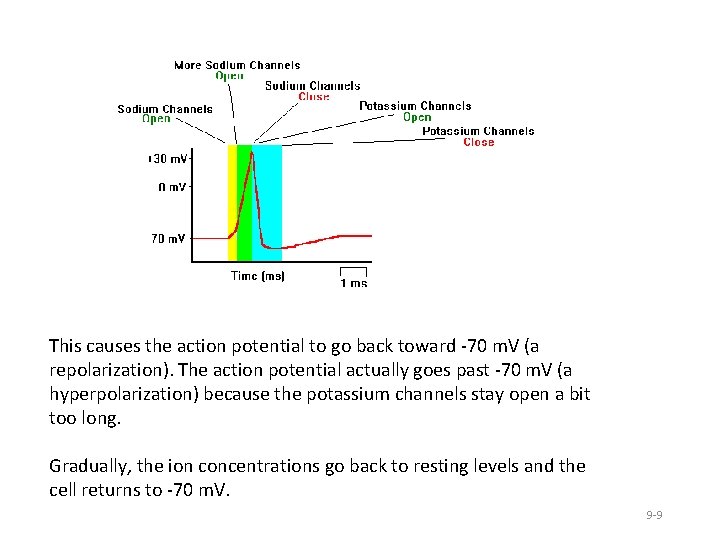
This causes the action potential to go back toward -70 m. V (a repolarization). The action potential actually goes past -70 m. V (a hyperpolarization) because the potassium channels stay open a bit too long. Gradually, the ion concentrations go back to resting levels and the cell returns to -70 m. V. 9 -9
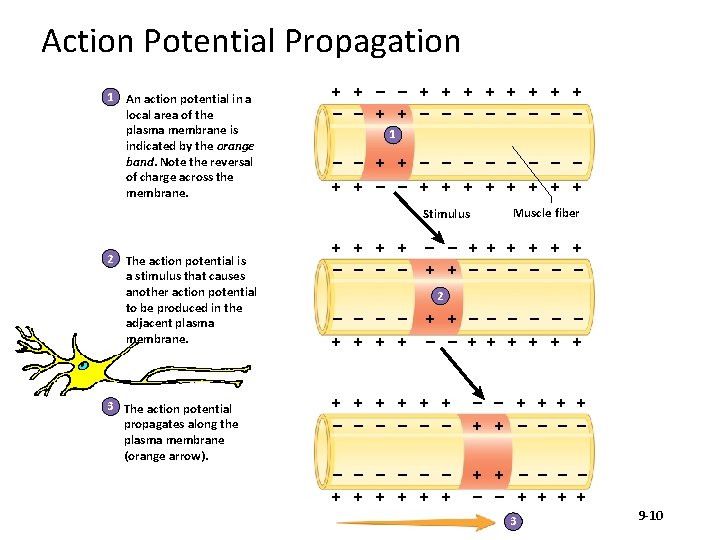
Action Potential Propagation 1 An action potential in a local area of the plasma membrane is indicated by the orange band. Note the reversal of charge across the membrane. + + – – + + – – – – 1 – – + + – – + + + + Stimulus 2 The action potential is a stimulus that causes another action potential to be produced in the adjacent plasma membrane. 3 The action potential propagates along the plasma membrane (orange arrow). + + – – Muscle fiber – – + + + + – – – 2 – – + + + – – – – + + + – – – – – + + + + – – – + + 3 9 -10
- Slides: 10