
RESTful APIs SWEN344 WEB ENGINEERING REST is an
RESTful APIs SWEN-344 WEB ENGINEERING
REST is an answer to a problem … ● When you wrote your DB code, you had Test_xx_function. Name my. Function(value 1, value 2) … This is a function call. In this case, both pieces of code (test code and my. Function) are on the same computer ● What do you do when your code on computer 1, needs to call a function on computer 2? ○ REST is one of the answers (most common answer in today’s world of computing)
Historical Context for REST Around this time, Software was having a revolution ● 1995: Java ● 1998: SOAP ● Y 2 K saw a massive increase in the market for software developers ● 1999 HTML 4 is ratified, CSS is the recommended styling approach ● 1999: 802. 11 b wifi protocol ● 2000: RESTful API dissertation by Roy Fielding, source: https: //restfulapi. net/ ● ~2000: Amazon. com explodes, e-commerce becomes culturally acceptable ● 2001: Agile Manifesto ● Dot-com bubble: ‘ 95 -’ 02 ● Huge needs for: ○ ○ Standardization Integration between services, esp. e-commerce Scaling up development teams Performance. Most internet was dial-up at this time

REpresentational State Transfer Architectural style with ~6 guiding constraints 1. 2. 3. 4. 5. 6. Client-server Stateless Cacheable Uniform interface Layered Code on demand (optional) This structure has heavily influenced web applications today. . . but REST is not necessarily over HTTP

Client-Server ● Two systems ○ ○ Server: run all the time, listen for requests Client: talk to server ● Typically, this means browser and web server ● BUT! Can be lots of systems
Statelessness ● Application state ● Resource state ● ● ○ ○ Server-side data Identify incoming client requests Context of previous calls RESTful APIs are application stateless ○ ○ ○ The actual data that you are storing e. g. your database This can change, and is not part of the RESTful API layer Server provides all information needed to create the state The client stores the state and provides everything necessary ○ ○ e. g. pagination: provide limit & offset e. g. queries ● ● Advantages: ○ ○ ○ H-scalability: just stand up more servers! REST servers don’t need lots of disk usage Reliability: just reboot crashed REST servers Simpler! Don’t need to “remember” clients and share with other servers Concurrency is easier to manage Caching! See next slide. Professors are often stateless ○ ○ We forget your most recent context. . . but we can look up what we need We know how to handle every request, we just handle tons of requests concurrently and choose to forget context in favor of handling “Did you get my email? ” assumes I remember state.

Statelessness: Authentication ● When you “log in”, doesn’t the server remember your state? yes and no … ● When you log in: ○ ○ ○ You are given a session key, which is a gigantic unguessable random number DB saves your session key, . . . NOT stored in the RESTful API b/c statelessness Every subsequent request must provide that session key The server always checks the session key to know how you are “Logout” means the DB forgets the session key
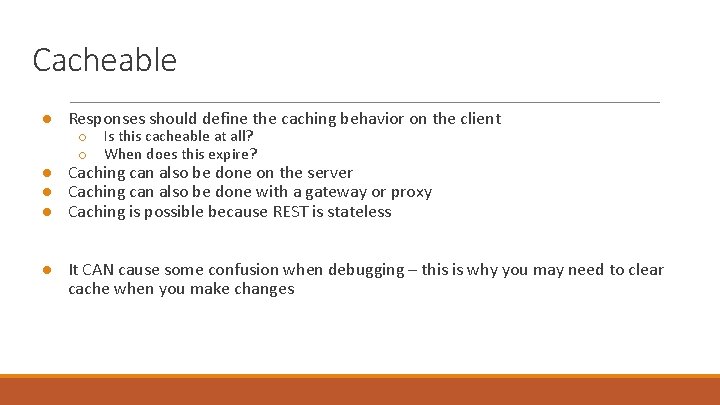
Cacheable ● Responses should define the caching behavior on the client ○ ○ Is this cacheable at all? When does this expire? ● Caching can also be done on the server ● Caching can also be done with a gateway or proxy ● Caching is possible because REST is stateless ● It CAN cause some confusion when debugging – this is why you may need to clear cache when you make changes
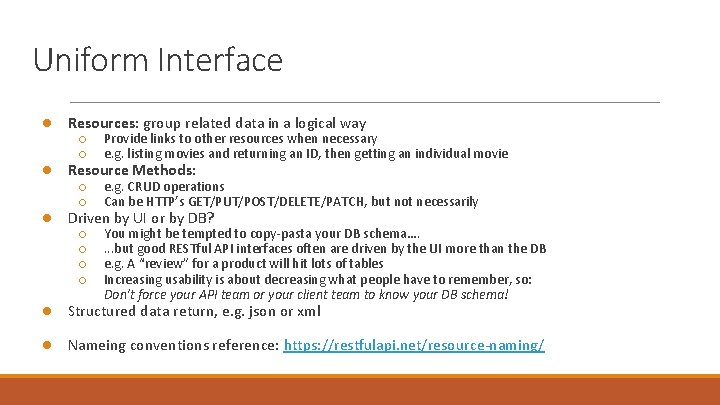
Uniform Interface ● Resources: group related data in a logical way ○ ○ Provide links to other resources when necessary e. g. listing movies and returning an ID, then getting an individual movie ○ ○ e. g. CRUD operations Can be HTTP’s GET/PUT/POST/DELETE/PATCH, but not necessarily ○ ○ You might be tempted to copy-pasta your DB schema…. . but good RESTful API interfaces often are driven by the UI more than the DB e. g. A “review” for a product will hit lots of tables Increasing usability is about decreasing what people have to remember, so: Don’t force your API team or your client team to know your DB schema! ● Resource Methods: ● Driven by UI or by DB? ● Structured data return, e. g. json or xml ● Nameing conventions reference: https: //restfulapi. net/resource-naming/
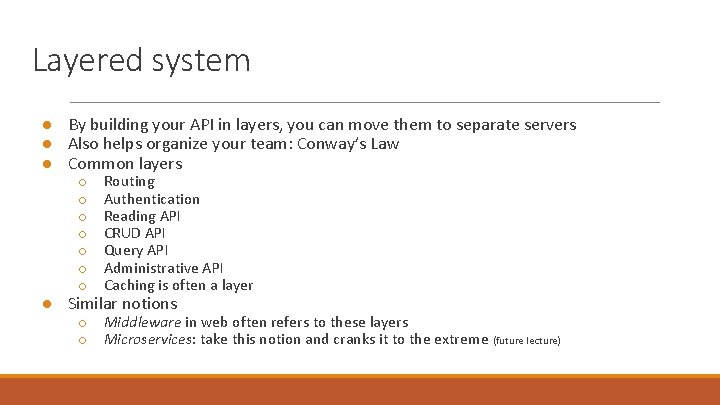
Layered system ● By building your API in layers, you can move them to separate servers ● Also helps organize your team: Conway’s Law ● Common layers ○ ○ ○ ○ Routing Authentication Reading API CRUD API Query API Administrative API Caching is often a layer ○ ○ Middleware in web often refers to these layers Microservices: take this notion and cranks it to the extreme (future lecture) ● Similar notions
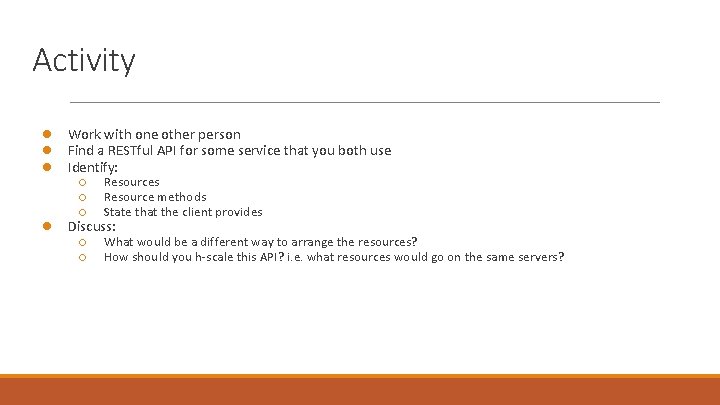
Activity ● Work with one other person ● Find a RESTful API for some service that you both use ● Identify: ○ ○ ○ Resources Resource methods State that the client provides ○ ○ What would be a different way to arrange the resources? How should you h-scale this API? i. e. what resources would go on the same servers? ● Discuss:
- Slides: 11